
What to expect ahead
What follows is a compact summary of each chapter in the book, designed to help you quickly grasp the core ideas while inviting you to continue into the full original text. Even when chapter text is presented here, these summaries are meant as a gateway to understanding, so your eventual reading of the complete book feels richer, deeper, and more fully appreciated.
Have you ever come home changed—and found that everyone you love is exactly the same?
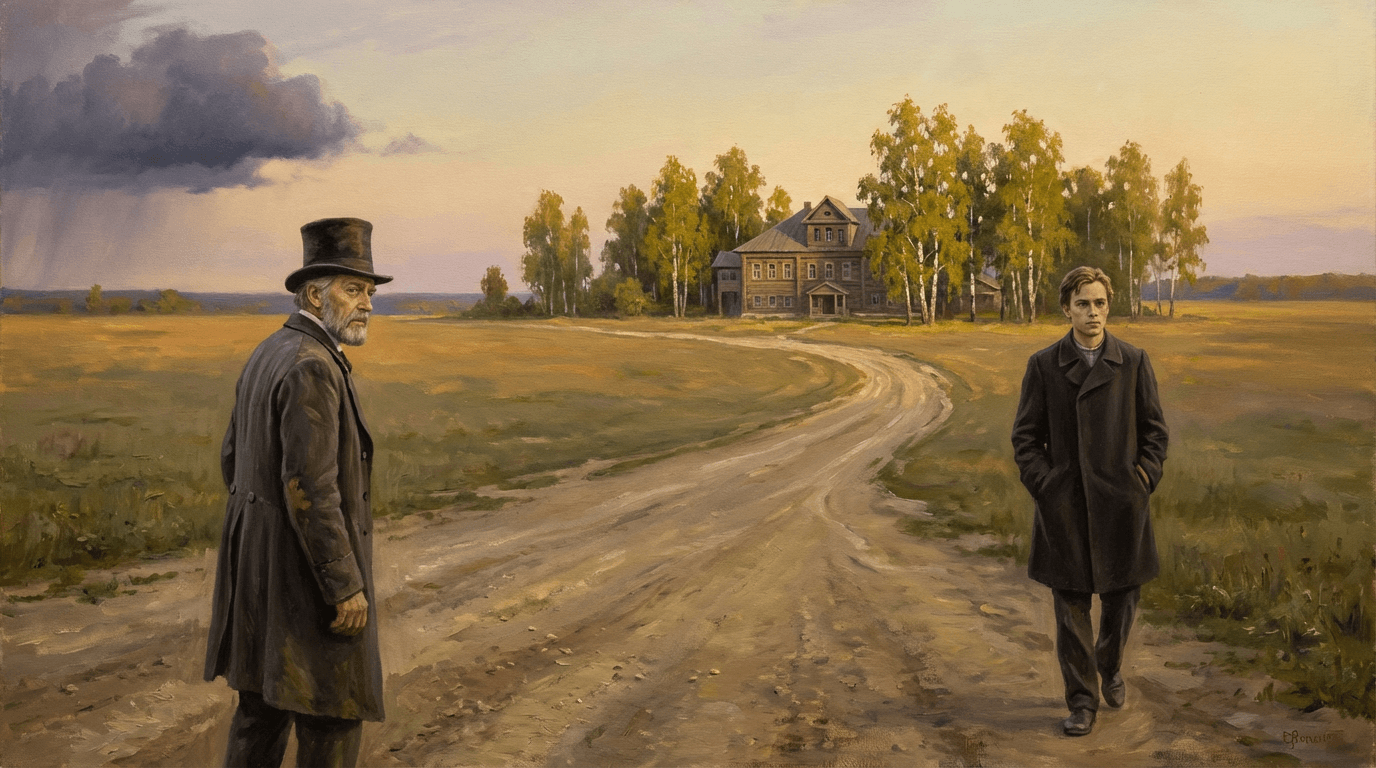
Bazarov is the new kind of man: a medical student, a self-declared nihilist, someone who believes in nothing but what he can see, measure, and dissect. He doesn't believe in art, romance, tradition, or God—only in science and in tearing down everything that doesn't serve a purpose. He is brilliant, abrasive, and utterly convinced he is right.
When he visits his friend Arkady's family estate, the collision is immediate. Arkady's father and uncle—men of culture, feeling, and principle—represent everything Bazarov despises. And Turgenev refuses to make either side the villain. He watches this war of worldviews with clear eyes, and what he sees is both sides failing each other in ways they barely understand.
Then something unexpected happens to Bazarov: he falls in love. And love is the one thing no ideology can survive intact.
Why this matters now: We live in an era of ideological certainty and generational contempt. Everyone is convinced the other side doesn't understand what's real. Turgenev wrote this novel in 1862 as a warning—not about who's right, but about what we lose when we stop being able to listen.
What's really going on: Across 28 chapters, you'll learn to recognize when your certainties are running up against their limits, understand how emotional armor protects and imprisons at the same time, and see how both sides of a generation gap can be simultaneously right and unable to reach each other.
The ideas that set you on fire may not be enough for the life you're actually living.
Essential Life Skills Deep Dive
Explore chapter-by-chapter breakdowns of the essential life skills taught in this classic novel.
Navigating the Generation Gap
7 chapters mapping the permanent war between parents and children—and how to stay in relationship across it without surrendering who you've become.
When Your Certainties Aren't Enough
7 chapters following Bazarov's nihilism into love, rejection, and death—and what genuine intellectual honesty requires when your framework runs out.
The Armor We Build Against Feeling
6 chapters on how Bazarov, Pavel, and Anna use cynicism, elegance, and composure as armor—and what it costs each of them to live behind their defenses.
The Art of Disagreeing Without Contempt
6 chapters tracing the Bazarov-Pavel war from breakfast table to duel—and the one conversation in the novel where two people finally speak honestly.
Essential Skills
Life skills and patterns this book helps you develop—drawn from its themes and characters.
Navigating the Generation Gap
Stay in relationship with people whose worldview has hardened against yours—without surrendering who you've become.
When Your Certainties Aren't Enough
Recognize when your framework is running up against its limits—and hold the gap with honesty rather than denial.
The Armor We Build Against Feeling
Identify when self-protection has become imprisonment—and what it takes to be briefly, carefully unguarded.
Disagreeing Without Contempt
Find the most intelligent version of a position you disagree with, and respond to that—rather than to the version that's easiest to dismiss.
Table of Contents
A Father's Anxious Wait
On a dusty May afternoon in 1859, Nikolai Petrovitch Kirsanov waits nervously at a rural posting-hou...
First Impressions and Social Masks
Arkady finally reunites with his father Nikolai at a roadside inn, and the joy between them is palpa...
The Awkward Homecoming Conversation
Arkady returns home after university to his father Nikolai's estate, and their carriage ride reveals...
First Impressions and Hidden Tensions
The travelers finally arrive at the Kirsanov family estate, where the real drama begins to unfold. A...
Morning Revelations and Uncomfortable Truths
The morning after brings clarity and complications. Bazarov starts his day dissecting frogs with loc...
When Old Meets New
The morning after Bazarov's arrival, tension explodes over breakfast as the young nihilist clashes w...
The Princess Who Broke a Man
This chapter reveals the tragic backstory behind Pavel's bitter personality through Arkady's explana...
Behind Closed Doors
This chapter reveals the complex web of relationships beneath the surface at Marino estate. Nikolai ...
First Impressions and Social Boundaries
Bazarov meets Fenichka, Nikolai's young partner and mother of his child, in a scene that reveals vol...
The Battle Lines Are Drawn
Two weeks into Bazarov's stay at Marino, the household dynamics crystallize around him. The servants...
The Weight of Memory
Nikolai retreats to his favorite garden spot, wrestling with the growing distance between himself an...
Meeting the Local Power Players
Arkady and Bazarov arrive in the provincial town and immediately encounter the local political drama...
The Emancipated Woman's Salon
Bazarov and Arkady visit Evdoksia Kukshin, a self-proclaimed 'emancipated' woman who embodies everyt...
The Governor's Ball and an Enchanting Stranger
At the Governor's ball, we witness the theater of provincial high society in full swing. Matvei Ilyi...
The Art of Social Performance
Bazarov and Arkady visit Anna Odintsova at her hotel, where Bazarov's usual confidence crumbles in h...
First Impressions at the Estate
Bazarov and Arkady arrive at Anna Sergievna's grand estate, where the opulent surroundings make both...
The Confession of Desire
The structured routine at Anna's estate creates a deceptive calm that masks growing tensions beneath...
The Confession That Changes Everything
The morning after their intense conversation, Anna and Bazarov are both clearly affected by what pas...
The Awkward Exit
The morning after his emotional confession, Bazarov apologizes to Anna but announces he's leaving im...
A Son Returns Home
Bazarov brings Arkady home to meet his parents, revealing a completely different side of the cynical...
A Father's Love and Letting Go
Vasili Ivanitch's morning garden work reveals a man desperate to connect with his son through shared...
The Weight of Unspoken Feelings
Arkady and Bazarov make an impulsive, uncomfortable visit to Anna Sergievna's estate on their way ho...
The Garden Encounter
Bazarov throws himself into his scientific work while tensions with Paul Petrovitch reach a cold sta...
The Duel and Its Aftermath
Paul Petrovitch formally challenges Bazarov to a duel, claiming his presence offends him while hidin...
Declarations Under the Ash Tree
In a pivotal garden scene, Arkady and Katia sit beneath an ash tree in comfortable silence, their re...
The Art of Letting Go
In the temple ruins on Anna's estate, two conversations unfold that will reshape everyone's future. ...
The Final Reckoning
Bazarov returns to his parents' home, initially throwing himself into work to avoid confronting his ...
Six Months Later: Where Everyone Ends Up
Six months after the dramatic events at Nikolskoe, winter has settled over the Russian countryside, ...
About Ivan Turgenev
Published 1862
Ivan Turgenev (1818–1883) was the first Russian novelist to gain a major international reputation, beloved by Flaubert, James, and Conrad for his psychological precision and formal elegance. Born into a wealthy landowning family, he grew up witnessing serfdom firsthand—an experience that shaped his lifelong commitment to human dignity and his suspicion of all forms of ideology, whether conservative or radical.
Fathers and Sons, published in 1862, exploded Russian intellectual society. Radicals felt betrayed—they saw Bazarov as a mockery. Conservatives felt vindicated—they saw him as a cautionary tale. Both camps missed Turgenev's actual argument: that he was writing with sympathy for all his characters, including the nihilist he couldn't entirely condemn. He spent years defending the novel and eventually left Russia for France, spending most of his remaining life near his lifelong companion, the singer Pauline Viardot.
What makes Turgenev unusual among the great Russian novelists is his refusal to provide answers. Where Tolstoy offers morality and Dostoevsky offers theology, Turgenev offers clarity—a cold, precise, compassionate look at people caught between worlds they cannot reconcile, rendered without judgment and without consolation.
Why This Author Matters Today
Ivan Turgenev's insights into human nature, social constraints, and the search for authenticity remain powerfully relevant. Their work helps us understand the timeless tensions between individual desire and social expectation, making them an essential guide for navigating modern life's complexities.
Amplified Classics is different.
not a sparknotes, nor a cliffnotes
This is a retelling. The story is still told—completely. You walk with the characters, feel what they feel, discover what they discover. The meaning arrives because you experienced it, not because someone explained a summary.
Read this, then read the original. The prose will illuminate—you'll notice what makes the author that author, because you're no longer fighting to follow the story.
Read the original first, then read this. Something will click. You'll want to go back.
Either way, the door opens inward.
Get the Full Book
Purchase the complete book to access all chapters and support classic literature
As an Amazon Associate, we earn a small commission from qualifying purchases at no additional cost to you.
Available in paperback, hardcover, and e-book formats
You Might Also Like




Free to read • No account required