
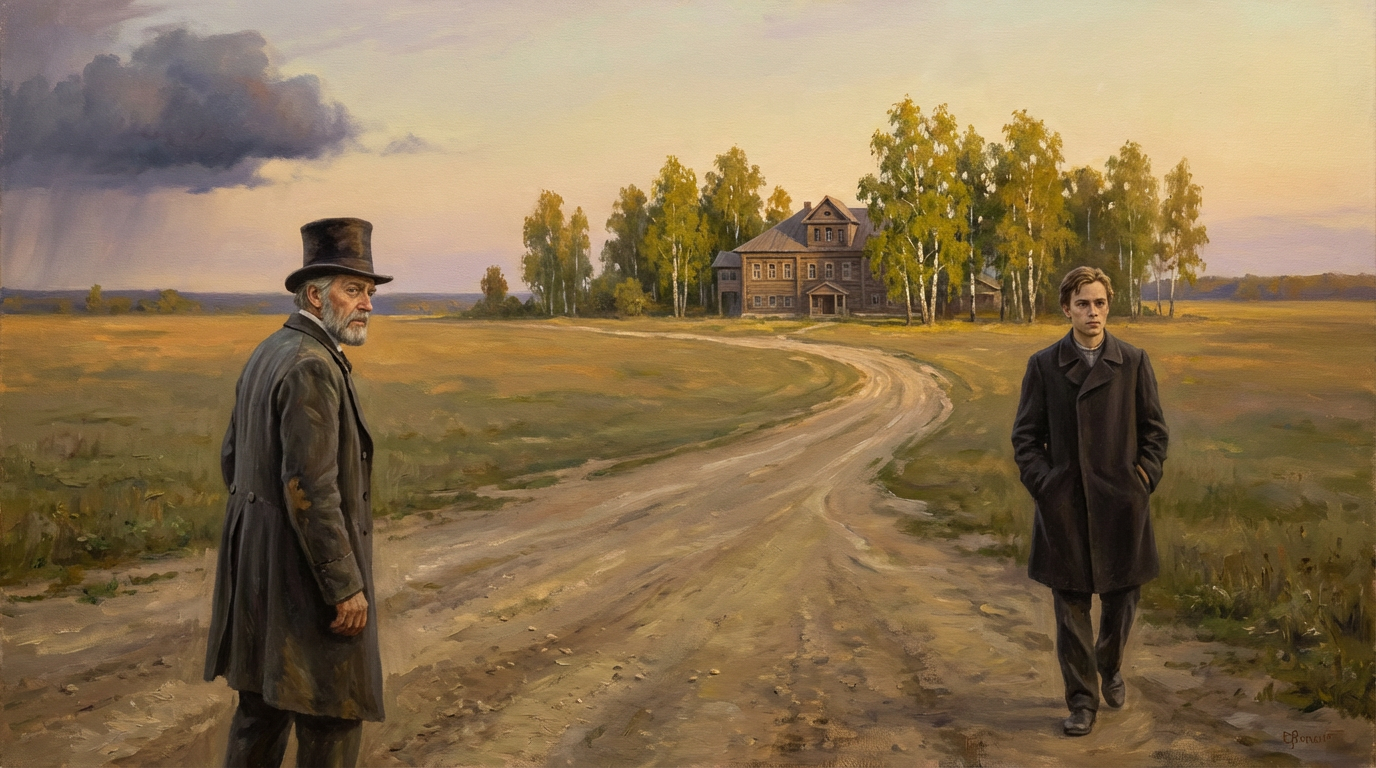
An excerpt from the original text.(complete · 1638 words)
"ow let us see to what category of mortals to assign this young
person," said Bazarov to Arkady as, on the following day, the pair
mounted the staircase of the hotel where Madame Odintsov was staying.
"Somehow I seem to scent impropriety in the air."
"You surprise me!" burst forth Arkady. "Do you, Bazarov, do you
hold with the narrow-minded morality which----"
"Idiot!" exclaimed Bazarov contemptuously. "Do you not know that
both in our jargon and in the understanding of the ordinary person
the term 'improper' has now come to mean the same as 'proper'? In
any case I seem to scent money here. You yourself told me, did you
not, that Madame's marriage was a very strange one?--though, for my
part, I look upon marrying a rich old man as anything but a strange
proceeding--rather, as a measure of prudence. True, I place little
reliance upon the gossip of townsfolk, but at least I prefer to suppose
that that gossip has, as our cultured Governor would say, 'a basis in
fact.'"
Arkady did not respond, but knocked at the door of Madame's suite;
and, the door having been opened, a liveried man-servant ushered the
visitors into a large, hideously furnished room of the type which
is always to be found in Russian hotels--the only exception in the
present case being that the apartment was adorned with flowers.
Presently Madame herself entered, clad in a plain morning gown, and
looking even younger in the spring sunlight than she had done in the
ballroom. Arkady duly presented Bazarov, and, as he did so, remarked
with surprise that his friend seemed confused, while Madame was as
imperturbable as ever. This gaucherie on his part Bazarov realised,
and felt vexed at.
"Phaugh!" he thought to himself. "The idea that I should be afraid of a
woman!"
Yet, like Sitnikov, he could only subside into a chair, and fall to
talking with an exaggerated emphasis to the woman who sat with her
brilliant eyes riveted with such attention upon him.
Anna Sergievna Odintsov had had for father one Sergei Nikolaievitch
Loktev, a well-known gambler, speculator, and beau. After fifteen years
of flaunting it in St. Petersburg and Moscow, and dissipating his whole
substance, he had been forced to retire to the country, where soon
afterwards he had died and left to his daughter Anna (aged twenty) and
his daughter Katerina (aged twelve) only a small joint competence.
As for the girls' mother (who had come of the impoverished house of
the Princes X.), she had expired during the heyday of her husband's
career in St. Petersburg. Anna's position after her father's death was
therefore a very difficult one, for the brilliant education which she
had received in the capital had in no way fitted her for the care of
a household and an estate, nor yet for the endurance of a life in the
country. Moreover, she possessed not a single acquaintance in that
country neighbourhood, nor any one to whom to turn for advice, since
her father had done his best to avoid associating with his neighbours,
in that he had despised them as much as they, in their several ways,
had despised him. Howbeit, Anna kept her head, and straightway sent
for her mother's sister, the Princess Avdotia Stepanovna X., who, a
malicious, presuming old woman, annexed, on the day of her arrival, all
the best rooms in the house, raged and stormed from morning till night,
and even declined to walk in the garden unless she could be accompanied
by her only serf, a sullen-looking lacquey who wore a faded green
livery, a blue collar, and a three-cornered hat. Nevertheless Anna put
up with these tantrums of her aunt's, superintended the education of
her sister, and resigned herself to the idea of living in seclusion for
the rest of her life. But fate had ordained otherwise. That is to say,
a certain Odintsov--a rich, bloated, unwieldy, soured, semi-imbecile
hypochondriac of forty-six who was, nevertheless, neither stupid nor
cruel--happened to see her, and became so enamoured that he offered her
marriage: and to this proposal she consented. For six years the pair
lived together, before the husband died, leaving her all his property.
The following year she spent in the country; after which she went
abroad with her sister--but only as far as Germany, since she quickly
wearied of foreign parts, and was only too thankful to return to her
beloved Nikolsköe, which lay some forty versts from the provincial town
of ----. At Nikolsköe she had at her disposal a splendid, tastefully
furnished mansion, a beautiful garden, and a range of orangeries (the
late Odintsov having denied himself in nothing); but inasmuch as she
made but rare appearances in the town, and then only on flying visits
connected with business, the provincial gentry conceived a grudge
against her, and took to gossiping of her marriage with Odintsov, and
relating such impossible tales as that she had assisted her father in
his nefarious schemes, that she had had her reasons for going abroad,
and that certain unfortunate results of that tour had had to be
concealed. "I tell you," the ardent retailer of such fables would say,
"that she has been through the mill right enough." Eventually these
rumours reached her ears, but she ignored them altogether, since her
nature was at once bold and independent.
Seating herself at full length in an armchair, and crossing one hand
over the other, she set herself to listen to Bazarov's harangue.
Contrary to his usual custom, he spoke without restraint, for he
was clearly anxious to interest his listener. Arkady again felt
surprised at this, though he failed to detect whether or not Bazarov
was succeeding in his aim, seeing that Anna Sergievna's face gave no
clue to the effect produced, so fixedly did her features retain their
faintly polite expression, so unvaryingly did her beautiful eyes
reflect unruffled attention. True, at first Bazarov's vehemence gave
her an unpleasant impression as of a bad smell or a jarring note; but
in time she began to understand that it came of his being ill at ease,
and she felt flattered at the fact. Only the paltry repelled her; and
no one could well have accused Bazarov of that quality. Indeed wonders
were never to cease for Arkady, since, though he had expected Bazarov
to talk to Madame Odintsov as to a woman of intellect--to speak to her
of his views and convictions (seeing that she had expressed a desire
to behold a man who had "the temerity to believe in nothing"), he
discoursed only on medicine, homoeopathy, and botany. At the same time,
Madame had not wasted her life of solitude, but had read a large number
of standard works, and could express herself in the best of Russian;
and though at one point she diverted the conversation to music, she
no sooner perceived that he declined to recognise the existence of
the art than she returned to botany, even though Arkady would gladly
have continued the discussion of the importance of national melodies.
In passing, her treatment of Arkady as a younger brother remained
the same. What she valued in him was, evidently, the good humour and
simplicity of youth--nothing more. Thus there was held, for three
hours, an animated, but intermittent, discursive conversation.
At length the friends rose to say farewell. With a kindly glance Anna
Sergievna offered them her beautiful white hand; then, after a moment's
reflection, said irresolutely, but with a pleasant smile:
"If neither of you fear finding the time tedious, will you come and pay
me a visit at Nikolsköe?"
"I should deem it the greatest pleasure!" cried Arkady.
"And you, Monsieur Bazarov?"
Bazarov merely bowed: which again surprised Arkady, while also he
noticed that his friend's face looked flushed.
"Well?" the younger man said as the pair issued into the street. "Are
you still of the opinion that she is, is----?"
"I cannot say. But what an icicle she has made of herself!" There was
a pause. "At all events, she is an imposing personage, a grande dame
who lacks but a train to her gown and a coronet to her head."
"But none of our grandes dames speak Russian as she does," remarked
Arkady.
"No; for she has undergone a rebirth, and eaten of our bread."
"And what a charm is hers!"
"You mean, what a splendid body--the very thing for a dissecting
theatre!"
"Stop, stop, for God's sake! Her body differs from all other women's."
"No need to lose your temper, young innocent. Have I not said that she
stands in the front rank of women? Yes, we must pay her that visit."
"When?"
"The day after to-morrow. Nothing else is to be done here, for we
need not stay to drink champagne with the Kukshin woman, and listen
to the harangues of your kinsman, the Liberal bigwig. Not we! The day
after to-morrow, therefore, let us give the whole thing the go-by. A
propos, my father's place lies near Nikolsköe. For Nikolsköe is on the
---- road, is it not?"
"It is."
"Optime! Then we shall gain nothing by delay: only fools and clever
people procrastinate. Her anatomy, I repeat, is splendid."
Within three days, in bright, but not too warm, weather, the two
friends were bowling along the road to Nikolsköe. With a will did the
well-fed stage horses trot out, and lightly swish their flanks with
their plaited, knotted tails; and as Arkady glanced along the road, he,
for some unknown reason, smiled.
"Congratulate me!" cried Bazarov of a sudden. "To-day is the 22nd of
June--the feast of my Patron Saint. Certainly he looks after me, does
he not?" Then the speaker added in a lower tone: "But to-day, also,
they are expecting me at home.... Well, let them expect me."
Master this chapter. Complete your experience
Purchase the complete book to access all chapters and support classic literature
As an Amazon Associate, we earn a small commission from qualifying purchases at no additional cost to you.
Available in paperback, hardcover, and e-book formats
Let's Analyse the Pattern
When someone's approval becomes important to us, our usual confidence disappears and we become awkward versions of ourselves.
Why This Matters
Connect literature to life
This chapter teaches how to recognize when someone's usual behavior shifts dramatically based on who's in the room.
Practice This Today
This week, notice when confident people become nervous—watch for topic changes, vocal shifts, or sudden agreeableness that signals someone's approval suddenly matters to them.
Now let's explore the literary elements.
Key Quotes & Analysis
"Do you not know that both in our jargon and in the understanding of the ordinary person the term 'improper' has now come to mean the same as 'proper'?"
Context: When Arkady questions his judgment about Anna's reputation
Bazarov is being cynical about social conventions, suggesting that what society calls 'improper' behavior is actually the smart, practical thing to do. He's defending Anna's pragmatic marriage choice.
In Today's Words:
What people call 'wrong' is usually just being realistic about how the world actually works.
"I look upon marrying a rich old man as anything but a strange proceeding--rather, as a measure of prudence."
Context: Explaining his view of Anna's marriage to a wealthy older man
Despite his cynical words, Bazarov is actually defending Anna's choice and showing he understands the practical realities women faced. This reveals his underlying respect for her intelligence.
In Today's Words:
Marrying for money isn't weird - it's just being smart about your options.
"Madame herself entered, clad in a plain morning gown, and looking even younger in the spring sunlight"
Context: Anna's entrance into the hotel room
The description emphasizes Anna's natural beauty and youth, explaining why she has such a powerful effect on Bazarov. The 'plain' dress suggests she doesn't need elaborate decoration to be impressive.
In Today's Words:
She walked in looking effortlessly beautiful, the kind of natural confidence that doesn't need fancy clothes.
Thematic Threads
Identity
In This Chapter
Bazarov's nihilistic identity crumbles when faced with genuine attraction to Anna
Development
Building from earlier chapters where his identity seemed unshakeable
In Your Life:
Notice when your usual personality feels fake or inadequate around certain people.
Class
In This Chapter
Anna's story reveals how limited options forced her into marriage for financial security
Development
Continuing exploration of how economic necessity shapes life choices
In Your Life:
Recognize when financial constraints force choices that others judge without understanding context.
Vulnerability
In This Chapter
Bazarov's intellectual confidence becomes a weakness when emotions are involved
Development
First major crack in his emotional armor shown in previous chapters
In Your Life:
Your greatest strengths can become liabilities in situations requiring emotional openness.
Judgment
In This Chapter
Local society gossips about Anna's past while ignoring the practical realities she faced
Development
Expanding theme of social judgment from earlier character interactions
In Your Life:
People who judge your survival choices often haven't faced your circumstances.
Performance
In This Chapter
Bazarov performs normalcy instead of his usual provocative debates
Development
Introduced here as new behavior pattern
In Your Life:
When you start censoring yourself heavily around someone, examine what you're hoping to gain from them.
You now have the context. Time to form your own thoughts.
Discussion Questions
- 1
Why does Bazarov, who usually dominates conversations with his bold opinions, suddenly become awkward and tongue-tied around Anna?
analysis • surface - 2
What does Anna's marriage to Odintsov reveal about the limited choices available to women in her situation, and how do people judge survival decisions differently when they're not the ones making them?
analysis • medium - 3
Where do you see this pattern today - confident people losing their composure around someone whose approval they want?
application • medium - 4
When you catch yourself performing instead of being genuine around someone you want to impress, what strategies could help you shift toward authentic connection?
application • deep - 5
What does Bazarov's transformation around Anna teach us about the difference between intellectual confidence and emotional vulnerability?
reflection • deep
Critical Thinking Exercise
Map Your Confidence Zones
Draw three circles: one for situations where you feel completely confident, one for situations where you perform well but feel nervous, and one for situations where you lose your composure entirely. Fill each circle with specific examples from your life. Then identify what makes the difference between these zones - is it stakes, preparation, or whose opinion matters?
Consider:
- •Notice if certain types of people or situations consistently move you from confident to nervous
- •Consider whether your 'performance anxiety' zones involve people whose approval you particularly want
- •Think about times when showing vulnerability actually created better connections than projecting confidence
Journaling Prompt
Write about a time when you lost your usual confidence around someone you wanted to impress. What did you learn about yourself from that experience, and how would you handle a similar situation now?
Coming Up Next...
Chapter 16: First Impressions at the Estate
The friends travel to Anna's magnificent estate at Nikolskoe, where they'll experience her world of wealth and refinement firsthand. The contrast between her luxurious surroundings and Bazarov's humble origins promises to create new tensions.



