
An excerpt from the original text.(complete · 3824 words)
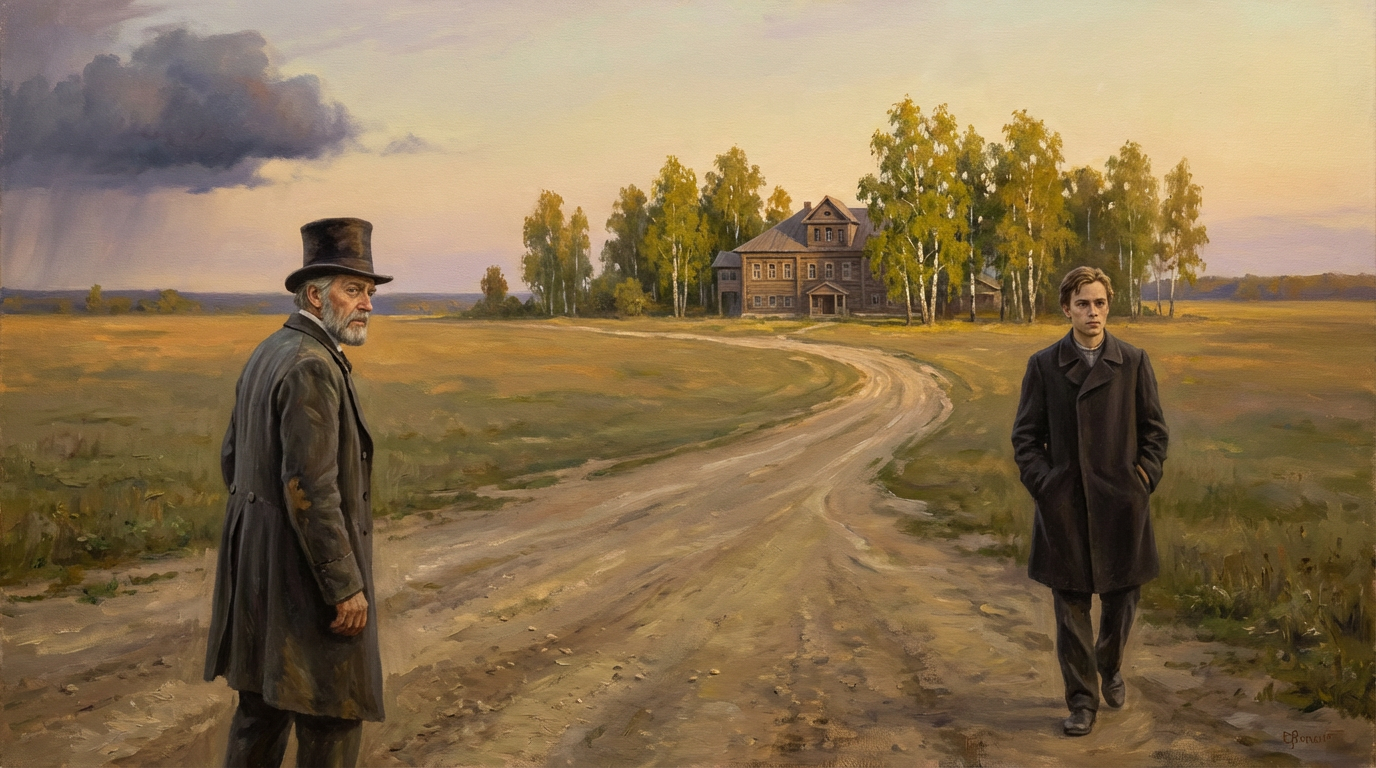
he manor-house in which Anna Sergievna resided stood on an open
hillock, and close to a yellow stone church with a green roof, white
columns, and an entrance surmounted by a fresco representative of Our
Lord's Resurrection--the latter executed in the "Italian" style, and
having as its most noticeable feature the figure of a swarthy warrior
whose rounded contours filled the entire foreground. Behind the church,
the village extended into two long wings, and had thatched roofs
surmounted by a medley of chimneys; while the manor-house itself was
built in a style homogeneous with the design of the church--that is
to say, in the style commonly known as "Alexandrine," and embracing
yellow-painted walls, a green roof, white columns, and a front
adorned with a coat-of-arms. In fact, both buildings had been erected
by a provincial architect to the order of the late Odintsov, a man
impatient (so he himself always expressed it) of "vain and arbitrary
innovations." Lastly, to right and left of the house there showed the
trees of an antique garden, while an avenue of clipped firs led the way
to the principal entrance.
The friends having been met in the hall by two strapping lacqueys in
livery, one of the latter immediately ran for the butler; who (a stout
man in a black tail-coat) proceeded to usher the guests up a carpeted
staircase, and into a room which contained a couple of beds and the
usual appurtenances of the toilet. Evidently neatness was the order of
the day in the establishment, for everything was both spotlessly clean
and as fragrant as the chamber wherein a Minister of State holds his
receptions.
"Anna Sergievna will be glad to see you in half an hour," the butler
said. "Meanwhile, have you any orders for me?"
"No, worthy one," replied Bazarov. "Except that you might so far
condescend as to bring me a small glassful of vodka."
"It shall be done, sir," said the butler with a shade of hesitation;
whereafter he departed with creaking boots.
"What grandeur!" commented Bazarov. "In your opinion, how ought our
hostess to be addressed? In the style of a duchess?"
"Yes, and of a very great duchess," replied Arkady. "The more so,
seeing that she has invited such influential aristocrats as ourselves
to visit her."
"I presume that you are referring to your humble servant--a future
doctor, the son of a doctor, and the grandson of a sexton? By the
way, are you aware that my grandparent was a sexton, even as was
Speransky's?"[1] A smile curled his lips. "Thus you see that the lady
is mistaken, woefully mistaken. We haven't such a thing as a tail-coat,
have we?"
Arkady shrugged his shoulders bravely; but he too was feeling a little
awe-stricken.
At the close of the half-hour the pair entered the drawing-room, which
they found to be a large, lofty apartment of rich, but tasteless,
appointments. Against the walls, in the usual affected style, stood
heavy, expensive furniture, the walls themselves were hung with brown
curtains to which were florid gilt borders (all these things the late
Odintsov had ordered through a Muscovite friend who kept a wineshop),
and above a divan in the centre of the room hung a portrait of a
wrinkled, sandy-haired individual who seemed to be regarding the
newcomers with extreme distaste.
"He," whispered Bazarov.
The hostess herself then entered. She was clad in a light dress, and
had her hair dressed behind the ears--a style which communicated to
her pure, fresh countenance an air of almost girlish juvenility.
"Thank you for having kept your promise," she said. "And now that you
are come, I think that you will find the time not altogether dull. For
one thing, I intend to introduce you to my sister, who is a skilful
piano-player (of course, Monsieur Bazarov, to you such things are a
matter of indifference, but you, Monsieur Kirsanov, I know, adore the
art of music). Also, an elderly aunt lives with me as my companion, and
at intervals a neighbour looks in for a game of cards. You see our home
circle. Now let us seat ourselves."
Madame delivered this little speech with the precision of a lesson
which she had learnt by heart, and then turned to converse with Arkady.
On finding that her mother had known his, and that the latter had
made the former her confidant during her love affair with Nikolai
Petrovitch, the lad fell to speaking enthusiastically of his dead
parent, while Bazarov applied himself to the inspection of some albums.
"What a domesticated individual I am!" thought he to himself.
Presently, with much pattering of paws, there burst into the room a
splendid Russian greyhound with a blue collar; and it was followed by
a young girl of eighteen with a dark complexion, dark hair, a round,
but pleasant, face, and small, dark eyes. She was carrying a basket of
flowers.
"My sister Katia," said Madame Odintsov, indicating the girl with her
head.
Katia seated herself beside Madame, and fell to arranging her flowers;
while the greyhound (whose name was Fifi) approached each of the guests
in turn, laid his cold nose in their hands, and wagged his tail.
"Have you gathered those flowers yourself?" asked Madame Odintsov.
"Yes, Anna Sergievna," the girl replied.
"And is your aunt going to join us at tea?"
"Yes."
These replies of Katia's were accompanied with a frank, but gentle
and bashful, smile, and an upward glance half grave, half sportive.
Everything in her betokened youth and freshness--her voice, the down on
her cheeks, her little pink hands with their white, dimpled palms, and
the slightly contracted shoulders. Also, she blushed without ceasing,
and drew her breath with a fluttering respiration.
Presently Madame Odintsov turned to Bazarov.
"Surely it is only out of politeness that you are looking at those
photographs?" she said. "They cannot possibly interest you. Pray move
nearer to us, and let us engage in an argument."
Bazarov approached her.
"What shall we argue about?" he inquired.
"About anything you like. But first let me warn you that I am a
redoubtable opponent."
"You?"
"Yes, certainly. You look surprised? Why so?"
"Because, so far as I can tell, your temperament is one of the cold and
lethargic order, whereas argument needs impulsiveness."
"How have you contrived so quickly to appraise me? To begin with, I am
both impatient and exacting. Ask Katia if I am not. Also, I am easily
moved to impulse."
Bazarov darted a glance at her.
"Possibly," he said. "Certainly you ought to know best. But, since
you desire to argue, let us argue. While looking at those views of
Saxon Switzerland, I heard you remark that they could not interest
me. This you said, I presume, because you suppose me to be lacking in
the artistic sense. Well, I am so. But might not those pictures be
interesting to me solely from the geological point of view--from the
standpoint of an observer, say, of the formation of mountains?"
"Pardon me, but, as a geologist, you would prefer to resort to some
special work on that science, not to a few pictures."
"Oh, not necessarily. For a picture may instantly present what a book
could set forth only in a hundred pages."
Anna Sergievna made no reply.
"Well," she resumed, leaning forward upon the table--a movement which
brought her face closer to Bazarov's, "since you possess not a grain of
the artistic instinct, how do you contrive to get on without it?"
"Rather, I would ask you: What is the artistic instinct able to effect?"
"It is able at least to help one to examine and to instruct one's
fellow man."
Bazarov smiled.
"In the first place," he retorted, "the prime requisite in that
connection is experience of life; and, in the second place, the study
of detached personalities is scarcely worth the trouble. For all we
human beings are alike, in body as in spirit. In each of us there is an
identical brain, an identical spleen, an identical heart, an identical
pair of lungs, an identical stock of the so-called moral qualities
(trifling variations between which we need not take into account).
Therefore from a single specimen of the human race may all the rest be
judged. In fact, human beings are like trees in a forest. You never
find a botanist studying its individual trunks."
Katia, who had been arranging her flowers, glanced at Bazarov in
amazement, and, in so doing, encountered his keen, contemptuous gaze,
and blushed to her ears. Anna Sergievna shook her head.
"Trees in a forest!" she exclaimed. "Think you, then, that there is no
difference between the wise man and the fool, the good and the bad?"
"No, I do not," replied Bazarov. "On the contrary, I believe that such
differences do exist. The point is that they exist only as between
the sound and the ailing. For instance, a consumptive's lungs are not
as yours and mine; yet they have been fashioned precisely as our own
have been. Also, whereas, to a certain extent, we know whence bodily
disorders arise, moral disorders come of faulty education, the
thousand and one follies with which the human brain is afflicted, in
short, any irregular condition of the social body. Rectify that body,
and moral sickness will soon cease to be."
Speaking as though he were saying to himself, "Believe me or not as you
like, it is all one to me," Bazarov drew his long fingers through his
whiskers, while his eyes glowed like coals.
"Then you think," pursued Anna Sergievna, "that, once the social body
has been rectified, stupid and evil people will cease to exist?"
"At all events, once the social body is properly organised, the
fact that a man be wise or stupid, good or bad, will cease to be of
importance."
"Ah! I understand! That is because we all possess an identical spleen?"
"Precisely so, madam."
She turned to Arkady.
"And what is your opinion, Arkady Nikolaievitch?" she enquired.
"I agree with Evgenii," was his reply as, in his turn, he received a
glance of astonishment from Katia.
"I am surprised, gentlemen," said Madame. "However, I can hear my aunt
approaching, so let us spare her ears, and discuss this later."
Anna Sergievna's aunt--a small, spare woman with a mallet-shaped face,
a pair of narrow, malicious eyes, and a grey false front--bestowed
scarcely so much as a bow upon the guests, but at once relapsed into a
huge velvet armchair which no one but herself was allowed to use. And
even when Katia hastened to place for her a footstool, the old woman
did not thank her, nor even look at her, but chafed her hands under the
yellow shawl which covered the whole of her frail figure. Beyond all
things was she fond of yellow; wherefore she had had her cap trimmed
with ribands of the same hue.
"Have you slept well, Auntie?" Madame Odintsov inquired with a raising
of her voice.
"That dog is here again!" the old woman muttered on noticing that Fifi
was taking an irresolute step or two in her direction. "Turn the beast
out, I say! Out with it!"
Calling Fifi, Katia opened the door for the animal to leave the room;
whereupon, though it bounded out in joyous mood (under the impression
that it was about to be taken for a walk), it no sooner found itself
marooned outside than it fell to whining and scratching at the panels;
which caused the Princess to frown, and necessitated Katia's exit to
rectify matters.
"Tea is ready, I believe," Madame Odintsov continued. "Gentlemen, pray
come. Will you have some tea, Auntie?"
The Princess rose from her chair in silence, and headed a procession
to the dining-room, where a Cossack footman pulled a padded armchair
from under the table (like the last, it was reserved for the Princess
alone), and she subsided into its depths. Katia poured out tea, and
handed her aunt the first cup--a cup adorned with a coat-of-arms;
whereafter the old woman added some honey to the beverage (she looked
upon tea-drinking with sugar as a sin of extravagance, and the more
so since never at any time would she consent to spend an unnecessary
kopeck), and then asked hoarsely:
"What has Prince Ivan to say in his letter?"
No one answered, and in time Bazarov and Arkady apprised the fact that,
though treated, certainly, with respect, the old woman attracted no
one's serious attention.
"They keep her here for show," Bazarov reflected. "She is kept because
she comes of a princely house."
Tea over, Anna Sergievna proposed a walk; but since at that moment a
drop of rain came pattering down, the company (with the exception of
the Princess) returned to the drawing-room. Presently the neighbour
addicted to a game of cards came in, and proved to be one Porphyri
Platonitch--a stout, grey-headed, affable, diverting individual who,
in addition, could boast of a pair of legs as shapely as though turned
with a lathe. Anna Sergievna then inquired of Bazarov (with whom she
had again been in conversation) whether he would care to join them in
the old-fashioned game of "Preferences"; and he consented on the ground
that he could not too soon prepare himself for the post of a district
physician.
"But take care," remarked his hostess. "Porphyri Platonitch and I
are not unlikely to beat you. Meanwhile, do you, Katia, go and play
something on the piano for the benefit of Arkady Nikolaievitch. I know
that he loves music, and we too shall be glad to listen to you."
Reluctantly Katia approached the piano; nor, in spite of Arkady's
fondness for music, did he follow her any more eagerly.
The truth of it was that he felt himself to be being "got rid of" by
Madame Odintsov, and already there was simmering in his heart, as in
the heart of any young man of his age, that vague, oppressive feeling
which is the harbinger of love.
Raising the lid of the piano, Katia murmured under her breath, and
without looking at Arkady:
"What shall I play?"
"Anything you wish," he replied with indifference.
"But what sort of music do you prefer?" she persisted with unchanged
attitude.
"Classical music," was the reply delivered with equal nonchalance.
"Mozart?"
"Certainly--Mozart."
So Katia produced the Viennese master's Sonata-Fantasia in C minor.
She played it well, but coldly, and not with any excess of precision.
Likewise, she kept her lips compressed, her eyes upon the keys, and
her form erect and motionless. Only towards the close of the piece did
her face kindle at all, while at the same moment a tiny curl detached
itself from her loosely-bound hair, and fell over her dusky forehead.
Arkady also felt moved by the closing portion of the Sonata--the
portion where the charming, careless gaiety of the melody gives place
to sudden bursts of mournful, almost tragic lamentation. Yet the
thoughts which Mozart's strains aroused in him bore no relation to
Katia. He merely looked at her now and then, and reflected:
"She plays well; nor is she bad-looking."
The Sonata over, Katia inquired, without removing her hands from the
keyboard: "Is that enough?" and Arkady replied that he would not think
of troubling her further. Then he went on to talk of Mozart, and to
ask her whether she herself had selected the Sonata, or whether it had
been selected for her by some one. Katia answered in monosyllables, and
from time to time went into hiding, retired into herself; and on each
occasion of this sort she made her reappearance but reluctantly, and
with a face composed to a stubborn, almost a stupid, air. Yet she was
not timid so much as diffident and a trifle overawed by the presence of
the sister who had brought her up (not that the sister in question ever
suspected it). Finally, she returned to her flowers, and Arkady found
himself reduced to calling Fifi to his side, and stroking the dog's
head with a kindly smile.
As for Bazarov, he had to pay forfeit after forfeit, for Anna Sergievna
was fairly clever at cards, and Porphyri Platonitch was a player
fully able to look after himself. Consequently the young doctor rose
a loser, not by a considerable sum, but by one which, at all events,
was sufficient to be scarcely agreeable. After supper Anna Sergievna
started a discussion on botany.
"I wish you would take me for a walk to-morrow morning," she said. "I
want you to teach me the Latin names of our field flowers, and also
their characteristics."
"But how could the Latin names benefit you?" he inquired.
"System is in all things necessary," she replied.
"A truly wonderful woman!" Arkady commented the same evening, on
finding himself alone with his friend in the bedroom.
"Yes," replied Bazarov. "She certainly possesses brains. Also, she has
dreamed dreams."
"In what sense?"
"In the best sense, my friend--in the very best sense, O Arkady
Nikolaievitch. Certain also am I that she manages her property well.
But the marvellous phenomenon is not she, but her sister."
"What? That hoyden?"
"Yes, that hoyden. The hoyden contains an element of freshness and
virginity and timidity and reticence and anything else you like which
makes her really an object worthy of interest. Of the one you could
make whatsoever you might desire, whereas of the other there is
nothing to be said save that she represents a yesterday's loaf."
Arkady made no reply, and soon the two men were asleep and dreaming
their own dreams.
The same night Anna Sergievna devoted much thought to her two guests.
Bazarov she liked both for his total lack of affectation and for
the piquancy of his criticisms; so that she seemed to divine in him
something new, something which had hitherto remained unknown to her
experience. All of which excited her curiosity.
And she too was a strange being. Free from all prejudice, and devoid
of all strong beliefs, she rendered obeisance to nothing, and had
in view no goal. Again, though much was open to her sight, and much
interested her, nothing really satisfied her, and she had no wish
for such satisfaction, since her intellect was at once inquiring
and indifferent, and harboured doubts which never merged into
insensibility, and aspirations which never swelled into unrest. True,
if she had been dowered with less wealth and independence, she might
have plunged into the fray, and learnt the nature of passion; but, as
things stood, she took life unhastingly, and, though often finding
it tedious, spent her days in a deliberate, rarely agitated manner.
True, at times rainbow colours gleamed even before her eyes; yet
no sooner had they faded than she would draw her breath as before,
and in no way regret their disappearance. Again, though, at times,
her imagination exceeded the bounds of what is considered permissible
by conventional morality, her blood still coursed tranquilly through
her lethargic and bewitchingly shaped frame; and only when she was
issuing in a warm and tender glow from her comfortable bathroom would
she fall to pondering upon the futility of life, its sorrow and toil
and cruelty, and feel her soul swell to sudden temerity, and begin to
seethe with noble aspirations. Yet even then, let but a draught happen
to blow in her direction from an open window, and at once she would
shrug her shoulders, commiserate herself, come very near to losing her
temper, and become conscious of nothing but the thought that the one
thing necessary was to ensure that by hook or by crook that abominable
draught should be averted.
Again, like all women who have never known what it is to fall in
love, she was sensible of a persistent yearning for something wholly
undefined. There was nothing that she actually lacked, yet she seemed
to lack everything. The late Odintsov she had merely tolerated (the
marriage having been one de convenance only--though she would never
have consented to become his wife had he not also been kindly of
heart), and from the experience she had derived a certain aversion to
the male sex in general, which she conceived to be composed exclusively
of creatures slovenly, idle, wearisome, and weakly exacting in their
habits. In fact, only once had she met (it was somewhere abroad) a
man who had in any way attracted her. He had been a young Swede of a
knightly countenance, honest blue eyes, and an open brow; but, for all
the impression that he had made upon her, the impression in question
had not prevented her from shortly afterwards returning to Russia.
"A strange man, that Bazarov," she thought to herself as she reposed
in her magnificent bed with its lace-embroidered pillows and its light
silken coverlet. It may be said, that, in addition to having inherited
her late father's fastidious and luxurious tastes, she still cherished
for that wayward, but kindhearted, parent a considerable affection,
since during his lifetime he had not only adored her and cracked jokes
with her on equal terms, but also accorded her his whole confidence,
and made it his invariable custom to seek her advice. Of her mother she
had but the scantiest of remembrance.
"Yes, a strange man is that Bazarov," she repeated; after which she
stretched her limbs, smiled, clasped her hands behind her head, ran an
eye over the pages of two foolish French novels, let fall the second
of these volumes from her hands, and relapsed into slumber--a cold,
spotless figure in spotless, fragrant white.
When breakfast was over next morning, she set forth upon the botanising
expedition with Bazarov; to return home just before luncheon time.
Meanwhile Arkady did not leave the house, but spent an hour with Katia,
nor found the time wearisome, seeing that of her own accord Katia
volunteered to repeat the Sonata. Yet the instant that his eyes beheld
Madame Odintsov returning his heart leapt within him. She was crossing
the garden with a slightly tired step, but with her cheeks rosy of hue,
her eyes shining under her round straw hat with even greater brilliancy
than usual, and her fingers twirling between them the stalk of some
field flower. Also, her light mantilla had slipped to her shoulders,
and the broad ribands of her hat were floating over her bosom.
Behind her walked Bazarov with his usual air of superciliousness and
self-assurance, while on his face there was an expression cheerful, and
even good-humoured. Yet somehow, Arkady did not like that expression.
Muttering "Good-morning," Bazarov passed towards his room, while Madame
Odintsov accorded the young man a negligent handshake--then similarly
continued her way.
"'Good morning!'" thought Arkady to himself. "One would think that she
and I had made one another's acquaintance only to-day!"
[1] Robert Wilhelm Bunsen (1811-1899), chemist and physicist; inventor
of Bunsen's burner and magnesium light; and originator (with Kirchhov)
of spectrum analysis.
Master this chapter. Complete your experience
Purchase the complete book to access all chapters and support classic literature
As an Amazon Associate, we earn a small commission from qualifying purchases at no additional cost to you.
Available in paperback, hardcover, and e-book formats
Let's Analyse the Pattern
Using intelligence as a weapon to maintain superiority and avoid vulnerability in uncomfortable social situations.
Why This Matters
Connect literature to life
This chapter teaches how to spot when someone (including yourself) uses intelligence as a shield rather than a tool for understanding.
Practice This Today
This week, notice when conversations turn into competitions - ask yourself whether you're trying to learn something or prove something.
Now let's explore the literary elements.
Key Quotes & Analysis
"All people are identical; each of us has brain, spleen, heart, lungs, all made alike; and the so-called moral qualities are the same in all of us - slight variations don't matter. A single human specimen is sufficient to judge all others by. People are like trees in a forest; no botanist would think of studying each individual birch."
Context: During philosophical debate with Anna about human nature and individuality
This reveals Bazarov's materialist worldview that reduces humans to their biological components while dismissing individual differences as superficial. It shows both his scientific training and his defensive rejection of the class distinctions that exclude him.
In Today's Words:
People are basically all the same - we all have the same body parts and emotions. The differences we think matter are just surface stuff that society teaches us to care about.
"She was struck by the strange combination of humility and arrogance in his manner."
Context: Anna's observation of Bazarov during their first extended conversation
This captures the internal conflict of someone who intellectually rejects social hierarchies but still feels their emotional impact. Bazarov's contradictory manner reflects the difficulty of maintaining revolutionary principles while navigating actual social situations.
In Today's Words:
She noticed how he acted both insecure and cocky at the same time.
"There was something fresh and innocent about her which made one think of the morning, of the sound of church bells, and of the dew on spring flowers."
Context: Bazarov's surprising thoughts about Katia as he reflects on the evening
This poetic description contrasts sharply with Bazarov's usual materialist language, suggesting that genuine attraction can break through even the most rigid philosophical positions. It shows how personal feelings can contradict intellectual theories.
In Today's Words:
There was something pure and natural about her that reminded him of peaceful, simple things.
Thematic Threads
Class
In This Chapter
Bazarov's discomfort in Anna's wealthy estate drives him to assert intellectual superiority over material privilege
Development
Building from earlier chapters where class differences created tension with Pavel
In Your Life:
You might feel the need to prove your worth through what you know when you're in spaces where others have more money or status
Identity
In This Chapter
Bazarov maintains his nihilist identity by dismissing individual differences, even when evidence contradicts his position
Development
His rigid self-concept is becoming more defensive as he encounters challenges to his worldview
In Your Life:
You might cling to old versions of yourself even when growth requires letting go of familiar but limiting beliefs
Attraction
In This Chapter
Both Anna and Bazarov are intrigued by each other despite their different social positions and philosophies
Development
Introduced here as a new dynamic that will challenge both characters' assumptions
In Your Life:
You might find yourself drawn to people who challenge your thinking, even when it makes you uncomfortable
Loneliness
In This Chapter
Anna's wealth and status create isolation, while Bazarov's intellectual superiority serves the same function
Development
Emerging theme showing how different forms of armor create similar isolation
In Your Life:
You might discover that the very things you use to protect yourself also keep others at a distance
Performance
In This Chapter
Everyone is playing roles—Bazarov the nihilist, Anna the sophisticated hostess, Arkady the loyal friend
Development
Continuing pattern of characters struggling between authentic selves and social expectations
In Your Life:
You might exhaust yourself maintaining different versions of who you think you should be in different settings
You now have the context. Time to form your own thoughts.
Discussion Questions
- 1
How does Bazarov use his intelligence as a weapon when he feels out of place at Anna's estate?
analysis • surface - 2
Why does Bazarov claim all people are identical like trees in a forest - does he really believe this or is something else happening?
analysis • medium - 3
Where have you seen people use their expertise or knowledge to shut down conversations instead of helping others understand?
application • medium - 4
When someone consistently makes you feel stupid during discussions, how can you tell if it's about your intelligence or their insecurity?
application • deep - 5
What's the difference between someone who uses intelligence to solve problems versus someone who uses it to win arguments?
reflection • deep
Critical Thinking Exercise
Decode the Intellectual Power Play
Think of a recent conversation where someone used their knowledge or expertise in a way that made you feel small or shut down. Write down what they said, then rewrite how they could have shared the same information in a way that invited discussion rather than ended it. Notice the difference between building bridges and building walls with intelligence.
Consider:
- •Pay attention to tone and word choice - how did they package their knowledge?
- •Consider their body language and timing - were they teaching or performing?
- •Think about the outcome - did the conversation move forward or shut down?
Journaling Prompt
Write about a time when you caught yourself using your knowledge or skills to make someone else feel inferior. What were you actually feeling in that moment, and how might you handle it differently now?
Coming Up Next...
Chapter 17: The Confession of Desire
As the days pass at the estate, routines develop that will either deepen these new relationships or expose their fundamental incompatibilities. The structured life Anna has created begins to work its influence on her guests.



