
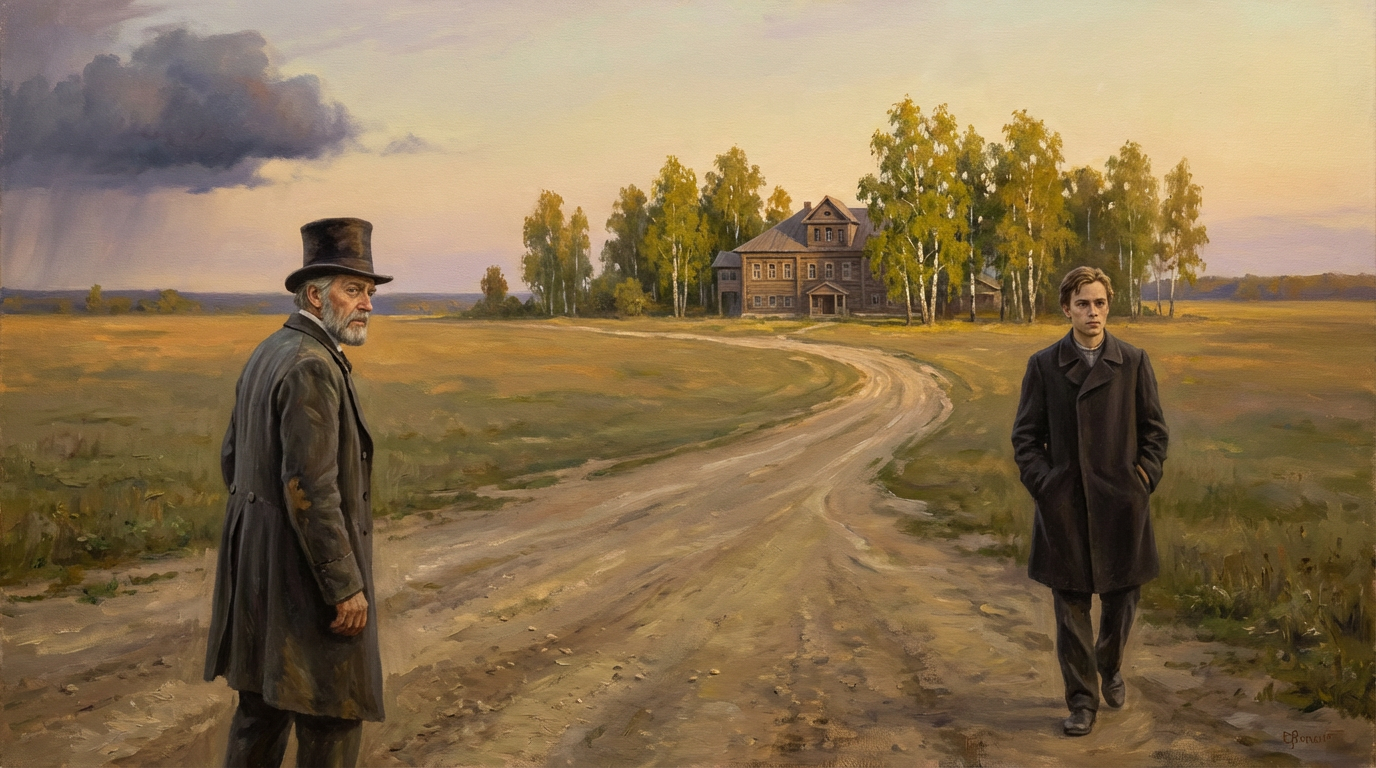
An excerpt from the original text.(complete · 4092 words)
s we know, time either flies like a bird or crawls like a snail. Thus
a man is in best case when he fails to notice either the rapidity or
the slowness of its flight. Similarly did Bazarov and Arkady spend
their fortnight at Madame Odintsov's. Of this another contributory
cause was the fact that alike in her household and in her daily life
she maintained a régime to which she herself strictly adhered, and
to which she constrained others to adhere; so that the daily domestic
round accomplished itself according to a fixed programme. At eight
o'clock the company would assemble for breakfast; whereafter, until
luncheon time, individuals could do whatsoever they chose (the hostess
herself devoting her attention to her steward--she administered her
estate on the obrok or tithes system--her household servants, and her
head housekeeper). Next, before dinner, the company would reassemble
for conversation or for reading aloud; and the rest of the evening
would be devoted to a walk, to cards, or to music. Lastly, at half-past
ten Anna Sergievna would withdraw to her room, issue her orders for the
following day, and retire to bed.
But to Bazarov this measured, slightly formal regularity was not wholly
agreeable. "Somehow it reminds one of running on a pair of rails," he
used to declare; while so much did the sight of liveried lacqueys and
graded serfs offend his democratic instincts that once he averred that
one might as well dine in the English fashion outright, and wear white
ties and black tail-coats. These views he expressed to Anna Sergievna
(something in her always led men to lay bare their opinions in her
presence); and, after she had heard him out, she said: "From your
point of view, the matter is as you say, and perhaps I play the fine
lady too much; but in the country one cannot live anyhow; such a course
always leads one to grow slovenly."
So she continued her régime as before. Yet, though Bazarov grumbled,
he and Arkady found that to that very formality they owed the fact that
everything in the establishment "ran as on rails." In passing it may be
mentioned that between the two young men there had taken place a change
which dated from the day of their arrival at Nikolsköe, and manifested
itself, as regards Bazarov (for whom Anna Sergievna evidently
entertained a liking, though seldom did she agree with his dicta), in
the form of an unwonted captiousness which led him easily to lose his
temper, to speak always with reluctance, to glare about him, and to be
as unable to sit still as though mines had been exploding beneath his
seat. As for Arkady (now come finally to the conclusion that he was in
love with Madame Odintsov), the change manifested itself, rather, in
his falling a prey to a melancholy which in no way prevented him from
making friends with Katia, and even helped him to maintain with her
kindly and cordial relations.
"Whereas Madame cares nothing for me," he would reflect, "this
good-hearted creature does not give me the cold shoulder."
And these reflections would cause his heart to taste once more the
sensuous joy of "magnanimity." Dimly Katia herself divined that
her society afforded him a sort of comfort; wherefore she saw no
reason to deny either him or herself the pleasure of this innocent,
half-diffident, half-trustful camaraderie. True, in the presence,
and under the keen eye, of the elder sister (who always caused Katia
to retire precipitately into her shell) the pair never exchanged a
single word (indeed, as a man in love, Arkady could not well have
paid attention to any one but the object of his adoration while in
the latter's vicinity); but as soon as he found himself alone with
Katia he began, to a certain degree, really to enjoy himself. That is
to say, whereas he knew himself to be incompetent to interest Madame
(seeing that whenever he found himself alone with her he blushed and
lost his head, while she, on her side, did not know what to say to him,
so jejune was his mind as compared with her own), in Katia's presence
he felt perfectly at home, and could treat her with condescension,
and let her expound to him the impressions which she derived from
music and the reading of tales, poems, and other "trifles." Nor did
he notice, nor would he have consented to recognise had he noticed,
the fact that those same "trifles" interested him as much as they did
Katia. At the same time, the latter in no way acted as a clog upon his
melancholy; wherefore, just as Madame was at her ease with Bazarov,
so the young man was at his with Katia, and, after a short period of
joint converse, the two couples would usually diverge. This happened
especially during walks, and the more readily in that, whereas Katia
adored nature, and Arkady too loved it (though he would never have
admitted the fact), to Madame and Bazarov the charms of the natural
world represented more or less a matter of indifference. Hardly need I
add that from this constant separation between Arkady and Bazarov there
flowed inevitable results which brought about in the relations of the
pair a gradual change. That is to say, Bazarov ceased to discourse on
Madame Odintsov--he ceased even to censure her for her "aristocratic
manners"; and while, with regard to Katia, he sang her praises as usual
(at the same time advising the placing of a check upon her sentimental
tendencies), he took to uttering these encomiums only in a half-hearted
and a perfunctory way, and, in general, to lecturing his pupil less
than he had formerly done. Rather, he seemed to avoid him, to feel in
some way uncomfortable in his presence.
These things Arkady duly noted, but kept his observations to himself.
The real cause of the innovation was the feeling which Madame Odintsov
inspired in Bazarov's breast, and which he found to be a torture and
a madness to him. Yet, had any one hinted to him, ever so distantly,
that what was taking place in his soul could ever have been possible,
he would have denied it with a contemptuous laugh and a cynical
imprecation, seeing that, though a great devotee of feminine society
and feminine beauty, he looked upon love in the ideal, the "romantic"
(to use his own term) aspect as unpardonable folly, and upon the
sentiment of chivalry as a sort of aberration or malady which moved
him frequently to express his astonishment that Toggenburg and his
Minnesingers and troubadours never ended by being clapped in a madhouse.
"Should a woman please you," he would say, "strive to attain your goal;
but if you cannot attain that goal, waste no further trouble--just turn
away. For the world does not rest upon a single keystone."
In similar fashion Madame Odintsov "pleased" Bazarov: yet, though the
widespread reports in circulation about her might, with the freedom
and independence of her views and the undoubted penchant which she
entertained for himself, have been reckoned to tell in his favour, he
soon discovered that, in her case, the "goal" was not to be attained.
Also, he found to his surprise that he could not "turn away"--rather,
that the mere thought of her made his blood boil. True, that symptom,
if it had been the only one, might have been dealt with; but there
became implanted in him something else--something which he had hitherto
refused to admit, something of which he had hitherto made sport,
but something which now aroused his pride. Therefore, although, when
conversing with Anna Sergievna, he poured added scorn upon everything
"romantic," he recognised, during his hours of solitude, that even
in his own personality there lurked an element of "Romanticism." And
at such times there was nothing for it but to rush out of doors into
the woods, and to stride along at a pace which snapped off chance-met
boughs, and found vent in curses at both them and himself. Or he would
seek a hayloft or stable, and, stubbornly closing his eyes, strive to
woo sleep, and almost invariably fail. Yet, as he sat there, there
would come to him delusions that those proud lips had once responded
to his kisses, that those chaste arms had embraced his neck, that
those soulful eyes had gazed tenderly--yes, tenderly--into his: and
at such times his head would whirl, and for a second or two, and until
his discontent returned, he would relapse into a state of trance, and,
as though urged by a demon, think thoughts of unavowable import. Again,
there were times when he would conceive a change similar to his own to
have taken place in her, and the expression of her face already to
be charged with a special significance. Yet, this point reached, he
would end merely by stamping his feet, grinding his teeth, and mentally
shaking his fist at himself.
Once, when walking with her in the garden, he announced to her in curt,
gruff tones that he intended soon to depart for his father's place;
whereupon Anna Sergievna turned pale, as though something had pricked
her heart, and pricked it in such a manner as to surprise even herself,
and to leave her wondering what it could portend. Yet not for the sake
of testing her, nor of seeing what might possibly come of it, had he
mentioned his purposed departure (never at any time did he indulge
in "scheming"). Rather, the reason was that, earlier that morning,
he had had an interview with his father's steward, Timotheitch, a
rough, but quick-witted, old fellow who, in past days, had acted as
his nurse, and had now presented himself--with tousled, flaxen hair,
red, weather-beaten face, watery, sunken eyes, short, stout jacket of
grey-blue cloth, leathern girdle, and tarred boots--at Nikolsköe.
"Good-day to you, ancient!" had been Bazarov's greeting.
"Good-day to you, batiushka!" had responded the old man with a
gleeful smile which had covered his face with wrinkles.
"And how is it that I see you here?" Bazarov had continued. "Is it that
they have sent you to fetch me?"
"By no means, pardon me, batiushka!" Timotheitch had stammered out
this denial for the reason that he had suddenly recollected certain
strict injunctions imposed upon him before starting. "No, it is merely
that I am on my way to the town on affairs connected with the estate,
and turned aside a little to pay my respects to your honour. No, not to
disturb you at all--oh dear no!"
"Do not lie," Bazarov had said. "Is this the way to the town?"
Timotheitch, cringing, had returned no reply.
"And how is my father?" Bazarov had continued.
"Quite well, thank God!"
"And my mother?"
"Your mother is the same, thank God!"
"And they are, I suppose, expecting me?"
The old man had cocked his head with a knowing air.
"Evgenii Vasilitch, why should they not be expecting you? Yes, as God
is my trust, I know that their hearts are simply aching for a sight of
you."
"Well, well! Do not make too long a stay of it, but tell them that I
will come presently."
"I will, batiushka."
Yet it had been with a sigh that Timotheitch had replaced his cap
on his head with both hands, left the house, remounted the shabby
drozhki which he had left waiting at the gates, and disappeared at a
trot--though not in the direction of the town.
The same evening saw Madame sitting in her boudoir with Bazarov, and
Arkady pacing the salon, and listening to Katia's music. As for the
Princess, she had gone to bed, for she could not abide the presence
of guests--least of all, of "those upstarts and good-for-nothings" as
she termed our friends. In fact, though she confined herself, in the
drawing-room or the dining-room, to sulking, she resorted, when alone
with her maid in the bedroom, to abuse of Arkady and Bazarov which made
her cap and her false front fairly dance on her head. These things, of
course, Madame Odintsov knew.
"Why need you depart?" she said to Bazarov. "Have you forgotten your
promise?"
Bazarov started.
"What promise?" he asked.
"Then you have forgotten it! I mean the promise to give me a few
lessons in chemistry?"
"How can I fulfil it? My father is expecting me at home, and I ought
not to stay a day longer. You had better read through Notions
Générales de Chimie, by Pelouse and Frémy. It is an excellent work,
and clearly written--the very thing you want."
"But you said that no book can adequately replace--I forget the exact
phrase you used, but you know what I mean, do you not?"
"I cannot help myself," he muttered.
"Nevertheless, why go?" She lowered her voice as she spoke. Bazarov
glanced at her as she leant back in her chair and crossed her arms
(which were bare to the elbow), and saw that by the light of the lamp
(softened with a shade of pleated paper) she was looking paler than
usual--also that the outlines of her figure were almost buried in a
soft white gown, from underneath which there peeped forth the tips of
her toes, posed crosswise.
"What reason should I have for remaining?" he replied.
She gave her head the faintest toss.
"What reason should you have?" she re-echoed. "Well, are you not happy
here? Do you think that there will be no one to regret your departure?"
"There will be no one. Of that I am certain."
"Then you are wrong," came the reply after a pause. "But I do not
believe you--I have an idea that you are not speaking seriously."
Bazarov said nothing.
"Why do you not answer me?" she persisted.
"What is there to say? In general, to regret people's absence is not
worth while, and, least of all, the absence of people like myself."
"Why, again?"
"Because I am a prosaic and eminently uninteresting individual. Nor do
I know how to talk."
"But you know how to play the esquire?"
"No, not even that. And, as you know, the softer aspect of life, the
aspect which you hold so dear, lies altogether beyond me."
Madame Odintsov nibbled the corner of her handkerchief.
"Think what you like," she said, "but at least I shall find things
dull when you are gone."
"Arkady will remain," he hazarded.
She shrugged her shoulders.
"Nevertheless I shall find the time wearisome," she repeated.
"Not for long."
"Why not?"
"Because, as you have very truly said, things never seem dull to you
save when your régime is infringed. In fact, with such faultless
regularity have you ordered your life that there abides in it no room
for dullness or depression or any other burdensome feeling."
"And I too am faultless, I suppose--I have ordered my life too
regularly ever to err?"
"I daresay. Take an example of it. In a few minutes it will be ten
o'clock; when, as I know by experience, you will request me to leave
your presence."
"Oh no, I shall not. You may remain. By the way, please open that
window. The room is simply stifling."
Bazarov rose and unfastened the casement, which swung backwards with a
snap, for the reason that he had not expected it to open so easily, and
that his hands were trembling. Into the aperture glanced the soft, warm
night with its vista of dark vault of heaven, faintly rustling trees,
and pure, free, sweet-scented air.
"Also, please pull down the blind, and then resume your seat. I wish to
have a little further talk with you before you go. Tell me something
about yourself--a person to whom, by the way, you never refer."
"I would rather converse with you on more profitable subjects."
"What modesty! Nevertheless I wish to learn something of you, and of
your family, and of the father for whose sake you are soon going to
abandon me."
"Why the word 'abandon'?" reflected Bazarov. Then he added aloud:
"Things of that kind interest no one--least of all you. I and my people
are obscure folk."
"Whereas I, you imagine, am an aristocrat?"
Bazarov looked up.
"Yes," he replied with emphasis.
She smiled.
"Then I can see that your knowledge of me is small," she remarked.
"But of course--you believe all human beings to be identical, and
therefore not worth the trouble of studying. Some day I will tell you
my history. But first tell me yours."
"You say that my knowledge of you is small?" queried Bazarov. "You may
be right. Possibly every human being is an enigma. Let us take an
example of that. You have withdrawn from society, and find it irksome,
and limit your visitors' list to a couple of students. Yet why, with
your intellect and your beauty, do you live in the country?"
"Why?" came the sharp rejoinder. "But first be so good as to explain
what you mean by my 'beauty.'"
Bazarov frowned.
"That lies beside the point," he muttered. "The point is that I cannot
understand why you settle in a rural spot of this kind."
"You cannot understand it, you cannot explain it?"
"No. There is only one possible explanation: and that is that you
remain here because you are a person of self-indulgence who love
comfort and the amenities of life, and are indifferent to aught else."
Again Madame Odintsov smiled.
"Then you are still determined to believe that I am incapable of being
moved?" she said.
Bazarov glanced at her from under his brows.
"By curiosity, yes," he said. "But by nothing else."
"Indeed? Then I cease to wonder that you and I do not get on together.
You are exactly like myself."
"That you and I do not get on together?" echoed Bazarov vaguely.
"Yes. But I had forgotten--you must be longing to retire?"
Bazarov rose. The lamp was casting a dim light, while into the
fragrant, darkened, isolated room there came wafted at intervals, under
the swinging blind, the sensuous freshness of the night, and the sounds
of its mysterious whisperings. Madame Odintsov did not stir. Over her
was stealing the same strange agitation which had infected Bazarov.
Suddenly he realised that he was alone with a young and beautiful woman.
"Need you go?" she asked slowly.
He made no reply--he merely resumed his seat.
"Then you think me a spoilt, pampered, indolent person?" she continued
in the same slow tone as she fixed her eyes upon the window. "Yet this
much I know about myself: that I am very unhappy."
"Unhappy? For what reason? Because you attach too much importance to
petty slanders?"
She frowned. Somehow she felt vexed that he should have understood her
thus.
"No; things of that kind do not disturb me," she said. "Never should
I allow them to do so--I am too proud. The reason why I am unhappy is
that I have no wish, no enthusiasm, to live. I daresay you will not
believe me, and will think that a mere 'petty aristocrat,' a person who
is lapped in lace and seated in an armchair, is saying all this (and I
will not conceal from you that I love what you call 'the comforts of
life'): yet all the while I feel as though I had no desire to continue
my existence. Pray reconcile that contradiction if you can. But perhaps
you consider what I say 'Romanticism'?"
Bazarov shook his head.
"You are yet young," he said. "Also, you are rich and independent. What
more could you have? What more do you desire?"
"What more?" she re-echoed with a sigh. "I do not know. I only know
that I feel tired, antiquated; I feel as though I had been living a
long, long time. Yes, I am growing old," she continued as she drew
the ends of her mantilla around her bare shoulders. In doing so, she
glanced at Bazarov. Her eyes met his, and the faintest of blushes stole
into her face. "Behind me lie many memories--memories of my life in St.
Petersburg, of a period of wealth followed by poverty, of my father's
death, of my marriage, of my travels abroad--yes, many such memories
there are. Yet none of them are worth cherishing. And before me lies
only a weary road with no goal to it, along which I have no desire to
travel."
"You are disenchanted," said Bazarov.
"No," she replied with a shiver. "Rather, I am dissatisfied. Oh that I
could form a strong attachment of some kind!"
"To fall in love might save you," remarked Bazarov. "But you are
incapable of that. That is where your misfortune lies."
Madame dropped her eyes upon the sleeve of her mantilla.
"I am incapable of falling in love?" she murmured.
"Not altogether. Moreover, I did wrong to call it a misfortune: for the
person most to be pitied is the person who meets with that experience."
"What experience do you mean?"
"The experience of falling in love."
"How come you to know that?"
"By hearsay," he replied irritably, while to himself he added: "You are
a mere coquette whom sheer idleness is leading to weary and madden me."
And his heart swelled within him.
"On the other hand," he went on, "it may be that you are too exacting?"
As he spoke he bent forward and fell to playing with the tassels of his
chair.
"Possibly I am," she agreed. "But, you see, I conceive that it ought to
be everything or nothing. 'A life for a life.' 'Take my all, give your
all, and put a truce to regrets and any thought of return.' That is the
best rule."
"Indeed?" queried Bazarov. "Well, it is not a bad rule, and I am
surprised that you should have failed to attain your desire."
"Self-surrender, you think, is an easy thing?"
"Not if one considers matters first, and appraises oneself, and
sets upon oneself a definite value. It is only surrender without
consideration that is easy."
"But how could one not value oneself? If one had value, no one would
desire one's surrender."
"That would not be your concern nor mine: some one else's business
would it be to determine our respective values. The one thing that
would immediately concern us would be to know how to surrender."
Madame Odintsov sat up sharply.
"I still believe you to be speaking from experience," she said.
"No; words, idle words--words not meant to be taken personally."
"Then you yourself might be capable of surrendering?"
"I might. But in any case I should not care to boast."
Both remained silent for a moment. From the drawing-room came the notes
of the piano.
"How late Katia is playing!" remarked Anna Sergievna.
Bazarov raised his head.
"Yes, it is late," he said. "Time for you to go to rest."
"Wait a moment, however. Why should you hurry away? I have something
more to say to you."
"What may it be?"
"Wait," she repeated. As she did so, her eyes gazed at him as though
studying his personality. For a few moments he paced the room--then
suddenly approached her, said "Good night," squeezed her hand until she
could have shrieked with the pain, and departed.
Raising her fingers to her lips, she blew after him a kiss. Then,
rising with an abrupt, convulsive movement, she ran towards the door
as though to call him back. But at that moment her maid entered with
a decanter on a silver tray, and Madame halted, bid the maid begone,
reseated herself, and sank into a reverie. Her hair, like a winding
black snake, had broken loose from its fastenings. Dimly illumined by
the lamp, she sat motionless, save that at intervals she chafed her
hands, for the night air was beginning to grow chilly.
Two hours later Bazarov re-entered his bedroom in a state of
dishevelment and despondency, and with his boots soaked with dew.
Arkady was seated, fully dressed, at the writing-table, with a book in
his hands.
"So you are not in bed yet?" Bazarov remarked irritably.
Arkady's only reply was to ask the counter-question:
"You have been sitting with Anna Sergievna, have you not?"
"I have," replied Bazarov. "I was sitting there while you and Katia
were playing the piano."
"Oh, I was not playing," retorted Arkady. Then he stopped, for he
felt the tears to be very near his eyes, and had no wish to let them
fall in the presence of his satirical mentor.
Master this chapter. Complete your experience
Purchase the complete book to access all chapters and support classic literature
As an Amazon Associate, we earn a small commission from qualifying purchases at no additional cost to you.
Available in paperback, hardcover, and e-book formats
Let's Analyse the Pattern
When our identity becomes so tied to being rational or superior that we can't admit new information or feelings without dismantling our sense of self.
Why This Matters
Connect literature to life
This chapter teaches how to identify when our resistance to change stems from protecting our self-image rather than actual disagreement with the situation.
Practice This Today
This week, notice when you feel defensive about feedback or new information—ask yourself 'Am I protecting my position or protecting my identity?' and experiment with responding with curiosity instead of justification.
Now let's explore the literary elements.
Key Quotes & Analysis
"Somehow it reminds one of running on a pair of rails"
Context: Complaining about Anna's rigid daily schedule and formal household routine
This metaphor reveals Bazarov's frustration with predictability and control. He values freedom and spontaneity, but Anna's structure feels restrictive. It also foreshadows how their relationship itself will become constrained by social expectations and emotional barriers.
In Today's Words:
This feels like going through the motions - no room to be real or spontaneous
"Time either flies like a bird or crawls like a snail"
Context: Opening observation about how the characters experience their fortnight at Anna's estate
This sets up the deceptive calm of their stay. Time seems suspended because they're avoiding real emotional confrontation. The routine creates an artificial bubble where nothing really changes or develops, despite underlying tensions.
In Today's Words:
Time drags when you're avoiding something, flies when you're dreading an end
"One might as well dine in the English fashion outright, and wear white ties"
Context: Continuing his complaint about the formal atmosphere and class distinctions
Bazarov mocks the aristocratic pretensions he sees around him. His democratic principles are genuinely offended by the display of wealth and hierarchy. Yet he's also using political criticism to mask his personal discomfort with his own feelings.
In Today's Words:
Might as well go full snob and dress like we're better than everyone else
Thematic Threads
Identity
In This Chapter
Bazarov's entire sense of self is built on being rational and dismissive of emotion, making love feel like a threat to who he is
Development
Evolved from his earlier confident nihilism to this crisis where his beliefs conflict with his experience
In Your Life:
You might recognize this when changing your opinion feels like losing yourself, even when you know you're wrong.
Class
In This Chapter
Bazarov's attraction to aristocratic Anna conflicts with his democratic principles, creating shame about his desires
Development
Deepened from earlier class tensions to personal internal conflict about his own feelings
In Your Life:
You might feel this when you're attracted to someone or something that goes against your stated values.
Vulnerability
In This Chapter
Both Anna and Bazarov confess deep unhappiness but can't fully open themselves to real connection
Development
First real moment of emotional honesty between characters who've maintained careful facades
In Your Life:
You might recognize this in relationships where you share problems but not hopes, complaints but not dreams.
Isolation
In This Chapter
Despite living in the same house and sharing intimate conversations, both characters remain fundamentally alone
Development
Contrasts with earlier social scenes to show how proximity doesn't equal connection
In Your Life:
You might feel this when you're surrounded by people but still feel like no one really knows you.
Control
In This Chapter
Anna admits she's incapable of the surrender that love requires, while Bazarov tries to control his emotions through dismissal
Development
Builds on earlier themes of both characters maintaining careful control over their environments and presentations
In Your Life:
You might notice this when you want connection but find yourself pulling back whenever things get too real.
You now have the context. Time to form your own thoughts.
Discussion Questions
- 1
Why does Bazarov become so irritable and restless at Anna's estate, even though he has everything he claims to want - intellectual conversation, comfort, and respect?
analysis • surface - 2
How does Bazarov's identity as a 'rational' person trap him when he starts having feelings for Anna? What would he have to give up to admit he's in love?
analysis • medium - 3
Where do you see this pattern today - people who get stuck defending positions because changing their mind would threaten their identity? Think about politics, workplace dynamics, or family arguments.
application • medium - 4
Anna admits she's 'incapable of surrendering' to love because it would mean losing control. How do you balance protecting yourself emotionally while still being open to genuine connection?
application • deep - 5
Both Anna and Bazarov are trapped by their own self-images - her as independent, him as rational. What does this reveal about the danger of building your identity around being 'above' certain human experiences?
reflection • deep
Critical Thinking Exercise
Map Your Intellectual Pride Points
Think about an area where you pride yourself on being logical, tough, or 'above' certain emotions - maybe you're the practical one in your family, the rational voice at work, or someone who 'doesn't do drama.' Write down this identity, then honestly examine: Has this self-image ever prevented you from admitting you were wrong, asking for help, or expressing vulnerability? Map out how protecting this identity might be costing you connections or growth.
Consider:
- •Notice areas where you dismiss others' concerns as 'emotional' or 'irrational'
- •Consider times when you've doubled down on a position instead of admitting uncertainty
- •Think about relationships where you maintain distance to preserve your self-image
Journaling Prompt
Write about a specific time when protecting your reputation as the 'logical' or 'strong' one prevented you from getting something you actually wanted. What would have happened if you had been willing to look uncertain or vulnerable in that moment?
Coming Up Next...
Chapter 18: The Confession That Changes Everything
The morning after brings awkward encounters and strained silences as both Anna and Bazarov struggle with what was revealed in their intimate conversation. The carefully maintained social order of the household begins to crack under the weight of unspoken desires.



