
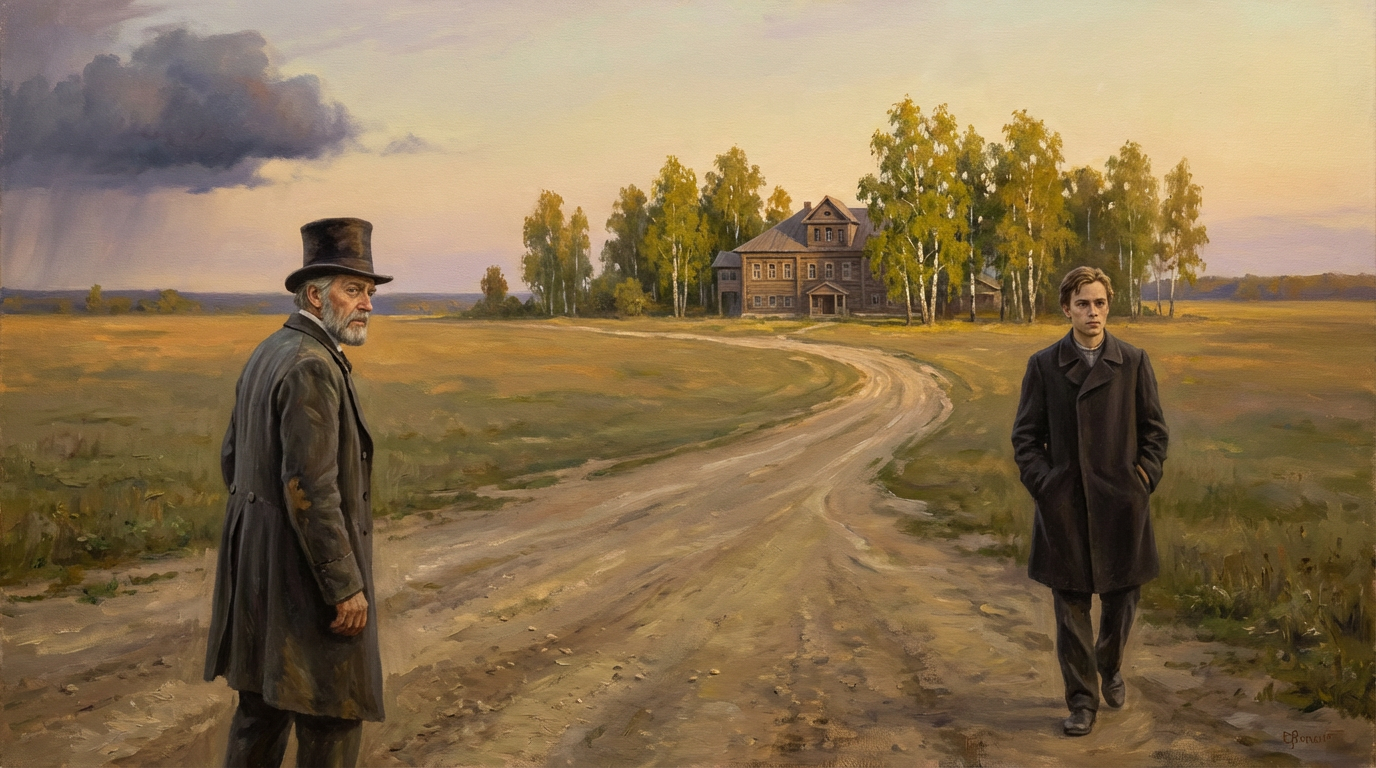
An excerpt from the original text.(complete · 1771 words)
hen Madame Odintsov entered the breakfast-room next morning, Bazarov
had been sitting over his cup for a considerable time. He glanced
sharply at her as she opened the door, and she turned in his direction
as inevitably as though he had signed to her to do so. Somehow her face
looked pale, and it was not long before she returned to her boudoir,
whence she issued again only at luncheon time. Since dawn the weather
had been too rainy to admit of outdoor expeditions, and therefore the
party adjourned to the drawing-room, where Arkady began to read aloud
the latest number of some journal, while the Princess manifested her
usual surprise at his conduct (as though it had been conduct of an
indecent nature!), and fixed upon him a gaze which, though one of
lasting malignancy, proved also to be one of which he took not the
slightest notice.
"Pray come to my boudoir, Evgenii Vasilitch," said Anna Sergievna. "I
have something to ask you. I think that last night you mentioned some
textbook or another?"
Rising, she moved towards the door, whilst the Princess stared around
the room as much as to say: "Dear, dear! This does surprise me!" Then
she brought her eyes back to Arkady, who, raising his voice, and
bending towards Katia (by whose side he was sitting), continued his
reading as before.
Meanwhile Madame Odintsov walked hurriedly to her boudoir, and Bazarov
followed with his eyes fixed upon the floor, and his ears open to
no sound but the faint rustling of a silk dress. Arrived at her
destination, Madame seated herself in the chair which she had occupied
overnight, and Bazarov also took a seat where he had sat on the
occasion in question.
"What is the title of the book?" she asked after a brief pause.
"Notions Générales, by Pelouse and Frémy. I can also recommend
Ganot's Traité Élémentaire de Physique Expérimentale, which is more
detailed in its plates than the other work, and, in general, is----"
But Madame Odintsov held up her hand.
"Pardon me," she interrupted. "I have not brought you here to discuss
textbooks. I have brought you here to renew our conversation of last
night, at the point where you left the room so abruptly. I hope that I
shall not weary you?"
"I am entirely at your service. What was it we were discussing?"
She glanced at him.
"Happiness, I think," she said. "In fact, I was speaking to you of
myself. The reason why I mention happiness is the following. Why is it
that when one is enjoying, say, a piece of music, or a beautiful summer
evening, or a conversation with a sympathetic companion, the occasion
seems rather a hint at an infinite felicity existent elsewhere than a
real felicity actually being experienced? Perhaps, however, you have
never encountered such a phenomenon?"
"'Where we are not, there do we wish to be,'--you know the proverb.
Last night you said that you are dissatisfied. Such a thought never
enters into my head."
"Is it that such thoughts seem to you ridiculous?"
"No--rather, that they never occur to me."
"Indeed? Well, to know what your thoughts are is a thing which I
greatly wish to attain."
"I do not understand you."
"Then listen. For a long time past I have been wishing to have this out
with you. Do not tell me--you yourself know that it is useless to do
so--that you are a man apart. As a matter of fact, you are a man still
young, with all your life before you. I wish to know for what you are
preparing, and what future awaits you, and what is the goal which you
are seeking to reach, and whither you are travelling, and what you have
in your mind--in short, who and what you are."
"I am surprised! Already you know that I dabble in natural science;
while, as regards my future----"
"Yes? As regards your future?"
"I have told you that I purpose to become a district physician."
Anna Sergievna waved her hand impatiently.
"Why tell me that, when you yourself do not believe it? It is for
Arkady to return me such answers, not you."
"And is Arkady in any way----?"
"Wait. Do you mean to tell me that such a modest rôle will really
satisfy you, when you yourself have asserted that the science of
medicine does not exist? No, no! You have given me that answer for the
reason that you desire to keep me at arm's length, that you have no
faith in me. Then let me tell you that I am capable of understanding
you, that I too have known poverty and ambition, that I too have had my
experiences."
"I daresay: yet pardon me when I intimate that I am not accustomed to
bare my soul. Moreover, there is fixed between you and me such a gulf
that----"
"A gulf? Do you again say that I am an aristocrat? Come, come, Evgenii
Vasilitch! Have I not already told you that I----?"
"Can it avail anything to discuss the future when, for the most part,
our futures are wholly independent of ourselves? Should the occasion
arise to be up and doing, well and good: but, should the occasion not
arise, at least let us leave ourselves room for thankfulness that we
did not waste time in useless chatter."
"What? You call a friendly talk 'useless chatter'? Then do you deem me,
as a woman, unworthy of your confidence, or do you despise all women?"
"You I do not despise: and that you know full well."
"I know nothing of the kind. Of course I can understand your reluctance
to speak of your future career; but as to what is taking place within
you at the present moment----"
"'Taking place within me at the present moment'?" Bazarov exclaimed.
"One would think I was a state or a community! Nor is it a process
which interests me; while, in addition, a man cannot always put into
words 'what is taking place within him.'"
"I do not see it. Why should you hesitate to express what may be in
your soul?"
"Could you do as much?" asked Bazarov.
"I could," came the reply after a brief hesitation.
Bazarov bowed in an ironical manner.
"Then you have the advantage of me," he said.
Her glance quickened into a note of interrogation.
"Very well," she said. "Yet I will venture to say that you and I
have not met in vain, and that we shall always remain good friends.
Moreover, I feel certain that in time your secretiveness and reserve
will disappear."
"Then have you noticed in me much such 'secretiveness and reserve'?"
"I have."
Bazarov rose, and moved towards the window.
"Do you really want to know the cause of that 'secretiveness, and
reserve'?" he asked. "Do you really want to know 'what is taking place
within' me?"
"I do," she replied. Yet even as she spoke she felt run through her a
tinge of apprehension for which she could not account.
"And you will not be angry with me if I tell you?"
"No."
"No?"
He approached her and halted behind her.
"Learn, then," he said, "that I love you with a blind, insensate
passion. You have forced it from me at last!"
She stretched out her arms before her, while Bazarov, turning, pressed
his forehead against the window-pane. His breath caught in his throat,
and his whole body was quivering. Yet this was not the agitation born
of the diffidence of youth, nor was it the awe inspired by a first
confession of love. Rather, it was the beating of a strong and terrible
emotion which resembled madness and was, perhaps, akin to it. As for
Madame Odintsov, a great horror had come over her--also a great feeling
of compassion for him.
"Evgenii Vasilitch!" she cried. In the words there rang an involuntary
note of tenderness.
Wheeling about, he devoured her with his glance. Then he seized her
hands in his, and pressed her to his bosom.
She did not free herself at once. Only after a moment did she withdraw
to a corner, and stand looking at him. He rushed towards her again, but
she whispered in hurried alarm:
"You have mistaken me!"
Had he taken another step, she would have screamed.
Biting his lips, he left the room.
Half an hour later her maid brought her a note. It consisted of a
single line only, and said: "Must I depart to-day, or may I remain
until to-morrow?"
To it Anna Sergievna replied: "Why depart? I have failed to understand
you, and you have failed to understand me--that is all."
But mentally she added: "Rather, I have failed to understand myself."
Until dinner time she remained secluded, and spent the hours in pacing
her room with her hands clasped behind her. Occasionally she would halt
before the window-panes or a mirror, to draw a handkerchief across a
spot on her neck which seemed to be burning like fire. And every time
that she did so she asked herself what had led her to force Bazarov's
confidence; also, whether or not she had had any suspicion that such a
thing might result.
"Yes, I am to blame," she finally decided. "Yet I could not have
foreseen the whole dénouement."
Then she recalled Bazarov's almost animal face as he rushed to seize
her in his arms. And at the thought she blushed.
"Or is it that----?" Here she stopped, and shook back her curls. The
reason was that she had seen herself in a mirror, and, as in a flash,
had learnt from that image of a head thrown back, with a mysterious
smile lurking between a pair of half-parted lips and in a pair of
half-closed eyes, something which confounded her.
"No, no! Again no!" she cried. "Only God knows what might come of it.
Such things are not to be played with. Freedom from worry is the chief
thing in the world."
Nor had her sangfroid really been shattered. Rather, she was a
little agitated--so little that, when, for some unknown reason, she
shed a tear or two, those tears owed their origin not to any deep
emotion, to the fact that she was wounded, but to a sense of having
involuntarily been at fault in permitting certain vague yearnings--a
certain consciousness of the transience of life, a certain desire for
novelty--to urge her towards the boundary line. And over that boundary
line she had peeped. And in front of her she had beheld, not an abyss,
but a waste, a sheer ugliness.
Master this chapter. Complete your experience
Purchase the complete book to access all chapters and support classic literature
As an Amazon Associate, we earn a small commission from qualifying purchases at no additional cost to you.
Available in paperback, hardcover, and e-book formats
Let's Analyse the Pattern
Demanding emotional vulnerability through pressure destroys the very connection it seeks to create.
Why This Matters
Connect literature to life
This chapter teaches how to recognize when someone's persistent questioning is really about their need for control, not genuine care for your wellbeing.
Practice This Today
This week, notice when someone keeps asking 'What's wrong?' or 'Why won't you just tell me?' - ask yourself if they've created safety for honest answers or just demand for them.
Now let's explore the literary elements.
Key Quotes & Analysis
"I have something to ask you. I think that last night you mentioned some textbook or another?"
Context: Anna uses this flimsy excuse to get Bazarov alone in her private room
This transparent pretense shows Anna wants to continue their emotional conversation but needs a socially acceptable reason. She's testing the waters while maintaining plausible deniability about her true intentions.
In Today's Words:
Can we talk privately? I'll make up some excuse about work stuff.
"What is taking place within you?"
Context: Anna presses Bazarov to reveal his true feelings during their private conversation
This direct question forces the emotional crisis. Anna wants honesty but isn't prepared for the intensity of what she'll receive. Her curiosity about his inner life becomes the catalyst for his devastating confession.
In Today's Words:
What's really going on with you? Tell me what you're actually feeling.
"Yes, I love you with a blind, insensate passion"
Context: His explosive confession after Anna keeps pushing him to open up
This raw admission destroys his carefully maintained nihilist facade. The words 'blind' and 'insensate' show he recognizes this love as irrational and overwhelming, contradicting everything he claims to believe about emotion being meaningless.
In Today's Words:
I'm completely, irrationally, head-over-heels in love with you and I can't think straight.
"You have misunderstood me"
Context: Her response when Bazarov tries to embrace her after his confession
This cold rejection reveals Anna's terror at the intensity of his feelings. She wanted intellectual intimacy but recoils from physical and emotional vulnerability, choosing social safety over authentic connection.
In Today's Words:
This isn't what I meant. You've got this all wrong.
Thematic Threads
Vulnerability
In This Chapter
Bazarov's confession of 'blind, insensate passion' strips away all his intellectual defenses
Development
Evolved from his earlier emotional detachment to this moment of complete exposure
In Your Life:
You might recognize this when someone's raw honesty makes you uncomfortable despite asking for it
Class
In This Chapter
Anna tries to bridge their class gap by sharing her own poverty, but it highlights rather than eliminates their differences
Development
Built on earlier tensions about Bazarov's common background versus Anna's aristocratic status
In Your Life:
You see this when trying to connect across economic differences feels forced or patronizing
Control
In This Chapter
Anna wants to manage the pace and intensity of their emotional connection but loses control when Bazarov responds authentically
Development
Escalated from her earlier attempts to intellectually categorize and understand him
In Your Life:
You might catch yourself wanting someone to open up on your terms, not theirs
Self-Knowledge
In This Chapter
Anna admits she 'failed to understand herself' and spends hours analyzing her own motivations
Development
Introduced here as her confident self-image crumbles under emotional pressure
In Your Life:
You experience this when your reaction to someone surprises you and forces uncomfortable self-examination
Communication
In This Chapter
Both characters send careful, measured notes after their explosive encounter, trying to manage the damage
Development
Contrasts sharply with their earlier direct, challenging conversations
In Your Life:
You see this in the formal, distant messages people send after an emotional confrontation goes wrong
You now have the context. Time to form your own thoughts.
Discussion Questions
- 1
What specific tactics does Anna use to try to get Bazarov to open up emotionally, and how does he initially respond to her pressure?
analysis • surface - 2
Why does Anna's strategy of demanding emotional vulnerability backfire so dramatically? What does she misunderstand about how intimacy actually develops?
analysis • medium - 3
Where have you seen this pattern of 'forced intimacy' play out in modern relationships - someone pushing for emotional openness until they get more than they bargained for?
application • medium - 4
If you were Anna's friend watching this unfold, what advice would you give her about building genuine connection without creating pressure?
application • deep - 5
What does this chapter reveal about the difference between wanting to understand someone and wanting to control their emotional expression?
reflection • deep
Critical Thinking Exercise
Map the Pressure Points
Think of a relationship in your life where someone (maybe you) pushes for emotional openness. Draw or write out the cycle: What triggers the pushing? What tactics get used? How does the other person typically respond? Where does it usually end up? Then identify one specific way to break this cycle by creating safety instead of applying pressure.
Consider:
- •Notice the difference between curiosity and interrogation in your approach
- •Consider why the other person might not feel safe sharing in the first place
- •Think about whether you want genuine connection or just want to feel in control
Journaling Prompt
Write about a time when someone pushed you to share something before you were ready. How did it feel, and what would have made you feel safer to open up naturally?
Coming Up Next...
Chapter 19: The Awkward Exit
The aftermath of Bazarov's confession creates an awkward tension that everyone can feel but no one discusses. As the household tries to return to normal routines, the unspoken drama threatens to explode in unexpected ways.



