
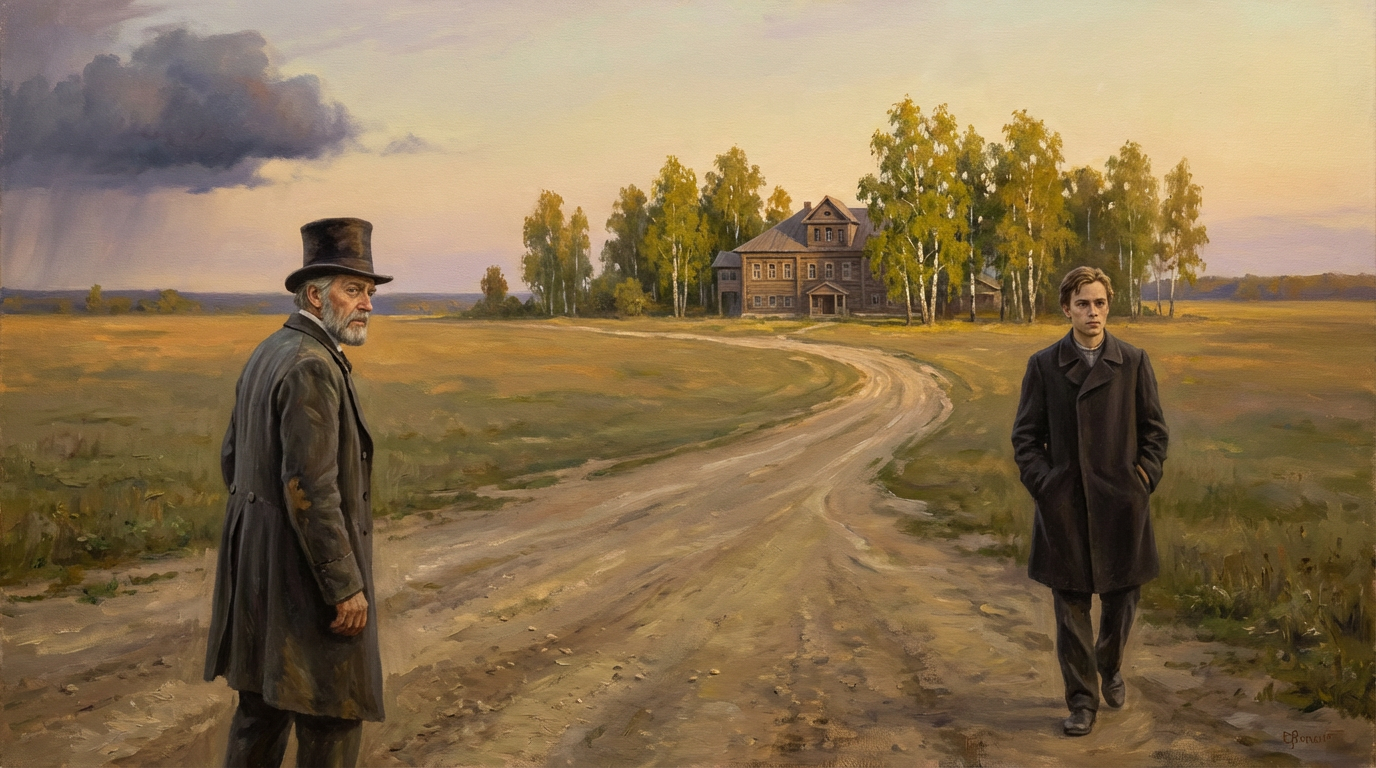
An excerpt from the original text.(complete · 2776 words)
spite of her self-command, in spite of her superiority to
convention, Madame Odintsov could not but feel a little uncomfortable
when she entered the dining-room for the evening meal. Nevertheless the
meal passed off without incident, and after it Porphyri Platonitch came
in, and related various anecdotes on the strength of a recent visit
to the neighbouring town--among other things, a story to the effect
that Governor "Bardeloue" had commanded his whole staff of officials
to wear spurs, in order that, if need be, he could dispatch them on
their errands on horseback! Meanwhile, Arkady talked in an undertone
to Katia, and also paid diplomatic attention to the Princess; while
Bazarov maintained such an obstinate, gloomy silence that Madame,
glancing at him (as she did twice, and openly, not covertly), thought
to herself, as she scanned his stern, forbidding face, downcast eyes,
and all-pervading expression of rigid contempt: "No, no! Again, no!"
Dinner over, she conducted her guests into the garden, and, perceiving
that Bazarov desired a word with her, walked aside a little, halted,
and waited for him. Approaching with his eyes on the ground, he said in
a dull way:
"I must beg your pardon, Anna Sergievna. Surely you must be feeling
extremely angry with me?"
"No, not angry so much as grieved," she replied.
"So much the worse! But I have received sufficient punishment, have I
not? My position now (I am sure that you will agree with me) is a very
awkward one. True, you wrote in your message: 'Why need you depart?'
but I cannot and will not remain. By to-morrow, therefore, I shall have
departed."
"But why need you, need you----?"
"Why need I depart?"
"No, I was going to have said something quite different."
"We cannot recover the past," he continued, "and it was only a question
of time before this should happen. I know only of one condition under
which I could remain. And that condition is never likely to arise. For
(pardon my presumption) I suppose you neither love me now nor could
ever do so?"
With the words there came a flash from under his dark brows.
She did not reply. Through her brain there flitted only the one
thought: "I am afraid of this man!"
"Farewell," he continued, as though he had divined that thought. Then
he moved away towards the house.
Entering the house a little later, Anna Sergievna called to Katia, and
took the girl by the arm: nor throughout the rest of the evening did
she once part from her. Also, instead of joining in a game of cards,
she sat uttering laugh after laugh of a nature which ill consorted with
her blanched and careworn face. Gazing at her perplexedly, as a young
man will do, Arkady kept asking himself the question: "What can this
mean?" As for Bazarov, he locked himself in his room, and only appeared
to join the rest at tea. When he did so, Anna Sergievna yearned to say
something kind to him, but could think of no words for the purpose. To
her dilemma, however, an unexpected incident put an end. This was the
entry of the butler to announce Sitnikov!
To describe the craven fashion in which the young Progressive
entered the room would be impossible. Although, with characteristic
importunity, he had decided to repair to the residence of a lady
with whom he was barely acquainted, and who had not accorded him an
invitation (his pretext for such presumption being that, according
to information received, she happened to be entertaining guests who
were both intellectual and "very intimate" with himself), he had since
felt his courage ebb to the marrow of his bones, and now, instead of
proffering all the excuses and compliments which he had prepared in
advance, blurted out some ridiculous story to the effect that Evdoksia
Kukshin had sent him to inquire after the health of Anna Sergievna,
and that Arkady Nikolaievitch had always spoken of him in terms of the
highest respect. But at this point he began to stammer, and so lost his
head as to sit down upon his own hat! No one bade him depart, however,
and Anna Sergievna even went so far as to present him to her aunt and
sister. Accordingly it was not long before he recovered his equanimity,
and shone forth with his accustomed brilliancy. Often the appearance
of the paltry represents a convenient phenomenon in life, since it
relaxes over-taut strings, and sobers natures prone to conceit and
self-assurance by reminding them of their kinship with the newcomer.
Thus Sitnikov's arrival caused everything to become duller and a trifle
more futile, but also rendered things simpler, and enabled the company
to partake of supper with a better appetite, and to part for the night
half an hour earlier than usual.
"Let me recall to you some words of your own," said Arkady when he had
got into bed, and Bazarov was still undressing. "I refer to the words:
'Why are you down-hearted? Have you just fulfilled a sacred duty?'"
Between the two there had become established those half-quizzical
relations which are always a sign of tacit distrust and a smouldering
grudge.
"To-morrow I intend to set out for my father's place," remarked
Bazarov, in disregard of what Arkady had said.
The latter raised himself on his elbow. Though surprised, he also, for
some reason, felt glad.
"Ah!" he exclaimed. "Then that is why you are down-hearted?"
Bazarov yawned.
"When you are come to be a little older," he replied, "you will know
more."
"And what of Anna Sergievna?" continued Arkady.
"Well? What of her?"
"Is it likely that she will let you go?"
"I am not her hireling."
Arkady relapsed into thought, and Bazarov sought his bed, and turned
his face to the wall.
For a few moments silence reigned.
"Evgenii," said Arkady suddenly.
"Yes?"
"I too intend to leave to-morrow."
Bazarov made no reply.
"True, I shall be returning to Marino," continued Arkady, "but we might
bear one another company as far as Khokhlovskïe Viselki, and there you
could hire horses of Thedot. Of course, I should have been delighted to
make your family's acquaintance, but, were I to accompany you, I might
act as a source of constraint upon them and yourself alike. You must
pay us another visit at Marino later."
"I will. As a matter of fact, I have left some of my things there."
Bazarov still had his face turned to the wall.
"Why does he not ask me the reason of my departure--a departure as
sudden as his?" reflected Arkady. "Why is either of us departing, for
that matter?"
As he continued to reflect he realised that, while unable to return a
satisfactory answer to the question propounded, he seemed to have got
a heartache somehow, to be feeling that he would find it hard to part
with the life at Nikolsköe to which he was grown so accustomed. Yet he
could not remain there alone. That would be worse still.
"Between him and her there is something in the wind," he reflected.
"That being so, what would my sticking here avail after he had gone? I
should weary Anna Sergievna, and lose my last chance of pleasing her."
Then he began to draw a mental picture of the lady whom he had just
named: until there cut across the fair presentment of the young widow
another set of features.
"Katia too I shall miss," he whispered to his pillow (which had already
received one of his tears). At length, raising his curly poll, he
exclaimed:
"What, in the devil's name, brought that idiot Sitnikov here?"
He heard Bazarov stir under the bedclothes, then remark:
"You yourself are an idiot. We need the Sitnikovs of this world. Such
donkeys are absolutely necessary to us, to me. The gods ought not to
have to bake pots."
"Ah!" reflected Arkady. For, as in a flash, there had become revealed
to him the bottomless profundity of Bazarov's conceit.
"Then you and I are the gods?" he said aloud. "Or are you a god, and I
a donkey?"
"You are," came the gruff reply. "As yet, at all events, you are."
No particular astonishment was evinced by Madame Odintsov when, on
the following day, Arkady informed her that it was his intention to
accompany Bazarov. Rather, she looked distraught and weary. Katia
glanced at him gravely and in silence, and the Princess went so far as
to cross herself under her shawl--a precaution against the young men
observing the gesture. Sitnikov too was dumbfounded at having just
entered the breakfast-room in a new and most elegant suit (this time
not of "Slavophil" cut, not to mention the fact that he had also had
the pleasure of amazing his temporary valet with the multitude of his
shirts), only to find himself confronted with the prospect of being
deserted by his comrades! He shuffled and wriggled like a hare driven
to the edge of a covert, and blurted out, almost in panic-stricken
fashion, that he too had a great mind to depart. Nor did Madame
Odintsov make any great effort to dissuade him.
"I have an exceedingly comfortable koliaska," the unfortunate young
man said to Arkady, "and I could give you a lift in it, and leave
Evgenii Vasilitch to use your tarantass, which would suit him better
than the koliaska."
"But I should not like to take you so far out of your way, for the
distance to my home is considerable."
"That would not matter, that would not matter. I have plenty of time to
spare, and also some business to do in that direction."
"What? Leasehold business again?" inquired Arkady disparagingly. But
Sitnikov was so distraught that he forbore to giggle in his usual
fashion.
"I can guarantee that the koliaska is comfortable," he repeated.
"Indeed, it could hold all three of us."
"Do not vex Monsieur Sitnikov by refusing," put in Madame Odintsov.
So, with a meaning glance at her, Arkady nodded assent to Sitnikov.
Breakfast over, the guests departed. Anna Sergievna offered Bazarov her
hand.
"I hope we shall meet again?" she said.
"Only if you wish it," he replied.
"Then we shall meet again."
The first to issue upon the verandah and enter Sitnikov's koliaska
was Arkady. The butler assisted him obsequiously, although Arkady could
with equal readiness have struck the man or burst into tears. As for
Bazarov, he took possession of the tarantass.
Khokhlovskïe Viselki reached, Arkady waited until Thedot, the local
posting-master, had harnessed fresh horses, and then, approaching the
tarantass, said to Bazarov with his old smile:
"Evgenii, take me with you. I should like to come to your place, after
all."
"Get in, then," muttered Bazarov.
This made Sitnikov, who had been walking up and down beside his
conveyance, and whistling, fairly gasp. Nevertheless the heartless
Arkady removed his luggage from the koliaska, seated himself beside
Bazarov, and, according his late fellow-traveller a courteous bow,
shouted: "Right away!" The tarantass started, and soon was lost to
view. Much taken aback, Sitnikov gazed at his coachman. But the latter
was flicking the flanks of the trace horse with his whip, and therefore
Sitnikov had no choice but to leap into the vehicle, to shout to a
couple of peasants: "Off with your caps, you rascals!" and be driven
to the town, whither he arrived at a late hour, and where, on the
following day, he declared to Madame Kukshin that he had had enough of
"those odious churls and upstarts."
On Arkady seating himself beside Bazarov in the tarantass, he pressed
his hand, and Bazarov seemed to divine the meaning of the silent
hand-clasp, and to appreciate it. During the previous night the elder
man had never once closed his eyes. Also, for several days past he had
neither smoked a cigar nor eaten more than the merest scrap of food.
Indeed, as he sat in the tarantass, his fine-drawn profile, under the
overshadowing cap, looked sharper and grimmer than ever.
"Give me a cigar, will you?" he said. "Also, pray look at my tongue,
and tell me if it has a bilious appearance."
"Yes, it has," replied Arkady.
"I thought so, for this cigar seems tasteless. Moreover, the infernal
thing has come unrolled."
"You have changed a good deal of late?" hazarded Arkady.
"I daresay. But I shall be myself again, soon. The only thing now
troubling me is the fact that my mother is so good-naturedly fussy.
Should one's paunch not be projecting, or should one not eat at least
ten meals a day, she relapses into despair. My father, of course, is
different, for he has been all over the world, and knows what is what.
This cigar is simply unsmokable." And Bazarov consigned it to the dust
of the roadway.
"The distance to your place is twenty-five versts, I suppose?" queried
Arkady.
"It is so. But inquire of that sage there." And Bazarov pointed to the
peasant (an employé of Thedot's) who was seated on the box.
The "sage" in question replied that he "could not say exactly," since
the verst-posts in those parts had not been measured out; after
which he went on to swear at the shaft horse for "kicking" its "jowl
about"--that is to say, jerking its head up and down.
"Aye, aye," commented Bazarov. "Take warning from me, my young friend.
An instructive example sits before you--an example of the vanity of
this world. By a single thread does the destiny of every man hang, and
at any moment there may open before him an abyss into which he and his
may plunge. For always he is laying up for himself misfortune."
"At what are you hinting?" asked Arkady.
"At nothing. I am merely saying outright that you and I have behaved
very foolishly. However, why talk of it? I have noticed that in
surgical operations it is the patient who fights against his hurt who
soonest gets well."
"I do not understand you," Arkady said. "So far as I can see, you have
nothing whatsoever to complain of."
"You cannot understand me? Well, mark this: that you had far better
go and break stones by the roadside than allow a woman to obtain
even the least hold over you. Such a thing is sheer" (he nearly said
"Romanticism," but changed his mind) "rubbish."
"Perhaps you do not believe me?" he went on. "Nevertheless, I tell you
that, though you and I have been cultivating feminine society, and
enjoying it, the sense of relief when such society is abandoned is like
taking a cold bath on a summer's day. Never ought a man to touch such
follies. Always he ought, as the excellent Spanish saying has it, 'to
remain as the beasts of the field.' Look here," he added to the peasant
on the box. "Do you, my man of wisdom, possess a wife?"
The peasant turned a portion of a flat, near-sighted visage in the
friends' direction.
"A wife?" he repeated. "Yes, I do. Why shouldn't I?"
"Never mind that. Do you ever beat her?"
"My wife? Sometimes. But never without good cause."
"Excellent! And does she ever beat you?"
The peasant gave his reins a jerk.
"What a thing, barin!" he exclaimed. "Surely you must be joking?"
Evidently the question had offended him.
"You hear that, Arkady Nikolaievitch?" said Bazarov. "You and I have
been similarly beaten. That is what comes of being gentry."
Arkady laughed in spite of himself, but Bazarov turned away, and did
not speak again until the end of the journey.
To Arkady the twenty-five versts seemed like fifty; but at length there
came into view, on the slope of a low hill, the homestead of the manor
where Bazarov's parents resided. On one side of it, amid a clump of
young birch trees, there could be seen the servants' quarters under
their thatched roofs; while at the door of the nearest hut a couple of
fur-capped peasants were engaged in a contest of mutual abuse.
"You are an old pig!" one of them said to the other. "And that is worse
than being a young one."
"Your wife is a witch," retorted the other.
"From the lack of restraint in their bearing," commented Bazarov, "as
well as from the playfulness of their terms of speech, you will gather
that my father's peasantry are not downtrodden. But here is my father
himself. I can see him stepping out on to the verandah. He will have
heard the sound of our collar-bells. Yes, it is he! I recognise his
figure. But how grey he looks, poor old fellow!"
Master this chapter. Complete your experience
Purchase the complete book to access all chapters and support classic literature
As an Amazon Associate, we earn a small commission from qualifying purchases at no additional cost to you.
Available in paperback, hardcover, and e-book formats
Let's Analyse the Pattern
When rejection wounds our ego, we disguise retreat as principled choice to protect our self-image.
Why This Matters
Connect literature to life
This chapter teaches how to recognize when wounded ego disguises itself as principled decision-making.
Practice This Today
Next time you want to quit, transfer, or cut contact after an awkward interaction, ask yourself: 'Am I leaving because this is genuinely wrong for me, or because my pride got hurt?'
Now let's explore the literary elements.
Key Quotes & Analysis
"No, not angry so much as grieved"
Context: When Bazarov asks if she's angry about his confession
Shows Anna's emotional complexity - she's not mad at Bazarov for being honest about his feelings, but she's sad about the situation and how it's changed their relationship. Her response reveals genuine care beneath her rejection.
In Today's Words:
I'm not mad at you, I'm just sad about how this turned out
"My position now is a very awkward one"
Context: During his apology to Anna before announcing his departure
Bazarov admits the social discomfort of staying after being rejected, but frames it practically rather than emotionally. He's acknowledging the awkwardness while protecting his pride.
In Today's Words:
This is really uncomfortable for me now
"No, no! Again, no!"
Context: While observing Bazarov's stern, forbidding expression during dinner
Anna's internal dialogue reveals she's still processing her rejection of Bazarov and perhaps questioning her decision. The repetition suggests ongoing internal conflict about her feelings.
In Today's Words:
Nope, definitely not changing my mind about this
Thematic Threads
Pride
In This Chapter
Bazarov's wounded pride forces him to leave immediately after rejection, unable to tolerate the vulnerability of staying
Development
Evolved from his intellectual arrogance to personal emotional defensiveness
In Your Life:
You might recognize this when you quit something after criticism instead of learning from it
Emotional Maturity
In This Chapter
Both young men flee emotional complexity they're unprepared to handle, choosing escape over growth
Development
Building from earlier chapters where their philosophies couldn't handle real human connection
In Your Life:
You see this when you avoid difficult conversations that might actually strengthen relationships
Social Masks
In This Chapter
Bazarov's cynical philosophizing about women masks his wounded feelings and genuine confusion
Development
His nihilistic theories are increasingly revealed as protective armor rather than genuine beliefs
In Your Life:
You might use cynicism or detachment to protect yourself after being hurt
Class Expectations
In This Chapter
The tension between Bazarov's common background and his presence in aristocratic circles adds pressure to his departure
Development
Continued exploration of how class differences create additional layers of social awkwardness
In Your Life:
You feel this when you don't quite fit in somewhere and one mistake feels like confirmation you don't belong
Friendship Loyalty
In This Chapter
Arkady chooses to leave with Bazarov despite his own conflicted feelings, prioritizing loyalty over personal desire
Development
Shows how their friendship dynamic is shifting as both face individual emotional challenges
In Your Life:
You face this when supporting a friend means sacrificing your own opportunities or happiness
You now have the context. Time to form your own thoughts.
Discussion Questions
- 1
Why does Bazarov decide to leave immediately after Anna rejects his confession, and how does he justify this decision to himself?
analysis • surface - 2
How does Bazarov's wounded pride transform his embarrassment into what he sees as a principled departure?
analysis • medium - 3
Where do you see this pattern of 'retreat disguised as choice' playing out in modern workplaces, relationships, or social situations?
application • medium - 4
When someone you know suddenly quits or leaves after a setback, how can you tell whether it's genuine incompatibility or wounded pride driving the decision?
application • deep - 5
What does Bazarov's inability to stay and work through awkwardness reveal about the relationship between intellectual confidence and emotional maturity?
reflection • deep
Critical Thinking Exercise
Map Your Exit Patterns
Think of three times you left a situation after feeling rejected, criticized, or embarrassed. For each situation, write down what you told yourself about why you left versus what you were actually feeling. Look for patterns in how you justify exits when your ego gets bruised.
Consider:
- •Notice the difference between the story you told others and what you felt inside
- •Identify any recurring phrases you use to justify leaving ('they don't appreciate me', 'it wasn't worth it', 'I deserve better')
- •Consider whether staying longer might have led to growth or better outcomes
Journaling Prompt
Write about a time when you almost left a difficult situation but chose to stay instead. What did you learn from pushing through the discomfort rather than retreating?
Coming Up Next...
Chapter 20: A Son Returns Home
Bazarov returns to his childhood home, where his aging parents wait with the kind of overwhelming love that makes grown children squirm. The reunion will test whether his nihilistic philosophy can withstand the simple, uncomplicated devotion of family.



