
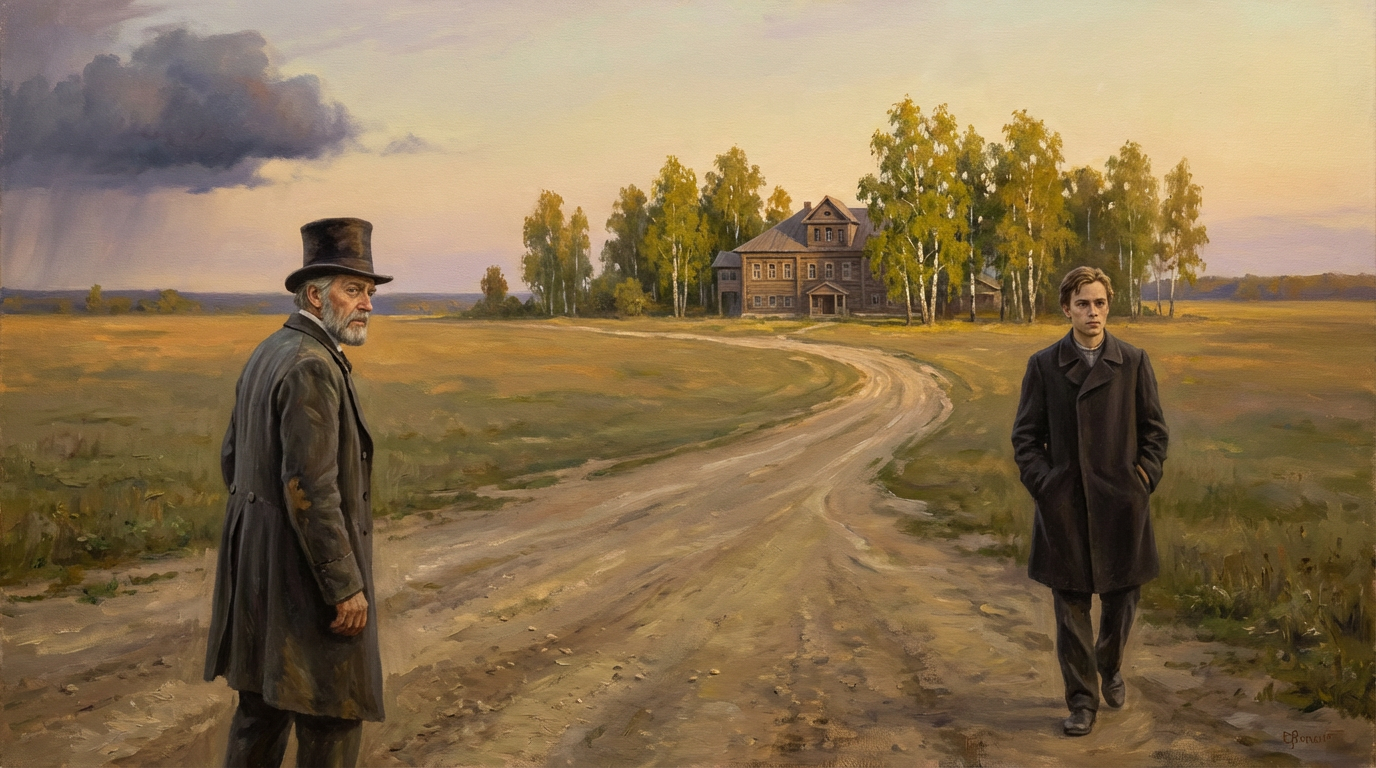
An excerpt from the original text.(complete · 3917 words)
azarov leant forward from the tarantass, and Arkady, peering
over his friend's shoulder, beheld, on the entrance steps of the
manor-house, a tall, thin man with dishevelled hair and a narrow,
aquiline nose. Clad in an old military tunic of which the front was
flying open, he was standing with legs apart, a long pipe in his mouth,
and eyes blinking in the glare of the sunlight.
The horses pulled up.
"So you have come at last!" exclaimed Bazarov's father, still
continuing to smoke (though, as he did so, the stem of the pipe was
rattling and shaking between his fingers). "Now, jump out, jump out!"
Again and again he embraced his son.
"Eniusha, Eniusha!"[1] the tremulous voice of an old woman also cried
as the door of the house opened and there appeared on the threshold
a short, rotund old dame in a white cap and a short striped blouse.
Gasping and staggering, she would have fallen had not Bazarov hastened
to support her. As he did so her fat old arms clasped him around the
neck, and her head sank upon his bosom. All then was still for a
moment. Only her convulsive sobs broke the silence. Meanwhile Bazarov
Senior breathed hard, and blinked more vigorously than ever.
"Enough, enough, Arisha!" he said at length with a glance at Arkady,
who had remained standing beside the tarantass (and even the peasant
on the box-seat had turned away his head). "Pray cease, I tell you.
This is not necessary. I beg of you to cease."
"Ah, Vasili Ivanitch!" whimpered the poor old woman. "To think of the
long while since last I saw my Eniusha, my own, my darling boy!" Still
keeping her arms clasped around Bazarov, she withdrew her ruffled,
convulsed, tear-stained face from his breast, looked at him for a
moment with blissful, yet comical, eyes, and glued herself again to his
bosom.
"Yes, yes," said Vasili Ivanitch. "Such is in the nature of things. But
had we not better go indoors? See! Evgenii has brought a guest!"
With a slight scrape and a bow, he added to Arkady:
"Pray pardon us, sir, but you will understand the situation. A woman's
weakness--ahem!--and a mother's heart."
His lips, chin, and eyebrows too were working. Evidently he was
striving to master himself, and to appear totally indifferent. Arkady
responded to his bow with a like salutation.
"Yes, yes, dear mother; let us go indoors," said Bazarov. Leading
the shaking old lady into the house, he seated her in a cosy chair,
bestowed upon his father another hurried embrace, and then presented
Arkady.
"I am glad indeed to make your acquaintance!" said Vasili Ivanitch.
"I am glad indeed! But do not expect too much of us, my dear sir. My
establishment is organised on simple lines; it is placed on what I
might call 'a war footing.' Come, come, Arina! Pray calm yourself, and
attend to your duties as a hostess. Oh, fie, to give way in such a
manner! What will our guest think of you?"
"My dear, I do not know the gentleman's name," the old lady sobbed
through her tears.
"Arkady Nikolaievitch," prompted Vasili Ivanitch in an undertone, but
with great ceremony.
"Then pray pardon a foolish old woman, sir." Arina Vlasievna blew her
nose, inclined her head to right and left, and wiped each eye in turn
as she did so. "Yes, pray pardon me, but I had thought never again to
see my darling boy before I died."
"But, you see, we have seen him again," said Vasili Ivanitch. "Here,
Taniushka!"--this to a barefooted serf girl of thirteen who, clad in a
bright red cotton frock, had been an interested, but timid, observer
in the doorway. "Bring your mistress a glass of water on a salver.
Do you hear? And you, gentlemen," he continued with old-fashioned
sprightliness, "will you be so good as to step into the study of a
retired veteran?"
"First another kiss, Eniusha," gasped Arina Vlasievna. Then, as Bazarov
bent over her form, she added: "How handsome you have grown!"
"Handsome or not, he is human," said Vasili Ivanitch. "Wherefore, now
that you have satisfied your mother's heart, I look to you to see also
to the satisfaction of our honoured guests. For than yourself no one
knows better that nightingales cannot be fed on air."
This caused the old lady to rise from her chair, and to exclaim:
"Yes, yes: in one moment, Vasili Ivanitch. The table shall be laid, and
I myself will hurry to the kitchen, and see that the samovar be got
ready. Everything shall be done. Why, it must be three years since last
I gave Eniusha a meal."
"Yes, three years, dear wife. But now bustle about, and do not let
yourself get flurried. Gentlemen, accompany me, I beg of you. But here
is Timotheitch coming to pay you his respects. How delighted he looks,
the old rascal! Now, pray favour me with your company."
And he strode fussily ahead with much shuffling and creaking of
flat-soled slippers.
The Bazarovian establishment consisted of six small rooms, of which
one--the room to which Vasili Ivanitch was now conducting our
friends--was looked upon as the study. Between its two windows there
stood a fat-legged table, strewn with dusty, fusty papers; on the walls
hung a number of Turkish weapons, nagaiki,[2] and swords, a couple
of landscapes, a few anatomical plates, a portrait of Hufeland,[3] a
black-framed monogram done in hair, and a diploma protected with a
glass front; between two large birchwood cupboards stood a ragged,
battered leathern sofa; on shelves lay huddled a miscellany of books,
boxes, stuffed birds, jars, and bladders; and, lastly, in a corner
reposed a broken electric battery.
"Already I have warned you," said Vasili Ivanitch to Arkady, "that we
live here, so to speak, en bivouac."
"Make no excuses," put in Bazarov. "Kirsanov knows that you and I are
not Croesuses, and that no butler is kept. But where can we find Arkady
a bed? That is the question."
"We have an excellent room in the wing, where he would be most
comfortable."
"You have added a wing, then?"
"Yes, Evgenii Vasilitch," Timotheitch interposed. "At least, a
bathroom."
"But it is to a room next the bathroom that I am referring," Vasili
Ivanitch hastened to explain. "However, that will not matter, since it
is now summer time. I will run up there at once, and see that it is
put in order. Meanwhile, Timotheitch, fetch in the luggage. To you,
Evgenii, I will allot the study. Cuique suum."[4]
"There!" said Bazarov to Arkady as soon as his father had left the
room. "Is he not just such a jolly, good-hearted, queer old fellow as
your own father, though in a different way? He chatters just as he
always used to do."
"Yes; and your mother seems an excellent woman."
"She is. Moreover, you can see that she does not attempt to hide her
feelings. Only wait and see what a dinner she will give us!"
"But as you were not expected to-day," put in Timotheitch, who had just
re-entered with Bazarov's portmanteau, "no beef has been got into the
house."
"Never mind. Let us dine without beef--or, for that matter, without
anything at all. 'Poverty is no crime.'"
"How many souls[5] are there on your father's property?" asked Arkady.
"It is not his property; it is my mother's. The number of souls on it
is, I think, fifteen."
"No, twenty-two," corrected Timotheitch with an air of pride. The next
moment the sound of shuffling slippers was heard once more, and Vasili
Ivanitch re-entered.
"Your room will be ready for you in a few minutes," he announced
grandiloquently to Arkady. "Meanwhile, here is your servant." He
pointed to a close-cropped urchin who, clad in an out-at-elbows blue
kaftan and an odd pair of shoes, had also made his appearance. "His
name is Thedika, and, for all my son's injunction, I had better repeat
to you not to expect too much of him--though certainly he will be able
to fill your pipe for you. I presume that you smoke?"
"I do, but only cigars."
"A commendable rule! I too prefer cigars, but find them extremely
difficult to procure in this isolated part of the country."
"Have done with bewailing your poverty," Bazarov good-naturedly
interrupted. "Rather, seat yourself on this sofa, and take a rest."
Vasili Ivanitch smilingly did as he was bidden. Extremely like his son
in features (save that his forehead was lower and narrower, and his
mouth a trifle wider), he was for ever on the move--now shrugging his
shoulders as though his coat cut him under the armpits, now blinking,
now coughing, now twitching his fingers. In this he was sharply
differentiated from his son, whose most distinguishing characteristic
was his absolute immobility.
"Have done with bewailing my poverty?" repeated the old man. "Why,
you cannot surely think that I would weary our guest with complaints
concerning our isolation? As a matter of fact, a man of brains need
never be isolated, and I myself do everything in my power to avoid
becoming moss-grown, and falling behind the times."
Extracting from his pocket a new yellow handkerchief which he had
contrived to lay hands upon while proceeding to Arkady's room, he
continued, as he flourished the handkerchief in the air:
"Of the fact that, at some cost to myself, I have organised my
peasantry on the obrok system, and apportioned them one-half, even
more, of my land, I will not speak, since I conceive that to have been
my duty, as well as a measure dictated by prudence (though no other
landowner in the neighbourhood would have done as much). Rather, I am
referring to scholarships and to science."
"I see that you have here The Friend of Health for 1855," remarked
Bazarov.
"Yes, a friend sent it me," Vasili Ivanitch hastened to explain.
"Phrenology too we take into account" (he addressed this last to Arkady
rather than to Bazarov, while accompanying it with a nod towards a
small plaster bust of which the cranial surface was divided into a
series of numbered squares). "Yes indeed! Nor are we ignorant of
Schönlein[6] and Rademacher."
"In the province of ---- you still believe in Rademacher?" queried
Bazarov.
Vasili Ivanitch laughed.
"In the province of ---- we still believe in ----? Ah, gentlemen!
Hardly could you expect us to move as fast as you do. You find us in
a state of transition. In my day, the humoralist Hoffmann and the
vitalist Braun had already come to be looked upon with ridicule (and
their fulminations undoubtedly seem absurd); but now you have replaced
Rademacher with a new authority, and are making obeisance to that
authority exactly as though in twenty years' time he too will not have
fallen into contempt."
"Let me tell you, for your comforting," said Bazarov, "that we ridicule
all medicine, and render obeisance to no one."
"What? Do you not wish to become a doctor?"
"Yes; but the one thing does not preclude the other."
Vasili Ivanitch raked out his pipe until only a glowing morsel of ash
remained.
"Perhaps so, perhaps so," he said. "That point I will not dispute.
For who am I that I should dispute such things--I who am a mere
retired army doctor, et voilà tout--an army doctor who has taken to
agriculture?"
With that he turned to Arkady.
"Do you know, I served under your grandfather," he said. "He was then
in command of a brigade. Many and many a review have I seen. And the
society in which I mixed, the men whom I had as comrades! Yes, this
humble individual has felt the pulses of Prince Vitzentschein and
Zhukovsky, and also known all the leaders of the Southern Army of '14."
He pursed his lips impressively. "At the same time, of course, my
department was a separate one from theirs. It was the department of the
lancet, you understand. Your grandfather stood high in the esteem of
every one, and was a true soldier."
"We will agree that he was a decent old curmudgeon," drawled Bazarov.
"To think of speaking so, Evgenii!" exclaimed the old man. "General
Kirsanov was not one of those who----"
"Never mind him. As we were driving hither I greatly admired your birch
plantation. It is doing splendidly."
Vasili Ivanitch's face brightened instantly.
"Yes, and see what a garden I have made!" he exclaimed. "Every tree in
it has been planted with my own hands--orchard trees, and bush fruit
trees, and every sort of medicinal herb. Ah, young sirs, though you may
be wise in your generation, many a truth did old Paracelsus[7] discover
in herbis et verbis et lapidibus. For myself, I have now retired from
practice; yet twice a week am I given a chance to refurbish my ancient
store of knowledge, since folk come to me for advice, and I cannot well
turn them away. In particular do the poor seek my help, since there is
no other doctor hereabouts. Yet stay! A certain retired major dabbles
in the art. Once I asked him whether he had ever studied medicine,
and he replied that he had not, that all that he did he did 'out of
philanthropy'! 'Out of philanthropy'! Ha, ha, ha! What think you of
that, eh? Ha, ha, ha!"
"Fill me a pipe, Thedika," said Bazarov curtly.
"And there was another doctor who came to visit a patient in this
neighbourhood," continued Vasili Ivanitch in a tone of mock despair.
"But by the time he arrived the patient had already joined his
forefathers, and the servant of the house would not admit the doctor,
saying that the latter's services were no longer required. This the
doctor had scarcely expected, and he was rather taken aback. 'Did the
barin gasp before he died?' he inquired. 'He did, sir,' was the
reply. 'Very much?' 'Yes, very much.' 'Good!--And the doctor returned
home. Ha, ha, ha!"
Yet no one laughed except the old man himself. True, Arkady contrived
to summon up a smile, but Bazarov only stretched himself and yawned.
The conversation lasted about an hour, and then Arkady managed to
get away to his room, which he found to consist of the vestibule to
the bathroom, but at the same time to be clean and inviting. Soon
afterwards Taniushka arrived to announce dinner.
The meal, though hastily prepared, was excellent, and even sumptuous.
Only the wine proved to be rather of the "gooseberry" order--the
dark-coloured sherry procured by Timotheitch from a certain wine
merchant in the town smacking in equal parts of resin and of honey.
Also, in addition, the flies made themselves a nuisance, owing to the
fact that the page boy whose duty it was to keep them at bay with a
green whisk had, for the nonce, been banished, lest he should excite
too much comment on the part of the up-to-date visitors. Lastly, Arina
Vlasievna had robed herself in gala attire--that is to say, in a
high-peaked cap with yellow ribands and a blue, embroidered shawl. She
burst into renewed weeping on beholding her beloved Eniusha, but, this
time, gave her husband no occasion to chide her, so speedily did her
own fear of staining her shawl cause her to wipe away the tears. None
but the two young men ate anything, for the host and hostess had long
ago dined; while as waiters there officiated Thedika (much burdened
with the novelty of wearing shoes) and a woman of a masculine type of
face, and with a hump on her back, who was also accustomed to execute
the functions of housekeeper, keeper of the poultry, and sempstress.
During the meal Vasili Ivanitch paced to and fro, and discussed,
in cheerful, and even rapturous, terms, the grave fears which
Napoleon's[8] policy and the intricacy of the Italian question inspired
in his breast. Arina Vlasievna, for her part, quite disregarded Arkady,
and offered him not a single dish, but, seated with her hand supporting
her face (to which a pair of puffy, cherry-coloured lips and a few
moles communicated a kindly expression), kept her eyes fixed upon her
son, while her breath came in a succession of pants. Her great desire
was to ask her son how long he was going to stay, but she dared not
do so for fear he should reply: "Only for two days," or something
of the kind--which was a prospect of a nature to make her heart die
within her. On the roast being served, Vasili Ivanitch disappeared, and
returned, the next moment, with an uncorked bottle of champagne.
"See here," he exclaimed. "Rustic though we may be, we still keep
something to make merry with on state occasions."
That said, he filled three tumblers and a wine-glass, proposed a health
to "our inestimable guests," heel-tapped his glass in the military
fashion, and forced his wife to drain hers to the dregs. Presently the
pastry course supervened; during which, though Arkady could not bear
anything sweet, he deemed it his duty to partake of no less than four
out of the many confections which had been prepared for his benefit.
And this obligation he felt to be the more binding in that Bazarov
bluntly declined all, and lit a cigar. Lastly there appeared tea,
cream, biscuits, and butter; after which Vasili Ivanitch conducted the
party into the garden, in order that the guests might admire the beauty
of the evening. As he passed a certain bench he whispered in Arkady's
ear:
"This is where I love to sit and meditate as I watch the sun sinking.
It is just the spot for a hermit like myself. And, further on, I have
planted a few of Horace's favourite trees."
"What trees?" asked Bazarov, who had partially overheard.
"Acacia trees."
The other yawned, and, on observing this, Vasili Ivanitch hastened to
say:
"I expect that you travellers would like now to seek the arms of
Morpheus?"
"We should," Bazarov assented. "Yes, that is a true saying."
Upon which the son said "Good night" to his mother, and kissed her
on the forehead, while she bestowed upon him a threefold embrace and
(covertly) a blessing; while Vasili Ivanitch conducted Arkady to his
room, and wished him "such God-given rest as I myself used to enjoy
during the happier years of my life."
And certainly Arkady slept splendidly in the mint-scented annexe to
the bathroom, where the only sound to be heard was that of a cricket
chirping lustily against a rival from behind the stove.
Meanwhile, on leaving Arkady, Vasili Ivanitch repaired to the study,
where, squatting at the foot of the sofa, he was about to enter into a
discursive conversation with his son when the latter dismissed him, on
the plea that he desired, rather, to go to sleep. Yet never once did
Bazarov close his eyes that night, but lay staring into the darkness,
since his memories of childhood had less power to move him than had
the remembrance of the bitter experience through which he had recently
passed.
For her part, Arina Vlasievna said her prayers with an overflowing
heart, and then indulged in a long talk with Anfisushka; who, planted
like a block before her mistress, with her solitary eye fixed upon
the latter, communicated in a mysterious whisper her opinions and
prognostications on the subject of Evgenii Vasilitch. Finally Arina
Vlasievna's pleasurable emotion, coupled with the wine and the tobacco
smoke, so caused the old lady's head to start whirling that, when
her husband came to bed, he found himself obliged to moderate her
exuberance with a gesture.
Arina Vlasievna was a true Russian housewife of the old school. That
is to say, she ought to have lived a couple of hundred years earlier,
during the period when the ancient Muscovite Empire was in being.
At once pious and extremely nervous, she believed in every species
of portent, divination, proverb, and vision; also in such things as
urodivïe,[9] household demons, wood spirits, unlucky encounters,
spells, popular medicines, Thursday salt, and an ever-imminent end
to the world. Again, she placed much faith in such ideas as that, if
a lighted candle lasts through the night preceding Easter Day, the
buckwheat crops will come up well; that, should a human eye chance to
fall upon a mushroom during the process of its growth, such growth
will terminate forthwith; that the devil loves to be where-soever
there is water; and that all Jews bear on their breasts a blood-red
stain. Again, she stood in great awe of mice, adders, frogs, sparrows,
leeches, thunder, cold water, draughts, horses, billy-goats, fair
men, and black cats, and also looked upon crickets and dogs as
unclean creatures. Again, she never ate veal, pigeons, crabs, cheese,
asparagus, artichokes, hare, or water melons (the last-named for the
reason that, when split open, they reminded her of the head of John
the Baptist!). Nor could she ever speak of oysters without a shudder.
Again, though she loved eating, she observed every fast; though she
slept ten hours out of the twenty-four, she never even went to bed if
Vasili Ivanitch had got a headache; she read no books beyond Alexis
or Siskins of the Forest; she wrote, at most, two letters a year; she
knew every wrinkle as regards the departments of housekeeping, boiling,
and baking (and that even though she herself never laid a finger upon
anything, and hated even to have to stir from her place); she was
aware that there were certain folk in the world who must command, and
others who must serve--wherefore she loved servility and genuflexions;
she treated all her subordinates with kindness and consideration; she
sent never a beggar away empty; and she condemned no one for a fault,
although at times she had a tendency to talk scandal. Likewise, in
her youth she had been comely, and a player of the clavichord, and
able to speak a little French; but, owing to long residence with a
husband whom she had married purely for love, she had grown rusty in
those accomplishments, and forgotten alike her French and her music;
she loved and feared her son to a degree almost beyond expression; she
deputed the management of her property entirely to Vasili Ivanitch, and
never interfered with it, but would fall to gasping, and waving her
handkerchief about, and affrightedly raising her eyebrows, whenever
her helpmeet happened to broach some new plan or some necessary reform
which he had in his mind's eye; and, lastly, she was of so apprehensive
a temperament that she lived in constant fear of some unknown
misfortune, and would burst into tears should any one mention anything
of a mournful character.
Such women are now extinct; and only God knows whether we ought to be
glad of the fact.
[1] An endearing diminutive of Evgenii.
[2] Cossack whips.
[3] Christoph Wilhelm Hufeland (1762-1836), a well-known German
physicist whose treatise Makrobiotik, or The Art of Prolonging
Life, has been translated into almost every European language.
[4] "To each his own."
[5] i.e. serfs.
[6] Johann Lukas Schönlein (1793-1864), a noted German physician.
[7] Theophrastus Bombastus von Hohenheim (1493-1541), most commonly
known by his self-coined name of Paracelsus, and a German-Swiss
traveller and physician.
[8] Napoleon III.
[9] Urodivïe, or "sacred imbeciles," were persons who, deficient of
intellect in the ordinary sense, were yet believed by ancient Russia
to enjoy particularly intimate communication with the divine and the
unseen.
Master this chapter. Complete your experience
Purchase the complete book to access all chapters and support classic literature
As an Amazon Associate, we earn a small commission from qualifying purchases at no additional cost to you.
Available in paperback, hardcover, and e-book formats
Let's Analyse the Pattern
The Road Home - How Family Strips Away Our Masks
Family relationships have the unique power to dissolve our constructed personas and reveal our authentic selves.
Why This Matters
Connect literature to life
This chapter teaches how to distinguish between genuine emotion and performance by observing what happens when people's guards drop.
Practice This Today
This week, notice when someone's tone or behavior shifts dramatically in different settings - often the most genuine version appears in unguarded moments.
Now let's explore the literary elements.
Key Quotes & Analysis
"So you have come at last!"
Context: The father's first words when he sees his son arrive after a long absence
Shows the deep longing and relief of a parent who has been waiting anxiously for their child's visit. The exclamation reveals how much this moment means to him.
In Today's Words:
You're finally here! I've been waiting forever!
"Eniusha, Eniusha!"
Context: The mother's emotional cry as she rushes to embrace her son
Using his childhood nickname shows how parents never stop seeing their children as their babies, no matter how grown up or changed they become.
In Today's Words:
My baby! My sweet boy!
"Enough, enough, Arisha! Pray cease, I tell you. This is not necessary."
Context: The father trying to stop his wife's emotional outburst in front of their guest
Reveals the father's embarrassment about showing too much emotion, especially in front of Arkady. He's caught between love for his family and social expectations.
In Today's Words:
Okay, okay, honey! That's enough. You're embarrassing us in front of company.
Thematic Threads
Identity
In This Chapter
Bazarov's nihilistic persona completely shifts when he encounters his parents' unconditional love
Development
Builds on earlier themes of constructed identity versus authentic self
In Your Life:
You might notice how different you feel and act when you're around family versus coworkers or friends
Generational Gap
In This Chapter
Vasili desperately tries to connect with his son through outdated intellectual references and medical theories
Development
Introduced here as a new dimension of class and social change
In Your Life:
You might recognize the struggle to bridge understanding between your parents' world and your current life
Love
In This Chapter
Arina's overwhelming joy and Vasili's nervous chatter both express deep parental love in different ways
Development
Contrasts with the romantic love complications seen in earlier chapters
In Your Life:
You might see how family love differs from romantic love in its unconditional, enduring nature
Class
In This Chapter
The modest household and Vasili's attempts to appear worldly highlight economic and social insecurities
Development
Continues exploration of how social position affects behavior and relationships
In Your Life:
You might notice how economic anxiety influences how your family presents itself to others
Vulnerability
In This Chapter
Bazarov allows himself to be tender and patient, showing sides of himself he hides from peers
Development
Introduced here as counterpoint to his earlier emotional detachment
In Your Life:
You might recognize how certain relationships allow you to show parts of yourself you usually keep hidden
You now have the context. Time to form your own thoughts.
Discussion Questions
- 1
What changes in Bazarov's behavior when he arrives at his parents' home, and how do his parents react to seeing him?
analysis • surface - 2
Why does Bazarov become gentle and patient with his emotional mother when he's usually dismissive of sentiment and emotion?
analysis • medium - 3
Think about people you know who act differently around their families than they do at work or with friends. What causes this shift?
application • medium - 4
When you visit family, do you feel yourself reverting to older patterns or becoming a different version of yourself? How do you handle that transition?
application • deep - 5
What does this chapter suggest about the relationship between our public personas and our authentic selves?
reflection • deep
Critical Thinking Exercise
Map Your Family Self vs. Public Self
Draw two columns on paper. In the left column, list 5-7 traits that describe how you act in professional or social settings. In the right column, list how you behave around family. Notice the differences and similarities. Then identify one family dynamic that either supports or undermines the person you're trying to become.
Consider:
- •Consider both positive changes (becoming more relaxed, authentic) and challenging ones (reverting to old conflicts, feeling judged)
- •Think about whether your family sees strengths in you that you don't recognize, or if they're stuck seeing an outdated version of who you are
- •Notice if certain family members trigger different responses than others
Journaling Prompt
Write about a time when being around family helped you remember something important about yourself that you'd forgotten, or when family expectations made it harder to grow into who you're becoming.
Coming Up Next...
Chapter 21: A Father's Love and Letting Go
Morning brings new dynamics as Vasili eagerly shows off his garden to Arkady, revealing more about the older generation's hopes and dreams. The peaceful domestic scene sets up deeper conversations about life, purpose, and the inevitable clash between old and new ways of thinking.



