
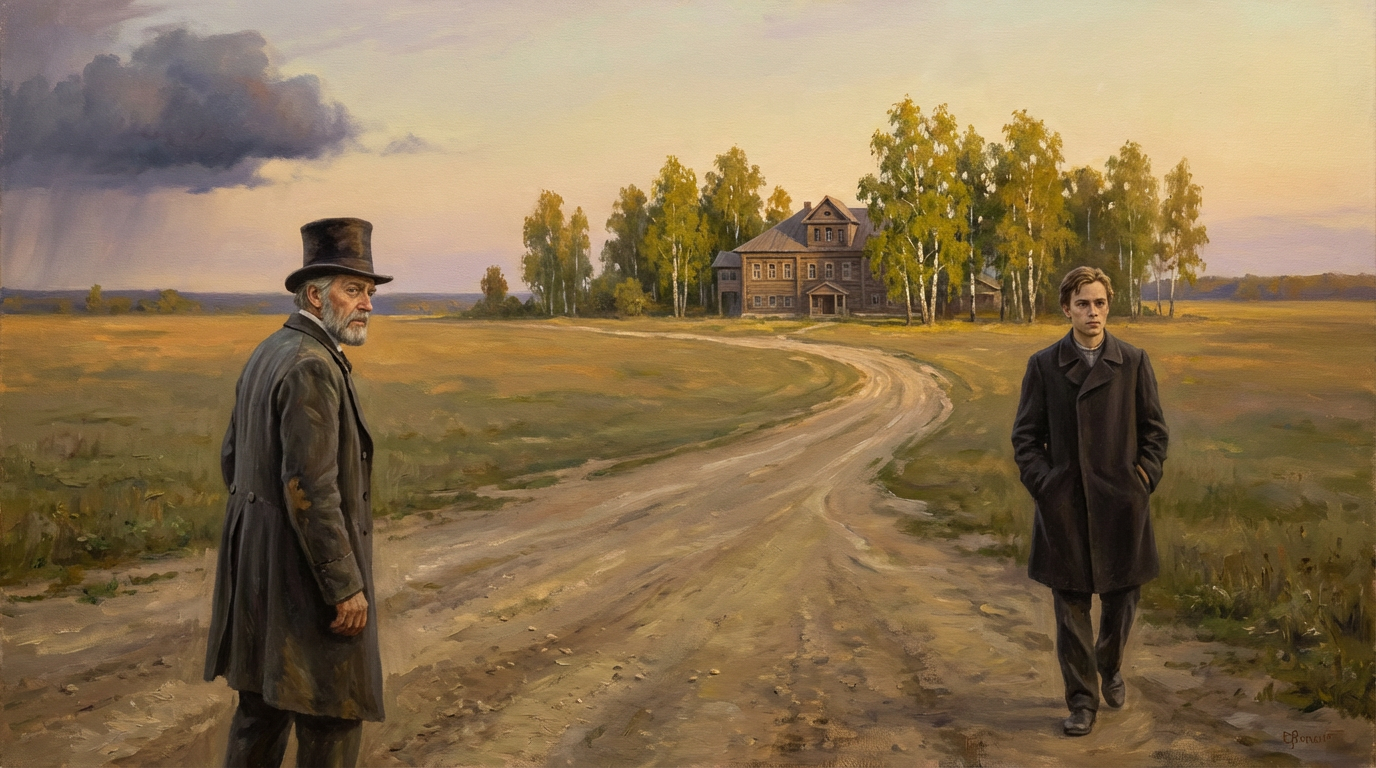
An excerpt from the original text.(complete · 6144 words)
hen, in the morning, Arkady rose and opened the window, the first
object to greet his eyes was Vasili Ivanitch. Clad in a smock-frock,
and belted with a handkerchief, the old man was busily digging in his
vegetable garden. As soon as he noticed his young guest, he leaned upon
his spade, and cried:
"Good morning! How have you slept?"
"Splendidly," replied Arkady.
"And I, as you see, am imitating Cincinnatus, and preparing a bed of
late turnips. By the mercy of God do the times compel every man to
win his bread with his own hands. At all times, indeed, is it useless
to rely upon others: it is best to work oneself. Thus Jean Jacques
Rousseau was right. Half an hour ago, however, you would have seen me
in a very different rôle--first of all, injecting opium into a woman
who had come to me with what the peasants call I the goad,' and we
dysentery, and then pulling out some teeth for a second woman. And,
would you believe it, when I proposed administering ether to the second
woman she would have none of it! These things I do gratis, you know,
and as an amateur. Yet, let that not surprise you, for, after all, I am
but a plebeian, but a homo novus. Come downstairs to sit in the shade
and enjoy the freshness of the morning until breakfast shall be ready."
Arkady did as invited.
"You confer a favour upon me," said Vasili Ivanitch, raising his hand
in military fashion to the battered skull-cap which adorned his head.
"You see, I know you to be used to luxury and ease. Yet even the folk
of the great world need not disdain to snatch a brief respite under the
roof of a cottage."
"I neither belong to the great world nor am used to luxury," protested
Arkady.
"Come now!" Vasili Ivanitch indulged in an amiable affectation of
incredulity. "I myself, though I am now on the shelf, have rubbed about
in my time, and can tell a bird by its flight. Also, I dabble a little
in physiognomy and psychology. For that matter, I will not hesitate
to say that, had I not enjoyed those advantages, I should long ago
have come to rack and ruin, for the reason that, being one of the small
fry, I should soon have been jostled out of the way by the crowd. Also,
without flattery, I may say that the friendship which I discern to
be existing between you and my son affords me the greatest pleasure.
Only this moment I was speaking to him; for (as probably you know) he
jumps out of bed at a very early hour, and goes careering all over the
countryside. M-might I make so bold as to ask you whether you have
known him long?"
"Only since last winter."
"Indeed? Also, might I make so bold as to ask whether--But sit you
down, will you not?--might I also, as his father, venture to ask your
frank opinion of him?"
"Your son is the most remarkable man that I have ever met," came the
enthusiastic reply.
Vasili Ivanitch's eyes closed suddenly, while his cheeks quivered, and
the spade slipped from his hand.
"Then you think?" he began.
"I do not think--I am certain that there lies before your son a
future which will make your name famous. I have felt certain of this
since the first moment I met him."
"Indeed? Indeed?" Vasili Ivanitch could scarcely articulate the words,
but on his capacious lips there had dawned, and become fixed, a smile
of triumph.
"Would you like to hear how our first meeting came about?"
"Indeed I should! And any other details you like."
Arkady therefore plunged into a discourse on Bazarov of the same ardour
and the same enthusiasm as he had displayed on the night of the mazurka
with Madame Odintsov. As Vasili Ivanitch listened, he blew his nose,
rolled his handkerchief into a ball, coughed, and ruffled his hair;
until, no longer able to contain himself, he reached over in Arkady's
direction, and pressed his lips to the young man's shoulder.
"You have indeed cheered my heart!" he exclaimed, still smiling. "I
simply idolise my son! But while my dear old wife is able to stand
on rather a different footing with Evgenii--she is his mother, you
know--I myself dare not express my whole feelings in his presence,
for the reason that he dislikes such things, and is opposed to any
manifestations of emotion. For the same reason some folk accuse him of
hardness of heart and pride and insensibility; but men like Evgenii
cannot be measured by ordinary standards, can they? For example, any
one but he would have gone on acting as a drag upon his parents; but,
would you believe it? never once since his birth has he asked us for a
kopeck more than he absolutely needed! There, by God!"
"Yes, your son is a sincere, single-minded man," agreed Arkady.
"Yes, single-minded," affirmed Vasili Ivanitch. "And not only do I
idolise him--I am proud of him, and have as my one conceit the hope
that some day there may stand in his biography the following words: 'He
was the son of a plain military doctor who, nevertheless, had the wit
to divine the merits of the subject of this book, and to spare no pains
in his education.'"
The old man's voice faltered for a moment, but presently resumed:
"What think you? Will the field of medicine bring him the fame which
you have foretold?"
"Not the field of medicine alone--though in it, as elsewhere, he will
become a leader."
"What field, then, Arkady Nikolaievitch?"
"I could not say. But in any case he will rise to fame."
"'He will rise to fame'!" The old man relapsed into a state of ecstatic
contemplation.
Presently Anfisushka arrived with a large plate of raspberries and the
message:
"Arina Vlasievna has sent me to say that breakfast is ready."
Vasili Ivanitch started from his reverie.
"Bring us also some nice cool plums," he said.
"I will, sir."
"Yes, mind that they are cool. Arkady Nikolaievitch, do not stand on
ceremony, but help yourself. Is Evgenii Vasilitch yet back, Anfisushka?"
"I am," called Bazarov from Arkady's room.
Vasili Ivanitch wheeled about.
"Aha!" he cried. "So you have gone to pay your friend a visit? But you
are too late, amice: he and I have been having a long conversation
together, and it is now breakfast time, and your mother is calling us.
By the way, Evgenii, a word or two with you."
"Concerning what?"
"Concerning a peasant who is suffering from jaundice."
"Jaundice?"
"Yes, of a very chronic and stubborn kind. I have prescribed scurvy
grass and St. John's wort, and ordered the man to eat carrots, and
given him a dose of soda; but such things are mere palliatives--I want
something of a more drastic nature. That you laugh at medicine I am,
of course, aware; but none the less I feel certain that you could give
me some good, practical advice. But that you can do later. At the
present moment, let us go in to breakfast."
And he leapt from the bench on which he had been seated, trolling gaily
the couplet:
"Let us take for our rule, for our rule let us take it,
To live but for pleasure, and never forsake it!"
"What high spirits!" Bazarov remarked as he retired from the window.
Later, when the noontide sun was glowing from behind a thin canopy of
dense, pale vapour, and all was still save that the chirping of a few
birds in the trees lulled the hearer to a curious, drowsy lethargy, and
the incessant call of a young hawk on a topmost bough made the air ring
with its strident note, Arkady and Bazarov made for themselves pillows
of sweet, dry, fragrant, crackling hay, and stretched themselves in the
shadow of a rick.
"Do you see that aspen tree?" remarked Bazarov. "I mean the one growing
at the edge of a depression, where a brick kiln used to stand? Well,
when I was a boy I used to believe that, together, the depression and
the aspen tree constituted a special talisman, in that, when near them,
I never found time hang heavy upon my hands. Of course, the explanation
is that in those days I failed to understand that that immunity from
ennui was due to the very fact of my being a boy. But, now that I am
grown up, the talisman seems to have lost its power."
"How long were you here in those days?"
"Only two years. After that we moved elsewhere. In fact, we led a
wandering life, and spent it mostly in towns."
"Is the house an old one?"
"It is. My maternal grandfather built it."
"Who was he?"
"The devil only knows! I think a major of some sort, a man who had
served under Suvorov,[1] and could tell all manner of tales about
crossing the Alps--though I daresay he told plenty of lies too."
"Ah! I noticed a portrait of Suvorov in the drawing-room.
Cheerful-looking old houses like this I simply love. Somehow they seem
to have a smell of their own."
"Yes--a smell of lamp-oil mingled with trefoil," agreed Bazarov with a
yawn. "But what flies they contain as well!"
There was a pause. Then Arkady resumed:
"Were you strictly kept when you were a boy?"
"You have seen for yourself what my parents are like. Surely they do
not seem very severe folk."
"And do you love them very much?"
"I do."
"Certainly they seem to love you."
Bazarov was silent. Presently, however, clasping his hands behind his
head, he asked:
"Do you know what is in my mind?"
"No. What?"
"I am thinking of the pleasant life that my parents must lead. To
think that at sixty my father can still fuss about, and talk of
'palliatives,' and doctor people, and do the bountiful to the peasants,
and, in short, enjoy himself, and that my mother has her days so
crammed full of occupations (including sighing and groaning) that she
does not know which to begin upon first! On the other hand, I----"
"Yes, you?"
"Am doing what you see--lying under a rick. The space occupied by my
body is small indeed compared with the surrounding immensity in which
it has neither part nor lot, and the portion of time allotted to me
here on earth is insignificant indeed compared with the eternity
which I have never known, and shall never enter! Yet in this same
atom, in this same mathematical point which I call my body, the blood
circulates, and the brain operates at will. A fine discrepancy for
you--a fine futility!"
"I would remark that what you have just said applies to every human
being in creation."
"True. What I mean is that my parents know not a single tedious
moment, nor are in the least distressed with the thought of their
insignificance--it is a thought which never stinks in their nostrils;
whereas I--well, I feel nothing but weariness and rancour in my
breast."
"Rancour? Why rancour?"
"How can you ask? Have you forgotten the recent past?"
"No: only, I do not recognise your right to be angry: unhappy,
perhaps, but not----"
"I perceive you to understand love as it is understood by all our
modern young men. That is to say, chirping 'Tsip, tsip, tsip!'
like pullets, you take to your heels as soon as ever you see love
approaching. I, however, am different.--But enough of this. What is
past help is best not talked about." Bazarov rolled over on to his
elbow. "Ah! Here is a young ant towing in its wake a half-dead fly.
Pull, brother, pull! Never mind that the fly hangs back, but avail
yourself of your animal right to abjure all sympathy, seeing that our
friend has only himself to thank for his trouble."
"Do not speak like that," expostulated Arkady. "How are you yourself to
thank for your trouble?"
Bazarov raised his head.
"Nay," he said, "I was but jesting. Never have I got myself into
trouble, and never shall any woman do it for me. Amen! I have spoken.
Never will you hear from me another word on the subject."
For a while the two friends lay without speaking.
"Yes," continued Bazarov, "man is a strange being. Contemplating from
a distance the dull life led by my parents, one would almost feel
inclined to say to oneself: 'What could be better than that, seeing
that in that existence one merely eats and drinks and knows oneself to
be acting in a sane and regular manner?' Yet a man will still become
depressed, and yearn for company, even though he may curse it when he
has got it."
"One ought so to order one's life that every moment in it shall be of
significance," said Arkady sententiously.
"Of course; but while the significant, and even the
pseudo-significant--yes, the absolutely insignificant as well--may be
bearable, it is trifles, trifles that matter."
"Unless a man recognise their existence, they do not exist."
"H'm! A contra-platitude."
"What is that?"
"This--that, should you say that education is useful, you will be
uttering a platitude; but, should you say that education is harmful,
you will be uttering a contra-platitude. The one is identical with the
other, except that they differ a little in elegance of expression."
"And which has right on its side?"
"'Which has right on its side?' I can only re-echo: 'Which?'"
"Come! You are out of spirits to-day."
"Am I? Then the sun must have touched me a little, or else I must have
eaten too many raspberries to be good for me."
"Then you would do well to have a sleep."
"I think you are right. Only, do not look at me while I sleep, for a
man cuts his very worst figure at such a time."
"Surely you do not care for people's opinion?"
"I do, even though a man in the best sense of the term ought never to
trouble his head about such things, seeing that such a man is either
above criticism or too feared and hated for critics to wish to tackle
him."
"Curious! For I myself never hate any one."
"And I hate a great many people. You, you see, are a tender soul,
you are so much pap, and therefore hatred could never come within
your purview. People as retiring, as devoid of self-confidence as you
are----"
"What about your own self-confidence?" interrupted Arkady. "What about
your own opinion of yourself?"
Bazarov paused--then replied:
"As we were passing the hut of your starosta to-day (what a neat,
pretty little place it looked!) you said to me: 'Not until every
peasant shall have come to own such a place as this, and every one of
us shall have contributed his mite to that end, will Russia attain
perfection.' But, for my part, I abominate the scurvy churl for whom
I am supposed to jump out of my skin, even though never a 'thank you'
should I get from him for doing so. For why should he thank me? His
métier happens to be living in a white hut, and mine to be----"
"Come, come, Evgenii! One is almost forced to agree with those who
accuse us of being unprincipled."
"You talk like your uncle. No such thing as principle exists. That
you seem never to have divined. Instincts only exist, and upon them
everything depends."
"How so?"
"Thus. We will take myself as an example. Owing to the nature of my
instincts, I am prone to deny--I am prone to deny because my brain
is so constituted. In the same way, if you were to ask me why I am
interested in chemistry, and why you like apples, I should reply that
the same reason holds good in each case--that our respective instincts
are what they are. In other words, there exists between your instincts
and mine a certain affinity. Deeper it is not given us to probe."
"Then is honour an instinct?"
"It is."
"Oh, Evgenii!" cried Arkady sorrowfully.
"Do you dislike the conversation? Then let us philosophise no more, but
'permit nature to waft upon us the silence of sleep,' to quote Pushkin."
"Pushkin never said any such thing," objected Arkady.
"Then, if he did not, he ought, being a poet, to have done so. Perhaps
he had served in the army?"
"Never did he serve in the army."
"Indeed? Why, in his every line we come across 'To battle, to battle,
for the honour of Russia!'"
"That is a mere invention on your part. The statement is an absolute
calumny."
"A calumny? What matters a calumny? What is there in the term to be
afraid of? Slander a man as much as you like, yet for himself he will
hear things twenty times worse."
"Suppose we sleep," said Arkady irritably.
"With pleasure," Bazarov replied.
Nevertheless neither succeeded in the effort, for almost every
sleep-destroying sentiment happened to be in the ascendant. So, after
five minutes of such ineffectual striving, both opened their eyes, and
lay mutely gazing about then.
"Look!" cried Arkady after a pause. "Do you see that withered maple
leaf fluttering to the ground? Are not its movements exactly like those
of a butterfly? Strange that an object so joyous and full of life
should be able so to counterfeit an object mournful and dead!"
"My friend," protested Bazarov, "let me make at least this request of
you: that you do not talk in 'beautiful language.'"
"I talk as I am able. I decline to be domineered over. Should a thought
chance to enter my head, why should I not express it?"
"Similarly am I at liberty to express the thought that to talk in
'beautiful language' is sheerly indecent."
"Indecent? Then swearing is not indecent?"
"Aha! I perceive you still to be minded to follow in your uncle's
footsteps. How the idiot would have rejoiced if he could have heard
you!"
"What did you call Paul Petrovitch?"
"I called him merely what he is--merely an idiot."
"Have done!" shouted Arkady.
"Therein I detect the tie of blood," said Bazarov calmly. "It is a
very stubborn factor, I have noticed, in some people. A man may abjure
everything else, and cut himself adrift from every other prejudice,
yet still remain powerless to confess that the brother who habitually
steals his shirts is a thief. You see, the difficulty lies in the word
'my.' Is not that so?"
"No. It was from a sense of justice, rather than from a sense of
kinship, that I spoke. But since you have no understanding of the
former, as an instinct which you simply do not possess, you are not in
a position to pass judgment upon such a feeling."
"In other words, 'I, Arkady Kirsanov, am altogether above your
comprehension,' Well, I make mute obeisance to that."
"Come, come, Evgenii! We shall end by quarrelling."
"Oh that you would do me the favour to quarrel! We could have a real
set-to à outrance, and with our coats off."
"To the end that----?"
"To the end that we might rend one another in pieces. Why not? Here,
amid the hay, in this idyllic setting, far from the madding crowd and
every human eye, it would be not at all a bad thing. No, you shall
not make it up with me! Rather will I seize you by the throat!"
As he extended his long, sharp fingers, Arkady rolled over and prepared
jestingly to grapple with his assailant. But the next moment the sight
of Bazarov's face, with its expression of malice and the non-jesting
menace which lurked in the twisted smile and the flashing eyes, gave
him a shock, and filled him with involuntary awe.
"This, then, is where you have got to!" cried Vasili Ivanitch from
behind them as, vested in a home-made cotton pea-jacket and a home-made
straw hat, the old military doctor suddenly confronted the pair. "I
have been searching for you everywhere, and certainly you have chosen
a capital spot, and are engaged also in a capital occupation--in the
occupation of lying on the earth and gazing at the heavens. For my
part, I believe that such an occupation can have its uses."
"I gaze at the heavens only when I am going to sneeze," said Bazarov.
Then, turning to Arkady, he added in an undertone: "Forgive me if I
hurt you."
"Do not mention it," was Arkady's rejoinder in a similar undertone, as
covertly he pressed his friend's hand.
Shocks of such a kind, however, were bound, in time, to react upon
their friendship.
"As I look at you, young gentlemen," Vasili Ivanitch continued as,
nodding his head, he rested his hands upon a crooked stick, his
own manufacture, which had a Turk's head for a handle, "I cannot
sufficiently admire you. What strength you embody! How you speak of
the flower of youth, of capacity, and of talent! You resemble Castor
and Pollux themselves."
"To think of your flaunting your mythology like that!" said Bazarov.
"At the same time, you must have been a fine Latin scholar in your day.
In fact, did not you once receive a silver medal for an essay?"
"The Dioscuri, the Dioscuri themselves!" continued the old man
ecstatically.
"Come, come, father! Do not play the fool,"
"Ah, well! No, I have not sought you out to pay you compliments: I have
come to inform the pair of you that dinner is nearly ready, and also to
give you, Evgenii, a warning. I know that, as a man of sense, as well
as a man well versed in the world, you will be charitable. The case
is this. This morning your mother took it into her head to organise a
thanksgiving ceremony on the occasion of your return.--No, do not think
that I am inviting you to the ceremony: on the contrary, it is over.
All that I am going to say is that Father Alexis----"
"The priest?"
"Yes, and our private confessor. Well, this Father Alexis is going
to dine with us, even though I had not expected it, and it was
not my suggestion, but merely an arrangement which has come about
somehow--probably through his having failed to understand me aright.
Not that we look upon him as anything but a man of rectitude and good
sense."
"Surely you do not mean to imply that he is likely to devour my portion
of the food, do you?"
Vasili Ivanitch burst out laughing.
"Ha, ha, ha!" he cried.
"I feel easy, then," continued Bazarov. "In fact, never do I mind with
whom I sit at table."
Vasili Ivanitch's face brightened at once.
"I felt sure of that in advance," he said. "Yes, I knew that you, a
young man, are as superior to prejudice as I am at sixty-two" (Vasili
had none the less shrunk from confessing that he had wished for the
thanksgiving ceremony as much as his wife had, since his piety was
fully equal to hers). "In any case Father Alexis would like to make
your acquaintance; while you, for your part, will very likely take to
him, seeing that he not only plays cards, but also (though this is
quite between ourselves) smokes a pipe!"
"Indeed? After dinner, then, we will have a game, and I will despoil
him utterly."
"Ha, ha, ha! We shall see, we shall see."
"Then at times you hark back to old days?" Bazarov asked with a tinge
of surprise.
Vasili Ivanitch's bronzed cheeks took on a faint flush.
"For shame, Evgenii!" he muttered. "Remember that the past is the past.
Nevertheless, even in this gentleman's presence I am ready to confess
that in my youth I had my addictions, and that, since, I have paid for
them. But how hot the weather is! Let me seat myself beside you; though
I hope that, in doing so, I shall not interrupt your conversation?"
"By no means," replied Arkady with alacrity.
Vasili Ivanitch subsided with a grunt and the remark:
"Your logement reminds me of my military bivouacking days--this rick
being a dressing-station." There followed a sigh. "Aye, many and many
an experience have I had in my time. For instance, let me tell you a
curious story about the black death in Bessarabia."
"When you received the order of St. Vladimir?" said Bazarov. "Yes, I
know the story. But why do you never wear the badge of the order?"
"As I have told you, I care not a jot for appearances," protested
Vasili Ivanitch (though only on the previous day had he had the red
riband of the order removed from his coat). He then embarked upon the
story.
"Evgenii has gone to sleep," presently he whispered to Arkady with a
good-humoured wink and a pointing finger. "Come, come, Evgenii!" he
added in a louder tone. "It is time to get up! Time for dinner!"
Father Alexis--a stout, good-looking man with thick, well-combed hair
and an embroidered girdle over a lilac cassock--proved a clever,
resourceful guest who, taking the initiative as regards shaking hands
with Arkady and Bazarov (somehow he seemed to divine that they did not
require his blessing), bore himself, in general, with complete absence
of restraint, and, while neither demeaning himself nor imposing general
constraint, made merry over scholastic Latin, defended his archbishop,
quaffed a couple of glasses of wine (refusing a third), and accepted
one of Arkady's cigars, though, instead of smoking it, he put it into
his pocket to take home with him. The only thing that was at all
unpleasant was the fact that every now and then, on raising a stealthy
hand to brush from his face a fly, he, in lieu of doing so, crushed the
insect flat!
Dinner over, he seated himself with modest zest at the card-table, and
ended by despoiling Bazarov of two-and-a-half roubles in paper money
(this rural establishment took no account of the system of computing
cash in silver). During the game the hostess sat beside her son with
her cheek resting on her hand as usual, and only rose from the table
when it became necessary to order further relays of refreshment. Yet
to caress Bazarov was more than she dared do; nor did he give her the
least encouragement in that direction; in addition to which Vasili
Ivanitch further restrained her ardour by whispering at intervals:
"Do not worry our Evgenii. Young men do not like that sort of thing."
Also, hardly need it be said that the dinner of which the company
had just partaken had been of the usual sumptuousness, seeing that at
break of day Timotheitch had set out for Circassian beef, and that
the starosta also had galloped in quest of trout, eels, and crabs,
while a sum of forty-two kopecks had been paid to peasant women for
mushrooms. Arina Vlasievna's eyes, fixed immovably upon Bazarov, had in
them something more than tenderness and affection. In them there were
also sadness, curiosity, a touch of apprehension, and a kind of painful
deference. Yet never did he mark their expression, since never did he
turn in her direction, save to put to her the curtest of questions,
and, once, to ask her to lay her hand in his, "for luck." On the latter
occasion she slipped her plump fingers into his hard, capacious palm,
waited a little, and then asked him:
"Has that helped you at all in your play?"
"It has not," he replied with a contemptuous grimace. "On the contrary,
things are even worse than they were before."
"Yes, the cards seem to be against you," remarked Father Alexis with an
assumed air of sympathy as he stroked his handsome beard.
"But beware of the Code Napoleon, my father," observed Vasili Ivanitch
as he played an ace. "Beware of the Code Napoleon."
"Which, in the end, brought Napoleon to St. Helena," retorted the
father as he trumped the ace.
"A glass of currant wine, Eniushka dear?" asked Arina Vlasievna.
Bazarov replied with a shrug of his shoulders.
Next day he said to Arkady:
"To-morrow I must depart. The place wearies me, for I wish to work, and
it is impossible to do so here. I will come to your place, I think,
for all my chemical preparations are there. Moreover, one can at least
lock one's door at your place; whereas here, though my father keeps
saying, 'My study is entirely at your disposal, and no one shall
disturb you,' he himself is never absent for a moment. And, for that
matter, I should be ashamed to lock him outside, or my mother either.
Sometimes I can hear her groaning in the next room. Yet no sooner do I
go out to her than I find that I have not a word to say."
"She will be much distressed at your departure," said Arkady. "And so
will he."
"But I intend to return."
"Exactly when?"
"When I am on my way back to St. Petersburg."
"I am particularly sorry for your mother."
"Why so? Has she been stuffing you with fruit?" Arkady lowered his eyes.
"You do not know her," he said. "She is not only a good woman, but also
a very wise one. This morning I had half an hour's very practical and
interesting talk with her."
"A talk in which she told you all about me?"
"We spoke of other topics besides yourself."
"Possibly. Possibly, too, you, as an outsider, may see things clearer
than I do. Yet when a woman can talk for half an hour it is a good
sign, and I will depart as I have said."
"But you will not find it easy to break the news to her, for her plans
for us extend over a couple of weeks."
"No, it may not prove easy, as you say; and the less so since the devil
led me to vex my father this morning. It was like this. A few days ago
he had one of his serfs flogged, and therein did rightly. No, you need
not look at me with such indignation. I say my father did rightly for
the reason that the peasant in question had proved himself to be an
arrant thief and drunkard. Unfortunately, my father had not expected
me to get to hear of the occurrence; wherefore he was the more put
out when he found that I had done so. Well, now his vexation will be
twofold! However, no matter. He will get over it before long."
Yet, though Bazarov had said "No matter," he let the whole of the rest
of the day elapse before he could make up his mind to acquaint Vasili
Ivanitch with his intention. Finally, just as he was saying good-night
to his father in the study, he observed with a prolonged yawn:
"By the way, I had almost forgotten to request you to have our horses
sent forward to Thedot's."
Vasili Ivanitch looked thunderstruck.
"Then is Monsieur Kirsanov leaving us?" he inquired.
"Yes, and I am going with him."
Vasili Ivanitch fidgeted for a moment or two.
"You say that you are going with him?" he murmured.
"Yes. I must go. So pray have the horses sent forward as requested."
"I--I will, I will," the old man stuttered. "So they are to go to
Thedot's? Yes, yes, very well. Only, only--is there any particular
reason for this change of plan?"
"There is. I am engaged to pay Arkady a short visit. That done, I will
return to you."
"Only to be a short visit? Good!" And Vasili Ivanitch pulled out his
pocket-handkerchief, and blew his nose. In doing so, he bent his head
very low--almost to the ground. "Well, well! Things shall be as you
desire. Yet we had hoped that you would have stayed with us a little
longer. Three days only! Three days after three years of absence! Ah,
that is not much, Evgenii--it is not much!"
"But I tell you I intend to return soon. You see, I must go."
"You have no choice, eh? Very well, very well. Of course, engagements
must be kept. Yes, yes; of course they must be kept. And I am to
send the horses forward? Very good. Naturally, Arina and I had not
altogether looked for this. Only to-day she has been to a neighbour to
beg flowers for your room."
Nor of the fact that, each morning, he had gone downstairs in his
slippers to confer with Timotheitch; nor of the fact that, producing,
with tremulous fingers, one ragged banknote after another, he had
commissioned his henchman to make various purchases with special
reference to the question of eatables (in particular, of a certain red
wine which he had noticed the young men to like); no, of none of these
facts did Vasili Ivanitch make any mention.
"The greatest thing in the world is one's freedom," he went on. "I,
too, make it my rule. Never should one let oneself be hampered or----"
A sudden break occurred in his voice, and he made for the door.
"I promise you that we will return soon, my father. I give you my word
of honour upon that."
But Vasili Ivanitch did not look round--he just waved his hand and
departed. Mounting to the bedroom, he found Arina asleep, so started to
say his prayers in an undertone, for fear of awaking her. But at once
she opened her eyes.
"In that you, Vasili Ivanitch?" she asked.
"Yes, mother."
"Have you just left Eniusha? Do you know, I am anxious about him. Does
he sleep comfortably on the sofa? To-day I told Anfisushka to lay him
out your travelling mattress and the new pillows. Also, I would have
given him our feather bed had he not disliked soft lying."
"Do not fret, mother dear. He is quite comfortable. 'Lord, pardon us
sinners!'" And Vasili Ivanitch went on with his prayers. Yet his heart
was full of an aching compassion for his old companion; nor did he
want to tell her overnight of the sorrow which was awaiting her on the
morrow.
Next day, therefore, Arkady and Bazarov departed. From earliest morn an
air of woe pervaded the household. Anfisushka let fall some crockery,
and Thedika's perturbation ended in his taking off his shoes. As for
Vasili Ivanitch, he fussed about, and made a brave show--he talked in
loud tones, and stamped his feet upon the floor as he walked; but his
face had suddenly fallen in, and his glance could not meet that of
his son. Meanwhile Arina Vlasievna indulged in quiet weeping. Indeed,
but for the fact that her husband had spent two hours that morning in
comforting her, she would have broken down completely, and lost all
self-control.
But at last, when, after reiterated promises to return within, at most,
a month, Bazarov had freed himself from the arms which sought to detain
him, and entered the tarantass; when the horses had started, and
their collar-bow had begun to tinkle, and the wheels to revolve; when
to gaze after the vehicle any longer had become useless, and the dust
had subsided, and Timotheitch, bent and tottering, had crawled back
into his pantry; when the old couple found themselves alone in a house
which seemed suddenly to have grown as dishevelled and as decrepit as
they--then, ah, then did Vasili Ivanitch desist from his brief show of
waving his handkerchief in the verandah, and sink into a chair, and
drop his head upon his breast.
"He has gone for ever, he has gone for ever," he muttered. "He has gone
because he found the life here tedious, and once more I am as lonely as
the sand of the desert!"
These words he kept repeating again and again; and, each time that he
did so, he raised his hand, and pointed into the distance.
But presently Arina Vlasievna approached him, and, pressing her grey
head to his, said:
"Never mind, my Vasia. True, our son has broken away from us; he is
like a falcon--he has flown hither, he has flown thither, as he willed:
but you and I, like lichen in a hollow tree, are still side by side, we
are not parted.... And ever I shall be the same to you, as you will be
the same to me."
Taking his hands from his face, Vasili Ivanitch embraced his old
comrade, his wife, as never--no, not even during the days of his
courtship--he had done before. And thus she comforted him.
[1] Alexander Vasilievitch Suvorov (1729-1800), the great Russian
general who, after defeating Napoleon in Italy, crossed the Alps to
join hands with Korsakov, but found the latter to have been routed by
Massena.
Master this chapter. Complete your experience
Purchase the complete book to access all chapters and support classic literature
As an Amazon Associate, we earn a small commission from qualifying purchases at no additional cost to you.
Available in paperback, hardcover, and e-book formats
Let's Analyse the Pattern
True love often requires letting go of what we most want to hold onto, choosing the other person's needs over our own emotional comfort.
Why This Matters
Connect literature to life
This chapter teaches how to recognize when someone is holding back their true feelings to protect a relationship.
Practice This Today
This week, notice when someone accepts your decision too easily—their restraint might be protecting you from their disappointment.
Now let's explore the literary elements.
Key Quotes & Analysis
"By the mercy of God do the times compel every man to win his bread with his own hands. At all times, indeed, is it useless to rely upon others: it is best to work oneself."
Context: While working in his garden and explaining his morning routine to Arkady
Vasili finds dignity in manual labor and self-reliance, trying to connect with his son's generation through shared values of independence. His reference to God shows how he blends traditional faith with modern self-sufficiency. This reveals his attempt to bridge old and new worldviews.
In Today's Words:
These days everyone has to hustle for themselves - you can't count on anyone else to take care of you, so you might as well work hard and be proud of it.
"We are like lichen in the hollow of a tree - we sit side by side and hold our peace."
Context: Describing her relationship with her husband and their approach to loving their son
This beautiful metaphor captures patient, enduring love that survives by adapting rather than demanding. Arina understands that true love sometimes means accepting silence and distance. Her wisdom comes from emotional intelligence rather than formal education.
In Today's Words:
We just stick together and don't make a fuss - sometimes love means being quietly there for someone without expecting much back.
"You and I belong to different generations; our gods are not the same."
Context: During his philosophical debate with Arkady about values and beliefs
Bazarov acknowledges the fundamental divide between his nihilistic worldview and traditional values. His use of 'gods' shows he understands this goes deeper than politics - it's about core beliefs and meaning. This explains why he can't connect with his parents despite their love.
In Today's Words:
We just see the world completely differently - what matters to you doesn't matter to me, and we'll never really understand each other.
Thematic Threads
Parental Love
In This Chapter
Vasili's desperate desire for connection with Bazarov, balanced against his wisdom to let his son leave without guilt
Development
Deepened from earlier glimpses of his devotion to show the full complexity of parental sacrifice
In Your Life:
You might see this when your grown children make choices you disagree with but you bite your tongue to preserve the relationship
Generational Divide
In This Chapter
Bazarov's inability to appreciate his parents' simple devotion, seeing it as weakness rather than strength
Development
Evolved from intellectual disagreements to emotional disconnection showing the full cost of nihilistic worldview
In Your Life:
You might see this in conflicts between your values and those of younger family members or coworkers
Dignity in Loss
In This Chapter
How Vasili and Arina maintain composure while their hearts break, refusing to burden Bazarov with their pain
Development
Introduced here as a masterclass in emotional maturity under devastating circumstances
In Your Life:
You might see this when you have to stay professional during layoffs or family crises
Friendship Under Strain
In This Chapter
Arkady and Bazarov's philosophical debate revealing how different values can fracture even close relationships
Development
Continued from earlier tensions, now showing the friendship may not survive their diverging paths
In Your Life:
You might see this when political differences or life changes create distance with old friends
Recognition and Validation
In This Chapter
Vasili seeking confirmation from Arkady that his son is truly remarkable, needing external validation of what he already knows
Development
Introduced here as a universal parental need to have others see their child's worth
In Your Life:
You might see this when you fish for compliments about your work or family from colleagues or friends
You now have the context. Time to form your own thoughts.
Discussion Questions
- 1
What does Vasili Ivanitch's behavior in the garden and his praise of Bazarov to Arkady reveal about what he really wants from his son?
analysis • surface - 2
Why does Vasili choose not to guilt-trip or argue when Bazarov announces he's leaving, even though it clearly breaks his heart?
analysis • medium - 3
Where have you seen this pattern of 'graceful release' in your own relationships - times when someone let you go even though they wanted you to stay?
application • medium - 4
Think of a relationship where you've felt someone pulling away. How might applying Vasili's approach change the outcome compared to trying to hold on tighter?
application • deep - 5
What does Arina's wisdom about being 'like lichen in a hollow tree' teach us about the difference between love that endures and love that demands?
reflection • deep
Critical Thinking Exercise
Practice the Graceful Release
Think of someone in your life who seems to be pulling away or creating distance. Write two responses: first, what your emotional impulse wants you to say or do. Then, rewrite it using Vasili's approach - expressing your feelings without making them responsible for managing those feelings, and showing support for their choices even when they hurt you.
Consider:
- •Notice the difference in tone between demanding connection and offering it freely
- •Consider how each approach might affect the other person's willingness to stay close
- •Pay attention to which response feels more mature, even if it's harder to execute
Journaling Prompt
Write about a time when someone gave you space when you needed it, even though it probably hurt them. How did their graceful release affect your feelings toward them and your relationship long-term?
Coming Up Next...
Chapter 22: The Weight of Unspoken Feelings
The journey to Thedot's posting-house becomes a silent reckoning between the two friends. Arkady's disappointment with Bazarov's treatment of his parents creates new tension, while Bazarov grapples with his own conflicted feelings about family and belonging.



