
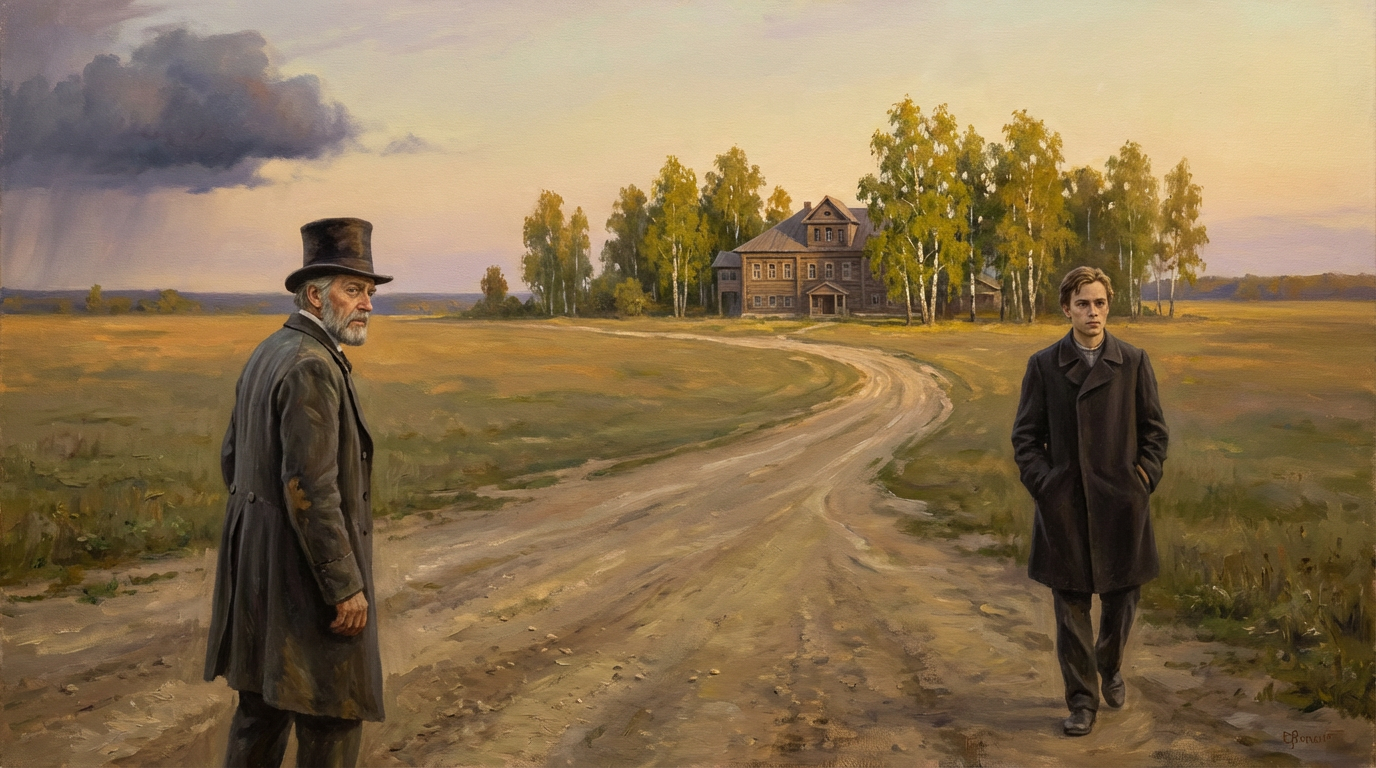
An excerpt from the original text.(complete · 2191 words)
silence, or merely exchanging a few unimportant words, the
travellers made their way to Thedot's posting-house. Arkady felt
anything but pleased with Bazarov, and Bazarov felt anything but
pleased with himself. Moreover, the younger man's heart was heavy with
the sort of unreasoning depression which is known only to youth.
The driver hitched his horses, and then, mounting to the box, inquired
whether he was to drive to the right or to the left.
Arkady started. The road to the right led to the town, and thence to
his father's house; while the road to the left led to Madame Odintsov's
establishment.
He glanced at Bazarov.
"To the left, Evgenii?" he queried.
Bazarov turned away his head.
"Why that folly again?" he muttered.
"Folly, I know," said Arkady, "but what does that matter? We need but
call in passing."
Bazarov pulled his cap over his eyes.
"Do as you like," he said.
"To the left, then," cried Arkady to the coachman; and the tarantass
started in the direction of Nikolsköe. Nevertheless, for all that the
friends had decided upon this foolish course, they remained as silent
and downcast as ever.
Indeed, Madame Odintsov's butler had not even made his appearance
upon the verandah before the pair divined that they had done unwisely
to yield to such an impulse. The fact that no one in the house had
expected them was emphasised by the circumstance that when Madame
entered the drawing-room they had already spent a considerable time
there in awkward silence. However, she accorded them her usual suave
welcome, though she seemed a little surprised at their speedy return,
and, at heart, not over-pleased at it. For this reason they hastened
to explain that theirs was a mere passing call, and that in about four
hours they would be continuing their journey to the town. In reply she
said nothing beyond that she requested Arkady to convey her greetings
to his father, and then sent for her aunt; and inasmuch as the Princess
entered in a state of having just overslept herself, her wrinkled old
face betokened even greater malignity than usual. Katia was not well,
and did not leave her room at all: and this caused Arkady suddenly to
realise that he would have been as glad to see her as Anna Sergievna.
The four hours were filled with a desultory conversation which Anna
Sergievna carried on without a single smile: nor until the very moment
of parting did her usual friendliness seem to stir within her soul.
"I am out of humour to-day," she said, "but that you must not mind.
Come again soon. I address the invitation to you both."
Bazarov and Arkady responded with silent bows, re-entered the
tarantass, and drove forward to Marino, whither they arrived, without
incident, on the following evening. En route, neither of the pair
mentioned Madame Odintsov, and Barazov in particular scarcely opened
his mouth, but gazed towards the horizon with a hard look in his eyes.
But at Marino every one was delighted to see them, for Nikolai
Petrovitch had begun to feel uneasy at the prolonged absence of his
son, and now leapt from the sofa with a cry of joy when Thenichka ran
to announce that "the young gentlemen" were arriving. Yes, even Paul
Petrovitch felt conscious of a touch of pleasant excitement, and smiled
indulgently as he shook hands with the wanderers. Ensued then much
talking and questioning, in which Arkady took the leading part, and
more especially during supper, which lasted far into the night, since
Nikolai Petrovitch ordered up several bottles of porter which had
just arrived from Moscow, and made so merry that his cheeks assumed a
raspberry tint, and he fell to venting half-boyish, half-hysterical
laughs. Moreover, the general enlivenment extended even to the kitchen,
where Duniasha kept breathlessly banging doors, and at three o'clock
in the morning Peter essayed to execute on the guitar a Cossack waltz
which would have sounded sweet and plaintive amid the stillness of the
night had not the performance broken down after the opening cadenza,
owing to the fact that nature had denied the cultured underling a
talent either for music or for anything else.
Indeed, of late, life at Marino had been far from comfortable. In
particular had poor Nikolai Petrovitch been in a bad way, for his
troubles in connection with the estate--troubles of an exclusively
futile and hopeless order--were growing greater from day to day. The
worst of them came of the system of hired labour, which enabled some
of the workmen to keep demanding either their discharge or an increase
of wages, and others to depart as soon as ever they had received their
earnest-money. Also, some of the horses had fallen sick, certain
implements had been burnt, all hands were performing their tasks in a
slovenly manner, a milling machine ordered from Moscow had turned out
to be useless owing to its weight, a second such machine had broken
down on its first being used, half the cattle sheds had disappeared
in a conflagration caused by a blind old serf woman "smoking" her cow
with a firestick during blustery weather (though she herself asserted
that the trouble had come of the barin's manufacturing new-fangled
cheeses and lacteal products in general), and, lastly, the steward
had grown so fat and lazy (as do all Russians who fall upon "easy
times"), and permitted his dislike of Nikolai Petrovitch so to limit
his activities, that he had come to doing no more than bestowing an
occasional prod upon a passing pig, or threatening some half-naked
serf boy, while spending the rest of the time in bed. Again, such of
the peasants as had received allotments under the obrok system had
failed to pay their dues, as well as applied themselves to stealing
timber to such an extent that, almost every night, the watchman had to
apprehend a culprit or two, as well as to impound horses which peasants
had turned out to graze in the meadows attached to the manor. For
illicit grazing of this sort Nikolai Petrovitch had decreed forfeiture
of the horses; but usually the matter ended in the animals being kept
for a day or two at the barin's expense, and then restored to their
owners. Lastly, the peasants had taken to quarrelling among themselves,
through brothers conceiving the idea of demanding a share of each
other's earnings, and through their wives suddenly finding themselves
unable to get on in the same hut; wherefore feuds had arisen which
had caused whole households to spring to their feet as at a word of
command, and to flock to the portico of the estate office, where,
breaking in upon the barin's privacy (very often with bruised faces
and drunken gait), they demanded justice and an immediate settlement,
while female sobs and whimperings mingled with the curses of the male
portion of the throng. Whenever this had happened Nikolai Petrovitch
had had to part the hostile factions from one another, and to shout
himself hoarse, even though he had known in advance that no equitable
decision was feasible. Finally, there had been a deficiency of hands
for the harvest, since a neighbouring odnovorzty[1] of benign aspect
who had undertaken taken to provide harvesters at two roubles per
desiatin had cheated without compunction, and supplied women workers
who also demanded extortionate wages. Meanwhile the grain had rotted
in the fields, and, later on, the women had not got through the mowing
before the Board of Overseers had begun to press for immediate payment
of percentage dues and arrears.
"I can do nothing," would be Nikolai Petrovitch's despairing
exclamation "My principles forbid me either to contend with these
people or to send for the stanovoi[2] yet, without the power to
threaten punishment, one can make no headway with such folk."
"Du calme, du calme," Paul Petrovitch would advise. Then he would
growl, frown, and twist his moustache.
From these brawls Bazarov kept entirely aloof: nor, as a guest, was
he called upon to interfere in them, but was free, from the day of
his arrival, to apply himself solely to his frogs, infusoria, and
chemical compositions. On the other hand, Arkady considered himself
bound, if not to help his father, at all events to offer to help him;
wherefore he listened to Nikolai's complaints with patience, and on
one occasion even tendered him advice (though not advice meant to
be taken, but advice designed to manifest the interest felt by him,
Arkady, in current affairs). As a matter of fact, estate-management
was not wholly distasteful to him, and he could find pleasure in
thinking out agricultural problems; but his mind was filled with other
preoccupations. For one thing, he discovered to his surprise that his
thoughts were constantly turning in the direction of Nikolsköe; and
though there had been a time when he would have shrugged his shoulders
upon being told that he would ever come to find residence under the
same roof as Bazarov--least of all, when that roof was his father's--a
dull affair, he found time hang heavy on his hands, and his attention
easily stray elsewhere. So he tried the expedient of walking until
thoroughly worn out, but even this did not help him; until eventually
he learnt, in conversation with his father, that recently some letters
of great interest had been chanced upon--letters which Arkady's mother
had indited to the mother of Madame Odintsov. And from that moment
onwards he never rested until he had induced Nikolai Petrovitch to
re-discover the said letters, and to turn out, during the search, a
score of boxes and drawers. Then only, when the half-mouldy documents
had been dragged to light, did the young man feel easier in his soul,
and bear himself as though now he saw before him the goal of his
existence.
"'I address the invitation to both of you,'" he kept whispering to
himself. "Yes, that is what she said. Damn it, I will go."
But next there would recur to his memory the recent visit and its cold
reception; until once more he would be seized with his old timidity
and awkwardness. In the end, however, the spirit of adventurous youth,
aided by a secret desire to try his luck, to test his strength unaided,
and without a protector, contrived to win the day.
Ten days later, therefore, he invented a pretext, in the shape of a
desire to study the working of Sunday schools, to drive to the town,
and thence to Nikolsköe. As he drove, the manner in which he encouraged
his postilion communicated to his progress the character, rather,
of a young officer's trip to fight his first duel, for diffidence,
impatience, and delight were well-nigh choking him.
"Above all things," he kept reflecting, "I must not think too much of
myself." And though the postilion who had fallen to his lot was of the
type of rascal who pulls up at every tavern door, there hove in sight,
before long, the familiar, high-pitched roof of the mansion.
"But what am I doing?" now occurred to him the thought. "Indeed, would
it not be better to go back?"
Unfortunately, to the sound of the postilion's whistlings and
tongue-clickings the troika of horses trotted bravely forward, and
presently the bridge thundered under the combined weight of the hooves
and wheels. Ah, there was the avenue of clipped firs! Yes, and
there was a glimpse of a pink dress amid some dark foliage! Yes, and
there a glimpse of a young face peering from the shade of a silken
parasol! Yes, yes--it was Katia! He had recognised her in an instant,
as she him! Bidding the postilion pull up, Arkady leapt from the
carriage, and approached the maiden.
"So it is you?" she exclaimed. And at the same moment a blush
overspread her face. "Let us go and look for my sister. She is in the
garden, and will be delighted to see you."
So she conducted him thither. How lucky that he had met her as he had
done! More pleased he could not have felt if she had been his own
sister. Yes, things were indeed fortunate! Now there would have to be
no butler, and no formal announcement of his arrival.
Of Anna Sergievna he caught sight at a turn in the path. She had
her back to him, but presently, on hearing the sound of approaching
footsteps, faced about.
Once more confusion seized Arkady in its grip. Yet no sooner had she
spoken than he felt his courage return.
"How do you do?" she said in her even, kindly way as she advanced to
meet him with a smile that was slightly tempered with the sun and wind.
"Where did you find him, Katia?"
"I have brought with me something which you are unlikely to have been
expecting," he said. "For I----"
"But you have brought me yourself," she rejoined. "And that is the best
bringing of all."
[1] A freeholder, a member of the class which, in the days of this
story, stood midway between the pomiestchik, or landowner, and the
Krestianin, or serf.
[2] Magistrate.
Master this chapter. Complete your experience
Purchase the complete book to access all chapters and support classic literature
As an Amazon Associate, we earn a small commission from qualifying purchases at no additional cost to you.
Available in paperback, hardcover, and e-book formats
Let's Analyse the Pattern
Using others as emotional protection actually prevents the authentic connections we're seeking.
Why This Matters
Connect literature to life
This chapter teaches how to recognize when group safety nets actually sabotage authentic connection.
Practice This Today
This week, notice when you use others as emotional buffers—try making one important conversation happen one-on-one instead.
Now let's explore the literary elements.
Key Quotes & Analysis
"Why that folly again?"
Context: When Arkady suggests visiting Anna's estate on their way home
Bazarov recognizes they're about to make an emotional mistake but can't bring himself to firmly refuse. His question reveals he's as conflicted as Arkady but trying to maintain his rational facade.
In Today's Words:
Why are we doing this dumb thing again?
"Folly, I know, but what does that matter?"
Context: Responding to Bazarov's objection about visiting Anna
Arkady admits he knows the visit is a bad idea but chooses emotion over logic. This shows his growing independence from Bazarov's influence and willingness to follow his heart despite consequences.
In Today's Words:
I know it's stupid, but I don't care.
"You have brought me yourself, and that is the best bringing of all"
Context: Welcoming Arkady when he visits alone
Anna's warm reception of his solo visit contrasts sharply with the awkwardness of the group visit. She values authentic individual connection over social obligations or group dynamics.
In Today's Words:
I'm glad you came by yourself - that's what I really wanted.
"The younger man's heart was heavy with the sort of unreasoning depression which is known only to youth"
Context: Describing Arkady's emotional state during the journey
Turgenev captures that specific type of young adult angst - intense feelings without clear cause or solution. This validates the emotional turbulence of figuring out who you are and what you want.
In Today's Words:
He had that heavy feeling you get in your twenties when everything feels wrong but you can't explain why.
Thematic Threads
Vulnerability
In This Chapter
Arkady's terror about visiting Anna alone transforms into genuine connection when he finally takes the risk
Development
Evolved from earlier chapters where characters hide behind social roles and expectations
In Your Life:
You might recognize this when you avoid difficult conversations by bringing allies, then wonder why nothing gets resolved.
Authenticity
In This Chapter
The group visit feels forced and awkward, while Arkady's solo visit allows for real warmth and connection
Development
Building on previous themes about performance versus genuine self-expression
In Your Life:
You might see this in how differently you act one-on-one versus in groups, even with the same people.
Personal Growth
In This Chapter
Arkady finally acts independently, making his own choice despite Bazarov's likely disapproval
Development
Marks a turning point from his earlier dependence on Bazarov's approval
In Your Life:
You might recognize this when you realize you've been seeking permission for decisions that are ultimately yours alone.
Class
In This Chapter
The family letters reveal historical connections between estates, showing how relationships transcend immediate social barriers
Development
Continues exploring how personal connections can bridge social divisions
In Your Life:
You might see this when you discover unexpected common ground with someone you assumed was 'different' from you.
Isolation
In This Chapter
Nikolai's joy at his son's return highlights how leadership and responsibility can create profound loneliness
Development
Introduced here as a counterpoint to the connection themes
In Your Life:
You might recognize this if you've ever felt most alone when surrounded by people who need things from you.
You now have the context. Time to form your own thoughts.
Discussion Questions
- 1
Why does the joint visit to Anna's estate feel so awkward, while Arkady's solo visit goes smoothly?
analysis • surface - 2
What role does Bazarov's presence play in sabotaging Arkady's ability to connect authentically with Anna?
analysis • medium - 3
Think about your own relationships - when have you used friends or family as 'emotional shields' to avoid direct, vulnerable conversations?
application • medium - 4
Arkady feels like 'a young soldier heading to his first duel' when traveling alone to see Anna. When has taking a solo risk felt terrifying but turned out to be exactly what you needed to do?
application • deep - 5
What does this chapter reveal about the difference between authentic connection and performing for an audience?
reflection • deep
Critical Thinking Exercise
Map Your Emotional Shield Patterns
Think of a current situation where you're avoiding a direct conversation or action. Write down who you typically bring along (physically or emotionally) as backup. Then imagine having that conversation or taking that action completely alone. What specifically scares you about the solo approach? What might you gain?
Consider:
- •Notice the difference between legitimate need for support versus fear of authentic vulnerability
- •Consider how group dynamics might be preventing the very connection you're seeking
- •Think about small, low-stakes ways you could practice taking solo risks
Journaling Prompt
Write about a time when you finally did something alone that you'd been avoiding. What did you discover about yourself or the situation that surprised you?
Coming Up Next...
Chapter 23: The Garden Encounter
With Arkady gone on his solo mission, Bazarov throws himself into his work with newfound intensity. But his isolation at Marino, combined with the changed dynamics between all the characters, sets the stage for deeper revelations about what each man truly wants from life.



