
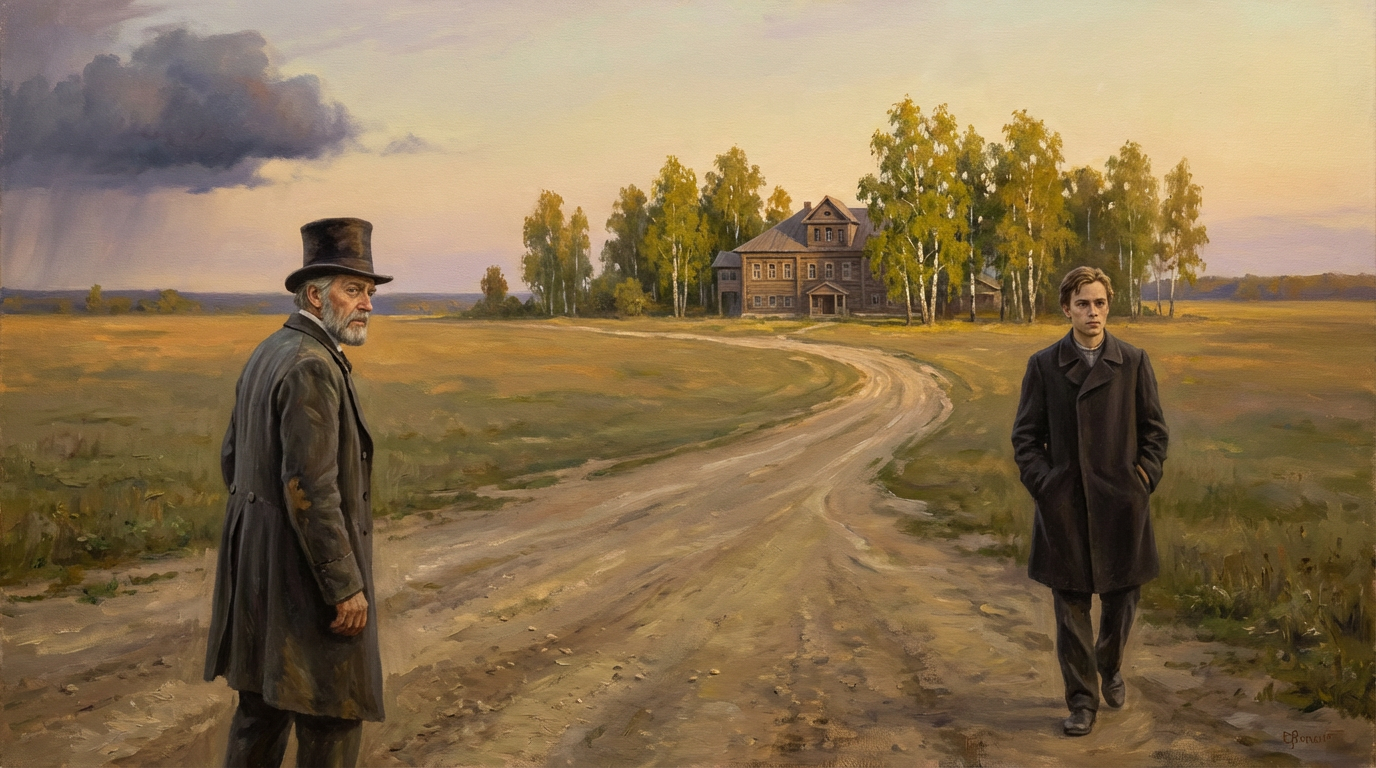
An excerpt from the original text.(complete · 2537 words)
fter speeding Arkady on his way with satirical expressions of regret
(as well as giving him to understand that the satirist laboured under
no delusions as to the object of the young man's journey), Bazarov
withdrew into complete seclusion, since a perfect fever for work had
come upon him. Nor did he quarrel any longer with Paul Petrovitch,
and the less so since the latter had now come to adopt an exclusively
aristocratic attitude, and to express his sentiments only in
monosyllables, not in words. Once, and once only, did he allow himself
to engage in a controversy with Bazarov over the then current question
of the rights of the dvoriané. But suddenly he checked himself, and
said with an air of cold politeness:
"It is clear that we shall never understand one another. At all events
I have not the honour to understand you."
"True," agreed Bazarov. "For a man may understand the precipitation
of ether, and be au fait with what is taking place in the sun, yet,
confront him with the fact that another man blows his nose differently
from the manner in which he blows his own, and at once that man will
become lost in perplexity."
At the same time, there were occasions when Paul Petrovitch requested
permission to attend the other's experiments; and once he went so far
as to apply his perfumed, clean-shaven features to the microscope, for
the purpose of observing how a transparent infusorium could swallow a
greenish-looking particle, and then masticate the same with fang-like
protuberances which grew in its throat. Still more frequently was
Nikolai Petrovitch present in Bazarov's room. Indeed, but for the
counter-distraction of estate-management, he would have spent his whole
time in the process of what he called "self-improvement." Yet he never
hampered the young naturalist: on the contrary, he would seat himself
in a remote corner of the room, and, but for a guarded question or
two, confine himself solely to silently and absorbedly watching the
experiments. Also, at meal times he always endeavoured to turn the
conversation in the direction of physics or geology or chemistry, for
the reason that he divined in any other direction (that of industry,
or, still more, that of politics) there lay a greater danger of
collisions, or, at all events, of mutual soreness. For rightly did
he divine that his brother's enmity towards Bazarov had by no means
abated. And to this conclusion an incident which occurred at a juncture
when cholera had just made its appearance in the neighbourhood, and
carried off two victims from Marino itself, lent additional colour.
One night Paul Petrovitch happened to be seized with a fainting fit,
yet refused to apply to Bazarov for assistance; and when Bazarov, on
meeting him on the following day, inquired why such a course had not
been adopted, Paul Petrovitch--still pale, but as carefully brushed and
combed as ever--retorted: "Did not you yourself tell me that you have
no belief in medicine?"
Thus day followed day. Yet, though Bazarov devoted himself wholly to
work, there was one person in the house whom he did not hold at arm's
length, but was always willing to talk to. That person was Thenichka.
Mostly he encountered her in the early mornings, when she was walking
in the garden or the courtyard; but never did he enter her room, nor
did she ever come to his door, save once, for the purpose of asking
him to help her with Mitia's bath. And she not only trusted Bazarov;
she also held him in no awe, and allowed herself more freedom in
his presence than she did in that of Nikolai Petrovitch himself.
The reason is difficult to determine. Perhaps it was the fact that
unconsciously she detected in Bazarov none of the dvorianin element,
none of that superiority which at once attracts and repels; the young
Nihilist, to her, was just a clever doctor, and no more. At all events,
she was so free from shyness in his presence that she would dandle her
child unabashed, and, on one occasion, when seized with a headache,
went so far as to accept at his hands a spoonful of medicine. True,
in Nikolai Petrovitch's presence she seemed to shun Bazarov; but this
was done more out of a sense of decorum than through subtlety. As for
Paul Petrovitch, she feared him as much as ever, for he had taken to
watching her with a keen, steady eye, and to making his appearance
behind her as though his figure, clad in its inevitable English
suit, and posed in its usual attitude of hands in trousers pockets,
had suddenly sprung from the floor. "Whenever I see him I feel cold
all over," once she complained to Duniasha; whereupon that maiden's
thoughts reverted longingly to another "unfeeling" individual who had,
all unwittingly, come to be "the cruel tyrant" of her heart.
Thenichka, therefore, liked Bazarov, and Bazarov liked Thenichka.
Indeed, no sooner did he speak to her than his face would undergo a
change, and, assuming a bright, almost a good-humoured, expression,
exchange its habitual superciliousness for something like playful
solicitude. Meanwhile she grew more beautiful daily. In the lives of
young women there is a season when they begin to unfold and bloom
like the roses in summer: and to that period Thenichka had just come.
Everything, even the July heat then prevalent, contributed to it.
Dressed in a gown of some light white material, she looked even lighter
and whiter than it; and though she escaped actual sunburn, the heated
air imparted to her cheeks and ears a faint tan, and, permeating her
frame with gentle indolence, imbued her exquisite eyes with dreamy
languor. No longer could she do any work; she could only let her hands
sink upon her lap, and there remain. Seldom going even for a stroll,
she spent the most of her time in a state of gently querulous and
panting, but not distasteful, inertia.
"You should go and bathe as often as you can," Nikolai Petrovitch said
to her one day (he had had a large, canopied bathing-place constructed
in one of the last few ponds on the estate).
"Ah!" she gasped. "Even to walk to the pond half-kills me: and to walk
back from it half-kills me again. There is no shade in the garden, you
see."
"True," he agreed, wiping his forehead.
At seven o'clock one morning, when Bazarov was returning from a walk,
he encountered Thenichka in the midst of a lilac clump which, though
past the season of flowering, was still green and leafy. As usual, she
had a white scarf thrown over her head, and beside the bench on which
she was sitting there was a bunch of red and white roses with the dew
yet glistening on their petals. He bade her good morning.
"It is you, then, Evgenii Vasilitch!" she exclaimed as she put aside a
corner of her scarf to look at him--a movement which bared her arm to
the elbow.
"What are you doing?" he asked as he seated himself beside her. "Is it
a nosegay you are making?"
"Yes, for the breakfast table. Nikolai Petrovitch is so fond of such
things."
"But breakfast is not yet. What a waste of flowers!"
"I know, but I gather them now because later the weather becomes too
hot for walking. This is the only time when it is possible even to
breathe. The heat makes me faint, and I am afraid of falling ill with
it."
"Mere fancy. Let me feel your pulse."
He took her hand in his, and found the pulse to be beating with such
regularity that he did not trouble even to count its throbs.
"You will live to be a hundred," he said as he relinquished her wrist.
"God preserve me from that!" exclaimed she.
"Why so? Surely you would like to live a long time?"
"Yes--I should; but not for a hundred years. You see, my grandmother
lived to be eighty-five, but suffered terribly. Long before she died
she had a constant cough, and was also blind and deaf and crooked, and
had become a burden to herself. What would be the use of a life like
that?"
"You think that it is better to be young?"
"I do. And why not?"
"How is it better? Tell me that."
"How is it better? Oh, as long as one is young one can do what one
wants to do--one can walk about, and carry things, and not be dependent
upon other folk. Is not that the best way?"
"I do not know. At all events I care not whether I be young or old."
"What makes you say that? Surely you cannot mean it?"
"No? Well, think of what my youth means to me. I am a lonely man, a man
without home or--"
"But all depends upon yourself."
"No, it does not. I only wish that some one would take pity upon my
loneliness!"
She glanced at him, but said nothing. After a pause she resumed:
"What is that book of yours?"
"This? It is a learned, scholarly work."
"How you study! Do you never grow tired of it? By this time, I should
think, you must know everything."
"Indeed I do not.... But try reading a few lines of the book."
"I should never understand them. Is it a Russian book?" (She took the
heavily bound volume into her hands.)
"What a large book!" she continued.
"Yes. Also, it is a Russian book."
"Nevertheless I should not be able to understand it.
"I do not want you to understand it. I merely want to be able to watch
you as you read. For when you read you twitch your little nose most
charmingly!"
She began to read aloud a page "on Creosote," but soon burst out
laughing, and replaced the book upon the bench, whence it slipped to
the ground.
"I love to see you laugh," said Bazarov.
"Say no more," she interrupted.
"Also, I love to hear you speak. Your voice is like the bubbling of a
brook."
She turned away her head, and fell to sorting her flowers. Presently
she resumed:
"Why do you love to hear me speak? You must have talked to many much
finer and cleverer ladies?"
"I assure you, nevertheless, that all the I fine and clever ladies' in
the world are worth less than your little finger."
"Oh, come!" And she crossed her hands.
Bazarov picked up the book.
"It is a work on medicine," he observed. "Why did you throw it away?"
"It is a work on medicine?" she re-echoed, and turned to him again. "Do
you know, ever since you gave me those capsules--you remember them, do
you not?--Mitia has slept splendidly! I can never sufficiently thank
you. You are indeed good!"
"But the physician ought to be paid his fee," remarked he with a
smile. "Doctors never do their work for nothing."
Upon this she raised her eyes. They looked all the darker for the
brilliant glare which was beating upon the upper portion of her face.
As a matter of fact, she was trying to divine whether he was speaking
in earnest or in jest.
"Of course I should be delighted to pay you!" she said. "But first I
must mention the matter to Nikolai Petrovitch."
"What?" he exclaimed. "You really think it is money I want? No, I do
not require of you money."
"What, then?" she queried.
"What? Well, guess."
"How can I guess?"
"Then I must tell you. I want, I want--I want one of those roses."
She burst into a peal of laughter, and clapped her hands with delight
at the request. Yet the laughter was accompanied with a certain sense
of relief. Bazarov eyed her.
"Ah, you must excuse my laughing, Evgenii Vasilitch," she said (bending
over the seat of the bench, she fumbled among the roses). "Which sort
should you prefer? A red rose or a white one?"
"A red one, and not too large."
"Then take this one," she said, sitting up again. Yet even as she spoke
she drew back her outstretched hand, and, biting her lips, glanced in
the direction of the entrance to the arbour, and listened intently.
"What is it?" asked Bazarov. "Do you hear Nikolai Petrovitch coming?"
"No. Besides, every one has gone out to the fields. Nor do I fear any
one except Paul Petrovitch. I merely thought that, that----"
"You thought what?"
"That some one might be coming this way. It seems I was wrong. Take
this rose."
She handed Bazarov the gift.
"Why do you fear Paul Petrovitch?" he asked.
"I do so because he frightens me--when I speak to him he returns me no
answer; he just stares at me in a meaning sort of way. You, too, do not
like him, I believe? It was with him that you had such a quarrel, was
it not? What it was all about I do not know, but at least I know that
you worsted him like, like With a gesture she signified the manner in
which she considered Bazarov to have routed Paul Petrovitch.
"And, had he worsted me," he inquired, "would you have taken my
part?"
"How could I? We should have agreed no better than you and he."
"You think so? Then let me tell you that a certain little hand could
twist me around its little finger."
"Whose hand is that?"
"I expect you can guess. But smell this rose which you have just given
me."
She bent forward in the direction of the flower, and as she did so her
scarf slipped from her head to her shoulders, and revealed a mass of
dark, soft, fluffy, glossy hair.
"Wait," said Bazarov. "I, too, will smell the rose." And, reaching
forward, he kissed her full on her parted lips.
She started back, and pressed her hands against his breast as though
to repel him; but so weak was the act of repulsion that he found it
possible to renew and to prolong his kiss.
Suddenly there sounded from among the lilac bushes a dry cough, and
just as Thenichka darted to the other end of the bench Paul Petrovitch
appeared, bowed slightly to the pair, said with a sort of melancholy
acidity in his tone: "It is you, then?" and turned on his heel and
departed. The next moment Thenichka picked up her roses and rushed from
the arbour. As she passed Bazarov she whispered in his ear: "That was
indeed wrong of you, Evgenii Vasilitch!" And the words voiced a note of
reproach that was palpably genuine and unfeigned.
Instantly Bazarov's thoughts recurred to another scene in which he
had recently taken part, and he became conscience-stricken, as also
contemptuous of himself, and vexed. He shook his head, congratulated
himself ironically on his folly, and departed to his room.
As for Paul Petrovitch, he left the garden and walked slowly into the
forest. He remained there a considerable time; and, on returning to
breakfast, looked so dark of mien that Nikolai Petrovitch inquired
anxiously whether he were not ill.
"As you know," replied the other quietly, "I suffer habitually from
biliousness."
Master this chapter. Complete your experience
Purchase the complete book to access all chapters and support classic literature
As an Amazon Associate, we earn a small commission from qualifying purchases at no additional cost to you.
Available in paperback, hardcover, and e-book formats
Let's Analyse the Pattern
Acting on immediate desires while abandoning stated principles, creating consequences that extend far beyond the moment of choice.
Why This Matters
Connect literature to life
This chapter teaches how to identify when stress, proximity, and opportunity create perfect storms for abandoning your principles.
Practice This Today
This week, notice when you feel impulses rising that contradict your stated values - pause and physically remove yourself from the situation before deciding.
Now let's explore the literary elements.
Key Quotes & Analysis
"For a man may understand the precipitation of ether, and be au fait with what is taking place in the sun, yet, confront him with the fact that another man blows his nose differently from the manner in which he blows his own, and at once that man will become lost in perplexity."
Context: Responding to Paul's claim that they'll never understand each other
Bazarov argues that people can understand complex science but get confused by simple human differences. This reveals his frustration with social conflicts and his preference for rational, scientific thinking over emotional understanding.
In Today's Words:
You can understand rocket science but lose your mind when someone does things differently than you do
"It is clear that we shall never understand one another. At all events I have not the honour to understand you."
Context: Cutting off a political argument with Bazarov
Paul uses formal, aristocratic language to create distance and assert superiority. The phrase 'honour to understand' is deliberately condescending, showing how class differences poison communication.
In Today's Words:
We're never going to see eye to eye, and frankly, I don't want to get you
"You were wrong to do that, Evgeny Vassilyich."
Context: After Bazarov kisses her in the garden
Despite being attracted to Bazarov, Thenichka recognizes that his kiss crosses social and moral boundaries. Her use of his formal name shows she's trying to restore proper distance between them.
In Today's Words:
That was not okay, and you know it
Thematic Threads
Trust
In This Chapter
Bazarov violates Thenichka's trust by taking advantage of her vulnerability and their doctor-patient relationship
Development
Builds on earlier themes of who deserves trust and how it's earned or lost
In Your Life:
You might see this when someone in authority uses their position to cross boundaries you thought were safe
Class
In This Chapter
Paul's horrified reaction shows how the aristocracy views any crossing of social boundaries as corruption
Development
Escalates the class tensions that have been building throughout the book
In Your Life:
You might experience this when different social or economic backgrounds create unspoken rules about who can interact how
Hypocrisy
In This Chapter
Bazarov acts against everything he claims to believe about rational behavior and emotional detachment
Development
Exposes the gap between Bazarov's philosophy and his actual human nature
In Your Life:
You might recognize this when you find yourself doing exactly what you've criticized others for doing
Shame
In This Chapter
Both Bazarov and Thenichka immediately feel shame and regret, showing they both knew the action was wrong
Development
Introduced here as a consequence of crossing moral boundaries
In Your Life:
You might feel this when you act in ways that contradict your values, especially when it affects innocent people
Power
In This Chapter
Bazarov uses his position as doctor and educated man to take advantage of Thenichka's trust and lower status
Development
Shows how power imbalances can corrupt even well-intentioned relationships
In Your Life:
You might see this in any situation where someone has authority over you or you have authority over others
You now have the context. Time to form your own thoughts.
Discussion Questions
- 1
What specific factors led to Bazarov kissing Thenichka, and how did each person react afterward?
analysis • surface - 2
Why do you think Bazarov, who prides himself on rational thinking, acted so impulsively in this moment?
analysis • medium - 3
Where have you seen people act against their own stated values when stress, opportunity, and attraction combine?
application • medium - 4
What safeguards could Bazarov have put in place earlier to prevent this situation from developing?
application • deep - 5
What does this scene reveal about the gap between our principles and our actions under pressure?
reflection • deep
Critical Thinking Exercise
Build Your Boundary System
Think of a situation in your life where you have regular contact with someone who could tempt you to compromise your values - a coworker, neighbor, or friend. Map out the specific conditions that make this situation risky, then design three concrete safeguards you could implement before temptation strikes.
Consider:
- •What makes this person or situation particularly tempting to you?
- •When are you most vulnerable - tired, stressed, lonely, or celebrating?
- •How could you change the setting, timing, or circumstances to reduce risk?
Journaling Prompt
Write about a time when you acted against your own values in the heat of the moment. What warning signs did you ignore, and what would you do differently now?
Coming Up Next...
Chapter 24: The Duel and Its Aftermath
Paul Petrovitch's discovery sets events in motion that will force a direct confrontation. Within hours, he appears at Bazarov's door, ready to address what he witnessed in the garden.



