
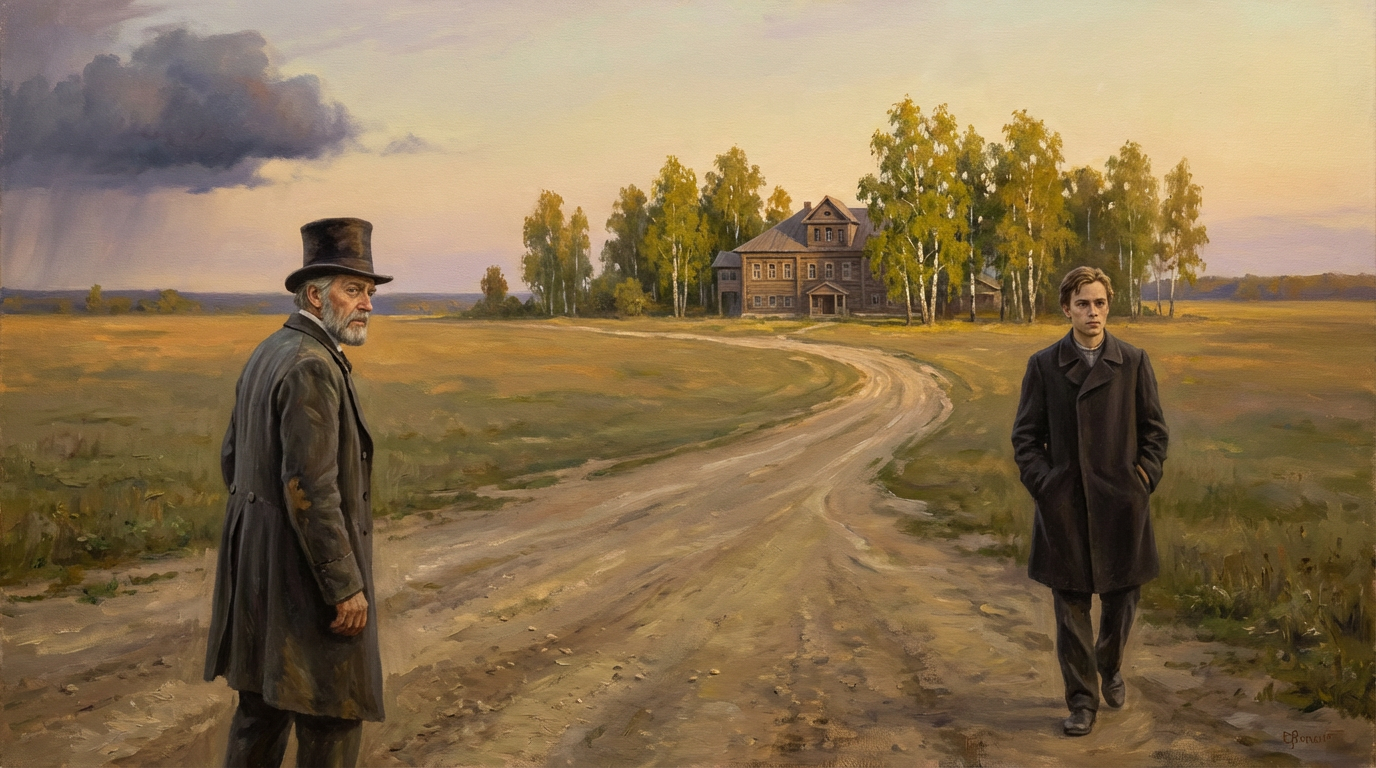
An excerpt from the original text.(complete · 6572 words)
wo hours later he knocked at Bazarov's door.
"I feel that I must apologise for disturbing you in your pursuits," he
said as he seated himself near the window and rested both hands upon
a fine ivory-headed cane which he had brought with him (as a rule he
did not carry one). "But the fact is that circumstances compel me to
request five minutes of your time."
"The whole of my time is at your disposal," replied Bazarov, across
whose features, as Paul Petrovitch had crossed the threshold, there had
flitted a curious expression.
"No; five minutes will be sufficient. I have come to ask you a simple
question."
"And what might that question be?"
"Listen. When first you came to stay in my brother's house, and I had
not yet been forced to deny myself the pleasure of conversing with you,
it fell to my lot to hear you hold forth on many different subjects.
But, unless my memory deceives me, never once did the conversation
between you and myself, or in my presence, happen to fall upon the
subject of the duel or single combat. Would you, therefore, mind
putting yourself out to the extent of giving me the benefit of your
views on the subject mentioned?"
Bazarov, who had risen to receive his visitor, now reseated himself
upon the edge of the table, and folded his arms upon his breast.
"My views are as follows," he replied. "From the theoretical
standpoint, the duel is a sheer absurdity. From the practical
standpoint, it is another matter altogether."
"You intend to convey (if I have understood you aright?) that,
apart from your theoretical views on the duel, you would not, in
practice, allow yourself to be insulted without subsequently demanding
satisfaction?"
"You have guessed my meaning precisely."
"Good! It is a view which I am indeed glad to hear you express, in that
it delivers me from a dilemma."
"You mean, from a state of indecision?"
"They are one and the same thing. I express myself in this manner to
the end that you may understand me. I am not one of your college rats.
Consequently I repeat that through your words I am relieved of the
necessity of resorting to what would have been a painful expedient. To
speak plainly, I have made up my mind to fight you."
Bazarov raised his eyebrows a little.
"To fight me?" he said.
"Yes, to fight you."
"And for what reason--if you do not mind telling me?"
"For a reason which I might explain, but concerning which I prefer to
remain silent. Suffice it for me to intimate that your presence offends
me, that I detest and despise your person, and (should the foregoing be
insufficient) that I----"
"Enough!" interrupted Bazarov. His eyes had flashed even as Paul's had
done. "Further explanations would be superfluous. You have presumed to
whet upon me your chivalrous spirit; wherefore, though I might have
refused it, I will afford you satisfaction to the top of your bent."
"I have to express to you my sincere obligation. From the first did
I feel encouraged to hope that you would accept my challenge without
constraining me to resort to more forcible measures."
"In other words, and speaking without metaphor, to that cane?" said
Bazarov in a tone of supreme indifference.
"Well, that is fair enough. Further insults are not needed--nor would
you have found the offering of them altogether free from danger.
Pray, therefore, remain a gentleman. It is as one that I accept your
challenge."
"Good!" replied Paul Petrovitch; and he laid aside his cane. "Next, a
few words on the subject of the conditions of our duel. First, pray be
so good as to inform me whether or not you deem it necessary to resort
to the formality of some such small difference of opinion as might
serve as an ostensible excuse for my challenge?"
"I think that unnecessary. Such things are best done without
formalities of any kind."
"I agree--that is to say, I, like you, consider that to go into the
true reasons for our antagonism would be inexpedient. Let us therefore
allege to the world that we could not abide one another. What need
would there be to say more?"
"What indeed?" echoed Bazarov in a tone decidedly ironical.
"Also, with regard to the actual conditions of the duel. Inasmuch as we
have no seconds--for where could we find them?----"
"Quite so. Where indeed?"
"I have the honour to propose to you the following. Let us fight
to-morrow morning--say, at six o'clock: the rendezvous to be behind the
copse, the weapons to be pistols, and the distance ten paces."
"Ten paces. Quite so! You and I abhor each other even at ten paces."
"Eight, then, if you wish?"
"The same applies to eight."
"And the number of shots to be two apiece. Also, in case either of us
should fall, let each of us previously place in his pocket a letter
laying upon himself the entire blame for his demise."
"To that condition I wholly demur," said Bazarov.
"I think that you are straying into the pages of a French novel, and
away from reality."
"Possibly I am. But, also, you will agree that to incur an unmerited
suspicion of murder is a prospect not pleasant to contemplate?"
"I do. Yet still there remains another method of avoiding such an
awkward imputation. That is to say, though we shall have no seconds, we
can have a witness."
"Whom precisely, if I might ask?"
"Peter."
"Peter? What Peter?"
"Peter the valet, a man who stands at the apex of contemporary culture,
and could therefore play the rôle, and perform the functions, proper to
such an occasion pre-eminently comme il faut."
"I think that you are jesting, my good sir?"
"No, I am not. If you will deign to give my proposal consideration you
will speedily arrive at the conviction that it is as simple as it is
charged with good sense. Schiller it would be impossible to hide in a
bag, but I will undertake to prepare Peter for the part, and to bring
him to the rendezvous."
"Still you are pleased to jest," said Paul Petrovitch as he rose. "But
as you have so kindly met me, I have not the right to make further
claims upon your time. All is arranged, then? In passing, have you any
pistols?"
"How should I have any pistols? I am not a man of war."
"Then perhaps you will allow me to offer you some of mine? Rest assured
that they have not been fired by me for five years."
"A very comforting assurance!"
"Lastly," said Paul Petrovitch as he reached for his cane, "it only
remains for me to thank you, and to leave you to your pursuits. I have
the honour to bid you good-day."
"And I to say farewell until our pleasant meeting."
With which Bazarov escorted his visitor to the door.
Paul Petrovitch gone, Bazarov stood awhile in thought. Then he
exclaimed:
"Splendid indeed! Yet also unutterably stupid! What a comedy to play!
Talk of educated dogs dancing on their hind legs!... However, I could
not have refused him, for, otherwise, he would have struck me and
then"--Bazarov turned pale, for his pride had been aroused--"well,
then I should have strangled him like a kitten!"
He returned to his microscope, but found his heart to be still
beating, and the coolness necessary to scientific observation to have
disappeared.
"I suppose he saw us this morning," he continued to himself. "Yet
surely he is not doing this on his brother's behalf? For what is there
in a kiss? No; something else is in the background. Bah! What if it
should be that he himself is in love with her? Yes, that is it. It is
as clear as day. What a mess! Truly a horrible mess, however it be
viewed! For first of all I am to have my brains blown out, and then I
am to be made to leave this place! And there is Arkady to consider, and
that old heifer Nikolai Petrovitch. Awkward! Awkward indeed!"
However, the day dragged its slow length along. Thenichka remained
practically non-existent (in other words, she kept to her room as
closely as a mouse to its hole), Nikolai Petrovitch walked about with
a careworn air (it had been reported to him that mildew had begun to
attack the wheat), and Paul Petrovitch's mien of icy urbanity succeeded
in damping the spirits of Prokofitch himself.
Presently Bazarov sat down to write a letter to his father, but tore it
up, and threw the pieces under the table.
"Should I be killed," he reflected, "my parents will hear of it soon
enough. But I shall not be killed--I have yet far to wander about the
world."
Next he ordered Peter to call him at dawn; and inasmuch as the order
was accompanied with a mention of important business, Peter jumped
to the conclusion that it was Bazarov's intention to take him to St.
Petersburg. Bazarov then retired to rest. Yet, late though he had done
so, he was troubled with fantastic visions. Ever before him there
flitted Madame Odintsov, who was also his mother. And ever behind her
there walked a black cat, which was also Thenichka. For his part, Paul
Petrovitch figured as a forest which the dreamer was engaged to fight.
At length, when four o'clock arrived, Peter came to rouse him. Hastily
dressing himself, he left the house with the valet. The morning was
fine and fresh, and though a few wisps of cloud were trailing across
the pale-blue transparency of the zenith, a light dew had coated the
grass and foliage with drops, and was shining like silver on spiders'
webs. The steaming earth seemed still to be seeking to detain the
roseate traces of dawn in her embrace; but presently every quarter of
the sky became lit up, and resounded again to the songs of larks.
Bazarov walked straight ahead until he reached the copse--then seated
himself at the shadowy edge of the trees, and explained to Peter the
services which he looked to the latter to perform; upon which the
"cultured" menial came near to fainting, and was calmed only with
an assurance that he would but have to stand at a distance, as a
looker-on, and that in no case would responsibility attach to his
person.
"And think," Bazarov concluded, "in what an important rôle you are
about to figure!"
But Peter, extending his hands deprecatingly, only turned up his eyes,
became green in the face, and went and leant against a birch tree.
The copse was skirted by the road from Marino, and the light coating of
dust bore no mark of having been disturbed since the previous evening,
whether by wheel or by foot. Involuntarily Bazarov kept glancing along
this road as, plucking and chewing stems of grass, he repeated again
and again to himself: "What a piece of folly!" More than once, too,
the morning air made him shiver, and Peter gaze plaintively in his
direction; but Bazarov only laughed, for he at least was no coward.
At length hoofs sounded along the road, and there came into sight from
behind the trees a peasant driving two horses with traces attached. As
the man passed Bazarov he looked at him inquisitively, but failed to
doff his cap; and this circumstance impressed Peter unfavourably, since
the valet considered it a bad omen.
"Like ourselves, that peasant has risen early," thought Bazarov. "But
whereas he has risen to work, we----!"
"Some one else is coming, I believe," whispered Peter.
Bazarov raised his head, and saw Paul Petrovitch, in a light check
jacket and a pair of snow-white trousers, walking briskly along the
road. Under his arm was a green, baize-covered box.
"Pardon me for having kept you waiting," he said with a bow to Bazarov,
and then one to Peter (for even to the latter he, for the nonce, seemed
to accord something of the respect due to a second). "As a matter of
fact, I was loth to arouse my valet."
"I beg that you will not mention it," replied Bazarov. "We ourselves
have only just arrived."
"So much the better!" And Paul Petrovitch glanced about him. "There
will be no one to see us or disturb us. Are you agreeable to
proceeding?"
"Quite."
"And I presume that you require no further explanations?"
"None whatsoever."
"Then kindly load these." Paul Petrovitch took from the box a brace of
pistols.
"No. Do you load, while I measure the distance--my legs are longer
than yours." This last Bazarov added with a dry smile. "Now, one, two,
three----"
"I beg your pardon, sir," gasped Peter, who was trembling as with ague.
"I beg your pardon, but might I move further away?"
"Four, five---- Certainly, my good fellow! Pray do so. You can go and
stand behind that tree there, and stop your ears--provided that you
do not also stop your eyes. Lastly, should either Monsieur Kirsanov
or myself fall, you are to run and pick up the fallen. Six, seven,
eight----" Bazarov halted. "That will do, I suppose?" he added to Paul
Petrovitch. "Or would you prefer me to add another couple of paces?"
"Do as you please," the other replied as he rammed home the second of
the two bullets.
"Then I will add those two paces." And Bazarov scratched a line in the
soil with his toe. "Here is the mark. Apropos, how many paces is each
of us to retire from our respective marks?"
"Ten, I presume," said Paul Petrovitch as he proffered Bazarov a brace
of pistols. "Will you kindly make choice of these?"
"I will. Nevertheless you will agree that our duel is singular, even to
the point of absurdity? For pray observe the countenance of our second!"
"It is still your pleasure to jest," Paul Petrovitch responded coldly.
"Of the singularity of our contest I make no denial. I merely consider
it my duty to warn you that I intend to right you in grim earnest. So,
à bon entendeur, salut!"
"Yet, even though we intend to exterminate one another, why should we
not enjoy our jest, and thus combine utile with dulce? You have
spoken to me in French. I reply in Latin."
"I repeat that I intend to fight you in grim earnest," said Paul
Petrovitch; with which he moved to his place, and Bazarov, after
counting ten paces from his mark, turned, and halted.
"Are you ready?" inquired Paul Petrovitch.
"I am."
"Then engage."
Bazarov started to advance, and Paul Petrovitch did the same, with
his left hand thrust into his coat pocket, and his right gradually
elevating the muzzle of his pistol.
"The fellow is aiming straight for my nose," thought Bazarov to
himself. "And how the rascal is screwing up his eyes as he marches!
This is not a wholly pleasing sensation. I had better keep my eyes
fixed upon his watch-chain."
Past Bazarov's ear something suddenly whistled, while almost at the
same moment there came the sound of a report.
"I seemed to hear something, but no matter," was the thought which
flashed through Bazarov's brain. Then he advanced another step, and,
without aiming, pulled the trigger.
As he did so Paul Petrovitch gave a faint start, and clapped his hand
to his thigh, down the white trouser-leg of which there began to
trickle a thin stream of blood.
Bazarov threw aside his pistol and approached his antagonist.
"Are you wounded?" he inquired.
"Pray recall me to the mark," said Paul Petrovitch. "You have the right
so to do, and we are merely wasting time. The conditions of the contest
allow of a second shot apiece."
"Pardon me, that can be deferred," said Bazarov, catching hold of Paul
Petrovitch, who was beginning to turn pale in the face. "I am no longer
a duellist, but a doctor, and must examine your wound. Peter! Here!
Where the devil has the man got to?"
"This is sheer folly," gasped Paul Petrovitch. "I need no help. Let
us----" Yet, even as he tried to twirl his moustache, his arm fell to
his side, his eyes closed, and he collapsed in a swoon.
"Something new!" involuntarily cried Bazarov as he laid his antagonist
upon the grass. "A swoon! Let us see what is the matter with him."
Taking out his pocket-handkerchief, he wiped away the blood, and probed
the neighbourhood of the wound.
"The bone is intact," he muttered. "Yes, and the bullet has merely
pierced the flesh a little below the surface. Nothing but the musculus
vastus externus is so much as touched. In three weeks' time we shall
have him trotting about again. A swoon! Oh these men of nerves! What
thin skins, to be sure!"
"Is--is he dead?" came in Peter's tremulous voice from behind.
Bazarov looked up.
"No," he said. "Run for a little water, and he will outlive us both."
Unfortunately the "perfect servant" did not understand what was said
to him, but remained stock still. In fact, even when, the next moment,
Paul Petrovitch opened his eyes Peter went on crossing himself and
repeating: "He is dying!"
"Monsieur Bazarov," the wounded man said with a twisted smile, "you
were perfectly in the right when you said that the face of that man was
the face of a fool."
"It is so," agreed Bazarov. "Damn you, will you fetch some water!" (The
latter to the valet.)
"There is no need," put in Paul Petrovitch. "It was only a passing
vertigo. Kindly assist me to sit up. That is it. A scratch like this
will require only to be bandaged for me to walk home again. There will
be no necessity to have the drozhki sent. For that matter, the duel
need not be renewed unless you wish it. At least to-day you have acted
like a gentleman. Kindly note that I have said so."
"To the past we have no need to refer," said Bazarov. "And, as regards
the future, it calls for equally little remark, seeing that I intend
to leave here at once. Allow me to bind your leg. The wound is not
dangerous, but one of a nature which will make it as well to have the
blood staunched. But first I must restore that stuck pig to life."
Shaking Peter vigorously by the collar, he dispatched him in search of
the drozhki.
"But see that you do not alarm my brother," was Paul Petrovitch's
injunction also to the man. "You are not to breathe a word of what has
happened."
Peter set off at full speed. During the time that he was hastening for
the drozhki, the two antagonists sat silently side by side on the
ground, while Paul Petrovitch tried his best not to look at Bazarov,
for the reason that he did not feel inclined to become reconciled with
him, while at the same time he felt ashamed alike of his impulsiveness,
his failure, and the scheme which had had this ending, though he
realised that it might have been worse.
"At least will the fellow swagger here no more," he thought to himself
by way of consolation. "And, for that, much thanks!"
The silence was a heavy, awkward silence, for neither of the pair felt
comfortable--each of them recognised that the other had taken his
measure. To friends, such a recognition may be very agreeable, but to
foes it is far from welcome--least of all, when neither explanations
nor a parting are feasible.
"I hope that I have not bound your leg too tightly?" said Bazarov at
last.
"Oh no," replied Paul Petrovitch. "As a matter of fact, it is doing
splendidly." After a pause he added: "But we cannot deceive my brother.
How would it be if we were to tell him that we fell out over politics?"
"Capital!" agreed Bazarov. "Tell him, for instance, that I started
cursing Anglomaniacs."
"A good idea! But what can that man be thinking of us? I cannot
imagine." The speaker pointed to the same peasant who, shortly before
the duel, had driven a pair of loose horses past Bazarov, and was
now shuffling homewards, while doffing his cap at the sight of the
gentlemen.
"Who can say?" replied Bazarov. "Probably he is thinking of nothing at
all. As Madame Radcliffe[1] frequently reminds us, the Russian muzhik
is an unknown quantity. Does any one understand him? He does not even
understand himself."
"There you go again!" began Paul Petrovitch, but suddenly broke off to
say in a still louder tone: "See what that fool Peter has done! Here
comes my brother himself!"
Sure enough, on turning his head, Bazarov saw Nikolai Petrovitch's pale
face peering from the drozhki. Nor had the vehicle come to a halt
before Nikolai had sprung from the step, and rushed towards his brother.
"What is this?" he cried in agitated accents. "Evgenii Vasilitch, I beg
of you to tell me what has happened."
"Nothing has happened," replied Paul Petrovitch in Bazarov's stead.
"You are disturbing yourself to no purpose. I had a small quarrel with
Monsieur Bazarov, and have paid a penalty as small."
"But whence did it arise? For God's sake tell me!"
"What is there to say? It arose from the fact that Monsieur Bazarov
spoke in disrespectful terms of Sir Robert Peel. I would hasten to add
that, throughout, I alone was at fault, and that Monsieur Bazarov bore
himself admirably--I being the challenger."
"But look at the blood!"
"Pshaw! Did you suppose my veins to run with water? As a matter of
fact, the blood-letting will do me good. Is not that so, doctor? Help
me to mount the drozhki, and away with melancholy! By to-morrow I
shall be recovered. Splendid! That is the way to do it. Right away,
coachman!"
When on the point of starting homewards in the wake of the drozhki,
Nikolai Petrovitch perceived Bazarov to be for remaining behind.
"Evgenii Vasilitch," he said, "I would beg of you to attend my brother
until a doctor can be procured from the town."
Bazarov nodded in silence.
An hour later Paul Petrovitch was reposing in bed with his leg neatly
and artistically bandaged. The whole house was in a turmoil, Thenichka
greatly upset, and Nikolai able to do nothing but wring his hands. The
sick man, on the contrary, laughed and jested, especially with Bazarov,
and, to meet the occasion, had donned a fine linen shirt, an elegant
morning jacket, and a Turkish fez. Lastly, he forbade any one to close
the shutters, and kept venting humorous protests against the necessity
of abstaining from food.
Towards nightfall, however, fever supervened, and his head began to
ache; with the result that when the doctor arrived from the town
(Nikolai Petrovitch had disobeyed his brother in this respect, and
Bazarov also had consented to his doing so, in that, after paying the
patient a single visit, and that a very brief one, and being put to
the mortification of having to avoid Thenichka on two occasions when
he met her, he had felt that he preferred to spend the rest of the day
in loneliness, bitterness, and rancour)--when the doctor arrived from
the town he advised a cooling draught, but at the same time confirmed
Bazarov's opinion that no danger was to be apprehended. In passing, it
may also be mentioned that, on being informed by Nikolai Petrovitch
that Paul Petrovitch's wound had been self-inflicted through an
accident, the said doctor replied "H'm!"; to which, on receiving into
his hand a fee of twenty-five roubles, he added that of course things
of the kind often occurred.
No one in the house, that night, retired to bed, or even undressed,
but at intervals Nikolai Petrovitch would tiptoe into his brother's
room, and as silently withdraw. At intervals, too, Paul Petrovitch
would awake from a doze, sigh faintly, and say to Nikolai either
"Couchez-vous" or "Please give me a drink." But once it happened that
Nikolai sent the invalid a glass of lemonade by the hand of Thenichka;
and this time Paul Petrovitch scanned her long and searchingly before
draining the tumbler to the dregs. Towards morning the fever increased
a little, and a trace of lightheadedness made its appearance which
for a while caused the patient only to utter disconnected words.
But suddenly he opened his eyes, and, on seeing his brother bending
solicitously over the bed, murmured:
"Nikolai, do not you think that Thenichka slightly resembles Nelly?"
"What Nelly, Paul? Who is Nelly?"
"How can you ask? The Princess R., of course. In the upper portion of
the face especially Thenichka resembles her. C'est de la même famille."
Nikolai Petrovitch made no reply. He could only remain lost in wonder
that bygone fancies could so survive in the human consciousness.
"That this should have cropped up again!" he reflected.
On another occasion Paul Petrovitch muttered as he clasped his hands
behind his head: "How I love this idle existence!" And again, a few
minutes later, he whispered: "I will not allow a single rascal to touch
me!"
Nikolai Petrovitch sighed. To whom the words referred he had not a
notion.
At eight o'clock next morning Bazarov entered Nikolai's room. His stock
of insects, birds, and frogs had either been packed up or liberated.
Rising to meet him, Nikolai said:
"So you have come to say good-bye?"
"I have."
"I understand your feelings, and I commend them. I know that my poor
brother alone was to blame, and is now paying the penalty. Also, I
gather from what he says that your position was such that you could not
possibly have acted otherwise than as you did--that for you to have
avoided this duel would have been impossible. That being so, we must
attribute the mischance to the--er--standing antagonism of your views"
(here Nikolai Petrovitch tripped over his words a little). "My brother
is one of the old school, a man of hot temper and great persistency.
Consequently we have God to thank that things have turned out no worse.
Finally I may say that every possible precaution against publicity has
been taken."
"Quite so," said Bazarov carelessly. "But I will leave my address with
you, in case of anything occurring."
"I hope that nothing will occur. Indeed, my one regret is that your
stay in my house should have--should have terminated in such a fashion.
And I am the more grieved in that Arkady---"
"I expect to be seeing him very soon," interrupted Bazarov, whom
"explanations" or "speeches" of any kind always roused to fever pitch.
"On the other hand, should I not do so, pray convey to him my
greetings and my regrets."
"I will," said Nikolai Petrovitch with a bow; but even before he had
finished Bazarov had left the room.
Paul Petrovitch, too, as soon as he heard that Bazarov was on the point
of departing, expressed a desire to see him, and to shake hands with
him. Yet Bazarov remained as cold as ice, for well he knew that Paul
Petrovitch's only aim was to make a show of "magnanimity," while to
Thenichka he did not say good-bye at all--he merely exchanged with her
a glance as she peeped from one of the windows. Her face looked to him
careworn.
"Before long she will either trip or elope," he reflected.
On the other hand, Peter was so moved at the prospect of parting
with his patron that he wept on the latter's shoulder until his
transports were cooled with the question: "Surely your eyes are not
made of water?" while Duniasha's emotion was such that she had to take
refuge in a thicket. Meanwhile the cause of all this grief mounted
the travelling-cart, and lit a cigar; and even when he had travelled
four versts, and reached a spot where a turn in the road brought
the Kirsanov farm into line with the new manor-house, he merely
expectorated some tobacco juice, and muttered, as he wrapped himself
closer in his cloak: "The cursed tomnoddies!"
Thenceforth Paul Petrovitch began to mend, but still was ordered to
keep his bed for another week. What he called his "imprisonment"
he bore with very fair patience, although he remained fussy in the
matter of his toilet, and constantly had himself sprinkled with
eau-de-Cologne. Meanwhile Nikolai Petrovitch read aloud to him the
newspapers, and Thenichka served him with soup, lemonade, scrambled
eggs, and tea. Yet she never entered the room without feeling a
mysterious nervousness come over her. Paul Petrovitch's unexpected
behaviour had frightened every one in the house, but her it had
frightened most of all. Only old Prokofitch seemed undismayed at the
occurrence, and kept asserting that, in his day, "the gentry used to
bore holes in one another right enough, but only the gentry. Jackanapes
like that Bazarov would have been ducked in the gutter for their pains."
Thenichka felt little pricking of conscience, but there were times when
the thought of the true cause of the quarrel rendered her at least
uneasy, and the more so because Paul Petrovitch's way of looking at
her was now so strange that, even when she turned her back to him, she
could still feel his eyes upon her. In combination, therefore, her
worries led to her growing thinner, and also (as often happens in such
circumstances) to her adding to her beauty.
At length, one morning, Paul Petrovitch felt so much better that he
left his bed, and removed to the sofa; while Nikolai Petrovitch, after
seeing that he had all he wanted, betook himself to the farm. Also,
it fell to Thenichka's lot to take the invalid a cup of tea; and when
she had placed it on the table, she was about to withdraw, when Paul
Petrovitch requested her to remain.
"Why should you hurry away?" he said. "Is it that you have other things
to do?"
"No--yes. That is to say, I have to go and pour out tea for the
servants."
"Duniasha can do that. Surely you will stay awhile with a sick man who
has something of great importance to say to you?"
Silently she seated herself on the edge of a chair.
"Listen," he continued, as he tugged at his moustache.
"For some time past I have been wanting to ask you why you are so
afraid of me?"
"Afraid of you?"
"Yes; for you never look at me. In fact, one would think that your
conscience was uneasy."
Her face reddened, but she looked Paul Petrovitch straight in the eyes.
Somehow his aspect struck her as peculiar, and her heart began to throb.
"Is your conscience clear?" he asked.
"Yes, Why should it not be?" she responded in a whisper.
"I do not know. Certainly I can recall no one against whom you can have
committed a fault. Against me? It is scarcely probable. Against others
in this house? That is as improbable. Against my brother? But him you
love, do you not?"
"I do."
"With your whole heart and soul?"
"With my whole heart and soul."
"Really and truly, Thenichka?" (never before had he addressed her
thus). "Look me in the eyes. To lie is a terrible sin. You know that,
of course?"
"But I am not lying, Paul Petrovitch. Did I not love Nikolai
Petrovitch, I should not want to live."
"And you would exchange him for no one else?"
"Whom should I exchange him for?"
"I do not know. Surely not for the gentlemen who has just left us?"
Thenichka rose to her feet.
"Why should you torment me in this way?" she cried. "What have I done
that you should speak to me so?"
"Thenichka," came the mournful reply, "I speak to you in this manner
for the reason that I saw----"
"You saw what?"
"I saw you--in the lilac arbour."
She blushed to her ears, to the very roots of her hair.
"But how was I to blame?" at length she contrived to say.
Paul Petrovitch raised himself on the sofa.
"You swear, do you, that you were not to blame?" he said. "That you
were not in the slightest degree to blame? Not at all?"
"I love Nikolai Petrovitch," came the reply, delivered with sudden
energy and a rising sob, "and never shall I love any other man. As
for what you saw, before the Throne of Judgment I swear that I am
innocent, that I have always been so, and that I would rather die than
be suspected of having deceived Nikolai Petrovitch, my benefactor."
Her voice failed her. Then, behold! she felt Paul seize and press
her hand! Turning her head, she looked down at him--and stood almost
petrified. For his face was even paler than usual, his eyes were
glistening, and--most surprising thing of all!--a great tear was
trickling down his cheek!
"Thenichka," he whispered in a voice which hardly seemed his own, "I
beg of you always to love, and never to cease loving, my brother. He
is such a good, kind fellow as has not his equal in the world. Never
desert him for another; never listen to any tales which you may hear of
him, but reflect how terrible it would be for him to love and not to be
loved! Yes, think well, Thenichka, before ever you forsake him."
Thenichka's amazement caused her eyes almost to start from her
head, and her nervousness completely to vanish. Judge, also, of her
surprise when, though he did not draw her to himself, nor kiss her,
Paul Petrovitch raised her hand to his lips, and then burst into a
convulsive fit of sobbing!
"God in Heaven!" she thought to herself. "What if this should make him
have another fainting fit?"
Meanwhile, in that one moment Paul Petrovitch was living over again a
past phase of his ruined life.
Presently hurried footsteps were heard causing the staircase to creak;
and just as Paul pushed Thenichka away from him and replaced his head
upon the pillow, the door opened, and Nikolai Petrovitch--fresh, ruddy,
and smiling--entered with little Mitia. The latter, equally fresh and
ruddy, was leaping in Nikolai's arms, and pressing his tiny, naked feet
against the buttons of his father's rural smock.
Running to father and child, Thenichka threw her arms around both
alike, and sank her head upon the former's shoulder. This caused him to
halt in amazement, for never before had the bashful, reserved Thenichka
shown him any endearment in the presence of a third person.
"What is the matter?" he exclaimed. Then he glanced at Paul, handed
Mitia to Thenichka, and, approaching the bedside, inquired if his
brother were worse.
Paul's face was buried in his handkerchief, but he replied:
"Oh dear no. Not at all. If anything, I am better--yes, very much
better."
"Nevertheless you have been over-hasty in removing to the sofa," said
Nikolai Petrovitch; after which he turned to ask Thenichka why she was
leaving the room, but she departed abruptly, and closed the door behind
her.
"I had come to show you my little rascal," Nikolai continued. "He had
been pining for a sight of his uncle. But she has carried him away for
some reason. What is the matter? Has something occurred?"
"My brother," replied Paul Petrovitch--and as he uttered the words
Nikolai Petrovitch gave a start, and felt ill at ease, he knew not why.
"My brother, pray give me your word of honour that you will fulfil the
request which I am going to make."
"What request, Paul? I beg of you to continue."
"A request of the first importance. Upon it, I believe, your entire
happiness depends. Also, what I am going to say represents the fruit of
much thought. My brother, the request is that you will do your duty,
the duty of a good and honourable man. In other words, I beseech you to
put an end to this scandal and bad example, which is unworthy of you,
unworthy of a man who is the best of souls."
"To what do you refer, Paul?"
"To this. You ought to marry Thenichka. She loves you, and is the
mother of your child."
Stepping back, Nikolai Petrovitch clasped his hands together.
"Do you say this?" he exclaimed. "Do you say this--you whom I
have always understood to be opposed to such unions? Do you say this?
Surely you know that solely out of respect for yourself have I hitherto
refrained from doing what rightfully you call my duty?"
"Wrongfully, then, have you respected me," said Paul Petrovitch with a
sad smile. "In fact, almost I am beginning to think that Bazarov was
right when he accused me of only feigning the aristocratic instinct.
For it is not enough for you and me to trouble ourselves about worldly
matters alone. We are old men past our prime, who ought to lay aside
all pettinesses, and to fulfil strictly our obligations. Nor forget
that, should we thus act, we shall receive an added measure of
happiness as our reward."
Nikolai Petrovitch flung himself upon his brother, and embraced him
again and again.
"You have opened my eyes," he cried. "When I described you as the best
man in the world I was not wrong: and now I perceive your wisdom to be
equal to your magnanimity."
"Quieter, quieter!" advised Paul. "Do not further inflame the leg of an
old fool who, at fifty, has fought a duel like a young ensign. Then the
matter is settled, and Thenichka is to become my belle-soeur?"
"Yes, my dearest Paul. But what will Arkady say?"
"Arkady? He will be delighted. True, marriage does not come within his
purview or principles, but at least his sense of social equality will
be tickled. And, in the nineteenth century, what does caste matter?"
"Paul, Paul, let me embrace you once more. You need not be afraid.
I will do it very carefully." And the two brothers flung their arms
around one another.
"Well?" continued Paul Petrovitch. "What think you? Shall we tell her
at once?"
"No, we need not be in too much of a hurry," replied Nikolai
Petrovitch. "As a matter of fact, you have been having a talk with her,
have you not?"
"I have been having a talk with her? Quelle idée!"
"However, your first business is to recover. Thenichka will not run
away, and in the meanwhile the affair must be carefully considered."
"Then you have decided upon it?"
"Certainly I have! And I thank you with all my heart. But I must
leave you for a while now, for you ought to have some rest, and any
excitement is bad for you. Matters can be discussed later. Go to sleep,
dearest of brothers, and may God restore you to health!"
"Why did he thank me?" thought Paul Petrovitch to himself after
Nikolai had gone." Does not the affair depend upon him alone, seeing
that, after the marriage, I myself shall have to depart elsewhere--to
Dresden or to Florence, and to abide there until I die?"
He bathed his forehead with eau-de-Cologne, and then closed his eyes.
As he lay with his handsome, refined head resting on the pillow, he
looked, in the clear light of the sun, like a corpse.
[1] Ann Radcliffe, née Ward (1764-1823), an English novelist who
wrote The Mysteries of Udolpho and other tales, and travelled
extensively.
Master this chapter. Complete your experience
Purchase the complete book to access all chapters and support classic literature
As an Amazon Associate, we earn a small commission from qualifying purchases at no additional cost to you.
Available in paperback, hardcover, and e-book formats
Let's Analyse the Pattern
People often require genuine crisis to cut through social expectations and focus on what actually matters in life.
Why This Matters
Connect literature to life
This chapter teaches how people often fight about surface issues when the real conflict lies much deeper.
Practice This Today
This week, notice when someone's anger seems disproportionate to the situation—ask yourself what deeper need or fear might be driving their reaction.
Now let's explore the literary elements.
Key Quotes & Analysis
"From the theoretical standpoint, the duel is a sheer absurdity"
Context: When Paul asks his views on dueling before challenging him
Shows how both men know they're about to do something stupid but can't back down. Bazarov's scientific rationality clashes with social pressure to defend his honor.
In Today's Words:
This is completely ridiculous and makes no sense, but I guess we're doing it anyway
"I have been a fool, a fool"
Context: During his emotional breakdown with Thenichka after being wounded
Paul's aristocratic facade completely crumbles as he faces his loneliness and mistakes. This moment of vulnerability transforms him and changes his priorities.
In Today's Words:
I've been an idiot about everything that actually matters
"You must marry my brother"
Context: Paul urging Thenichka to accept Nikolai's proposal during his breakdown
Complete reversal of his earlier class prejudices. Near-death experience taught him that love matters more than social status or family reputation.
In Today's Words:
Forget what people think - marry him because you love each other
"He is so good, so good"
Context: Paul talking about his brother Nikolai to Thenichka
Shows Paul finally recognizing his brother's genuine goodness instead of judging him for not following aristocratic conventions. Family love wins over social expectations.
In Today's Words:
He's a really good person and that's what matters most
Thematic Threads
Pride
In This Chapter
Paul's aristocratic pride drives him to a pointless duel, but his wound forces him to abandon pride for genuine care
Development
Evolved from Paul's constant class superiority to his complete emotional breakdown and transformation
In Your Life:
You might cling to being 'right' in arguments when admitting fault would actually strengthen relationships
Class
In This Chapter
Paul abandons his class prejudices and actively encourages Nikolai to marry below his station
Development
Transformed from rigid class barriers to recognition that love transcends social categories
In Your Life:
You might judge people by their job titles or education rather than their character and actions
Vulnerability
In This Chapter
Paul's complete emotional breakdown with Thenichka reveals the pain beneath his polished exterior
Development
Breakthrough moment where Paul finally shows authentic emotion instead of aristocratic control
In Your Life:
You might maintain a tough exterior at work while struggling internally with stress or personal problems
Family
In This Chapter
The brothers achieve genuine reconciliation as Paul prioritizes Nikolai's happiness over social conventions
Development
Evolved from tension and competition to authentic support and understanding
In Your Life:
You might let old family grudges or different life choices create distance when love should come first
Transformation
In This Chapter
Paul's near-death experience catalyzes complete personality change from rigid aristocrat to caring brother
Development
Culmination of Paul's character arc from antagonist to someone capable of growth and sacrifice
In Your Life:
You might resist changing your opinions or behavior even when you know it would improve your relationships
You now have the context. Time to form your own thoughts.
Discussion Questions
- 1
What triggers Paul's emotional breakdown after the duel, and how does his behavior toward Thenichka completely change?
analysis • surface - 2
Why does Paul's brush with danger suddenly make him see his brother's happiness as more important than social conventions?
analysis • medium - 3
Think about someone in your life who had a major attitude shift after a crisis or scare. What changed for them, and what stayed the same?
application • medium - 4
Paul waits until he's wounded and vulnerable to finally do right by his family. What important conversations or actions are you postponing that shouldn't wait for a crisis?
application • deep - 5
Why do humans often need shock or crisis to act on wisdom we already possess? What does this reveal about how we protect ourselves from uncomfortable truths?
reflection • deep
Critical Thinking Exercise
Create Your Crisis Prevention Audit
Paul's near-death experience forces him to prioritize love over pride and family over social status. Create a personal 'crisis prevention audit' by listing three important relationships or situations you've been avoiding addressing. For each one, write what you know needs to happen and what you're actually waiting for before taking action.
Consider:
- •Focus on situations where you already know what's right but haven't acted yet
- •Consider what you'd regret not saying or doing if you only had six months
- •Think about patterns where you wait for external pressure instead of creating internal motivation
Journaling Prompt
Write about a time when crisis or shock made you suddenly see a situation clearly. What had you been avoiding before that moment, and what would have happened if you'd acted on that clarity earlier?
Coming Up Next...
Chapter 25: Declarations Under the Ash Tree
As the dust settles at Marino, we shift to a very different scene at Nikolsköe, where Arkady and Katia sit quietly together in the garden. Their peaceful moment suggests important conversations are about to unfold—conversations that will determine the direction of both their futures.



