
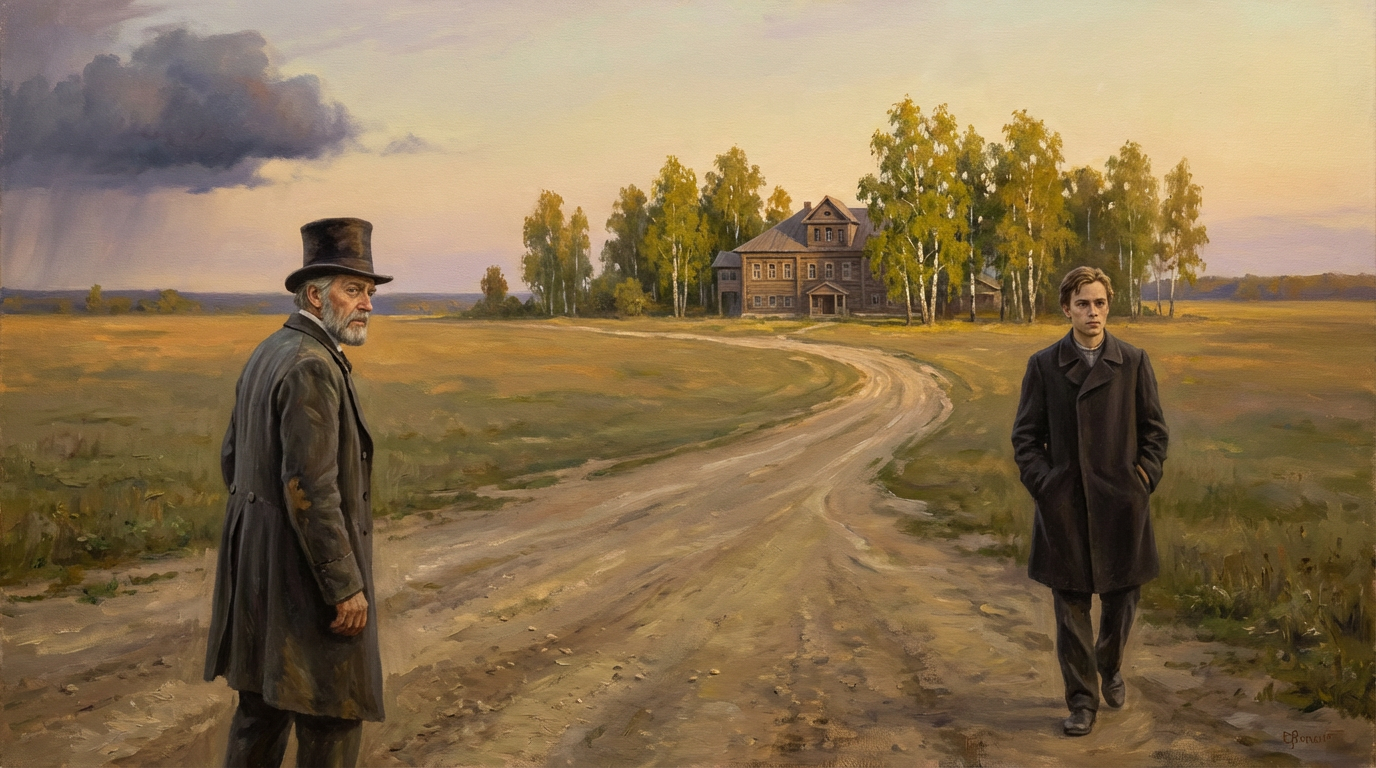
An excerpt from the original text.(complete · 3776 words)
the shade of a tall ash tree in the garden at Nikolsköe Katia
and Arkady were seated on a bench. Beside them, on the ground, lay
Fifi--his lengthy body twisted into the curve known to sporting folk
as "the hare's crouch." Neither from Arkady nor from Katia was a word
proceeding. Arkady was holding in his hands a half-opened book, and she
was picking a few crumbs from a basket, and throwing them to a small
family of sparrows which, with the timid temerity of their tribe, were
chirping and hopping at her very feet. A faint breeze was stirring
the leaves of the ash tree, and dappling Fifi's tawny back and the
dark line of the pathway with a number of wavering circles of pale
golden light; but Arkady and Katia were wholly in shade, save that an
occasional streak glanced upon, and gleamed in, her hair. Just for the
reason that the pair were silent and side by side was there present
to their consciousness a camaraderie which, while causing neither
to have the other definitely in mind, pleased each with the sense of
the other's propinquity. The expression of both is changed since last
we saw them. Arkady's face wears a staider air, and Katia looks more
animated and less retiring.
At length, however, Arkady spoke.
"Do you not think," he said, "that our Russian term yasen is
particularly suitable to the ash tree? For no other tree cleaves the
air with such airy brightness."(1) Katia looked up.
"I agree," she replied, while Arkady proudly reflected: "At all events
she does not reprove me for talking in 'beautiful language.'"
"By the way," Katia continued with a glance at the book in his hands,
"I cannot say that I always approve of Heine. I like him neither when
he is laughing nor when he is in tears--I like him only when he is
meditative and languid."
"Well, I like him when he is laughing," Arkady remarked.
"Then still there survives in you a trace of your old satirical
tendency. Still your reformation needs to be completed."
"Indeed?" thought Arkady. "My satirical tendency? Oh, that Bazarov
could have heard that!"
While aloud he said:
"Who is 'we'? Yourself?"
"Oh dear no! My sister, and Porfiri Platonitch, with whom you no longer
quarrel, and my aunt, whom, three days ago, you escorted to church."
"I did so only because I could not refuse. And as regards Anna
Sergievna, kindly remember that, in many things, she agrees with
Bazarov."
"Yes, she used to be greatly under his influence, and so did you."
"And so did I? Then am I now emancipated from that influence?"
Katia returned no reply.
"I know that you never liked him," Arkady continued.
"Did I not? It was not for me to judge him."
"Never do I hear that reply without declining to believe it. There is
not a person living whom all of us have not the right to judge. A
disclaimer of that kind always represents an excuse."
"To tell the truth, I disliked him less than I felt him to be a
stranger to me--as complete a one as I to him--or you either, for that
matter."
"What do you mean?"
"I mean that--well, how can I express it? That, whereas he was a wild
bird, you and I are tame ones."
"I am a tame one?"
Katia nodded assent. Arkady scratched his ear.
"Look here," he said. "I may tell you that that constitutes, in
essence, an insult."
"Why so? Do you want to be a wild bird?"
"Not necessarily a wild one, but at least one strong and energetic."
"You need wish no such thing. Your friend was both, yet he would rather
have been otherwise.
"H'm! You believe that he used to exercise a considerable influence
over Anna Sergievna?"
"Yes. But no one can hold a rein over her for long." Katia added this
last sotto voce.
"What makes you think that?"
"The fact that she is very proud--rather, that she values her
independence."
"Who does not?" queried Arkady, while there flashed through his mind
the thought: "Why this mention of her?" Curiously enough, the same
thought occurred to Katia too. But this was not so curious as might
have been supposed, seeing that when young people meet in frequent and
amicable converse, identical thoughts are apt to enter their brains.
Arkady smiled, edged nearer to Katia, and said in a whisper: "Confess
that you are a little afraid of her."
"Of whom?"
"Of her" repeated Arkady meaningly.
"Are you afraid of her?" countered Katia.
"I am. Please note that I believe you to be the same."
Katia raised a menacing finger.
"I am surprised at you!" she exclaimed. "Never at any time has my
sister been better disposed towards you than she is now. She likes you
considerably more than when you first came."
"Really?"
"Yes. And have you not noticed it? You ought to be pleased at the
notion."
Arkady reflected.
"How I have contrived to win Anna Sergievna's good graces I do not
know," at length he said. "Surely it cannot be because I brought her
those letters which were written by your mother?"
"It is, though, and because of other reasons as well--reasons which I
will forbear to mention."
"Why will you?"
"Because I will."
"Oh, I know your faculty for obstinacy."
"It is one which I possess."
"Also, your faculty for observing things."
Katia glanced at him. Then she inquired:
"Why lose your temper? What are you thinking of?"
"This: that I cannot understand how you come to possess those powers
of observation which undoubtedly are yours. I understand it the less
because you are so nervous and distrustful and shy of everybody and----"
"It is because I have lived such a lonely life. A life of that kind
leads one to reflect in spite of oneself. Am I shy of every one,
though?"
Arkady bestowed upon her an appreciative glance.
"Never mind," he said. "At all events it is not often that people in
your position--I mean, people of your wealth--possess such a gift. To
them, as to the Tsars, truth penetrates hardly."
"But I am not wealthy."
Arkady failed at first to follow her meaning, but reflected: "Certainly
the property belongs to her sister, not to her." Nor was the thought
wholly unpleasing--so little so that presently he added:
"You said that very prettily."
"I said what?"
"That you are not wealthy. You said it so simply, so without any
false shame, so without the least arrière pensée. Apropos, the
consciousness of the ordinary person who both knows and confesses that
he or she is poor always seems to me to contain more than the mere
words imply--it harbours also a touch of vanity."
"I have, thanks to my sister, had no experience of poverty. And as
for my possessions, I mentioned them only because the words came of
themselves to my lips."
"Quite so. Yet confess that you too harbour a grain of the vanity to
which I have alluded."
"Give me an example of my doing so."
"An example? Well, may I ask why you have not married a rich man?"
"Were I to love such a one very much, I----But no man of that sort has
come my way: wherefore I have made no such marriage."
"There, now!" cried Arkady. "But why should you not do so in the
future?"
"Because even the poets deprecate mésalliances."
"You mean that you wish either to rule or----?"
"Oh no! What good would that be? On the contrary, I am prepared to be
ruled, even though I believe that inequality in any form works badly. A
union of self-respect with submission--that is what I best understand,
that is what spells true happiness. A mere subordinate existence
is--well, something which I do not fancy."
"'Something which I do not fancy,'" commented Arkady. "Yes, you are of
the same blood as Anna Sergievna: you are as independent as she, and
you are even more secretive. In fact, however deep-rooted and sacred
a stock of sentiments you might hold, you would never, of your own
accord, give them utterance."
"Of course! How could you suppose anything else?"
"Also, you are clever, and have a measure of character equal to, if not
greater than, hers."
"I dislike being compared with my sister. You seem to have forgotten
that she is both 'beautiful' and 'intellectual' and---- Moreover, you,
above all people, ought not to say anything to her disparagement, and
still less to say it seriously."
"Why 'you, above all people'? Do you think that I am jesting?"
"I am certain of it."
"Indeed? But what if I were to say that I really mean my words? What if
I were to say that, if anything, I have under-expressed what is in my
mind?"
"I fail to follow you."
"Do you? Your quickness of perception has been overrated."
"Why has it?"
Averting his head, Arkady returned no reply, while Katia fell to
searching for the last crumbs in her basket, and throwing them to the
sparrows. Unfortunately, the throw of her arm proved too strong, and
the birds flew away without even touching the food offered them.
"Katia," said Arkady, "it may be that you look upon these things as
matters of no moment. Kindly note, therefore, that neither for your
sister nor for any other person would I exchange Mademoiselle Katerina
Sergievna."
Rising, he walked away as though in sudden alarm at having allowed the
words to escape his lips. Meanwhile Katia, with her hands resting upon
the basket and her head bent, gazed after him. Gradually there crept
into her cheeks a rosy tint; and though her lips were not smiling, and
her dark eyes contained a hint of perplexity, there lurked also in her
expression another unexpressed feeling.
"Are you alone?" said Anna Sergievna's voice from behind her. "I
thought that Arkady came with you into the garden?"
Katia slowly raised her eyes to her sister (tastefully, and even
showily, dressed, the latter was standing on the path, and engaged in
stirring Fin's ears with the point of an open parasol), and as slowly
replied:
"Yes--I am alone."
"So I see," commented Madame with a smile. "He has gone indoors, I
suppose?"
"Probably."
"And you have been reading with him?"
"I have."
Anna Sergievna took Katia under the chin, and raised her face towards
her own.
"You have not quarrelled, I hope?" she said.
"Oh no," said Katia, and quietly put away her sister's hand.
"What solemn replies! Well, I came here to propose a walk, since he is
always asking me to go one. But, to pass to another subject, some shoes
have arrived for you from the town, so you had better go and try them
on. Only yesterday I was noticing how shabby your old ones are. In
general, you do not take sufficient pains in such matters, for you have
charming feet, and also not ugly hands, even though a trifle too large.
You ought to take care of your feet. When you are here you do not do so
sufficiently."
Madame passed onwards with a light rustle of her handsome gown, while
Katia rose from the bench, and, taking the volume of Heine, departed in
another direction--though not to try on the boots.
"'You have charming feet,'" she repeated to herself as she tripped up
the sun-baked steps of the terrace. "'You have charming feet.' Well,
before long some one shall be at them."
Confusion then overcame her, and she took the remaining steps at a
bound.
Meanwhile Arkady made for his room. As he was passing through the hall
he was overtaken by the butler, and informed that Monsieur Bazarov was
awaiting him above.
"Evgenii Vasilitch?" exclaimed Arkady in a tone very much as of alarm.
"Has he been here long?"
"A few minutes only. He instructed me not to announce him to Madame but
to take him straight to your room."
"I hope that nothing unfortunate has occurred at home," reflected
Arkady as he ran up the stairs and opened the door of the bedroom. But
the first sight of Bazarov's face reassured him, even though a more
experienced eye might have detected in the features of the unlooked-for
guest certain signs that inward turmoil underlay their usual rigidity.
Clad in a dust cloak and a travelling cap, he was seated on the
window-sill, and did not rise even when, rushing towards him with
exclamations of astonishment, and fussing to and fro like a man who
believes himself to be overjoyed, as well as desires other people to
believe it, Arkady cried:
"What a surprise! What has brought you here? Surely everything at home
is well, and all are in good health?"
"Everything at your home is well," said Bazarov; "but all are not in
good health. However, if your brains are not hopelessly wandering,
first tell them to bring me some kvass, and then sit down and listen
to my few but, I hope, well-chosen words."
This quieted Arkady, and upon that Bazarov told him of the duel with
Paul Petrovitch. The recital finished, Arkady stood amazed, as well as
distressed. But this he did not think it necessary to state--he merely
inquired whether his uncle's wound were really a harmless one, and, on
receiving the reply that it was of a nature uninteresting from every
but the medical point of view, forced a smile. Yet all the while he
felt secretly hurt, and also secretly ashamed. This Bazarov seemed to
divine.
"See," he said, "what comes of consorting with feudal folk! Should
one's lot be cast among them, inevitably one gets drawn into their
knightly tourneys. Being on my way to my parents' place, I have turned
aside to But no; I will not be guilty of a foolish and useless lie. The
real reason why I have turned aside is that--oh, the devil only knows
why! Times there are when a man ought to take himself by the scruff of
the neck, and uproot himself like a radish from a garden border. That
is what I did when I was last here. But, since, a longing has come
upon me to take just another peep at all that I then forsook--to view
once more the border where I used to grow."
"By the words 'all that I then forsook' I hope that you do not mean
myself as well?" cried Arkady anxiously. "Do not say that you intend to
sever me also from your friendship?"
Bazarov looked at him. He did so fixedly, almost sharply.
"Would the eventuality distress you?" he inquired. "Rather, it is you
who have forsaken me, O verdant and transparent soul. Inter alia, I
hope that your affair with Anna Sergievna is progressing?"
"My 'affair with Anna Sergievna'?"
"For her sake, was it not, you came hither from the town? Ah, tender
young chicken of mine, what about those Sunday Schools? Come, come!
Do not tell me that you are not in love with her. Or have you at last
learnt to be secretive?"
"Always I have been frank with you, as you know; wherefore pray believe
me when I say--I call God to witness that it is true--that your
surmises are mistaken."
"Truly a new song!" remarked Bazarov sotto voce.
"But do not disturb yourself: it is all one to me. Certainly, a
Romanticist would have said: 'Our roads are beginning to diverge'; but
I say no more than that clearly we have no further use for one another."
"Oh, Evgenii!"
"Dear lad, it is no misfortune. At all times is something in the world
finding out that it has no use for something else. So we must say
good-bye. Ever since I arrived in this place I have been feeling as
uncomfortable as a Governor's lady when she hears a work of Gogol's
read aloud. In fact, I did not order my horses to be unharnessed."
"But you cannot act like this!"
"Why not?"
"Because, apart from my own feelings, such a speedy departure would be
the height of rudeness to Anna Sergievna. I know that she would like to
see you."
"No, she would not."
"I am positive that she would. Why pretend like this? Are you going to
say that it is not for her sake alone that you are here?"
"You have grounds for that surmise, yet I say that you are wrong."
But Arkady proved to be right, for Anna Sergievna really desired to see
Bazarov, and, through the butler, sent him word to that effect. After
tidying his costume, therefore, and tucking his new great-coat under
his arm (in readiness to depart as soon as the interview should be
concluded), he went downstairs, and was received, not in the room where
he had unexpectedly disclosed his passion, but in the drawing-room.
Anna Sergievna's manner, as she offered him the tips of her fingers,
was pleasant enough, yet her face betrayed involuntary tension.
"To begin with," Bazarov hastened to say, "allow me to reassure you.
You see before you a corpse which has long returned to its senses, and
is also not destitute of hope that others have forgotten its folly. I
am unlikely to see you again for an extended period, but, though (as
you know) I am not given to sentiment, I feel that I should like to
bear away with me the thought that my image still fills your mind with
aversion."
She caught at her breath like a person who has just arrived at the
summit of a lofty mountain. Then her face lightened into a smile, and,
offering Bazarov her hand a second time, she allowed it to respond to
the pressure of his.
"When sorrow is asleep, do not wake it," she said. "And the less so
since my conscience convicts me, if not of coquetry on that occasion,
at all events of something else. One word more. Let us be friends
again. For it was all a dream, was it not? And who remembers dreams?"
"Who indeed? And love--well, love is a mere empirical sentiment."
"I am glad to hear you say so."
Thus Anna Sergievna, and thus Bazarov. And both conceived themselves to
be speaking the truth. But was it the truth?--at all events, the whole
truth? The speakers themselves did not know, and therefore the author
does not. Nevertheless both the man and the woman framed their words to
create an atmosphere of mutual confidence.
Next Anna Sergievna asked Bazarov how he had spent his time at the
Kirsanovs'; and though he came within an ace of telling her of the duel
with Paul Petrovitch, he checked himself in time, and replied that he
had been engaged in work.
"And I," she said, "have been, for some unknown reason, out of humour,
and meditating going abroad; but the fit is passing now (thanks to the
arrival of your friend Arkady Nikolaievitch), and already I find myself
relapsing into my old rut, and resuming my true rôle."
"And what is your true rôle?"
"The rôle of acting as aunt or preceptress or mother--call it what you
like--to my sister. In passing, I wonder if you are aware that once
upon a time I did not altogether understand your close friendship with
Arkady Nikolaievitch? Somehow he seemed too insignificant for you. But
now, I know him better, and have convinced myself that in his head
there is a brain. Above all things, he is young, young--not like you
and myself, Evgenii Vasilitch."
"But he is still shy in your presence?" queried Bazarov.
"He" began Anna Sergievna; then, checking herself, continued: "No; he
is gaining confidence, and has taken to talking to me quite freely;
whereas once upon a time, though I did not seek his company, he used
to flee whenever I came near him. By the way, he is great friends with
Katia."
Somehow this irritated Bazarov.
"Never can a woman forbear dissembling," was his reflection. Aloud he
said with a frigid smile: "Then you say that he used to flee from you?
But surely it cannot be a secret that formerly he cherished for you
une grande passion?"
"What? He too?"
"Yes, he too," affirmed Bazarov with a nod. "But I think that you knew
that? It was not a piece of news that I have just told you?"
Her eyes became fixed upon the floor.
"I believe you to be wrong," she observed.
"So do not I. But perhaps I ought not to have mentioned it?" To himself
he added: "And perhaps you will not, in future, play the hypocrite with
me."
"Why should you not have mentioned it?" she queried. "As a matter
of fact, I believe you to be attaching importance to a mere passing
impression, and shall soon think that you have a tendency to
exaggerate."
"Suppose we talk of something else?" he suggested.
"For what reason?"
However, of her own accord she diverted the conversation into another
channel. True, she had assured him, and she herself believed, that
everything was buried in the past; yet she felt ill at ease, and
conscious that, even while jesting or exchanging the merest of
bagatelles, she had weighing upon her a nervous oppression. In fact,
it was akin to the case of passengers afloat. Though such folk will
laugh and talk with the same apparent indifference as on land, let but
the machinery stop, or the least sign of anything unusual appear, and
at once every face will display that peculiar expression of anxiety
which comes only of constant knowledge of ever-present danger.
Of similar sort was Anna Sergievna's interview with Bazarov; nor was
it prolonged, in that soon she began to feel so absent-minded, and to
answer with such vagueness, that she proposed a move to the hall, where
there were found Katia and the Princess.
"And where is Arkady Nikolaievitch?" inquired the hostess; and, on
being told that he had not been seen for over an hour, she sent
messengers to summon him. But this proved a lengthy task, seeing that
he had withdrawn to the remotest corner of the garden, and, sitting
with chin upon hands, was plunged in thought. Those thoughts were
important and profound, but not sad; and though he knew that Anna
Sergievna was alone with Bazarov, he felt none of his old jealousy,
but, rather, gazed before him with quiet cheerfulness--with an air as
though something had pleased and surprised him, and led him to arrive
at a certain decision.
[1] Yasen is derived from the adjective yasni, meaning clear or
bright.
Master this chapter. Complete your experience
Purchase the complete book to access all chapters and support classic literature
As an Amazon Associate, we earn a small commission from qualifying purchases at no additional cost to you.
Available in paperback, hardcover, and e-book formats
Let's Analyse the Pattern
Living inauthentically by performing roles that don't match your true nature, creating internal friction and preventing genuine connections.
Why This Matters
Connect literature to life
This chapter teaches how to recognize when you're forcing behaviors that don't match your natural temperament versus when you're operating from your genuine strengths.
Practice This Today
This week, notice when interactions feel effortless versus when you're working hard to maintain a certain image—the difference reveals what's authentic to your nature.
Now let's explore the literary elements.
Key Quotes & Analysis
"Do you not think that our Russian term yasen is particularly suitable to the ash tree? For no other tree cleaves the air with such airy brightness."
Context: Breaking the comfortable silence to make conversation with Katia
This seemingly simple comment about language shows Arkady's growth - he's no longer spouting Bazarov's cynical theories but making his own observations about beauty and meaning. The fact that he's noticing and appreciating nature shows he's becoming his own person.
In Today's Words:
Don't you think some words just perfectly capture what they describe?
"Bazarov was a wild bird, but you and I are tame ones."
Context: Explaining to Arkady why they're better suited for each other than either would be with Bazarov
Katia's insight cuts to the heart of compatibility - it's not about superior versus inferior, but about matching temperaments. She recognizes that domestic happiness isn't settling for less, it's finding what actually fulfills you.
In Today's Words:
Some people need constant adventure, but we're the type who find happiness in stable, everyday love.
"The expression of both is changed since last we saw them. Arkady's face wears a staider air, and Katia looks more animated and less retiring."
Context: Describing how both characters have evolved
This observation shows how real relationships change both people for the better. Arkady has gained maturity and seriousness, while Katia has gained confidence and openness. They're becoming more themselves, not less.
In Today's Words:
They both looked different - he seemed more grown-up, and she seemed more confident and outgoing.
Thematic Threads
Authentic Identity
In This Chapter
Arkady stops performing Bazarov's cynicism and embraces his naturally gentle, domestic nature
Development
Evolved from his earlier slavish imitation of Bazarov to genuine self-recognition
In Your Life:
You might recognize this when you finally admit what you actually want instead of what you think you should want.
Relationship Compatibility
In This Chapter
Katia's 'wild bird versus tame bird' insight shows that different natures aren't better or worse, just different
Development
Builds on earlier tensions between characters with fundamentally different temperaments
In Your Life:
You see this when trying to force relationships with people whose basic approach to life conflicts with yours.
Emotional Honesty
In This Chapter
Arkady's declaration to Katia carries weight because it's based on genuine understanding, not fantasy
Development
Contrasts with his earlier infatuation with Anna, which was based on projection
In Your Life:
This appears when you finally tell someone how you really feel instead of what you think they want to hear.
Restless Disconnection
In This Chapter
Bazarov's inability to settle anywhere and his awkward reunion with Anna show the cost of emotional detachment
Development
His isolation has intensified as others form genuine connections around him
In Your Life:
You might experience this when your defensive strategies start preventing the very connections you actually crave.
Growth Through Choice
In This Chapter
Arkady's preference for Katia represents choosing reality over illusion, substance over surface appeal
Development
Culminates his journey from passive follower to active decision-maker
In Your Life:
This happens when you choose the relationship, job, or path that fits your actual life rather than your fantasy of who you should be.
You now have the context. Time to form your own thoughts.
Discussion Questions
- 1
What changes do we see in Arkady's behavior and thinking when he talks with Katia compared to his earlier conversations with Bazarov?
analysis • surface - 2
Why does Katia's observation about 'wild birds' versus 'tame ones' help Arkady understand himself better than Bazarov's philosophy ever did?
analysis • medium - 3
Where do you see people today performing roles that don't fit their natural personality - at work, in relationships, or on social media?
application • medium - 4
How can you tell the difference between growing as a person versus forcing yourself to be someone you're not?
application • deep - 5
What does Bazarov's restless energy and inability to settle anywhere teach us about the cost of living inauthentically?
reflection • deep
Critical Thinking Exercise
Audit Your Performance Roles
Make two lists: situations where you feel energized and natural, and situations where you feel like you're performing or forcing behaviors. Look for patterns in each list. What does this tell you about your authentic nature versus the roles you think you should play?
Consider:
- •Notice physical sensations - do you feel tense or relaxed in different situations?
- •Consider feedback you've received - when do people say you seem most like yourself?
- •Think about what you admire in others - are you trying to copy traits that don't fit your personality?
Journaling Prompt
Write about a time when you stopped performing a role that didn't fit you. What did you learn about yourself, and how did your relationships change?
Coming Up Next...
Chapter 26: The Art of Letting Go
The stage is set for final revelations as characters gather in an unusual Greek temple built by Anna's late father. In this symbolic space between the artificial and natural world, long-simmering tensions will finally come to a head.



