
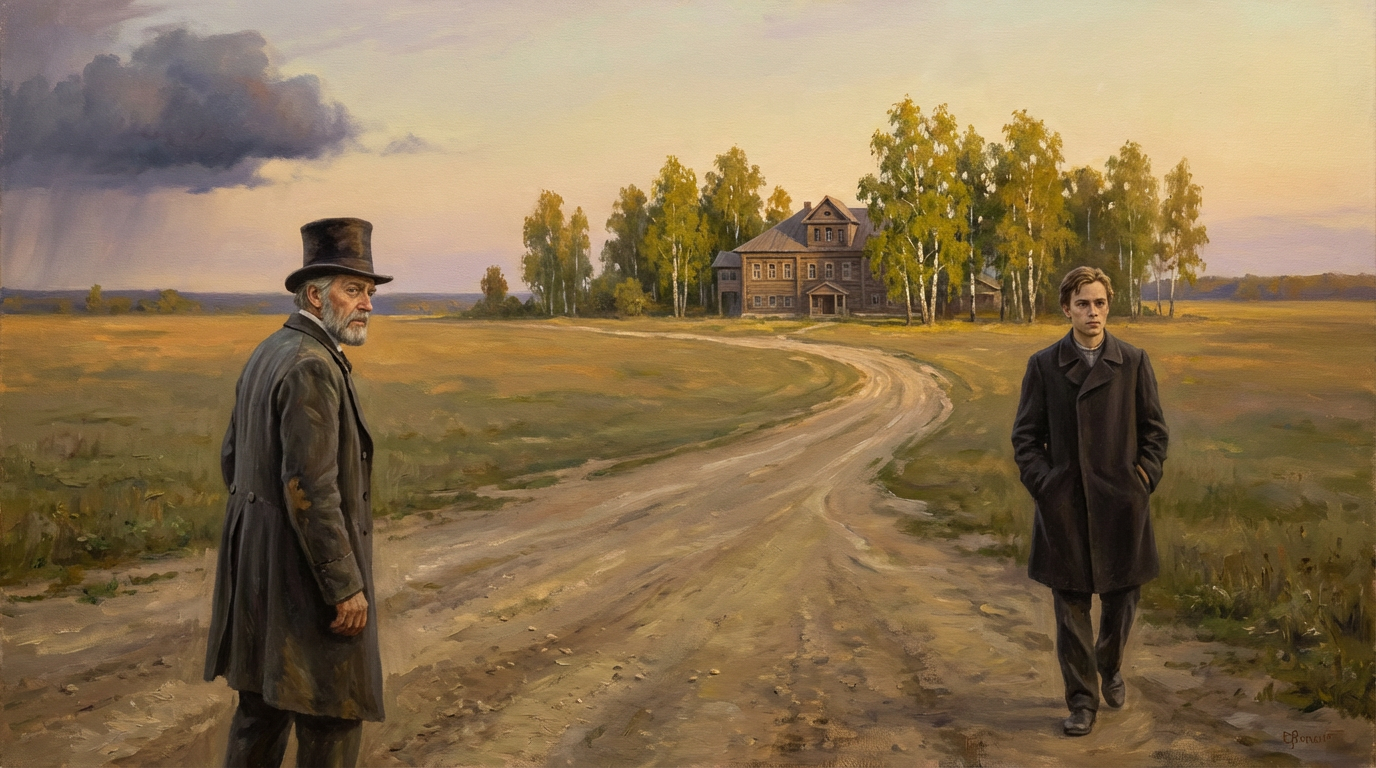
An excerpt from the original text.(complete · 3401 words)
lthough the late Monsieur Odintsov had disliked "innovations," he
had not been opposed to the indulgence of "a certain play of refined
taste," and had erected, in a space between the hothouses and the lake,
a building modelled in the style of a Greek temple, but consisting
of undeniable Russian bricks. Also, he had caused to be inserted in
the massive rear wall of this temple or gallery six niches for six
statues which were designed to represent Solitude, Silence, Thought,
Melancholy, Modesty, and Sensibility, and which he had purposed to
import from abroad; but only one of these, the statue of the Goddess
of Silence, with a finger to her lips, had actually been delivered and
erected; and even of that the household underlings had knocked off the
nose on the very day of the statue's arrival. True, a neighbouring
sculptor had offered to furnish the goddess with a nose "twice as good
as the last one," but Odintsov had none the less ordered her removal to
a corner of the millhouse, where for several years past she had acted
as a source of superstitious awe to the peasant women of the district.
Likewise, the front wall of the temple had become so overgrown with
bushes that only the capitals of the supporting columns remained
visible above the mass of verdure, and even at midday the interior
of the building was cool and pleasant; and though Anna Sergievna had
never really liked the place since the day when she had discovered an
adder there, Katia paid it frequent visits, and, seating herself on
a great stone bench which was fixed under one of the niches, would
read or work, or surrender herself to the influence of that perfect
restfulness which, known, probably, to every one, comes of a silent,
half-unconscious contemplation of the great waves of life as they
break for ever around and against us.
On the morning after Bazarov's arrival Katia was in her usual position
on the bench, and beside her was Arkady--he having specially asked her
to accompany him thither.
Though an hour was still wanting to luncheon time, the dew and the
freshness of the morning had already given place to the sultriness
and the aridity of noontide. Arkady's face yet bore the expression
of yesterday, but Katia's features were stamped with one, rather, of
depression. This was because after breakfast her sister had called
her into the boudoir, and to some of those blandishments which always
alarmed the girl had added a word of advice that Katia should observe
more caution in her converse with Arkady, and, above all things, avoid
such solitary tête-à-têtes with him as appeared to have aroused
the attention of the household in general, and of the Princess in
particular. Since the previous evening Anna Sergievna had been out
of humour; and inasmuch as Katia's conscience was not wholly clear
of responsibility in the matter, she had intimated, when yielding to
Arkady's request, that it must be for the last time.
"Katia," he began with a sort of easy uneasiness, "since the day when I
had the good fortune to reside under the same roof as yourself I have
talked to you on many different subjects. But one particular question
has for me a paramount importance: nor upon that question have I yet
touched. Yesterday you said that during my stay here I have undergone
a process of reformation"--he neither sought nor avoided Katia's
eye--"and, to be frank, such a reformation has, in part at least, come
about. Better than any one else do you know that this is so--you to
whom, above all others, that remaking is due."
"To me?" she re-echoed.
"Yes, to you," Arkady repeated. "No longer am I the presumptuous lad
who came here a short while ago: not for nothing have I attained my
twenty-third year. And though I still wish to be of use in life, though
I still wish to consecrate the whole of my faculties to the service of
Truth, I no longer seek my ideals where I was wont to do--they appear
to me to stand much nearer home. Hitherto I have been in ignorance of
myself, hitherto I have set myself tasks beyond my powers; but now,
through a certain feeling which is within me, my eyes have become
opened. By the way, the manner in which I express myself may be lacking
in clarity, yet I venture to hope that I have made myself understood?"
Katia said nothing; but she ceased to look at the speaker.
"In my opinion," he went on in a tone of rising emotion, while in
a birch tree overhead a chaffinch started pouring forth a flood of
unstudied song, "in my opinion, it is the duty of an honourable man to
be frank with those who, with those who--in short, with those who stand
nearest to him in life. Consequently I, I am minded to--to---"
Here Arkady's eloquence failed him. He stumbled and stuttered and
had to pause for a moment. Meanwhile Katia's eyes remained lowered.
One would have thought that she did not in the least understand this
preamble, but was expecting to hear something quite of a different
nature.
"That I shall surprise you I know in advance," continued Arkady, once
more spurring his faculties. "And that surprise will be the greater
when I tell you that the feeling to which I have alluded concerns, to a
certain extent--yes, to a certain extent, yourself. For yesterday, you
will remember, you imputed to me a lack of gravity "--he was speaking
much like a man who, having blundered into a bog, feels that at each
step he sinks deeper and deeper, yet struggles on in the hope of
eventually extricating himself--"and such a reproach is all too often
levelled against, all too often falls upon, young people who have
ceased to deserve it. Were I but possessed of more self-confidence"
("God help me! God help me!" he thought despairingly, but Katia did not
even turn her head)--"had I but the right to hope that----"
"Did I but feel sure that you really mean what you say," broke in, at
this moment, the clear accents of Anna Sergievna.
Arkady became dumb, and Katia turned pale; for along a little path
which skirted the bushes screening the temple there were advancing
Bazarov and Madame! Katia and Arkady could not actually see the pair,
yet they could hear every word uttered, and even catch the sound of
their breathing, and the rustle of Anna Sergievna's dress. Advancing a
few more steps, the couple halted, and remained standing in front of
the building.
"It is like this," Anna Sergievna continued. "You and I have blundered
into an error. That is to say, while neither of us is in the heyday of
youth--I so least of the two--and both of us have lived our fives and
are weary, we are also (for I need not stand on ceremony) individuals
of intellect. Consequently, though, at first, we interested one
another, and felt our mutual curiosity aroused, it happened that
subsequently----"
"That subsequently I grew stale in your eyes," hazarded Bazarov.
"Oh no! That that was not the cause of the situation you are well
aware. But, whatever the cause, you and I have not a compelling need
of one another. Therein lies the point. In other words, both of us have
in us--how shall I express it?--both of us are too mutually akin. We
were slow to grasp that fact. Now, Arkady---"
"Have you a 'compelling need'--of him?" put in Bazarov.
"For shame, Evgenii Vasilitch! You yourself have averred that he is
not wholly indifferent to me; and I too have long suspected that he
cherishes for me at least a measure of admiration. As we are on the
subject, I will not attempt to conceal from you that of late the fact
that I am old enough to be his aunt has not prevented me from devoting
to him more of my thoughts than I used to do. In his fresh young
sentimentality there is a certain charm."
"The term 'fascination' comes handier in such cases," said Bazarov in
the deep, quiet tone which, with him, always signified sarcasm. "As a
matter of fact, I found Arkady secretive yesterday--he made but the
scantiest of references either to you or your sister. That constitutes
an important symptom."
"Katia and he are brother and sister to one another," said Madame.
"Indeed I am pleased to see it--though perhaps I ought not to connive
at so much familiarity."
"I presume that the element speaking in you is the sister?" drawled
Bazarov.
"Of course! But need we stand here? Let us move on. We hold curious
conversations, do we not? Indeed, to think of all the things which I
now say to you! Yet I still fear you a little, even though I trust you
as being, at heart, a good man."
"I am far from good; and you only call me so because I have lost all
significance in your eyes. Ill boots it to weave chaplets for the head
of a corpse."
"Evgenii Vasilitch, we cannot always command ourselves," came the sound
of Anna Sergievna's next words; but the next moment the wind soughed,
the leaves rustled, and the rest of what she was saying was carried
away into the distance. Nothing beyond it save (after a pause) "You are
free, are you not?" on the part of Bazarov could be distinguished.
Then the sound of their footsteps died away, and once more complete
silence reigned.
Turning to Katia, Arkady saw that she was sitting as before, but with
her head more bent.
"Katerina Sergievna," he said tremulously, and with his hands clasped,
"I shall love you always, and beyond recall; nor shall I ever love
another woman. This is what I have been trying to say to you this
morning, in the hope that I might ascertain your views, and then beg
for your hand. I am not a rich man, but I would make any sacrifice for
your sake. Come, then! Will you answer me? Will you trust me? Surely
you do not think that I am speaking out of frivolity? Recall the past
few days: may you not rest assured now that my remaining self (you know
what I mean) is gone for ever? Come, look at me--look at me and speak
but a word, a single word. I love you, I love you! Do not refuse to
believe that I mean what I say."
Gravely, yet with a radiant look in her eyes, Katia raised her head,
and, after a moment's thought, said with the trace of a smile: "Yes."
Arkady leapt up.
"'Yes'? You have said 'Yes,' Katia! But what do mean by that word? Do
you mean that you believe in my love, or do you mean that----? No, no;
I dare not finish the sentence."
Katia repeated only the word "Yes," but this time she left no room for
misunderstanding. Arkady seized her large, but not unshapely, hands in
his, and, panting with rapture, strained her to his breast. He could
scarcely stand upon his feet--he could only keep repeating again and
again: "Katia! Katia!" Meanwhile she shed a few innocent tears at which
she smiled as they fell. The man who has not seen such tears in the
eyes of his beloved does not know the height of happiness to which,
with mingled joy and gratitude and modesty, a woman can attain.
Next morning Anna Sergievna sent for Bazarov to her boudoir; and when
he arrived she, with a forced smile, handed him a folded sheet of
notepaper. That sheet represented a letter from Arkady, a letter in
which he begged for her sister's hand.
Bazarov skimmed the epistle--then scarcely could forbear venting the
rancour which blazed for a moment in his breast.
"It is as I said, you see," he commented. "Only yesterday you were
telling me that his feeling for Katerina Sergievna was that of a
brother for a sister! And what are you going to do?"
"What would you advise me to do?" she said, still smiling.
"I presume"--he also was smiling, although he was feeling as wholly out
of spirits, as little inclined towards gaiety, as she was--"I presume
that we have no choice but to bestow our blessing upon the young
couple. In every respect it would be a good match, for his father has
a nice little property, Arkady is the only son, and the father is too
easy-going to be likely to raise any difficulty."
Madame Odintsov rose and paced the room for a moment or two--her face
alternately flushing and turning pale.
"So that is what you think?" she said. "Well, I too see no impediment.
Indeed, the affair rejoices me both for Katia's sake and for--yes, for
his. But first I must await his father's consent; and for that purpose
I will send Arkady himself to interview Nikolai Petrovitch. So I was
right yesterday, was I not? I was right when I said that you and I are
become elderly? How did I fail to foresee this? I am indeed surprised
at it!"
Again she smiled, but, in the very act of smiting, turned away.
"Our young folk are indeed cunning," remarked Bazarov. After a pause he
added:
"Good-bye now. I hope that the affair may develop Well. From a distance
I, too, shall rejoice."
She turned and faced him.
"Need you really go?" she asked. "Why not stay a little longer? Pray
stay, for I find talking to you a stimulant--it is like walking on the
edge of a precipice: at first one is afraid, then one gathers courage.
Do not go."
"I thank you for the proposal, as also for your flattering estimate of
my conversational powers," said Bazarov. "Nevertheless, I have tarried
overlong in a sphere which is alien to my personality. Only for a while
can flying fish support themselves in the air. Then they relapse into
their natural element. Allow me to flop back into mine."
Yet a bitter laugh was twisting his pale features. She saw it, and felt
sorry for him.
"The man still loves me," was her thought, and she extended a
sympathetic hand.
He understood her, however.
"No, no!" he exclaimed as he withdrew a step or two. "Though poor, I
have never yet accepted aims. Good-bye, and may your lot always be
happy."
"Yet we shall meet again," she replied with an involuntary gesture. "Of
that I am certain."
"Anything may occur in this world," he remarked--then bowed and was
gone.
That afternoon he said to Arkady as he knelt down to pack his trunk:
"I hear that you are going to make a nest for yourself? And why should
you not? It is an excellent course to take. But for you to dissemble
is useless, and I had scarcely expected that you would do so. Has the
preoccupation of it all deprived you of your tongue?"
"When I left you at Marino I had no thought of this," said Arkady. "You
are the dissembler, though, are you not? For when you say 'It is an
excellent course to take,' you dissemble, as well as waste your time,
seeing that I am well aware of your views on marriage."
"Merely my way of expressing myself. You see what I am doing at this
moment. In my trunk is a vacant space. I am packing it with straw.
And the same with life's trunk. To avoid leaving empty spaces therein
we pad the interstices. You need not be offended. You cannot fail
to remember what I really think of Katerina Sergievna. While some
maidens earn cheap reputations by merely smiling at right moments, your
inamorata can show more--indeed, so much more that soon you will be
(and very properly) under her thumb."
Slapping down the lid of the trunk, Bazarov rose from the floor.
"Now, farewell," he said. "No, I will not deceive you: we are parting
for ever, and you know it. In my opinion you have acted wisely,
for you were not meant to live the hard, bitter, reckless life of
Nihilism--you lack at once the necessary coolness and the necessary
venom. But this is not to say that in you there is not a due measure of
youthful spirit. What I mean is that that asset alone is not sufficient
for the work. The dvorianin is powerless to progress beyond either
well-bred effervescence or well-bred humility: and both sentiments
are futile. For example, you have not yet been blooded, yet already
you think yourself a man: whereas the two chief conditions of our
existence are battle and bloodshed. Yes, the dust from our heels hurts
your eyes, and the grime on our bodies makes you feel dirty. In other
words, although you derive a certain gratification from indulging in
self-criticism, and think no small beer of yourself, you have failed
to grow to our stature. To us such things are vanities. Tools' of an
altogether different kind are what we need for the task. Consequently
I repeat that, though a fine young fellow enough, you are also just a
little-minded, so-called 'liberal-minded' baritch[1]--what my father
calls a 'product of evolution.'"
"Evgenii," was Arkady's sad reply, "we are parting for ever, yet this
is all that you have to say to me!"
Bazarov scratched his head.
"Something else I could say, Arkady," he replied. "But I will not say
that something--it would savour too much of Romanticism. Get married
as soon as you can, line your nest, and beget plenty of offspring. Nor
will those offspring be altogether fools, seeing that they will be born
in due season, and not when you and I were.... My horses are ready and
I must depart. Of the rest of the household I have taken leave already.
Shall we embrace once more, eh?"
The tears gushed in torrents from Arkady's eyes as he flung himself
upon his old friend and mentor.
"Ah, youth, youth!" commented Bazarov. "See what comes of being young!
But before long, I know, Katerina Sergievna will have set things right.
Yes, she will console you."
With a last good-bye he mounted the travelling cart, and, in the act of
doing so, pointed to a pair of jackdaws which were sitting perched upon
the stable roof.
"See!" he cried. "There's an instructive lesson for you!"
"What do you mean?" queried Arkady.
"What?" was Bazarov's ejaculation. "Are you so ignorant of, or so
forgetful of, natural history as not to know that the jackdaw is the
most respected of family birds? Mark the good example before you.
Farewell, señor!"
And with a clatter the cart started on its way.
Nor was Bazarov mistaken, for, even before nightfall, Arkady, deep
in conversation with Katia, had completely forgotten his vanished
instructor. Moreover, already the young fellow was beginning to play
second fiddle to his fiancée: which circumstance the girl, on
realising, in no way felt surprised at. So it was arranged that on the
following day he should depart for Marino to interview his father;
and in the meanwhile, Anna Sergievna, having no desire to hamper the
young couple, merely observed such a show of propriety as involved
her not leaving them together for long, but at the same time keeping
at a distance the Princess, who, since the tidings of the impending
union, had been in a state of lachrymose rancour. For herself, Anna
Sergievna had at first feared that the spectacle of the young people's
happiness would prove too much for her; but now the contrary proved to
be the case, and she not only failed to feel hurt at the spectacle,
but even found that it interested her and eventually softened her--a
consummation which brought both relief and regret.
"Bazarov was right," she reflected. "It was mere curiosity, mere love
of ease, mere egoism, mere----"
"Children, is love an empirical sentiment?" once she asked of Arkady
and Katia: but neither of the pair understood her meaning. Moreover,
they were fighting a little shy of her, since they could not altogether
forget the conversation which they had involuntarily overheard; but in
time Anna Sergievna succeeded in overcoming also this timidity, and
found the task the more easy to perform in that she had succeeded also
in overcoming her disappointment.
[1] A small squire.
Master this chapter. Complete your experience
Purchase the complete book to access all chapters and support classic literature
As an Amazon Associate, we earn a small commission from qualifying purchases at no additional cost to you.
Available in paperback, hardcover, and e-book formats
Let's Analyse the Pattern
When relationships end through mutual recognition and truth-telling rather than drama or deception, creating space for better matches.
Why This Matters
Connect literature to life
This chapter teaches how to distinguish between relationships that work because they complement versus those that fail because they mirror too closely.
Practice This Today
This week, notice when conflicts with someone feel like arguing with yourself—that's often a sign you're too similar to sustain long-term partnership.
Now let's explore the literary elements.
Key Quotes & Analysis
"We haven't the compelling need of each other - that's the trouble! I think I never properly understood this before."
Context: Anna explains to Bazarov why their relationship failed
This reveals Anna's mature understanding that intellectual attraction isn't enough for lasting love. She recognizes that real relationships require emotional necessity, not just mental compatibility.
In Today's Words:
We don't actually need each other - we just thought we did because we had good conversations.
"You're not made for our sort of life. You haven't the audacity, you haven't the hatred, though you have youth and daring and self-confidence."
Context: Bazarov's brutal farewell assessment of Arkady
Bazarov recognizes that Arkady lacks the fundamental anger needed for revolutionary life. This isn't an insult but a realistic assessment - Arkady is meant for happiness, not rebellion.
In Today's Words:
You're not angry enough to be a real rebel - you're meant for a normal, happy life.
"I love you! I love you! Do you understand me?"
Context: His stammering declaration of love to Katia
The repetition and question show his desperation to be understood and accepted. This moment represents his complete emotional vulnerability and his choice of love over intellectual posturing.
In Today's Words:
I'm crazy about you! Please tell me you feel the same way!
Thematic Threads
Compatibility
In This Chapter
Anna and Bazarov realize they're too intellectually similar while Arkady and Katia complement each other perfectly
Development
Evolved from earlier attraction to mature understanding of what actually works long-term
In Your Life:
You might discover that sharing everything in common isn't as important as balancing each other's strengths and weaknesses
Self-Knowledge
In This Chapter
Bazarov accepts he's a 'flying fish' who must return to his natural element rather than forcing an unnatural fit
Development
Culmination of his journey from arrogant certainty to honest self-assessment
In Your Life:
You might recognize when you're trying to be someone you're not to fit into a situation that doesn't suit you
Mentorship
In This Chapter
Bazarov's brutal but caring final advice to Arkady about domestic happiness versus nihilist rebellion
Development
Transformation from competitive friendship to genuine guidance
In Your Life:
You might need to give someone hard truths about their path, even when it means letting them go
Timing
In This Chapter
Arkady's confession succeeds while Anna and Bazarov's connection fails, showing how readiness matters more than intensity
Development
Built throughout the book as characters mature at different rates
In Your Life:
You might realize that being right for each other isn't enough if the timing is wrong
Grace
In This Chapter
Both failed lovers handle their ending with dignity, even helping arrange the successful match
Development
Shows how painful experiences can teach wisdom and generosity
In Your Life:
You might find that your biggest disappointments teach you how to genuinely celebrate others' happiness
You now have the context. Time to form your own thoughts.
Discussion Questions
- 1
Why does Anna tell Bazarov they were 'too similar' to make their relationship work, and what does she mean by lacking 'compelling need'?
analysis • surface - 2
What makes Arkady and Katia's relationship succeed where Anna and Bazarov's failed, and how does their confession scene contrast with the earlier tension between the older pair?
analysis • medium - 3
Where do you see this pattern of 'honest endings' in modern relationships - romantic, professional, or friendship - and why do people often avoid this kind of direct conversation?
application • medium - 4
When have you had to choose between offering someone false comfort and telling them a difficult truth? How did you handle it, and what were the results?
application • deep - 5
What does Bazarov's final gesture - pointing to the jackdaws as 'perfect family birds' - reveal about his understanding of love and his own nature?
reflection • deep
Critical Thinking Exercise
Practice the Clean Ending
Think of a relationship in your life (work, personal, romantic) that has run its course but hasn't been honestly addressed. Write out what Anna and Bazarov's 'surgical precision' conversation would sound like in your situation. Focus on stating facts without blame, acknowledging what worked, and clearly naming why it's time to move on.
Consider:
- •What would honest acknowledgment look like without cruelty or false softening?
- •How can you take responsibility for your part without taking on guilt that isn't yours?
- •What would 'releasing completely' mean in practical terms for this relationship?
Journaling Prompt
Write about a time when someone gave you an honest ending instead of letting things drag out. How did their directness serve you, even if it hurt initially? What did you learn about yourself from that experience?
Coming Up Next...
Chapter 27: The Final Reckoning
Bazarov returns to his parents' humble home, where his arrival brings unexpected joy to the old couple. But the man who left seeking revolution returns changed, carrying wounds that even parental love may not be able to heal.



