
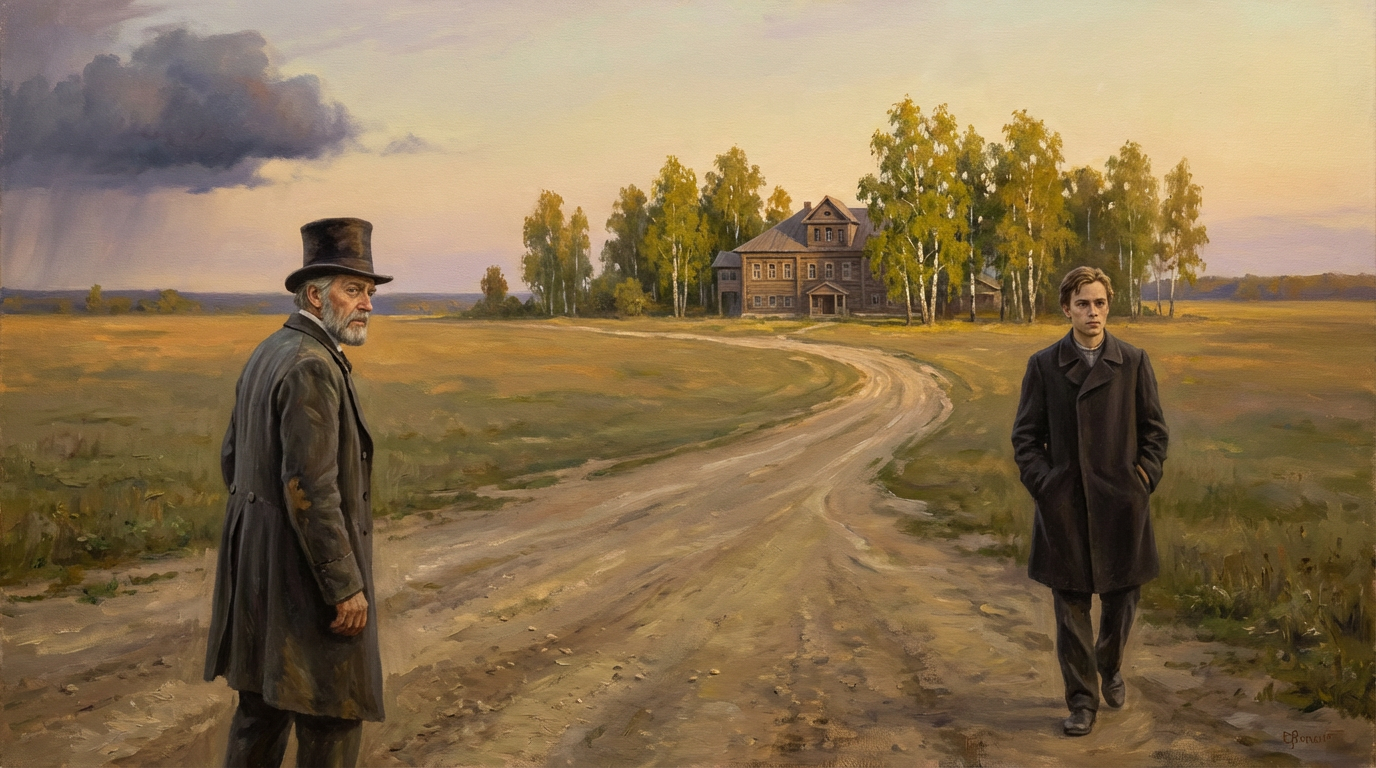
An excerpt from the original text.(complete · 1420 words)
"ell, Peter? Cannot you see them yet?" asked a barin[1] of about
forty who, hatless, and clad in a dusty jacket over a pair of tweed
breeches, stepped on to the verandah of a posting-house on the 20th
day of May, 1859. The person addressed was the barin's servant--a
round-cheeked young fellow with small, dull eyes and a chin adorned
with a tuft of pale-coloured down.
Glancing along the high road in a supercilious manner, the servant
(in whom everything, from the turquoise ear-ring to the dyed, pomaded
hair and the mincing gait, revealed the modern, the rising generation)
replied: "No, barin, I cannot."
"Is that so?" queried the barin.
"Yes," the servant affirmed.
The barin sighed, and seated himself upon a bench. While he is
sitting there with his knees drawn under him and his eyes moodily
glancing to right and left, the reader may care to become better
acquainted with his personality.
His name was Nikolai Petrovitch Kirsanov, and he owned (some fifteen
versts from the posting-house) a respectable little property of about
two hundred souls (or, as, after that he had apportioned his peasantry
allotments, and set up a "farm," he himself expressed it, a property
"of two thousand desiatini"[2]). His father, one of the generals
of 1812, had spent his life exclusively in military service as the
commander, first of a brigade, and then of a division; and always he
had been quartered in the provinces, where his rank had enabled him to
cut a not inconspicuous figure. As for Nikolai Petrovitch himself, he
was born in Southern Russia (as also was his elder brother, Paul--of
whom presently), and, until his fourteenth year, received his education
amid a circle of hard-up governors, free-and-easy aides-de-camp, and
sundry staff and regimental officers. His mother came of the family of
the Koliazins, and, known in maidenhood as Agathe, and subsequently as
Agathoklea Kuzminishna Kirsanov, belonged to the type of "officer's
lady." That is to say, she wore pompous mobcaps and rustling silk
dresses, was always the first to approach the cross in church, talked
volubly and in a loud tone, of set practice admitted her sons to kiss
her hand in the morning, and never failed to bless them before retiring
to rest at night. In short, she lived the life which suited her. As
the son of a general, Nikolai Petrovitch was bound--though he evinced
no particular bravery, and might even have seemed a coward--to follow
his brother Paul's example by entering the army; but unfortunately,
owing to the fact that, on the very day when there arrived the news of
his commission, he happened to break his leg, it befell that, after
two months in bed, he rose to his feet a permanently lamed man. When
his father had finished wringing his hands over the mischance, he sent
his son to acquire a civilian education; whence it came about that
Nikolai, at eighteen, found himself a student at the University of
St. Petersburg. At the same period his brother obtained a commission
in one of the regiments of Guards; and, that being so, their father
apportioned the two young men a joint establishment, and placed it
under the more or less detached supervision of Ilya Koliazin, their
maternal uncle and a leading tchinovnik.[3] That done, the father
returned to his division and his wife, and only at rare intervals
sent his sons sheets of grey foolscap (scrawled and re-scrawled in
flamboyant calligraphy) to which there was appended, amid a bower of
laborious flourishes, the signature "Piotr Kirsanov, Major-General."
In the year 1835 Nikolai Petrovitch obtained his university degree;
and in the same year General Kirsanov was retired for incompetence
at a review, and decided to transfer his quarters to St. Petersburg.
Unfortunately, just as he was on the point both of renting a house
near the Tavritchesky Gardens and of being enrolled as a member of
the English Club, a stroke put an end to his career, and Agathoklea
Kuzminishna followed him soon afterwards, since never had she succeeded
in taking to the dull life of the capital, but always had hankered
after the old provincial existence. Already during his parents'
lifetime, and to their no small vexation, Nikolai Petrovitch had
contrived to fall in love with the daughter of a certain tchinovnik
named Prepolovensky, the landlord of his flat; and since the maiden was
not only comely, but one of the type known as "advanced" (that is to
say, she perused an occasional "Science" article in one newspaper or
another), he married her out of hand as soon as the term of mourning
was ended, and, abandoning the Ministry of Provincial Affairs to which,
through his father's influence, he had been posted, embarked upon
connubial felicity in a villa adjoining the Institute of Forestry.
Thence, after a while, the couple removed to a diminutive, but in
every way respectable, flat which could boast of a spotless vestibule
and an icy-cold drawing-room; and thence, again, they migrated to the
country, where they settled for good, and where, in due time, they
had born to them a son Arkady. The existence of husband and wife
was one of perfect comfort and tranquillity. Almost never were they
parted from one another, they read together, they played the piano
together, and they sang duets. Also, she would garden or superintend
the poultry-yard, and he would set forth a-hunting, or see to the
management of the estate. Meanwhile Arkady led an existence of equal
calm and comfort, and grew, and waxed fat; until, in 1847, when ten
years had been passed in this idyllic fashion, Kirsanov's wife breathed
her last. The blow proved almost more than the husband could bear--so
much so that his head turned grey in a few weeks. Yet, though he sought
distraction for his thoughts by going abroad, he felt constrained, in
the following year, to return home, where, after a prolonged period of
inaction, he took up the subject of Industrial Reform. Next, in 1855,
he sent his son to the University of St. Petersburg, and, for the same
reason, spent the following three winters in the capital, where he
seldom went out, but spent the greater part of his time in endeavouring
to fraternise with his son's youthful acquaintances. The fourth winter,
however, he was prevented by various circumstances from spending in St.
Petersburg; and thus in the May of 1859 we see him--grey-headed, dusty,
a trifle bent, and wholly middle-aged--awaiting his son's home-coming
after the elevation of the latter (in Nikolai's own footsteps) to the
dignity of a graduate.
Presently either a sense of decency or (more probably) a certain
disinclination to remain immediately under his master's eye led the
servant to withdraw to the entrance gates, and there to light a pipe.
Nikolai Petrovitch, however, continued sitting with head bent, and his
eyes contemplating the ancient steps of the verandah, up which a stout
speckled hen was tap-tapping its way on a pair of splayed yellow legs,
and thereby causing an untidy, but fastidious-looking, cat to regard
it from the balustrade with marked disapproval. Meanwhile the sun
beat fiercely down, and from the darkened interior of a neighbouring
granary came a smell as of hot rye straw. Nikolai Petrovitch sank
into a reverie. "My son Arkady a graduate!"--the words kept passing
and repassing through his mind. Again and again he tried to think of
something else, but always the same thought returned to him. Until
eventually he reverted to the memory of his dead wife. "Would that she
were still with me!" was his yearning reflection. Presently a fat blue
pigeon alighted upon the roadway, and fell to taking a hasty drink from
a pool beside the well. And almost at the instant that the spectacle of
the bird caught Nikolai Petrovitch's eye, his ear caught the sound of
approaching wheels.
"They are coming, I think," hazarded the servant as he stepped forward
through the gates.
Nikolai Petrovitch sprang to his feet, and strained his eyes along the
road. Yes, coming into view there was a tarantass,[4] drawn by three
stagehorses; and in the tarantass there could be seen the band of a
student's cap and the outlines of a familiar, well-beloved face.
"Arkasha, Arkasha!" was Kirsanov's cry as, running forward, he
waved his arms. A few moments later he was pressing his lips to the
sun-tanned, dusty, hairless cheek of the newly-fledged graduate.
[1] Gentleman or squire.
[2] The desiatin = 2.86 acres.
[3] Civil servant.
[4] A species of four-wheeled carriage.
Master this chapter. Complete your experience
Purchase the complete book to access all chapters and support classic literature
As an Amazon Associate, we earn a small commission from qualifying purchases at no additional cost to you.
Available in paperback, hardcover, and e-book formats
Let's Analyse the Pattern
When love for someone creates fear of disappointing them or being outgrown by them, leading to emotional distance despite genuine affection.
Why This Matters
Connect literature to life
This chapter teaches how to recognize when love creates performance pressure between people at different life stages.
Practice This Today
This week, notice when you feel like you need to prove your worth to someone you care about—that's the generational anxiety trap in action.
Now let's explore the literary elements.
Key Quotes & Analysis
"Everything, from the turquoise ear-ring to the dyed, pomaded hair and the mincing gait, revealed the modern, the rising generation"
Context: Describing Peter the servant's appearance and attitude
This shows how social change affects everyone, even servants. Peter's fancy appearance and attitude signal that old hierarchies are breaking down. The narrator's tone suggests both fascination and concern about these changes.
In Today's Words:
Everything about him screamed 'young person trying too hard to be trendy and important'
"His father, one of the generals of 1812, had spent his life exclusively in military service"
Context: Explaining Nikolai's family background and military tradition
This establishes the family's proud military heritage and shows how Nikolai broke from tradition. The reference to 1812 (Napoleon's invasion) connects the family to Russian national glory, making Nikolai's civilian life seem like a departure from duty.
In Today's Words:
His dad was a war hero who made the military his whole life
"He had married her for love—a thing which, in his day, was seldom done"
Context: Describing Nikolai's marriage to his deceased wife
This reveals Nikolai as someone who chose personal happiness over social expectations. Marrying for love rather than social advantage was revolutionary, showing he was progressive for his time but may now seem old-fashioned to his son.
In Today's Words:
He married her because he actually loved her, which was pretty radical back then
Thematic Threads
Class
In This Chapter
Nikolai's anxiety about his son's university education reflects class mobility fears—will Arkady's new learning make him look down on his father?
Development
Introduced here
In Your Life:
You might feel this when your kids get opportunities you never had, or when you advance beyond your family's expectations.
Identity
In This Chapter
Nikolai defines himself through his roles as father and widower, but his son's return forces him to question who he is beyond those identities.
Development
Introduced here
In Your Life:
You might recognize this when your primary identity (parent, caregiver, worker) gets challenged by life changes.
Social Expectations
In This Chapter
The pressure for Arkady to succeed at university and for Nikolai to be a proper father creates performance anxiety for both.
Development
Introduced here
In Your Life:
You might feel this pressure when family milestones approach—graduations, weddings, promotions—and everyone expects you to play your role perfectly.
Personal Growth
In This Chapter
Arkady's education represents growth that creates distance from his origins, a common tension in personal development.
Development
Introduced here
In Your Life:
You might experience this when therapy, education, or new experiences change how you see the world, making old relationships feel strained.
Human Relationships
In This Chapter
The love between father and son is complicated by time, change, and unspoken expectations about who they should be to each other.
Development
Introduced here
In Your Life:
You might see this in any relationship where both people have grown but haven't talked about how that growth affects their connection.
You now have the context. Time to form your own thoughts.
Discussion Questions
- 1
Why is Nikolai so nervous about his son coming home from university? What specific fears does his waiting reveal?
analysis • surface - 2
How does Nikolai's broken leg early in life actually shape his entire future? What does this tell us about how unexpected setbacks can redirect our paths?
analysis • medium - 3
Think about someone in your life who's gone through major education or career changes. How did that change the dynamic between you? Did love make the transition harder or easier?
application • medium - 4
Nikolai wants to share his pride with his deceased wife but can't. How do you handle celebrating achievements when the people who would be proudest aren't there to see them?
application • deep - 5
What does this chapter suggest about the relationship between love and fear? Why might caring deeply about someone actually make relationships more fragile during transitions?
reflection • deep
Critical Thinking Exercise
Map Your Own Generational Anxiety
Think of a relationship where education, career changes, or life transitions created distance between you and someone you care about. Draw two columns: 'What I was afraid of' and 'What they might have been afraid of.' Fill in both sides, then identify which fears were spoken out loud and which ones stayed hidden.
Consider:
- •Consider how assumptions about what the other person was thinking might have been wrong
- •Notice whether the fear of disappointing each other prevented honest conversation
- •Think about whether the distance was temporary growing pains or permanent change
Journaling Prompt
Write about a time when you felt like you had outgrown someone or they had outgrown you. What would you say to them now if you could have that conversation over again?
Coming Up Next...
Chapter 2: First Impressions and Social Masks
Father and son reunite after months apart, but Arkady isn't traveling alone. The mysterious companion he's brought home will soon shake up the quiet country estate in ways Nikolai never expected.



