
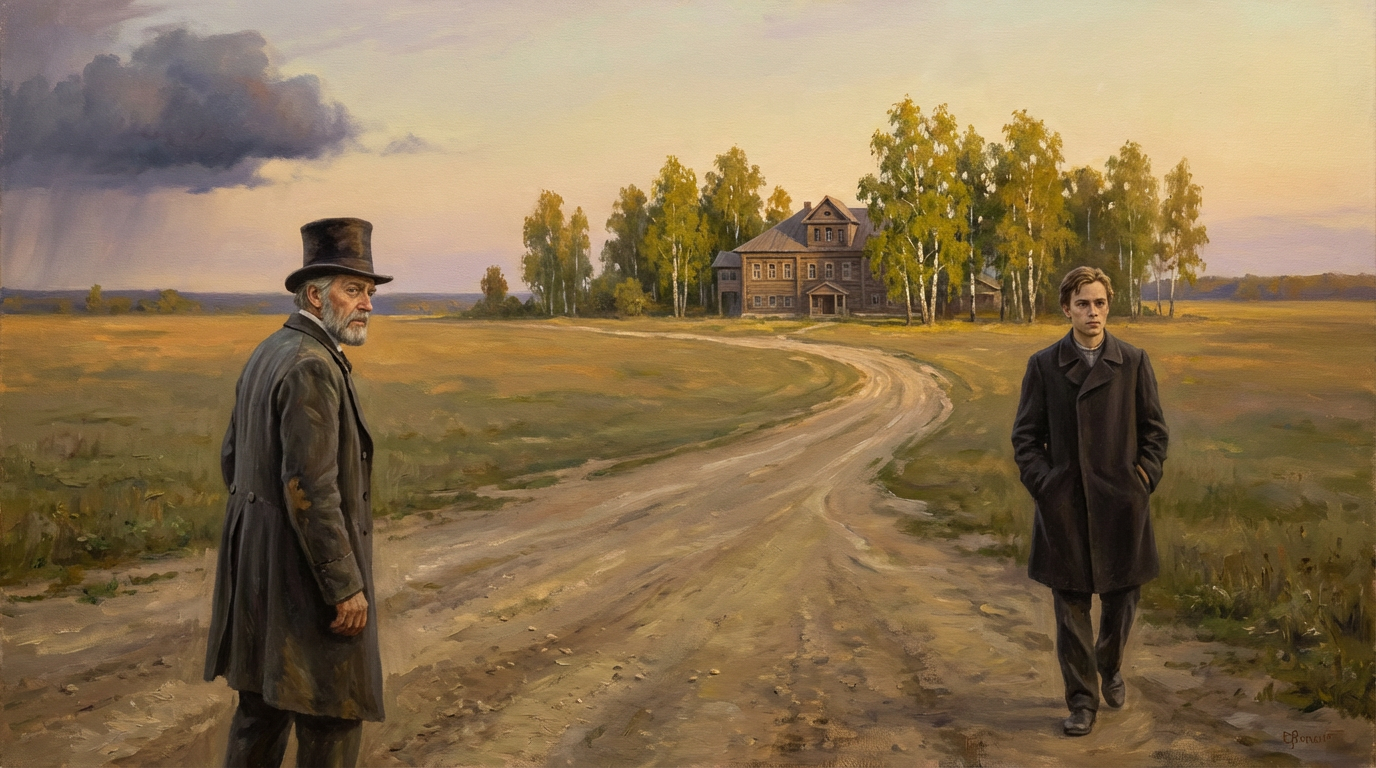
An excerpt from the original text.(complete · 1547 words)
alf an hour later Nikolai Petrovitch sought his favourite arbour.
Despondent thoughts were thronging through his brain, for the rift
between himself and his son was only too evident. Also, he knew that
that rift would widen from day to day. For nothing had he spent whole
days, during those winters in St. Petersburg, in the perusal of modern
works! For nothing had he listened to the young men's discourses! For
nothing had he been delighted when he had been able to interpolate a
word into their tempestuous debates!
"My brother says that we are more in the right than they," he
reflected. "And certainly I too can say without vanity that I believe
these young fellows to stand at a greater distance from the truth than
ourselves. Yet also I believe that they have in them something which
we lack--something which gives them an advantage over us. What is that
something? Is it youth? No, it is not youth alone. Is it that there
hovers about them less of the barin than hovers about ourselves?
Possibly!"
Bending his head, he passed his hand over his face.
"Yet to reject poetry!" he muttered. "To fail to sympathise with art
and nature!"
And he gazed around as though he were trying to understand how any
one could be out of sympathy with the natural world. Evening was just
closing in, and the sun sinking behind a small aspen copse which,
situated half a verst from the garden, was trailing long shadows over
the motionless fields. Along the narrow, dark track beside the copse
a peasant on a white pony was trotting; and though the pair were
overshadowed by the trees, the rider was as clearly visible, even to a
patch on his shoulder, as the twinkling legs of his steed. Piercing
the tangled aspens, the sun's beams were bathing the trunks in so
brilliant a glow that trunks and beams were one bright mass, and only
the foliage on the boughs above formed a dusky blur against the lighter
tints of the flame-coloured sky. Overhead bats were whirling; the wind
had sunk to rest; a few late-homing bees were buzzing somnolently,
sluggishly amid the lilac blossoms; and a pillared swarm of gnats was
dancing over a projecting bough.
"O God, how fair!" was Nikolai's involuntary thought as his lips
breathed a favourite couplet.
Suddenly he remembered Arkady and Stoff und Kraft; and though
he continued to sit where he was, he quoted poetry no more, but
surrendered his mind wholly to the play of his lonely, irregular,
mournful thoughts. At all times he was a man fond of dreaming; and
to this tendency his life in the country had added confirmation. To
think of what only a short while ago he had been dreaming as he waited
for his son on the post-house verandah! For since that hour a change
had come about, and in the vague relations between himself and his
son there had dawned a more definite phase. Next, he saw before him
his dead wife. Yet he saw her, not as she had appeared to him during
the later years of her life--that is to say, as a kindly, thrifty
châtelaine--but as a young girl slim of figure and innocently
inquiring of eye. Yes, there flitted before his vision a picture only
of neatly plaited tresses falling over a childish neck. And he thought
of his first meeting with her when, as a student, he had encountered
her on the staircase leading to his suite of rooms. He remembered how,
having accidentally brushed against her, he had stopped to apologise,
but had only succeeded in muttering "Pardon, monsieur"; where-upon
she had bowed, and smiled, and fled as in sudden alarm--but only
to turn, the next moment, at the bend of the staircase, to look
swiftly back, and then, as swiftly, to blush, and assume a more demure
demeanour. Ah, those first timid meetings, those half-spoken words,
those bashful smiles, those alternate fits of rapture and despair, that
courtship that was destined to be crowned with swooning joy! Whither
was it all fled? True, she had become his wife, and had conferred upon
him such happiness as falls to the lot of few men on earth; but ever
the thought recurred to him, and recurred again: "Why could those days
of sweetness not have lasted for ever, so that we might have lived a
life which should never have known death?"
He made no attempt to co-ordinate his thoughts. The predominant feeling
in his mind was that he would give worlds to be able to connect himself
with those blessed days by something stronger than the mere power of
memory. He wanted to feel his Maria near him once more, to scent her
dear breath. A curious mood had him in its grip.
"Nikolai Petrovitch!" came the voice of Thenichka from a spot somewhere
in the vicinity. "Where are you?"
As he heard the call, a feeling that was neither vexation nor shame
passed over him. No comparison between his dead wife and Thenichka was
possible, yet he gave a start, and felt a passing regret that Thenichka
had seized that moment to seek him. For in some way did the sound
of her voice bring back to him his grey hairs, his old age, all that
constituted the present. So for an instant the enchanted world which
he had just entered, and which he had just seen emerge from the misty
waves of the past, quivered--then disappeared.
"I am here, Thenichka," he called. "Please go away. I will come
presently."
"Another reminder that I am a barin," he reflected.
Thenichka retired, and suddenly he became aware of the fact that since
the moment when he had sunk into a reverie nightfall had come. Yes,
all around him there lay a motionless obscurity, with, gleaming amid
it, as a small, pale blur, Thenichka's face. Rising, he started to
return to the house, but his unstrung nerves could not calm themselves,
and, glancing now at the ground, now towards the heavens where there
swarmed myriads of twinkling stars, he fell to pacing the garden. He
continued this pacing until he was almost worn out; for still did the
vague, despondent, insistent sense of agitation refuse to leave his
breast. Could Bazarov have divined his thoughts, how the Nihilist would
have laughed! And even Arkady would have condemned him. For from the
eyes of Nikolai Petrovitch--from the eyes of a man of forty-four who
was the proprietor of an estate and a household--there were welling
slow, uncalled-for tears. This was a hundred times worse than the
'cello-playing!
And still he continued his pacing, for he could not make up his mind
to enter the peaceful, inviting retreat which beckoned to him so
cheerfully with its lighted windows, and to leave the darkness of the
garden, to forego the touch of fresh air upon his face, to throw off
his present mood of sadness and emotion.
At a turn in the path he encountered Paul Petrovitch.
"What is the matter with you?" Paul inquired. "You are looking as white
as a ghost. Are you ill? Why not go to bed?"
Nikolai Petrovitch explained to him in a few words his frame of
mind--then moved towards the house. Paul Petrovitch sauntered down
towards the other end of the garden, and ever and anon, as he did so,
indulged in wrapt contemplation of the heavens. Yet, save for the
reflection of the starlight, there was nothing to be seen in his dark,
handsome eyes; for he had not been born a Romanticist, and his drily
fastidious, passionate, Frenchified, misanthropic soul was incapable
of castle-building.
"I tell you what," Bazarov said to Arkady the same night. "A splendid
idea has come into my head. You know that to-day your father said that
a certain eminent relation had sent him an invitation which he had no
intention of accepting. Well, how would it be if you and I were to
accept it, seeing that you too have been included in the honour? The
weather has turned beautiful, and we might drive over and look at the
town, and thus, incidentally, secure a few days' uninterrupted talk
together."
"Should you then return here?"
"No. I should go on to my father's. You see, he lives thirty versts
away only, and it is a long time since last I saw either him or my
mother. Moreover, the old folk deserve to be humoured a little, seeing
that they have been very good to me--especially my father--and that I
am their only son."
"And shall you stay long?"
"No. Staying in that place is dull work."
"Then pay us a second visit on your way back?"
"I will if possible. We will go, then, eh?"
"At your pleasure," Arkady replied with a show of indifference. But, as
a matter of fact, he was delighted with Bazarov's proposal; and only
the thought that he must keep up his "Nihilism" prevented him from
manifesting his feelings.
So, the next day, the pair set out for the town of ----; while with one
consent the youth of Marino broke into lamentations over their going,
and Duniasha even went so far as to weep. Only their elders breathed
more freely.
Master this chapter. Complete your experience
Purchase the complete book to access all chapters and support classic literature
As an Amazon Associate, we earn a small commission from qualifying purchases at no additional cost to you.
Available in paperback, hardcover, and e-book formats
Let's Analyse the Pattern
The painful distance that grows between people who love each other but no longer share the same values or worldview.
Why This Matters
Connect literature to life
This chapter teaches how to spot when love and care actually create distance between people with different worldviews.
Practice This Today
This week, notice when you feel frustrated by someone's different approach - ask what drives their perspective instead of defending your own.
Now let's explore the literary elements.
Key Quotes & Analysis
"My brother says that we are more in the right than they. And certainly I too can say without vanity that I believe these young fellows to stand at a greater distance from the truth than ourselves. Yet also I believe that they have in them something which we lack--something which gives them an advantage over us."
Context: While reflecting alone in his garden about the growing rift with his son's generation
This captures the painful honesty of someone trying to understand why they feel left behind. Nikolai admits the young might be wrong, but he can't deny they have some quality that makes them seem more vital and relevant.
In Today's Words:
I think we're right and they're wrong, but somehow they still seem to have something we don't - and that's what hurts.
"Yet to reject poetry! To fail to sympathise with art and nature!"
Context: His dismay at the younger generation's dismissal of beauty and sentiment
This shows what Nikolai sees as the fundamental tragedy of the new worldview - the loss of appreciation for beauty and emotion. To him, rejecting poetry means rejecting what makes life meaningful.
In Today's Words:
How can they not care about anything beautiful or meaningful?
"He could see her as though she were alive--he could see her as she had been when first he had met her."
Context: As Nikolai remembers his late wife Maria in the garden
This reveals how grief and nostalgia can make the past feel more real than the present. Nikolai escapes his current loneliness by retreating into idealized memories of young love.
In Today's Words:
He could picture her exactly as she was when they first fell in love, like she was standing right there.
Thematic Threads
Generational Change
In This Chapter
Nikolai feels increasingly disconnected from Arkady's new worldview and values
Development
Deepening from earlier hints of tension into profound emotional isolation
In Your Life:
You might feel this when your adult children make choices you can't understand or support.
Memory vs Reality
In This Chapter
Nikolai escapes into idealized memories of his late wife rather than engaging with present circumstances
Development
Building on his earlier nostalgia, now becoming a refuge from current pain
In Your Life:
You might retreat into 'the good old days' when current relationships feel difficult or disappointing.
Emotional Vulnerability
In This Chapter
Nikolai cries alone in the garden, knowing his son and Bazarov would mock such displays
Development
His increasing isolation from masculine expectations in his own household
In Your Life:
You might hide your true feelings because you know others in your life would judge them as weakness.
Class Consciousness
In This Chapter
Thenichka's call reminds Nikolai of his landowner status and social position
Development
Continuing exploration of how class shapes relationships and self-perception
In Your Life:
You might feel the weight of your social position limiting how authentic you can be with others.
Love and Distance
In This Chapter
The deeper Nikolai's love for Arkady, the more painful their growing apart becomes
Development
Introduced here as a central paradox of parental relationships
In Your Life:
You might find that caring deeply about someone makes their rejection or indifference hurt even more.
You now have the context. Time to form your own thoughts.
Discussion Questions
- 1
What triggers Nikolai's emotional breakdown in the garden, and how does he try to cope with his feelings about Arkady's changes?
analysis • surface - 2
Why does Nikolai retreat into memories of his late wife Maria rather than focusing on his current relationship with Thenichka?
analysis • medium - 3
Where have you seen this pattern of parents feeling disconnected from their adult children's values or choices in your own family or community?
application • medium - 4
When someone you love develops beliefs or interests that feel foreign to you, what strategies could help maintain connection without compromising your own values?
application • deep - 5
What does Nikolai's struggle reveal about the universal challenge of watching people we love grow beyond our understanding?
reflection • deep
Critical Thinking Exercise
Bridge the Gap Exercise
Think of someone in your life whose values or choices feel increasingly foreign to you. Write a brief conversation where you ask three genuine questions about their perspective without defending your own position. Focus on understanding what drives their choices rather than changing their mind.
Consider:
- •Start questions with 'What makes you feel...' or 'How did you come to believe...' rather than 'Why don't you...'
- •Listen for the underlying values beneath surface differences - they might care about the same things but express them differently
- •Notice your own urge to correct or convince, and redirect that energy toward curiosity
Journaling Prompt
Write about a time when someone asked you genuine questions about your beliefs without trying to change your mind. How did that feel different from being argued with or dismissed?
Coming Up Next...
Chapter 12: Meeting the Local Power Players
Arkady and Bazarov head to a provincial town ruled by a young, progressive governor who has already managed to quarrel with everyone in power. Their arrival promises new conflicts and revelations about how their nihilistic ideas play out in the real world of politics and society.



