
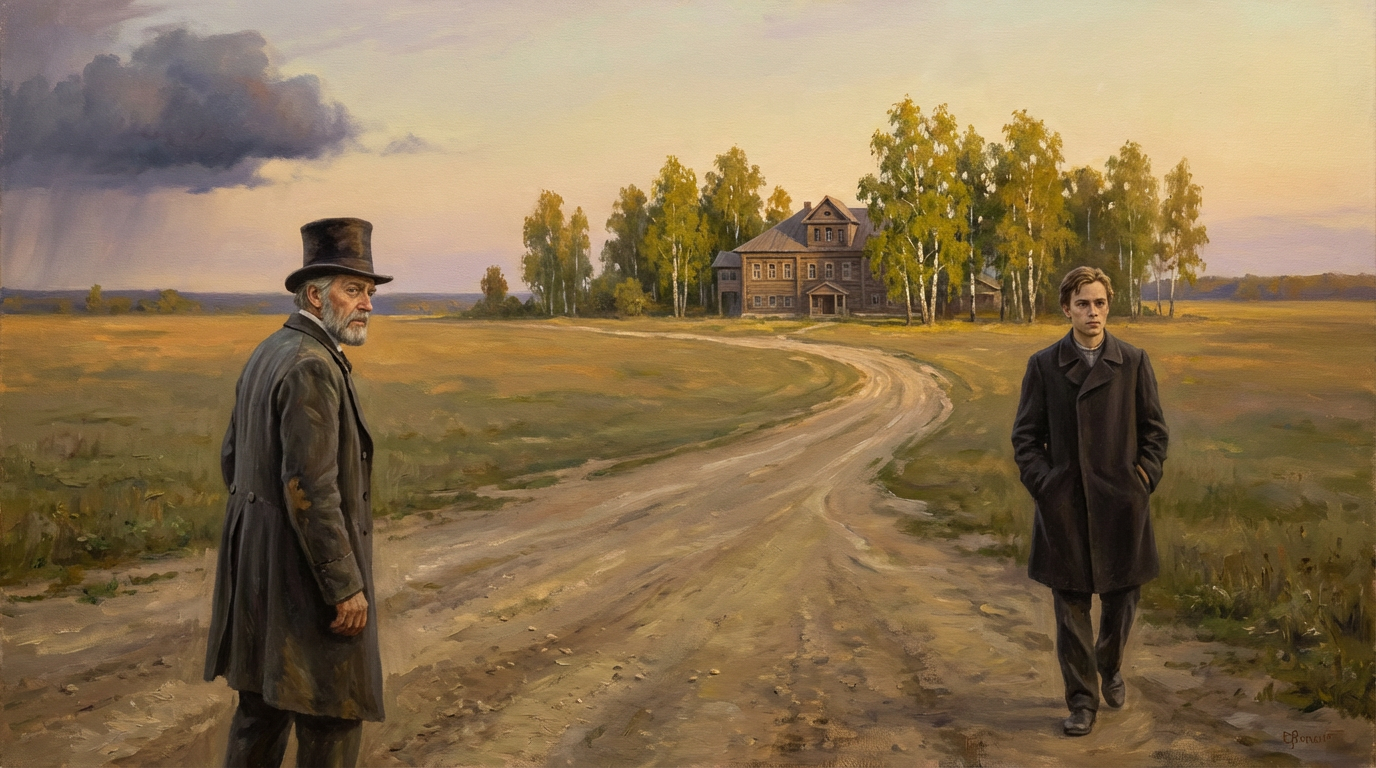
An excerpt from the original text.(complete · 4415 words)
uring the next two weeks life at Marino pursued its normal course.
Arkady took things easily, and Bazarov worked. In passing, it may be
said that, for all his careless manner and abrupt, laconic speech, the
latter had become an accepted phenomenon in the house. In particular
had Thenichka so completely lost her shyness of him that one night
she sent to awake him because Mitia had been seized with convulsions;
whereupon Bazarov arrived, and, half-joking, half-yawning, according
to his usual manner, helped her for two hours in the task of attending
to the baby. Only Paul Petrovitch disliked the man with the whole
strength of his soul, for he accounted him a proud, cynical, conceited
plebeian, and suspected him not only of failing to respect, but even of
holding in contempt, the personality of Paul Petrovitch Kirsanov. Also,
Nikolai Petrovitch stood in slight awe of the young Nihilist, since he
doubted the likelihood of any good accruing from Bazarov's influence
over Arkady. Yet always he would listen with pleasure to Bazarov's
discourses, and gladly attend the chemical or physical experiments with
which the young doctor (who had brought a microscope with him) would
occupy himself for hours at a stretch. On the other hand, in spite of
Bazarov's domineering manner, all the servants had become attached
to him, for they felt him to be less a barin than their brother;
and in particular did Duniasha readily joke and talk with him, and
throw him many meaning glances as she sped past in quail-like fashion,
while Peter himself, though a man full of conceit and stupidity, with
a forehead perpetually puckered, and a dignity which consisted of a
deferential demeanour, a practice of reading journals syllable by
syllable, and a habit of constantly brushing his coat; even Peter,
I say, would brighten and strike an attitude when he was noticed
by Bazarov. In fact, the only servant to disapprove of Bazarov was
old Prokofitch, the butler, who looked sour whenever he handed the
young doctor a dish, and called him a "sharper" and a "flaunter," and
declared that, for all his whiskers, Bazarov was no better than "a
dressed-up pig," whereas he, Prokofitch, was practically as good an
aristocrat as Paul Petrovitch himself.
In the early days of June, the best season of the year, the weather
became beautiful. True, from afar there came threatenings of cholera,
but to the local inhabitants such visitations had become a commonplace.
Each day Bazarov rose early to set forth upon a tramp of some two or
three versts; nor were those tramps undertaken merely for the sake of
the exercise (he could not abide aimless expeditions), but, rather,
for the sake of collecting herbs and insects. Sometimes, too, he would
succeed in inducing Arkady to accompany him; and whenever this was the
case the pair would, on the way back, engage in some dispute which
always left Arkady vanquished in spite of his superior profusion of
argument.
One morning the pair lingered considerably by the way, and Nikolai
Petrovitch set out across the garden to meet them. Just as he reached
the arbour, he heard their voices and brisk footsteps approaching,
though he himself was invisible to the returning friends.
"You do not understand my father," Arkady was saying.
Nikolai Petrovitch halted instead of revealing himself.
"Oh, he is a good fellow enough," replied Bazarov. "But also he is a
man on the shelf, a man whose song has been sung."
Though Nikolai Petrovitch strained his ears, he failed to catch
Arkady's reply. So the "man on the shelf" lingered for a minute or
two--then walked slowly back to the house.
"For the past three days I have noted him reading Pushkin," continued
Bazarov. "You ought to explain to him that no good can come of that,
for he is no longer a boy, and ought to have shaken himself free of
such fiddlesticks. Who would desire to be a Romanticist? Give him
something practical."
"For instance?"
"Let me consider. For a start, give him Büchner's[1] Stoff und Kraft."
"Good!" Arkady's tone was approving. "Stoff und Kraft is at least
written in a popular style."
The same day Nikolai Petrovitch was sitting with his brother. At length
he said:
"I find that you and I are men on the shelf, that our songs have been
sung. Eh? And perhaps Bazarov is right. Yet I confess that one thing
hurts me: and that is that, though I had hoped to draw nearer to
Arkady, I am being left in the rear, and he is for ever marching ahead.
No longer do he and I understand one another."
"And why is he for ever marching ahead?" asked Paul Petrovitch
indignantly. "How comes he to stand at such a distance from us? The
reason is simply the ideas which that precious 'Nihilist' is putting
into his head. For myself, I detest the fellow, and think him a
charlatan. Also, I am certain that, in spite of his frogs, he is making
no real progress in physics."
"We ought not to say that, brother. For my own part, I look upon him as
a man of culture and ability."
"If so, a detestably conceited one."
"Perhaps he is conceited," Nikolai Petrovitch allowed. "But then it
would appear that nothing can be done without something of the kind.
What I cannot make out is the following. As you know, I have done
everything possible to keep up with the times--I have organised my
peasantry, I have set up such a farm that throughout the province I am
known as 'Fine Kirsanov,' persistently I read and educate myself, in
general I try to march abreast of the needs of the day. Yet, though I
do all this, I am now given to understand that my day is past and gone!
And, brother, I do not say that I am not partially inclined to accept
that view."
"For what reason?"
"For the following. To-day, as I was reading Pushkin (I think it was
'The Gipsies' that I had lighted upon), there suddenly entered the room
Arkady. Silently, and with an air of kindly regret, and as gently as a
child, he withdrew the book from my hand, and laid before me another
book--a German production of some kind. That done, he gave me another
smile, and departed with my volume of Pushkin under his arm."
"Good gracious! And what might be the book which he has given you?"
"This."
Nikolai Petrovitch extracted from the tail pocket of his frock-coat a
copy (ninth edition) of Büchner's well-known work.
Paul Petrovitch turned it over in his hands.
"H'm!" he grunted. "Arkady does indeed seem solicitous for your
education! Have you tried reading the book?"
"Yes."
"And how do you like it?"
"Well, either I am a fool or the thing is rubbish. Of the two views,
the former seems to me the most probable."
"It is not because you have forgotten your German, I suppose?"
"Oh no. I understand the language perfectly."
Again Paul Petrovitch turned over the book, and again he glanced at his
brother from under his brows. A moment's silence ensued.
"By the way," continued Nikolai Petrovitch with an evident desire to
change the conversation, "I have received a letter from Koliazin."
"From Matvei Ilyitch?"
"From the same. It seems that he has just arrived at ----, for the
purpose of carrying out the Revision[2] of the province, and he writes
very civilly that, as our kinsman, he would be glad to see Arkady and
you and myself."
"Do you intend to accept his invitation?" asked Paul Petrovitch.
"I do not. Do you?"
"No. We have no need to drag ourselves fifty versts to eat blanc-mange.
The good Mathieu wants to show off a little--that is all. He can
do without us. But what an honour to be a Privy Councillor! Had I
continued in the Service, continued hauling at the old tow-rope, I
myself might have been Adjutant-General! As it is, I, like yourself, am
on the shelf."
"Yes, brother. Clearly it is time that we ordered our tombstones, and
folded our hands upon our breasts."
A sigh concluded Nikolai Petrovitch's speech.
"But I do not intend to give in so soon," muttered his brother.
"There is first going to be a skirmish between that chirurgeon of
Arkady's and myself. That I can see beyond a doubt."
And, sure enough, the "skirmish" occurred the same evening. Ready for
battle as soon he repaired to the drawing-room for tea, Paul Petrovitch
entered angrily, but firmly, and sat waiting for an excuse to advance
upon the foe. Yet for a while that excuse hung fire, since Bazarov
never said much in the presence of "the old Kirsanovs," and to-night
was feeling out of spirits, and drank his tea in absolute silence.
However, Paul Petrovitch was so charged with impatience that his wish
was bound to attain fulfilment.
It happened that the conversation became turned upon a neighbouring
landowner.
"He is just a petty aristocrat," Bazarov drily remarked (it seemed that
he and the landowner had met in St. Petersburg).
"Allow me," put in Paul Petrovitch, his lips quivering. "In your view,
do the terms 'good-for-nothing' and 'aristocrat' connote the same
thing?"
"I said 'petty aristocrat,'" replied Bazarov as he lazily sipped his
tea.
"Quite so. Then I take it that you hold the same opinion of aristocrats
as of 'petty aristocrats'? Well, I may remark that your opinion is not
mine. And to that I would add that, while I myself possess a reputation
for Liberal and progressive views, I possess that reputation for the
very reason that I can respect real aristocrats. For instance, my
dear sir" (the latter term was so heatedly uttered that Bazarov raised
his eyebrows), "for instance, my dear sir, take the aristocracy of
England. While yielding upon their rights not an iota, they yet know
how to respect the rights of others. While demanding fulfilment of
obligations due to themselves, they yet fulfil their own obligations.
And for those reasons it is to her aristocratic caste that England
stands indebted for her freedom. It is because the English aristocratic
caste itself supports that freedom."
"A tale which we have heard many times before!" commented Bazarov. "But
what are you seeking to prove?"
"I am seeking to prove this," replied Paul Petrovitch. "That without
a certain sense of personal dignity, without a sense of self-respect
(both of which senses are inborn in the true aristocrat), the social
edifice, the bien public, cannot rest upon a durable basis. It is
personality that matters, my dear sir: and the human personality
requires to be as firm as a rock, in that there rests upon it the
entire structure of society. For example, I know that you ridicule
my customs, my dress, my fastidious tastes. Yet do those very things
proceed from that sense of duty--yes, of duty, I repeat--to which I
have just alluded. In other words, I may live in the depths of the
country, yet I do not let myself go. For I respect in myself the man."
"Allow me, Paul Petrovitch," said Bazarov. "You say that you respect
yourself. Very good. Yet you can sit there with your hands folded!
How will that benefit the bien public, seeing that inaction would
scarcely seem to argue self-respect?"
Paul Petrovitch blanched a little.
"That is another question altogether," he said. "However, I do not
feel called upon to explain the reason why I sit with my hands folded
(according to your own estimable term). It will suffice merely to
remark that in the aristocratic idea there is contained a principle,
and that nowadays men who live without principles are as destitute of
morality as they are of moral substance. The same thing did I say to
Arkady on the day after his arrival, and I say it now to you. You agree
with me, Nikolai, do you not?"
Nikolai Petrovitch nodded assent, while Bazarov exclaimed:
"The aristocratic idea, forsooth! Liberalism, progress, principles!
Why, have you ever considered the vanity of those terms? The Russian of
to-day does not need them."
"Then what, in your opinion, does he need? To listen to you, one would
suppose that we stood wholly divorced from humanity and humanity's
laws; whereas, pardon me, the logic of history demands----"
"What has that logic to do with us? We can get on quite well without
it."
"How can we do so?"
"Even as I have said. When you want to put a piece of bread into your
mouth do you need logic for the purpose? What have these abstractions
to do with ourselves?"
Paul Petrovitch waved his hand in disgust.
"I cannot understand you," he said. "You seem to me to be insulting
the Russian people. How you or any one else can decline to recognise
principles and precepts is a thing which passes my comprehension. For
what other basis for action in life have we got?"
Arkady put in a word.
"Both I and Bazarov have told you," he said, "that we recognise no
authority of any sort."
"Rather, that we recognise no basis for action save the useful,"
corrected Bazarov. "At present the course most useful is denial.
Therefore we deny."
"Deny everything?"
"Deny everything."
"What? Both poetry and art and--I find it hard to express it?----"
"I repeat, everything," said Bazarov with an ineffable expression of
insouciance.
Paul Petrovitch stared. He had not quite expected this. For his part,
Arkady reddened with pleasure.
"Allow me," interposed Nikolai Petrovitch. "You say that you deny
everything--rather, that you would consign everything to destruction.
But also you ought to construct."
"That is not our business," said Bazarov. "First must the site be
cleared."
"Yes; for the present condition of the people demands it," affirmed
Arkady. "And that demand we are bound to fulfil, seeing that no one
has the right merely to devote himself to the satisfaction of his own
personal egotism."
With this last Bazarov did not seem altogether pleased, since the
phrase smacked too much of philosophy--rather, of "Romanticism," as
Bazarov termed that science; but he did not trouble to confute his
pupil.
"No, no!" Paul Petrovitch exclaimed with sudden heat. "I cannot
believe that gentlemen of your type possess sufficient knowledge of the
people to be rightful representatives of its demands and aspirations.
For the Russian people is not what you think it to be. It holds
traditions sacred, and is patriarchal, and cannot live without faith."
"I will not dispute that," observed Bazarov. "Nay, I will even agree
that you are right."
"And, granting that I am right----"
"You have proved nothing."
"Yes, proved nothing," echoed Arkady with the assurance of a
chess-player who, having foreseen a dangerous move on the part of his
opponent, awaits the attack with expert composure.
"But how have I proved nothing?" muttered Paul Petrovitch, rather taken
aback. "Do you mean to say that you are opposed to, not in favour of,
the people?"
"Good gracious! Do not the common folk believe, when it thunders, that
the Prophet Elijah is going up to Heaven in his chariot? You and I do
not agree with that? The point is that the people is Russian, and that
I am the same."
"Not after what you have just said! Henceforth must I decline to
recognise you as any countryman of mine."
With a sort of indolent hauteur Bazarov replied:
"With his own hand did my grandfather guide the plough. Ask, therefore,
of your favourite peasant which of us two--you or myself--he rates most
truly as his countryman. Why, you do not know even how to speak to him!"
"And you, while speaking to him, despise him."
"Should he merit contempt, yes. Reprobate, therefore, my views as much
as you like, but who told you that they have come to me fortuitously
rather than been derived from the very national spirit of which you are
so ardent an upholder?"
"Phaugh! We need you Nihilists, do we not?"
"Not ours is it to decide the need or otherwise, seeing that even a man
like yourself considers that he has a use."
"Gentlemen, gentlemen!" interposed Nikolai Petrovitch as he rose to his
feet. "I beg of you to indulge in no personalities!"
Paul Petrovitch smiled. Then, laying his hand upon his brother's
shoulder, he forced him to resume his seat.
"Do not be alarmed," he said. "That very sense of dignity at which this
gentleman pokes such bitter fun will keep me from forgetting myself."
And he turned to Bazarov again.
"Do you suppose your doctrine to be a new one?" he continued. "If so,
you are wasting your time. More than once has the Materialism which you
preach been mooted; and each time it has been proved bankrupt."
"Another foreign term!" muttered Bazarov. He was now beginning to lose
his temper, and his face had turned a dull, copperish tint. "In the
first place, we Nihilists preach nothing at all. For to preach is not
our custom."
"What, then, is your custom?"
"To proclaim facts such as that our civil servants accept bribes, that
we lack highways, commerce, and a single upright judge, and that----"
"Of course, of course! In other words, you and yours are to act as our
'censors' (I believe that to be the correct term?). Well, I agree with
many of your censures, but----"
"Other tenets which we hold are that to chatter, and to do nothing but
chatter, concerning our differences is not worth the trouble, seeing
that it is a pursuit which merely leads to pettiness and doctrinairism;
that beyond question are our so-called leaders and censors not worth
their salt, seeing that they engage in sheer futilities, and waste
their breath on discussions on art and still life and Parliamentarism
and legal points and the devil only knows what, when all the time it is
the bread of subsistence alone that matters, and we are being stifled
with gross superstition, and all our commercial enterprises are failing
for want of honest directors, and the freedom of which the Government
is for ever prating is destined never to become a reality, for the
reason that, so long as the Russian peasant is allowed to go and drink
himself to death in a dram-shop, he is ready to submit to any sort of
despoilment."
"You have decided, then, you feel conscious, that your true métier is
to apply yourselves seriously to nothing?"
"Even so," came the sullen reply, for Bazarov had suddenly become vexed
with himself for having exposed his mind with such completeness to this
barin.
"You have decided merely to deny everything?"
"We have decided merely to deny everything."
"And that you call Nihilism?"
"That we call Nihilism." In Bazarov's repetition of Paul Petrovitch's
words there echoed, this time, a note of pride.
Paul Petrovitch knit his brows.
"So, so!" he said in a voice that was curiously calm. "Nihilism
is designed to combat our every ill, and you alone are to act as
our saviours and our heroes! Well, well! But in what consider you
yourselves and your censorious friends to excel the rest of us? For you
chatter as much as does every one else."
"No, no!" muttered Bazarov. "At least we are not guilty of that,
however we may err in other ways."
"You do things, then? At all events, you are preparing to do things?"
Bazarov did not reply, although, in his excitement, Paul Petrovitch had
started up and then quickly recovered his self-command.
"H'm!" continued Paul Petrovitch. "With you to act is to demolish.
But how is such demolition to benefit when you do not even know its
purpose?"
"We demolish because we are a force," interposed Arkady.
Paul Petrovitch stared--then smiled.
"And a force need render account to no one," added Arkady with a
self-conscious straightening of his form.
"Fool!" gasped Paul Petrovitch. Evidently he could contain himself
no longer. "Have you ever considered what you are maintaining with
your miserable creed? Even an angel would lose patience! 'A force,'
forsooth! You might as well say that the wild Kalmuck, or the barbaric
Mongol, represents a force. What boots such a force? Civilisation and
its fruits are what we value. And do not tell me that those fruits
are to be overlooked, seeing that even the meanest barbouilleur,[3]
the meanest piano-player who ever earned five kopecks a night, is of
more use to society than you. For men of that kind at least stand for
culture rather than for some rude, Mongolian propelling-power. Yes, you
may look upon yourselves as 'the coming race,' yet you are fit but to
sit in a Kalmuck shanty. 'A force,' forsooth! Good and 'forceful' sirs,
I beg to tell you that you number but four men and a boy, whereas those
others number millions, and are folk of the kind who will not permit
such as you to trample upon their sacred beliefs, but will first
trample upon your worthy selves."
"Let them trample upon us," retorted Bazarov. "We are more in number
than you think."
"What? You really believe that you will succeed in inoculating the
nation as a whole?"
"From a little candle," replied Bazarov, "there arose, as you know, the
conflagration of Moscow."[4]
"A pride almost Satanic in its nature, and then banter! And thus you
would seek to attract our youth, thus you would attempt to win the
inexperienced hearts of our boys! For sitting beside you is one of
those very boys, and he is absolutely worshipping you!" (Upon this
Arkady knit his brows, and averted his head a little.) "Yes, the
canker has spread far already. For instance, they tell me that in Rome
our artists decline to enter the Vatican, and look upon Raphael as
next-door to a fool, just because he is an 'authority'! Yet those very
artists are themselves so barren and impotent that their fancy cannot
rise above 'Girls at Fountains,' and so forth, villainously executed!
And such artists you account fine fellows, I presume?"
"Like those artists," said Bazarov, "I consider Raphael to be worth not
a copper groat. And as for the artists themselves, I appraise them at
about a similar sum."
"Bravo, bravo!" cried Paul Petrovitch. "Listen, O Arkady--listen to
the way in which the young men of the present day ought to express
themselves! Surely our youth will now rally to your side? For once upon
a time they had to go to school, since they did not like to be taken
for dunces, and therefore worked at their studies; but now they have
but to say: 'Everything in the world is rubbish,' and, behold! the
trick is done. They consider that delightful--and naturally! In other
words, the blockheads of former days are become the Nihilists of the
present."
"Your self-sufficiency--I mean, your self-respect--is carrying you
away," Bazarov remarked nonchalantly (as for Arkady, his eyes had
flashed, and his whole form was quivering with indignation). "But our
dispute has gone far enough. Let us end it. Whenever you may feel that
you can point out to me a single institution in our family or our
public life which does not call for complete and unsparing rejection, I
shall be pleased to accept your view."
"Of institutions of that kind I could cite you millions," exclaimed
Paul Petrovitch. "For example, take the village commune."
Bazarov's lips twisted themselves into a contemptuous smile.
"The village commune," said he, "is a subject which you would do better
to discuss with your brother, since he is learning by experience the
meaning of that commune, and of its circular guarantee, and of its
enforced sobriety and other contrivances."
"Take the family, then--yes, take the family, since at least among the
peasantry it is still a surviving institution."
"And that question, too, I should imagine were best not dissected by
you in detail. But see here, Paul Petrovitch. Allow yourself a minimum
of two days to think over these things (you will need quite that amount
of time to do so); and cite to yourself in succession our various
social conditions, and give them your best attention. Meanwhile Arkady
and myself will go and----"
"Go and make sport of everything, I presume?"
"No, go and dissect frogs. Come, Arkady! Au revoir, gentlemen."
And the two friends departed. Left alone, the brothers looked at one
another.
"So," at last said Paul Petrovitch, "you see the young men of the
day--you see our successors!"
"Our successors--yes," re-echoed Nikolai Petrovitch despondently.
Throughout the conversation he had been sitting simply on pins and
needles; throughout it he had dared do no more than throw an occasional
pained glance at Arkady. "My brother, there came to me just now a
curious reminiscence. It was of a quarrel which once I had with my
mother. During the contest she raised a great outcry, and refused to
listen to a single word I said; until at length I told her that for
her to understand me was impossible, seeing that she and I came of
different generations. Of course this angered her yet more, but I
thought to myself: 'What else could I do? The pill must have been a
bitter one, but it was necessary that she should swallow it.' And now
our turn is come; now is it for us to be told by our heirs that we
come of a different generation from theirs, and must kindly swallow the
pill."
"You are too magnanimous and retiring," expostulated Paul Petrovitch.
"For my part, I feel sure that we are more in the right than these
two youngsters, even though we may express ourselves in old-fashioned
terms, and lack their daring self-sufficiency. Indeed, what a puffed-up
crowd is the youth of to-day! Should you ask one of them whether he
will take white wine or red, he will reply, in a bass voice, and with
a face as though the whole universe were looking at him: 'Red is my
customary rule.'"
"Should you like some more tea?" interrupted Thenichka, who had been
peeping through the doorway, but had not dared to enter during the
progress of the dispute.
"No," was Nikolai Petrovitch's reply as he rose to meet her. "So you
can order the samovar to be removed."
Meanwhile, with a brief "Bon soir," Paul Petrovitch betook himself to
his study.
[1] Ludwig Büchner (1824-1899), German physician and materialist
philosopher.
[2] i.e. the census-taking of the serf population.
[3] Scribbler.
[4] In 1812.
Master this chapter. Complete your experience
Purchase the complete book to access all chapters and support classic literature
As an Amazon Associate, we earn a small commission from qualifying purchases at no additional cost to you.
Available in paperback, hardcover, and e-book formats
Let's Analyse the Pattern
When people feel their core identity threatened, they transform intellectual disagreements into personal battles.
Why This Matters
Connect literature to life
This chapter teaches how to identify when someone transforms disagreement into personal warfare because their identity feels threatened.
Practice This Today
This week, notice when workplace conflicts escalate beyond the actual issue—watch for the moment when people stop discussing the problem and start defending their worth.
Now let's explore the literary elements.
Key Quotes & Analysis
"We recognize only what is useful"
Context: When Pavel challenges what nihilists actually believe in
This reveals Bazarov's purely practical worldview that rejects anything without immediate, measurable benefit. It shows how nihilism reduces all human experience to utility.
In Today's Words:
If it doesn't help me get ahead, I don't care about it
"At the present time, negation is the most useful of all"
Context: When accused of only destroying without building anything
Bazarov argues that tearing down corrupt systems is more important than having a replacement ready. This shows the revolutionary mindset that change requires destruction first.
In Today's Words:
Sometimes you have to burn everything down before you can build something better
"We have been told that we belong to a different generation"
Context: Reflecting sadly after the heated argument
This captures the pain of being dismissed as irrelevant by your own children. It shows how generational conflict can feel like personal rejection.
In Today's Words:
My own kid thinks I'm too old to understand anything
"In particular did Duniasha readily joke and talk with him"
Context: Describing how the servants relate to Bazarov
This shows that working people respond to Bazarov's lack of aristocratic pretension. Class solidarity matters more than philosophical differences.
In Today's Words:
The staff liked him because he didn't act like he was better than them
Thematic Threads
Generational Conflict
In This Chapter
Pavel and Bazarov's philosophical debate becomes personal warfare over whose generation's values matter
Development
Escalated from earlier tensions—now open combat between old and new worldviews
In Your Life:
You might see this when older coworkers resist new methods or when parents can't accept their adult children's different choices
Identity
In This Chapter
Pavel's aristocratic identity is so threatened by nihilism that he can't separate critique from personal attack
Development
Building from his earlier discomfort—now his very sense of self is under siege
In Your Life:
You might experience this when criticism of your methods feels like criticism of your worth as a person
Class
In This Chapter
The servants embrace Bazarov while Pavel despises him, showing how class shapes perspective
Development
Continued from earlier observations—class determines who sees Bazarov as ally versus threat
In Your Life:
You might notice how your background affects whether you see change as opportunity or threat
Pride
In This Chapter
Both Pavel and Bazarov let ego drive them deeper into conflict rather than seeking understanding
Development
Pavel's wounded pride now matches Bazarov's intellectual arrogance in destructive dance
In Your Life:
You might catch yourself escalating arguments to save face rather than solve problems
Human Relationships
In This Chapter
The confrontation damages family bonds as Nikolai feels increasingly distant from his son
Development
The philosophical divide is now creating emotional distance between father and son
In Your Life:
You might see how taking sides in family conflicts can isolate you from people you love
You now have the context. Time to form your own thoughts.
Discussion Questions
- 1
What specific trigger transformed Pavel and Bazarov's philosophical discussion into personal warfare?
analysis • surface - 2
Why does Pavel feel personally attacked when Bazarov criticizes aristocratic values, while Nikolai shows more acceptance of generational change?
analysis • medium - 3
Where have you seen this pattern play out - when someone transforms a disagreement about ideas into an attack on character because they feel their identity threatened?
application • medium - 4
If you were witnessing this dinner conversation, what could you have said or done to prevent it from escalating into personal warfare?
application • deep - 5
What does this chapter reveal about why some people adapt to change while others resist it so fiercely they'll destroy relationships to defend their worldview?
reflection • deep
Critical Thinking Exercise
Rewrite the Conversation
Take the dinner table argument and rewrite it as if one person recognized the pattern of threatened identity and chose to de-escalate. Pick either Pavel or Bazarov and have them respond differently when they feel the conversation turning personal. Show how acknowledging the other person's underlying fear could change the entire dynamic.
Consider:
- •What specific words triggered the escalation from ideas to personal attacks?
- •What fear or insecurity was driving each person's need to 'win' the argument?
- •How could someone validate the other's experience while still expressing their own views?
Journaling Prompt
Write about a time when you felt your core values or identity were being attacked in a conversation. What were you really defending? How might the situation have gone differently if someone had acknowledged your underlying concerns?
Coming Up Next...
Chapter 11: The Weight of Memory
Nikolai retreats to his garden sanctuary to process the painful reality of his growing distance from Arkady. His reflections on failed attempts to stay current with modern thinking reveal the deeper wounds of a father watching his son slip away into an alien world of ideas.



