
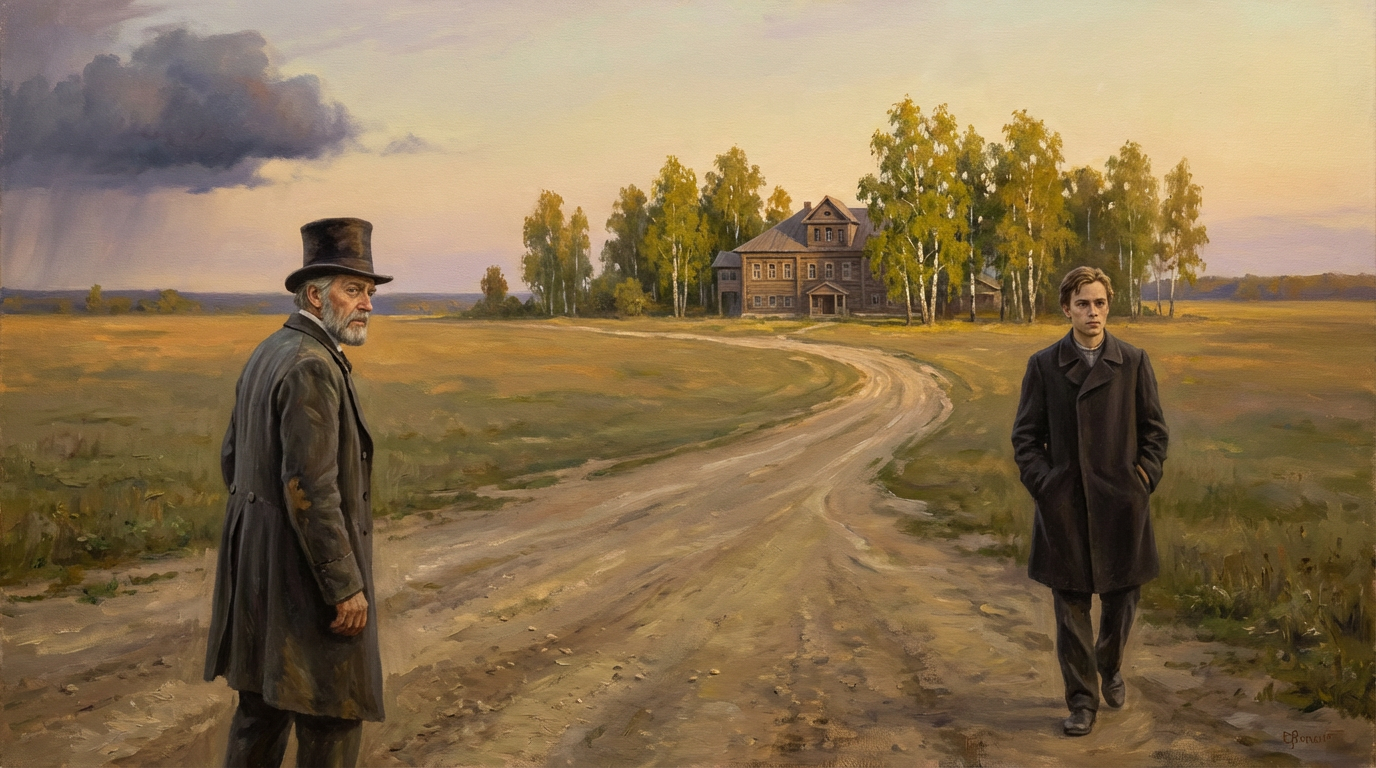
An excerpt from the original text.(complete · 1031 words)
he same day also saw Bazarov make Thenichka's acquaintance. This was
when he was walking in the garden with Arkady, and discussing the
question of why certain trees in the garden, especially oaks, had not
prospered as they might have done. Said he:
"You ought to plant the place with as many silver poplars as you can,
and also with Norwegian firs--limes too, if loam should first be added.
For instance, the reason why this clump has done so well is that it is
made up of lilacs and acacias, of which neither require much room. But
hullo! There is some one sitting there!"
The persons seated in the arbour were Thenichka, Duniasha, and little
Mitia. Bazarov halted, and Arkady nodded to Thenichka as to an old
acquaintance. Then the pair passed on again, and Bazarov inquired of
his companion:
"Who was she?"
"To whom are you referring?"
"You know to whom. My word, she is good-looking!"
Arkady explained, with a touch of embarrassment, the identity of
Thenichka.
"Ah!" Bazarov remarked. "Then your father has not at all bad taste.
Indeed, I commend it. But what a young dog he is! I too must be
introduced."
And he turned back in the direction of the arbour.
"Evgenii!" exclaimed Arkady nervously as he followed his friend. "For
God's sake be careful what you do!"
"You need not be alarmed. I know what is what. I am no rustic."
And, approaching Thenichka, he doffed his cap.
"Allow me to introduce myself," he said with a polite bow. "I am a
friend of Arkady's, and a perfectly harmless individual."
Rising from her seat, Thenichka gazed at him in silence.
"Oh, and what a fine baby!" he continued. "Pray do not disturb
yourself. Never yet have I cast upon a child an evil spell. But why are
his cheeks so red? Is he cutting teeth?"
"Yes," replied Thenichka. "He has now cut four of them, and the gums
are a little swelled."
"Then let me see them. Do not be afraid. I am a doctor."
With that he took the baby into his arms, and both Thenichka and
Duniasha were astonished at the fact that it made no resistance, showed
no fear.
"I see," he continued. "Well, everything is going right with him, and
he will have plenty of teeth. Nevertheless, should he in any way ail,
please let me know. Are you yourself well?"
"Yes, thank God!"
"'Thank God,' say I too, for health on the part of the mother is
the chief point of all. And you?" he added, turning to Duniasha.
The latter, ultra-prim of demeanour in the drawing-room, and
ultra-frivolous of behaviour in the kitchen, answered with a giggle.
"Well, you look all right. Here! Take your hero back again."
He replaced the baby in Thenichka's arms.
"How quiet he has been with you!" she exclaimed under her breath.
"Always children are quiet with me," he remarked. "You see, I know how
to handle them."
"And they know when people are fond of them," put in Duniasha.
"True," assented Thenichka. "Though it is seldom that Mitia will go to
any one's arms but mine."
"Would he come to me?" ventured Arkady, who, until now standing in
the background, at this moment came forward towards the arbour. But
on his attempting to wheedle Mitia to his arms, the infant threw back
its head, and started to cry--a circumstance which greatly perturbed
Thenichka.
"Another time--when he has come to be more used to me," said Arkady
indulgently. And the two friends departed.
"What is her name?" asked Bazarov.
"Thenichka--Theodosia," replied Arkady.
"And her patronymic?"
"Nikolaievna."
"Bene! What I like about her is her total absence of shyness. True,
that is a trait which some might have condemned in her, but I say,
'What rubbish!' For why need she be bashful? She is a mother, and
therefore justified."
"I agree," said Arkady. "And my father----"
"Also is justified," concluded Bazarov.
"No, I do not agree in that respect."
"You do not altogether welcome a superfluous heir?"
"For shame, Evgenii!" cried Arkady heatedly. "How can you impute such
motives? What I mean is that my father is not justified from one
point of view. That is to say, he ought to marry her."
"Oh, ho!" said Bazarov quietly. "How high and mighty we are getting! So
you still attribute importance to the marriage rite? This I should not
have expected of you."
For some paces the friends walked on in silence. Then Bazarov
continued:
"I have been inspecting your father's establishment. The cattle look
poor, the horses seem broken-down, the buildings have a tipsy air, the
workmen manifest a tendency to loaf, and I cannot yet determine whether
the new steward is a fool or a rogue."
"You are censorious to-day?"
"I am; and the reason is that these good peasants are cheating your
father--exemplifying the proverb that 'The Russian muzhik will break
even the back of God.'"
"Soon I shall have to agree with my uncle in his opinion that you think
but poorly of Russia."
"Rubbish! The Russian's very best point is that he holds a poor opinion
of himself. Two and two make four. Nothing but that matters."
"And is nature also rubbish?" queried Arkady with a musing glance at
the mottled fields where they lay basking in the soft, kindly rays of
the morning sun.
"Nature is rubbish--at least in the sense in which you understand
her. She is not a church, but a workshop wherein man is the labourer."
At this moment there came wafted to their ears the long-drawn strains
of a violoncello, on which a sensitive, but inexperienced, hand was
playing Schubert's Erwartung. Like honey did the voluptuous melody
suffuse the air.
"Who is the musician?" asked Bazarov in astonishment.
"My father."
"What? Your father plays the 'cello?"
"He does."
"At his age?"
"Yes--he is only forty-four."
Bazarov burst out laughing.
"Why do you laugh?" asked Arkady.
"Pardon me, but the idea that your father--a man of forty-four, a
paterfamilias, and a notable in the county--should play the 'cello!"
And he continued laughing, though Arkady, for all his reverence for his
mentor, failed to accomplish even a smile.
Master this chapter. Complete your experience
Purchase the complete book to access all chapters and support classic literature
As an Amazon Associate, we earn a small commission from qualifying purchases at no additional cost to you.
Available in paperback, hardcover, and e-book formats
Let's Analyse the Pattern
Authentic interest and genuine behavior create more influence than following social rules or seeking approval.
Why This Matters
Connect literature to life
This chapter teaches how to distinguish between people who command respect naturally versus those who demand it through position or protocol.
Practice This Today
This week, notice when someone puts you at ease in an awkward situation—study what they do differently from those who make things more tense.
Now let's explore the literary elements.
Key Quotes & Analysis
"I am no rustic."
Context: When Arkady warns him to be careful approaching Fenichka
Bazarov dismisses Arkady's class-based anxiety with confidence in his own social skills. He knows how to treat people as individuals rather than getting caught up in social protocols.
In Today's Words:
I know how to talk to people.
"Your father has not at all bad taste. Indeed, I commend it."
Context: After seeing Fenichka and learning she's Nikolai's partner
Bazarov judges the relationship on its own merits rather than worrying about social conventions. He appreciates Fenichka's natural beauty and genuine character.
In Today's Words:
Your dad picked a good one.
"What a young dog he is!"
Context: Commenting on Nikolai having a young partner and baby
Shows Bazarov's mix of admiration and mild mockery for older men pursuing romance. He's both impressed and amused by Nikolai's continued romantic life.
In Today's Words:
Good for him, still getting some action at his age.
Thematic Threads
Class
In This Chapter
Bazarov ignores social barriers with Fenichka while Arkady worries about propriety and 'legitimacy'
Development
Building from earlier tensions about aristocratic vs. common values
In Your Life:
You might catch yourself treating people differently based on their job title or economic status rather than their character.
Authenticity
In This Chapter
Bazarov's natural manner succeeds where Arkady's careful behavior fails
Development
Continues exploring how genuine behavior trumps performed behavior
In Your Life:
You might notice times when trying too hard to impress actually pushes people away.
Generational Divide
In This Chapter
Bazarov mocks Nikolai's cello playing as romantic foolishness from an older generation
Development
Deepening the conflict between old romantic ideals and new practical worldview
In Your Life:
You might find yourself dismissing older family members' interests without understanding their value.
Social Expectations
In This Chapter
Arkady wants his father to marry Fenichka for respectability; Bazarov sees marriage ceremonies as meaningless
Development
Expanding the critique of social conventions versus personal truth
In Your Life:
You might pressure yourself or others to follow traditional paths that don't actually serve anyone's happiness.
Connection
In This Chapter
Bazarov connects with both baby and mother through genuine interest, not social performance
Development
Introduced here as counterpoint to failed connections in earlier chapters
In Your Life:
You might notice how your most meaningful relationships formed through shared interests rather than social networking.
You now have the context. Time to form your own thoughts.
Discussion Questions
- 1
Why does baby Mitya calm down with Bazarov but cry with Arkady, even though Arkady is the family friend?
analysis • surface - 2
What does Bazarov's ease with Fenichka reveal about his character compared to Arkady's nervousness about the 'improper' situation?
analysis • medium - 3
Where have you seen someone command respect through authenticity rather than following social rules?
application • medium - 4
When you're in an awkward social situation, do you focus more on appearing appropriate or on making others comfortable? How might changing that focus change the outcome?
application • deep - 5
What does this chapter suggest about the difference between earned authority and assumed authority?
reflection • deep
Critical Thinking Exercise
Map Your Natural Authority
Think of a time when you naturally took charge or when people looked to you for guidance without you asking for it. Write down what you were doing differently in that moment compared to times when you tried to assert authority but struggled to get it. Look for patterns in your behavior, tone, and focus.
Consider:
- •Were you focused on the problem or on how you appeared while solving it?
- •Did you ask questions or give orders?
- •Were you trying to prove something or genuinely trying to help?
Journaling Prompt
Write about a situation where you need more influence or respect. Based on your natural authority patterns, how could you approach it differently?
Coming Up Next...
Chapter 10: The Battle Lines Are Drawn
Over the next two weeks, Bazarov becomes an accepted presence at Marino, with even Fenichka losing her initial shyness around him. When baby Mitya falls seriously ill one night, she turns to Bazarov for help—a decision that will deepen his integration into the household's most intimate moments.



