
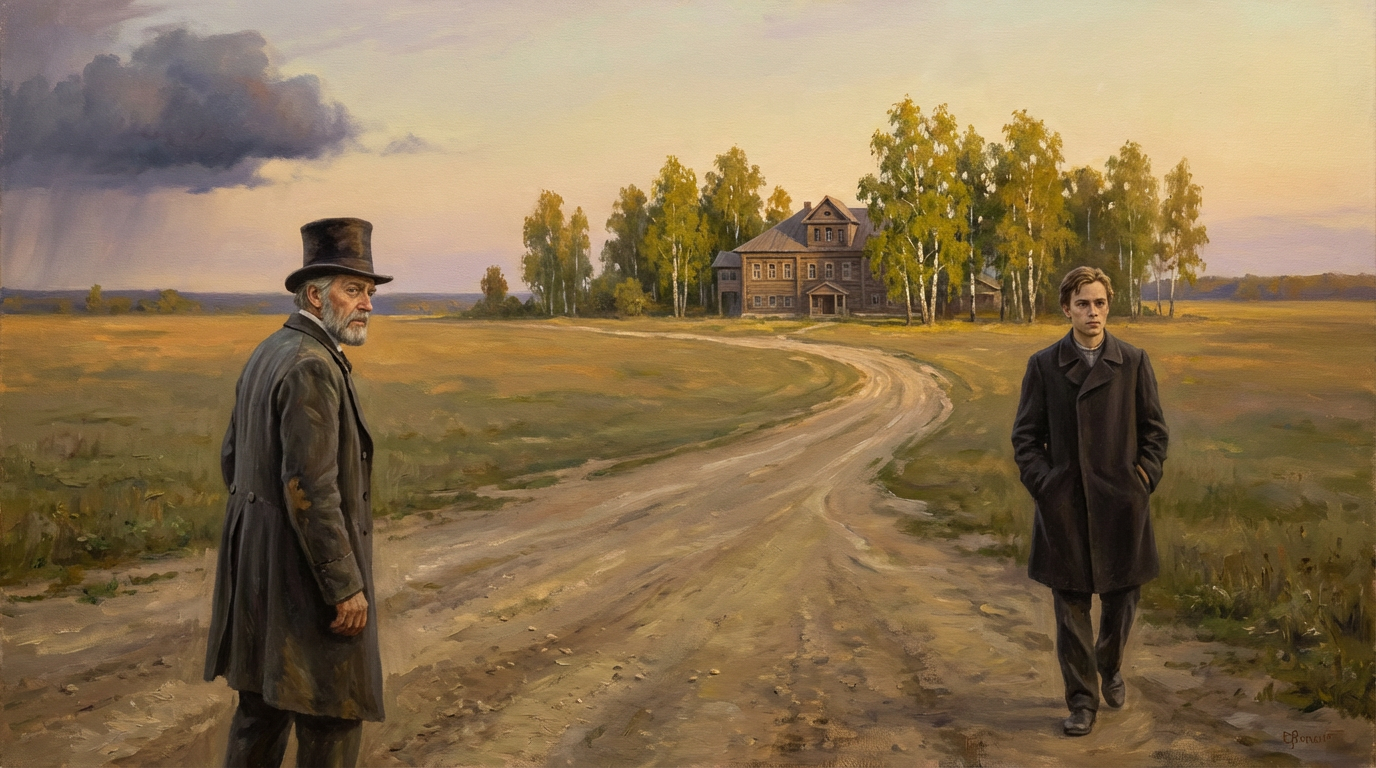
An excerpt from the original text.(complete · 2306 words)
ext morning Bazarov was the first to awake and go out of doors.
"Ah," thought he to himself as he gazed about him, "this is not much
of a place to look at."
When apportioning allotments to his peasantry, Nikolai Petrovitch had
found himself forced to exclude from the new "farm" four desiatins
of level, naked land, and upon this space had built himself a house,
quarters for his servants, and a homestead. Also, he had laid out
a garden, dug a pond, and sunk two wells. But the young trees had
fared badly, very little water had risen in the pond, and the wells
had developed a brackish taste. The only vegetation to attain robust
growth was a clump of lilacs and acacias, under the shade of which the
household was accustomed to take tea or to dine. Within a few minutes
Bazarov had traversed all the paths in the garden, visited the stables
and the cattlesheds, and made friends with two young household serfs
whom he happened to encounter, and with whom he set forth to catch
frogs in a marsh about a verst from the manor.
"For what do you want frogs, barin?" asked one of the lads.
"To make them useful," replied Bazarov (who possessed a peculiar gift
for winning the confidence of his inferiors, even though he never
cozened them, but, on the contrary, always treated them with asperity).
"You see, I like to open them, and then to observe what their insides
are doing. You and I are frogs too, except that we walk upon our hind
legs. Thus the operation helps me to understand what is taking place in
ourselves."
"And what good will that do you?"
"This. That if you should fall sick, and I should have to treat you, I
might avoid some mistakes."
"Then you are a doctor?"
"I am."
"Listen to that, Vasika! The barin says that you and I too are frogs.
My word!"
"I don't like frogs," remarked Vasika, a barefooted boy of seven with
a head as white as tow, and a costume made up of a grey blouse and a
stiff collar.
"Why don't you like them?" asked Bazarov. "Do you think they will
bite you? Nay! Into the water, my young philosophers!"
Nikolai Petrovitch too had left his bed, and, on going to visit Arkady,
found him fully dressed; wherefore father and son proceeded to repair
to the terrace, and there seated themselves under the shade of the
awning. Amid nosegays of lilac, a tea-urn was simmering on a table
by the balustrade, and presently there appeared upon the scene also
the damsel who, on the previous night, had met the arrivals on the
verandah. She announced in shrill tones:
"Theodosia Nikolaevna is not very well this morning, and cannot come to
breakfast. So she has told me to ask you whether you will pour out tea
for yourselves, or whether she is to send Duniasha?"
"I will pour it out myself," Nikolai Petrovitch replied with some
haste. "Will you have cream or lemon in your tea, Arkady?"
"Cream," he replied. After a pause he continued:
"Papasha----"
Nikolai Petrovitch glanced confusedly in his direction.
"Yes?" said he.
Arkady lowered his eyes.
"Pardon me if my question should seem to you indiscreet," he began,
"but, owing to your frankness of last night, I am emboldened to return
it. You will not take offence, will you?"
"Oh no! Pray go on."
"Then I feel encouraged to ask you whether it--whether it is because
I am here that she--that is to say, Thenichka--has not joined us at
breakfast?"
Nikolai Petrovitch slightly averted his face.
"It may be so," he said at length. "At all events, I presume that--that
she prefers, she prefers--in fact, that she is shy."
Arkady glanced at his father.
"But why should she be shy?" he inquired. "In the first place, you know
my views" (he uttered the words with no little complacency), "and, in
the second place, surely you cannot suppose that I would by a hair's
breadth intrude upon your life and your habits? No; sure am I that
never could you make a bad choice; and if you have asked this girl
to reside under your roof, that is tantamount to saying that she has
well deserved it. In any case, moreover, it is not for a son to summon
his father to judgment--least of all for me, who possess a father
like yourself, a father who has never restricted his son's freedom of
action."
At first Arkady's voice had trembled a little, since not only did he
feel that he was doing the "magnanimous," but also he knew that he
was delivering something like a "lecture" to his father; but such an
effect does the sound of his own voice exercise upon a human being that
towards the end Arkady pronounced his words firmly, and even with a
certain degree of empressement.
"I thank you, Arkady," Nikolai Petrovitch said faintly as his fingers
began their customary perambulation of his forehead. "Nor is your
conjecture mistaken, for if this girl had not deserved the invitation,
I should not, of course, have--in other words, as you imply, this is no
frivolous whim on my part. Nor need I have spoken of the matter, were
it not that I desired you to understand that she might possibly have
felt embarrassed at meeting you on the very day after your arrival."
"Then let me go and meet her," exclaimed Arkady with another access
of "magnanimity" as he sprang from his chair. "Yes, let me go and
explain to her why she need not shun me."
Nikolai Petrovitch also rose.
"Arkady," he began, "pray do me a favour. Hitherto I had not warned you
that----"
But, without listening to him, Arkady darted from the terrace. For
a moment or two Nikolai Petrovitch gazed after him--then, overcome
with confusion, relapsed into a chair. His heart was beating rapidly.
Whether or not he was picturing to himself a strangeness of future
relations with his son; whether he was imagining that, had his son
refrained from interfering, the latter might have paid him more respect
in future; whether he was reproaching himself for his own weakness--it
is difficult to say what his thoughts were. Probably in them there was
a combination of the feelings just indicated, if only in the form of
apprehensions. Yet those apprehensions cannot have been deeply rooted,
as was proved by the fact that, for all the beating of his heart, the
colour had not left his face.
Soon hasty footsteps were heard approaching, and Arkady reappeared on
the terrace.
"I have made her acquaintance!" he shouted with a kindly,
good-humoured, triumphant expression. "That Theodosia Nikolaievna is
not well to-day is a fact; but also it is a fact that she is going to
appear later. And why did you not tell me that I had a little brother?
Otherwise I should have gone and kissed him last night, even as I have
done this moment."
Nikolai Petrovitch tried to say something--to rise and to make an
explanation of some sort; but Arkady cut him short by falling upon his
neck.
"What is this? Again embracing?" said Paul Petrovitch behind them.
As a matter of fact, neither father nor son was ill-pleased to see
him appear, for, however touching such situations may be, one may be
equally glad to escape from them.
"At what are you surprised?" asked Nikolai Petrovitch gaily. "Remember
that I have not seen Arkesha for several centuries--at all events, not
since last night!"
"Oh, I am not surprised," said Paul Petrovitch. "On the contrary, I
should not mind embracing him myself."
And Arkady, on approaching his uncle, felt once more upon his cheek the
impression of a perfumed moustache. Paul Petrovitch then sat down to
table. Clad in an elegant morning suit of English cut, he was flaunting
on his head a diminutive fez which helped the carelessly folded tie to
symbolise the freedom of a country life. At the same time, the stiff
collar of the shirt (which was striped, not white, as best befitted
a matutinal toilet) supported with its usual rigour an immaculately
shaven chin.
"Well, Arkady?" said he. "Where is your new friend?"
"Out somewhere. He seldom misses going for an early morning walk.
But the great thing is to take no notice of him, for he detests all
ceremony."
"So I have perceived." And with his usual deliberateness Paul
Petrovitch began to butter a piece of bread. "Will he be staying here
very long?"
"Well, as long as he may care to stay. As a matter of fact, he is going
on to his father's place."
"And where does his father live?"
"Some eighty versts from here, in the same province as ourselves. I
believe he has a small property, and used to be an army doctor."
"H'm! Ever since last night I have been asking myself where I can have
heard the name before. Nikolai, do you remember whether there was a
doctor of that name in our father's division?"
"Yes, there used to be."
"Then that doctor will be this fellow's father. H'm!" And Paul
Petrovitch twitched his moustache. "What exactly is your Bazarov?" he
enquired of Arkady.
"What is he?" Arkady repeated smiling. "Do you really want me to tell
you what he is, Uncle?"
"If you please, my nephew."
"He is a Nihilist."
"A what?" exclaimed Nikolai Petrovitch, while even Paul Petrovitch
paused in the act of raising a knife to the edge of which there was a
morsel of butter adhering.
"A Nihilist," repeated Arkady.
"A Nihilist?" queried Nikolai Petrovitch. "I imagine that that must
be a term derived from the Latin nihil or 'nothing.' It denotes,
I presume, a man who--a man who--well, a man who declines to accept
anything."
"Or a man who declines to respect anything," hazarded Paul Petrovitch
as he re-applied himself to the butter.
"No, a man who treats things solely from the critical point of view,"
corrected Arkady.
"But the two things are one and the same, are they not?" queried Paul
Petrovitch.
"Oh no. A Nihilist is a man who declines to bow to authority, or to
accept any principle on trust, however sanctified it may be."
"And to what can that lead?" asked Paul Petrovitch.
"It depends upon the individual. In one man's case, it may lead to
good; in that of another, to evil."
"I see. But we elders view things differently. We folk of the
older generation believe that without principles" (Paul Petrovitch
pronounced the word softly, and with a French accent, whereas Arkady
had pronounced it with an emphasis on the leading syllable)--"without
principles it is impossible to take a single step in life, or to draw a
single breath. Mais vous avez changé tout cela. God send you health
and a general's rank, Messieurs Nihil--how do you pronounce it?"
"Ni-hi-lists," said Arkady distinctly.
"Quite so (formerly we had Hegelists, and now they have become
Nihilists)--God send you health and a general's rank, but also let us
see how you will contrive to exist in an absolute void, an airless
vacuum. Pray ring the bell, brother Nikolai, for it is time for me to
take my cocoa."
Nikolai Petrovitch did as requested, and also shouted for Duniasha;
but, instead of the latter, there issued on to the terrace Thenichka
in person. A young woman of twenty-three, she was pale, and
gentle-looking, with dark eyes and hair, a pair of childishly red,
pouting lips, and delicate hands. Also, she was clad in a clean
cotton gown, a new blue kerchief was thrown lightly over her rounded
shoulders, and she was carrying in front of her a large cup of cocoa.
Shyly she placed the latter before Paul Petrovitch, while a warm, rosy
current of blood suffused the exquisite skin of her comely face, and
then she remained standing by the table, with lowered eyes and the
tips of her fingers touching its surface. Yet, though she looked as
though she were regretting having come, she looked as though she felt
that she had a right to be there.
Paul Petrovitch frowned, and Nikolai Petrovitch looked confused.
"Good morning, Thenichka," the latter muttered.
"Good morning," she replied in a low, clear voice. Then she glanced
askance at Arkady, and he smiled at her in friendly fashion. Finally
she departed with a quiet step and slightly careless gait--the latter a
peculiarity of hers.
Silence reigned on the terrace. For a while Paul Petrovitch drank his
cocoa. Then he suddenly raised his head, and muttered:
"Monsieur Nihilist is about to give us the pleasure of his company."
True enough, Bazarov could be seen stepping across the flowerbeds. On
his linen jacket and trousers was a thick coating of mud, to the crown
of his ancient circular hat clung a piece of sticky marshweed, and in
his hand he was holding a small bag. Also, something in the bag kept
stirring as though it were alive. Approaching the terrace with rapid
strides, he nodded to the company and said:
"Good morning, gentlemen! Pardon me for being so late. I shall be back
presently, but first my captures must be stowed away."
"What are those captures?" Paul Petrovitch inquired. "Leeches?"
"No, frogs."
"Do you eat them? Or do you breed them?"
"I catch them for purposes of experiment," was Bazarov's only reply as
carelessly he entered the house.
"In other words, he vivisects them," was Paul Petrovitch's comment. "In
other words, he believes in frogs more than in principles."
Arkady threw his uncle a reproachful look, and even Nikolai Petrovitch
shrugged his shoulders, so that Paul Petrovitch himself felt his bon
mot to have been out of place, and hastened to divert the subject to
the estate and the new steward.
Master this chapter. Complete your experience
Purchase the complete book to access all chapters and support classic literature
As an Amazon Associate, we earn a small commission from qualifying purchases at no additional cost to you.
Available in paperback, hardcover, and e-book formats
Let's Analyse the Pattern
When beliefs become so central to identity that questioning them feels like a personal attack, leading to defensive warfare instead of productive discussion.
Why This Matters
Connect literature to life
This chapter teaches how to distinguish between genuine disagreement and ego-driven defensiveness when people's identities are threatened by new ideas.
Practice This Today
This week, notice when someone's reaction to your suggestion seems disproportionately personal—they might be defending their identity, not just their opinion.
Now let's explore the literary elements.
Key Quotes & Analysis
"I like to open them, and then to observe what their insides are doing"
Context: When peasant children ask why he wants to catch frogs
This perfectly captures Bazarov's materialist philosophy - he believes everything can be understood by taking it apart and examining it scientifically. It also shows his directness in explaining complex ideas to simple people without talking down to them.
In Today's Words:
I want to see how things actually work, not just accept what people tell me
"Believing in frogs more than principles"
Context: His cutting remark about Bazarov's scientific interests
Pavel's contempt for Bazarov's empirical approach reveals the fundamental clash between traditional values based on abstract principles and the new scientific materialism. This line encapsulates the generational and ideological battle at the novel's heart.
In Today's Words:
You care more about your experiments than about what really matters
"A Nihilist - someone who accepts nothing on faith"
Context: Proudly explaining Bazarov's philosophy to his uncle
Arkady's definition shows both his admiration for Bazarov and his incomplete understanding of the philosophy's implications. He's excited by the rebellious aspect but hasn't fully grasped how destructive pure nihilism can be.
In Today's Words:
He questions everything and doesn't believe anything just because people say it's true
Thematic Threads
Class
In This Chapter
Bazarov treats peasant children as equals while Pavel maintains aristocratic distance, revealing how class shapes every interaction
Development
Deepening from earlier hints—now we see how class differences create genuine philosophical divides
In Your Life:
Notice how your background shapes what you consider 'normal' or 'proper' in ways others might find strange
Identity
In This Chapter
Arkady proudly claims the 'nihilist' label while Pavel recoils from it, showing how labels become badges of belonging
Development
Building on Arkady's earlier uncertainty—he's now choosing sides
In Your Life:
Consider which labels you wear proudly and which ones make you defensive
Social Expectations
In This Chapter
Thenichka's discomfort at breakfast reveals the unspoken rules about who belongs where
Development
Introduced here as a new tension point
In Your Life:
Think about spaces where you feel like you don't quite belong and how others' comfort affects yours
Personal Growth
In This Chapter
Arkady tries to be mature about his father's relationship, stretching beyond his comfort zone
Development
Continuing his evolution from passive follower to active participant
In Your Life:
Remember times you've had to accept family situations that challenged your assumptions
Human Relationships
In This Chapter
The breakfast scene shows how ideological differences can poison even simple family meals
Development
Escalating from polite tension to open philosophical warfare
In Your Life:
Notice how political or religious differences can make family gatherings feel like minefields
You now have the context. Time to form your own thoughts.
Discussion Questions
- 1
Why does Bazarov dissect frogs with peasant children while Pavel dismisses his scientific work as meaningless?
analysis • surface - 2
What makes Pavel react so strongly to hearing the word 'nihilist' - why does he take it as a personal threat?
analysis • medium - 3
Where do you see people today turning their beliefs into identity armor - defending ideas not because they're right, but because admitting error feels like losing themselves?
application • medium - 4
How would you handle a situation where someone attacks your core beliefs - and how do you know when you're doing the same thing to others?
application • deep - 5
What does this breakfast scene reveal about why smart people often have the most destructive arguments?
reflection • deep
Critical Thinking Exercise
Separate the Person from the Position
Think of a recent disagreement where you felt personally attacked or where you attacked someone else's character instead of their argument. Write down what each person was actually defending underneath their stated position - their fears, identity, or sense of worth. Then rewrite the conversation focusing only on the practical problem to be solved.
Consider:
- •Notice when you start using words like 'always' or 'never' - that's usually ego talking
- •Look for what each person needs to feel respected or heard
- •Ask yourself: am I trying to win or trying to understand?
Journaling Prompt
Write about a belief or opinion you hold strongly. What would it cost you emotionally to be wrong about this? What would you gain if you could hold this belief more lightly?
Coming Up Next...
Chapter 6: When Old Meets New
Bazarov returns to join the family for tea, but his presence only intensifies the unspoken tensions. As the brothers watch him in silence, the real battle of ideas is about to begin.



