
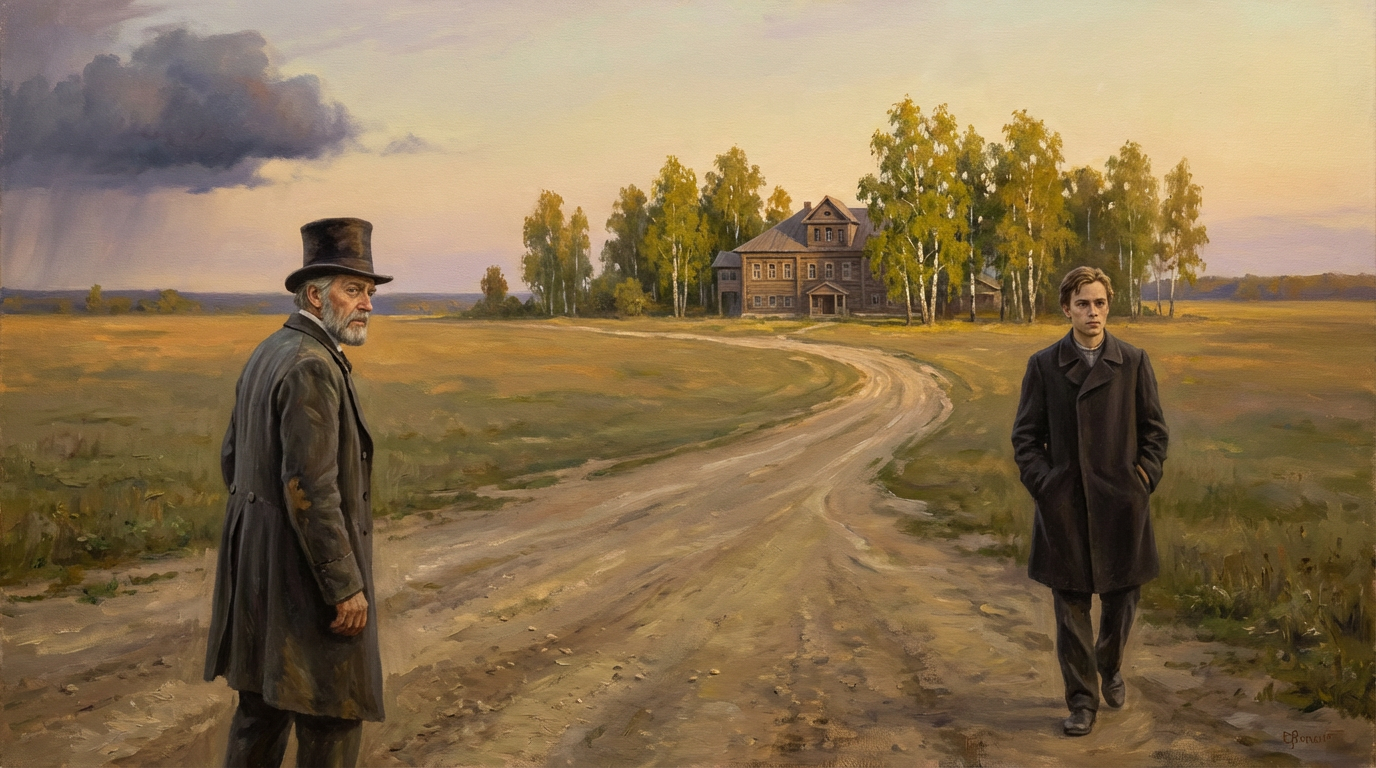
An excerpt from the original text.(complete · 1588 words)
here issued on to the verandah to greet the arrivals no throng of
household serfs--only a solitary girl of twelve. Presently, however,
she was joined by a young fellow much resembling Peter, but dressed
in a grey livery coat to which embossed, silver-gilt buttons were
attached. This was Paul Kirsanov's valet. In silence he opened the door
of the koliaska, and unhooked the apron of the tarantass; whereupon
the three gentlemen alighted, passed through a dark, bare hall (the
face of a young woman peered at them for a moment from behind a door),
and entered a drawing-room upholstered in the latest fashion.
"So here we are at home again!" exclaimed Nikolai Petrovitch, taking
off his cap, and shaking back his hair. "Let us have supper, and then
for bed, bed!"
"Yes, something to eat would undoubtedly be welcome," remarked Bazarov
as, yawning, he seated himself upon a sofa.
"Quite so; I will have supper served at once." Nikolai Petrovitch,
for no apparent reason, tripped over his own feet. "And here comes
Prokofitch," he added.
As he spoke entered a man of about sixty who, white-haired, and of
thin, swarthy features, was wearing a cinnamon-coloured tail-coat
with brass buttons and a crimson collar. He smiled with delight as he
approached and shook hands with Arkady. Then, with a bow to the guest,
he retired to the doorway, and folded his hands behind his back.
"So here is the young master, Prokofitch!" said Nikolai Petrovitch.
"He is home at last. And how, think you, is he looking?"
"Very well, very well," the old man said with another smile. The next
moment, however, he knit his shaggy brows, and suggested: "Shall I lay
the table?"
"If you please, if you please." Nikolai Petrovitch turned to Bazarov.
"Before supper," he said, "would you care to go to your room?"
"I thank you, no. But please have my trunk conveyed thither, and also
this wrap." And Bazarov divested himself of his cloak.
"Certainly. Prokofitch, take the gentleman's cloak."
The old butler received the garment gingerly, held it well away from
him with both hands, and left the room on tiptoe.
"And you, Arkady?" continued Nikolai Petrovitch. "Do you not wish to go
to your room?"
"Yes; for a wash I should be thankful," was Arkady's reply as he moved
towards the door. At that moment it opened to admit a man of medium
height who was dressed in a dark English suit, a fashionably low
collar, and a pair of patent leather boots. This was Paul Petrovitch
Kirsanov. Although forty-five, he had close-cropped grey hair of the
sheen of new silver, and his sallow, unwrinkled face was as clear-cut
and regular of outline as though carved with a light, fine chisel.
Still retaining traces of remarkable comeliness, his bright, black,
oblong eyes had a peculiar attraction, and his every well-bred, refined
feature showed that symmetry of youth, that air of superiority to the
rest of the world which usually disappears when once the twenties have
been passed.
Drawing from his trouser pocket a slender hand the long, pink nails
of which looked all the slenderer for the snowy whiteness of the
superimposed cuff and large opal sleeve-link, he offered it to his
nephew; after which, this prefatory European "handshake" over, he
thrice kissed Arkady in the Russian fashion--that is to say, touched
his nephew's cheek with his perfumed moustache, and murmured: "I
congratulate you."
Next Nikolai Petrovitch presented to him Bazarov. Inclining his supple
figure with a faint smile, Paul Petrovitch this time did not offer his
hand. On the contrary, he replaced it in his pocket.
"I was beginning to think that you never meant to arrive," he said with
an amiable hoist of his shoulders and a display of some beautiful white
teeth. "What happened to you?"
"Nothing," replied Arkady, "except that we lingered a little. For the
same reason are we as hungry as wolves; so pray tell Prokofitch to be
quick, Papa, and I shall be back in a moment."
"Wait; I will go with you," added Bazarov as he rose from the sofa; and
the two young men left the room together.
"Who is your guest?" asked Paul Petrovitch.
"A friend of Arkady's, and, according to Arkady's showing, a man of
intellect."
"He is going to stay here?"
"He is."
"A long-haired fellow like that?"
"Certainly."
In that particular direction Paul Petrovitch said no more, but, tapping
the table with his finger-nails, added:
"Je pense que notre Arkady s'est dégourdi.[1] And in any case I am
pleased to see him back again."
At supper little was said. In particular did Bazarov scarcely speak,
though he ate heartily; and only Nikolai Petrovitch proved garrulous as
he related various incidents in what he termed his "agricultural life,"
and gossiped of forthcoming administrative measures, committees,
deputations, the need of introducing machinery, and other such topics.
For his part, Paul Petrovitch paced the room (he never took supper),
and sipped a glassful of red wine, and occasionally interjected some
such remark--rather, exclamation--as "Ah!" or "Oh, ho!" or "H'm!"
Arkady's contribution consisted of a little St. Petersburg gossip, even
though, throughout, he was conscious of a touch of that awkwardness
which overtakes a young man when, just ceased to be a boy, he returns
to the spot where hitherto he has ranked as a mere child. In other
words, he drawled his phrases unnecessarily, carefully avoided the use
of the term "Papasha,"[2] and, once, even went so far as to substitute
for it the term "Otety"[3]--though, true, he pronounced it with some
difficulty. Lastly, in his excessive desire to seem at his ease, he
helped himself to more wine than was good for him, and tasted some of
every brand. Meanwhile Prokofitch chewed his lips, and never removed
his eyes from his young master.
Supper over, the company dispersed.
"A queer fellow is that uncle of yours," Bazarov said to Arkady as,
clad in a dressing-gown, he seated himself by his friend's bed, and
sucked at a short pipe. "To think of encountering such elegance in the
country! He would take a prize with his finger-nails."
"You do not know him yet," said Arkady. "In his day he was a leading
lion, and some time or another I will tell you his history. Yes, many
and many a woman has lost her head over his good looks."
"Then I should think that he has nothing to live on save memories,"
observed Bazarov. "At all events, there is no one here for him to
enslave. I looked him over to-night, and never in my life have beheld
a collar of such marvellous gloss, or a chin so perfectly shaven. Yet
such things can come to look ridiculous, do not you think?"
"Yes--perhaps they can. But he is such an excellent fellow in himself!"
"Oh, certainly--a truly archangelic personage! Your father, too, is
excellent; for though he may read foolish poetry, and though his ideas
on the subject of industry may be few, his heart is in the right place."
"He is a man with a heart of gold."
"Nevertheless, did you notice his nervousness to-night?"
Arkady nodded as though to himself such a weakness was a perfect
stranger.
"Curious indeed!" commented Bazarov. "Ah, you elderly Romanticists!
You over-develop the nervous system until the balance is upset. Now,
good-night. In my room there is an English washstand, yet the door
will not shut! But such things (English washstands I mean) need to be
encouraged: they represent 'progress.'"
And Bazarov departed, while Arkady surrendered himself to a sensation
of comfort. How pleasant was it to be sinking to sleep in one's
comfortable home, and in one's own familiar bed, and under a well-known
coverlet worked by loving hands--perhaps those of his good, kind,
tireless old nurse! And at the thought of Egorovna he sighed, and
commended her soul to the Heavenly Powers. But for himself he did not
pray.
Soon both he and Bazarov were asleep; but certain other members of the
household there were who remained wakeful. In particular had Nikolai
Petrovitch been greatly excited by his son's return; and though he went
to bed, he left the candle burning, and, resting with his head on his
hands, lay thinking deeply.
Also, his brother sat up in his study until nearly midnight. Seated
in an ample armchair before a corner where a marble stove was
smouldering, he had effected no alteration in his costume beyond
having exchanged his patent leather boots for a pair of heelless, red
felt slippers. Lastly, he was holding, though not reading, the latest
number of Galignani, and his eyes were fixed upon the stove, where
a quivering blue spurt of flame kept alternately disappearing and
bursting forth again. Whither his thoughts were wandering God only
knows; but that they were not meandering through the past alone was
proved by the fact that in his expression there was a concentrated
gloom which is never in evidence when a man's mind is occupied with
memories and no more.
Finally, seated on a chest in a small room at the back of the house,
and wearing a blue dressing-jacket and, thrown over her dark hair,
a white scarf, was the girl Thenichka. As she sat there she kept
listening, and starting, and gazing towards an open door which at once
afforded a glimpse of an infant's cot and admitted the sound of a
sleeping child's respiration.
[1] "I think that our friend Arkady has acquired some polish."
[2] Dear Papa.
[3] Father.
Master this chapter. Complete your experience
Purchase the complete book to access all chapters and support classic literature
As an Amazon Associate, we earn a small commission from qualifying purchases at no additional cost to you.
Available in paperback, hardcover, and e-book formats
Let's Analyse the Pattern
The exhausting cycle of performing who we think we should be instead of discovering who we actually are.
Why This Matters
Connect literature to life
This chapter teaches how to distinguish between authentic behavior and social performance in yourself and others.
Practice This Today
This week, notice when you change your voice, posture, or word choices in different settings - ask yourself if you're performing or adapting authentically.
Now let's explore the literary elements.
Key Quotes & Analysis
"So here we are at home again!"
Context: When they first enter the house after the long journey
This simple exclamation reveals Nikolai's genuine joy and relief at having his son home. But the word 'again' hints that things might not be the same as before - home is the same, but the people have changed.
In Today's Words:
We made it! Everything's back to normal now!
"And here comes Prokofitch"
Context: Introducing the old family servant who's approaching to greet Arkady
Nikolai's warm tone shows how the household operates like a family, with servants who are genuinely cared for. This represents the traditional Russian way of life that Bazarov will challenge.
In Today's Words:
Oh good, here's someone who's really excited to see you!
"So here is the young master, Prokofitch! He is home at last."
Context: Presenting Arkady to the delighted old servant
The formal title 'young master' shows the household hierarchy, but Nikolai's pride and excitement come through clearly. He's showing off his son to someone who helped raise him.
In Today's Words:
Look who's finally back! Our boy made it home!
Thematic Threads
Identity
In This Chapter
Arkady struggles between his old self and new university persona, unsure how to be authentic with his family
Development
Introduced here as central conflict
In Your Life:
You might recognize this when you find yourself acting differently around different groups, never feeling fully yourself anywhere.
Class
In This Chapter
Pavel's aristocratic refinement clashes with Bazarov's deliberate rejection of social polish and manners
Development
Deepened from earlier hints into open tension
In Your Life:
You see this in code-switching between work and home, or feeling judged for your background in professional settings.
Generational Divide
In This Chapter
The older generation (Pavel, Nikolai) represents tradition while the younger (Arkady, Bazarov) challenges established ways
Development
Established as core structural conflict
In Your Life:
This appears when your values clash with your parents' expectations or when you struggle to understand your children's worldview.
Belonging
In This Chapter
Everyone seems slightly out of place - Arkady between worlds, Bazarov as outsider, Pavel clinging to faded relevance
Development
Introduced as underlying tension
In Your Life:
You feel this when starting a new job, moving to a different community, or when your life circumstances change dramatically.
Observation
In This Chapter
Bazarov watches and judges while saying little, Pavel makes subtle disapproving comments, everyone is sizing everyone else up
Development
Introduced here
In Your Life:
This happens in any new social situation where people are figuring out power dynamics and where they fit in the hierarchy.
You now have the context. Time to form your own thoughts.
Discussion Questions
- 1
How does Arkady's behavior change when he returns home, and what specific things does he do differently?
analysis • surface - 2
Why do you think Arkady feels the need to perform a new version of himself instead of just being natural with his family?
analysis • medium - 3
Where do you see people today performing an identity instead of living authentically - at work, on social media, or in relationships?
application • medium - 4
If you were Arkady's friend, how would you help him feel comfortable being himself around both his university peers and his family?
application • deep - 5
What does this chapter reveal about how we protect ourselves when we're unsure where we belong?
reflection • deep
Critical Thinking Exercise
Identity Performance Audit
Think about three different environments where you spend time (work, family, friends, online, etc.). For each space, write down how you act, speak, and present yourself. Notice where you feel most natural versus where you feel like you're performing a role. Identify one small way you could be more authentic in the space where you perform the most.
Consider:
- •Performance isn't always bad - sometimes we adapt appropriately to different contexts
- •The key is recognizing when performance becomes exhausting or prevents real connection
- •Authentic doesn't mean saying everything you think - it means your responses come from your true self rather than from fear
Journaling Prompt
Write about a time when you felt caught between two different versions of yourself. What were you afraid would happen if you stopped performing? Looking back, what do you wish you had done differently?
Coming Up Next...
Chapter 5: Morning Revelations and Uncomfortable Truths
Morning brings new opportunities for conflict as Bazarov ventures outside, ready to explore his surroundings and likely stir up more trouble with his unconventional ways.



