
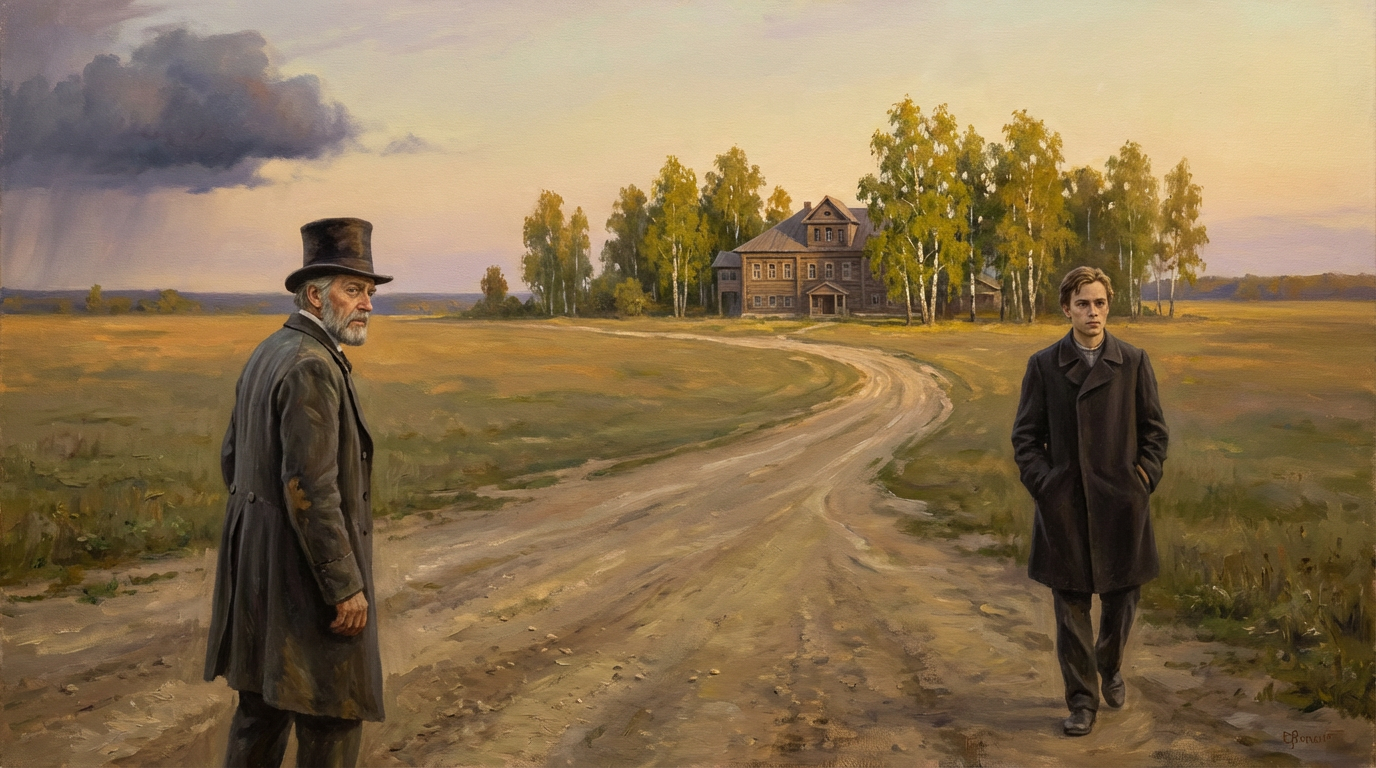
An excerpt from the original text.(complete · 5043 words)
ince that time six months have passed, and there has fallen upon the
country a "white" winter--a winter of clear, keen, motionless frosts,
of deep, crackling snow, of pink-rimed trees, of pale-emerald heavens,
of smoke-capped chimneys, of puffs of vapour from momentarily opened
doors, of faces fresh and hard-bitten, of horses galloping headlong
to thaw their frozen limbs. It is now the close of a January day,
and the increasing chill of evening is nipping the still air in an
ever-tightening vice as the sun sinks downward into a sea of red.
But in the windows of Marino there are lights burning, and Prokofitch,
vested in a black tail-coat, a pair of white gloves, and a peculiar
atmosphere of solemnity, is laying the table with seven covers. This
is because a week ago there were solemnised in the tiny church of
the parish--solemnised quietly, almost without a witness--two sets
of nuptials: the nuptials of Arkady and Katia and those of Nikolai
Petrovitch and Thenichka. And to-day Nikolai Petrovitch is offering his
brother a farewell dinner, for the reason that Paul is on the point of
departing for Moscow, whither Anna Sergievna has already removed after
bestowing upon the younger of the two couples a handsome dowry.
At three o'clock precisely the company gathers around the board.
Mitia too is present with his niania (in nurse's cap), while Paul
Petrovitch is seated between Katia and Thenichka, and the bridegrooms
are ranged one on either side of their newly-wedded spouses. A change
has taken place in our old acquaintances since last we saw them--they
have improved, as regards the younger ones, both in appearance and in
sedateness of demeanour. Only Paul Petrovitch looks thinner; though
the circumstance imparts, if anything, an added touch of refinement and
"grand-seignorishness" to his always expressive features. Thenichka,
in particular, is a different person from what she was. Clad in a
brand-new silken gown, and wearing a broad velvet band over her hair
and a necklace around her throat, she holds herself with an immovable
dignity, yet also with an immovable deference towards her surroundings.
And meanwhile she smiles, as much as to say: "Pardon me, but I am not
responsible for this"; while the others respond with similar smiles,
as though they too would be glad to excuse themselves for their share
in the proceedings. Yet the fact that on every one present sits a
touch of gravity and embarrassment becomes the company no less than
do their other characteristics. Everywhere, too, there is to be seen
such an anxious solicitude for mutual wants that the company could seem
unanimously to be playing some simple-minded comedy; and though, of
the guests, the quietest is Katia, it is plain, from her confidence of
bearing, that, as a daughter-in-law, she has found favour in the eyes
of Nikaiai Petrovitch.
At length the meal comes to an end, and Nikolai, rising and grasping a
wine-glass, addresses Paul Petrovitch:
"Dearest brother, you are about to leave us. Yes, you are about to
leave us. But not for long must you be absent, since I, for one, could
never express to you how much I, how much I--that is to say, how much
we But, to tell you the truth, I am not good at making a speech.
Arkady, to you I depute the task."
"But I am not ready, Papa."
"Neither am I. However, Paul, I embrace you, and wish you every joy,
and beg of you to return to us soon."
Whereupon Paul Petrovitch exchanges greetings all round (not excluding
little Mitia), and, in particular, kisses Thenichka's hand (which she
has not learnt to offer in the right way), drinks a twice-filled glass
to the company at large, and says with a profound sigh: "May you all
be happy, my friends! Farewell![1]" And though the English terminal
flourish passes unnoticed, every one is touched with the benediction
which has preceded it.
"Yes, and I drink to the memory of Bazarov," whispers Katia to her
husband as she clinks glasses with him: but though, in response, he
squeezes her hand, he decides not to propose the toast in public.
* * * * *
And here, apparently, there ought to follow the word Finis; but since
some of my readers may care to know how each of the characters in the
book is faring at the present day, I will satisfy that curiosity.
To take Anna Sergievna first, she has married--not for love, nor yet
out of a sense of duty--a rising young statesman who is an intelligent
legislator, a severely practical thinker, a man of strong will and
eloquence, and a lover with a temperament as cold as ice. Nevertheless
the pair reside on amicable terms, and may, in time, attain to
happiness--nay, even to love.
As for the Princess, she is dead, and her memory perished with her.
The Kirsanovs, father and son, are settled at Marino, and appear to be
righting their industrial affairs, in that Arkady has developed into a
capable manager, and the estate now brings in a fair income. Nikolai
Petrovitch, too, is constant in his endeavours to make peace on the
property, and, riding systematically round it, delivers long speeches
in the belief that only need the peasantry be "reasoned with"--that is
to say, plied with the same words over and over again--for the muzhik
gradually to become a tractable animal. Yet Nikolai earns the approval
neither of the educated gentry, who speak with affected jauntiness of
the coming "'mancipation"[2] (they invariably give the syllable "an" a
nasal inflection), nor of those uneducated landowners who roundly curse
what they term "that ----'muncipation." In other words, for both
classes Nikolai Petrovitch is too "mild."
Katerina Sergievna has had a son born to her, and named him Kolia;
Mitia is now a big, active, volubly lisping boy; and Thenichka (rather,
Theodosia Nikolaievna) adores her daughter-in-law only less than her
husband and Mitia. In fact, that adoration reaches the point that,
should Katia sit down to the piano, Thenichka cannot leave her though
the playing continue all day.
Then a word concerning Peter the valet. As much a lump of mingled
stupidity and conceit as ever, he still pronounces his e's as u's, but
has taken unto himself a wife, and, with her, a respectable dowry. The
daughter of a market gardener of the neighbouring town, she had already
refused two eligible partis solely on the ground that they did not
possess watches! But Peter possesses not only a watch, but also a pair
of patent leather pumps.
Again, any day on the Brühl Terrace, in Dresden, you may meet, between
two and four o'clock in the afternoon (the fashionable hour for a
promenade), a man of about fifty. Grey-headed, and afflicted with gout,
yet still handsome, he is elegantly dressed, and stamped with that air
of good breeding which comes only of long association with elevated
strata of society. That man is Paul Petrovitch. Having left Moscow for
foreign parts for his health's sake, he has settled in Dresden for
the reason that there he possesses the largest number of English and
nomad-Russian acquaintances. Towards the former he bears himself with
simplicity, and almost with modesty, but with a touch of hauteur;
and, in return, the English look upon him as a trifle tedious, but
respect him on the score of his being "quite a gentleman." In the
presence of the Russian element, however, Paul Petrovitch is more
free and easy--he gives rein unstintedly to his sarcasm, and rallies
both his compatriots and himself. Yet from him such things come
pleasantly, and with a gay insouciance, and in a becoming manner;
while, in addition, he holds Slavophil views--views which (as we all
know) invariably induce the great world to rate their holder a person
très distingué. True, never by any chance does Paul read a Russian
book; yet by way of compensation, there stands on his writing-table
a silver ash-tray shaped like a muzhik's clog. Moreover, from some
of our Russian tourists he receives considerable attention when they
happen to be passing through the town; and even our old friend Matvei
Ilyitch Koliazin, on finding himself "in temporary opposition," has
paid him a visit while en route to Bohemia for a course of the
waters. In fact, the only persons who show Paul no deference at all are
the native Germans, whose society he does not greatly cultivate. Yet
even they agree that, in the matter of obtaining tickets for the Court
Chapel or the theatre and so forth, none is so clever, so dexterous, as
"der Herr Baron von Kirsanov." In fact, always does he do "the right
thing" so far as he is able; and even yet he can create some stir,
owing to the fact that he has once, and to good purpose, been a social
lion. Yet life presses upon him not a little heavily--more heavily
than he himself is aware. Merely need one look at him as, huddled
against the aisle wall of the Russian church, he sits plunged in
thought, with his lips bitterly compressed, and continues sitting there
until, remembering his surroundings, he makes, almost imperceptibly,
the sign of the cross. In similar fashion, Madame Kukshin has gone
abroad--in her case, to Heidelberg, where she is engaged in studying,
not natural science, but architecture--a branch wherein she has,
according to herself, "discovered several new laws." Also, still she
is hail-fellow-well-met with students, more especially with some of
those Russian physicists and chemists who swarm in Heidelberg, and who,
though at first flabbergasting the simple-minded German professors with
the moderation of their views, subsequently proceed to flabbergast
those professors with the wholeheartedness of their sloth. In fact, it
is of two or three of those chemistry students who, though unable to
distinguish even oxygen from azote, are yet charged to the brim with
conceit and the spirit of "denial," that Madame Kukshin's circle is
chiefly composed.
Similarly, friend Sitnikov is preparing to become a great man. For
which purpose he is flaunting it in St. Petersburg, and (to quote
his own expression) "carrying on the work of the late Bazarov."
True, rumour declares that some one has recently given him a second
thrashing; as also that he (Sitnikov) has declined to face the
music--rather, that he has preferred to hint in an obscure article in
an equally obscure newspaper that his assailant is the coward; but to
this report Sitnikov merely attaches the epithet "ironical." For the
rest, his father continues to send him remittances, while his wife
accounts him equally a littérateur and a fool.
Lastly, in a remote corner of Russia there lies a little country
cemetery. Like most cemeteries of the kind, it is depressing of aspect.
Over its fences dense masses of weed have grown, its drab wooden
crosses are rickety and turning mouldy under their blistered, painted
canopies, its stone paths have lost their alignment, and look as though
some one has displaced them from below, its two or three ragged trees
diffuse only the scantiest of shade, and sheep wander unhindered over
its tombs. But among those tombs there lies a grave which no man
molests and no animal tramples upon: only the birds perch upon it and
sing as evening falls. For around that grave stands an iron railing,
and at its head and foot are planted two young fir trees. It is the
grave of Evgenii Vasilitch Bazarov. Occasionally from the neighbouring
manor-house there come two aged and decrepit folk, a man and his wife.
Supporting one another with a step which ever grows heavier, they
approach the railing, sink upon their knees, and weep long, bitter
tears as they gaze at the dumb headstone where their son lies sleeping.
Then they exchange a word or two, dust the stone with assiduous care,
lay upon it a sprig of fir, and offer a last petition. Yet even then
they can scarce bear to tear themselves from the spot where they can
draw nearest to their son, and to their memories of him.
But are those tears, those prayers, all fruitless? Is that love, that
hallowed, selfless love, of theirs to be wholly unavailing? No, no,
and a thousand times no! For, though the heart which lies within that
tomb may have been passionate and wild and erring, the flowers which
bloom in that spot contemplate us with eyes of naught but peace and
innocence, and speak to us of naught but the eternal, mighty calm of
"unheeding" nature, as an image of the Eternal Reconciliation, and of
the Life which shall have no End.
[1] In the text this word is given in English.
[2] i.e. the emancipation of the serfs, which was carried out in 1861.
End of Project Gutenberg's Fathers and Sons, by Ivan Sergeevich Turgenev
*** END OF THE PROJECT GUTENBERG EBOOK FATHERS AND SONS ***
Updated editions will replace the previous one—the old editions will
be renamed.
Creating the works from print editions not protected by U.S. copyright
law means that no one owns a United States copyright in these works,
so the Foundation (and you!) can copy and distribute it in the United
States without permission and without paying copyright
royalties. Special rules, set forth in the General Terms of Use part
of this license, apply to copying and distributing Project
Gutenberg™ electronic works to protect the PROJECT GUTENBERG™
concept and trademark. Project Gutenberg is a registered trademark,
and may not be used if you charge for an eBook, except by following
the terms of the trademark license, including paying royalties for use
of the Project Gutenberg trademark. If you do not charge anything for
copies of this eBook, complying with the trademark license is very
easy. You may use this eBook for nearly any purpose such as creation
of derivative works, reports, performances and research. Project
Gutenberg eBooks may be modified and printed and given away—you may
do practically ANYTHING in the United States with eBooks not protected
by U.S. copyright law. Redistribution is subject to the trademark
license, especially commercial redistribution.
START: FULL LICENSE
THE FULL PROJECT GUTENBERG LICENSE
PLEASE READ THIS BEFORE YOU DISTRIBUTE OR USE THIS WORK
To protect the Project Gutenberg™ mission of promoting the free
distribution of electronic works, by using or distributing this work
(or any other work associated in any way with the phrase “Project
Gutenberg”), you agree to comply with all the terms of the Full
Project Gutenberg™ License available with this file or online at
www.gutenberg.org/license.
Section 1. General Terms of Use and Redistributing Project Gutenberg™
electronic works
1.A. By reading or using any part of this Project Gutenberg™
electronic work, you indicate that you have read, understand, agree to
and accept all the terms of this license and intellectual property
(trademark/copyright) agreement. If you do not agree to abide by all
the terms of this agreement, you must cease using and return or
destroy all copies of Project Gutenberg™ electronic works in your
possession. If you paid a fee for obtaining a copy of or access to a
Project Gutenberg™ electronic work and you do not agree to be bound
by the terms of this agreement, you may obtain a refund from the person
or entity to whom you paid the fee as set forth in paragraph 1.E.8.
1.B. “Project Gutenberg” is a registered trademark. It may only be
used on or associated in any way with an electronic work by people who
agree to be bound by the terms of this agreement. There are a few
things that you can do with most Project Gutenberg™ electronic works
even without complying with the full terms of this agreement. See
paragraph 1.C below. There are a lot of things you can do with Project
Gutenberg™ electronic works if you follow the terms of this
agreement and help preserve free future access to Project Gutenberg™
electronic works. See paragraph 1.E below.
1.C. The Project Gutenberg Literary Archive Foundation (“the
Foundation” or PGLAF), owns a compilation copyright in the collection
of Project Gutenberg™ electronic works. Nearly all the individual
works in the collection are in the public domain in the United
States. If an individual work is unprotected by copyright law in the
United States and you are located in the United States, we do not
claim a right to prevent you from copying, distributing, performing,
displaying or creating derivative works based on the work as long as
all references to Project Gutenberg are removed. Of course, we hope
that you will support the Project Gutenberg™ mission of promoting
free access to electronic works by freely sharing Project Gutenberg™
works in compliance with the terms of this agreement for keeping the
Project Gutenberg™ name associated with the work. You can easily
comply with the terms of this agreement by keeping this work in the
same format with its attached full Project Gutenberg™ License when
you share it without charge with others.
1.D. The copyright laws of the place where you are located also govern
what you can do with this work. Copyright laws in most countries are
in a constant state of change. If you are outside the United States,
check the laws of your country in addition to the terms of this
agreement before downloading, copying, displaying, performing,
distributing or creating derivative works based on this work or any
other Project Gutenberg™ work. The Foundation makes no
representations concerning the copyright status of any work in any
country other than the United States.
1.E. Unless you have removed all references to Project Gutenberg:
1.E.1. The following sentence, with active links to, or other
immediate access to, the full Project Gutenberg™ License must appear
prominently whenever any copy of a Project Gutenberg™ work (any work
on which the phrase “Project Gutenberg” appears, or with which the
phrase “Project Gutenberg” is associated) is accessed, displayed,
performed, viewed, copied or distributed:
This eBook is for the use of anyone anywhere in the United States and most
other parts of the world at no cost and with almost no restrictions
whatsoever. You may copy it, give it away or re-use it under the terms
of the Project Gutenberg License included with this eBook or online
at www.gutenberg.org. If you
are not located in the United States, you will have to check the laws
of the country where you are located before using this eBook.
1.E.2. If an individual Project Gutenberg™ electronic work is
derived from texts not protected by U.S. copyright law (does not
contain a notice indicating that it is posted with permission of the
copyright holder), the work can be copied and distributed to anyone in
the United States without paying any fees or charges. If you are
redistributing or providing access to a work with the phrase “Project
Gutenberg” associated with or appearing on the work, you must comply
either with the requirements of paragraphs 1.E.1 through 1.E.7 or
obtain permission for the use of the work and the Project Gutenberg™
trademark as set forth in paragraphs 1.E.8 or 1.E.9.
1.E.3. If an individual Project Gutenberg™ electronic work is posted
with the permission of the copyright holder, your use and distribution
must comply with both paragraphs 1.E.1 through 1.E.7 and any
additional terms imposed by the copyright holder. Additional terms
will be linked to the Project Gutenberg™ License for all works
posted with the permission of the copyright holder found at the
beginning of this work.
1.E.4. Do not unlink or detach or remove the full Project Gutenberg™
License terms from this work, or any files containing a part of this
work or any other work associated with Project Gutenberg™.
1.E.5. Do not copy, display, perform, distribute or redistribute this
electronic work, or any part of this electronic work, without
prominently displaying the sentence set forth in paragraph 1.E.1 with
active links or immediate access to the full terms of the Project
Gutenberg™ License.
1.E.6. You may convert to and distribute this work in any binary,
compressed, marked up, nonproprietary or proprietary form, including
any word processing or hypertext form. However, if you provide access
to or distribute copies of a Project Gutenberg™ work in a format
other than “Plain Vanilla ASCII” or other format used in the official
version posted on the official Project Gutenberg™ website
(www.gutenberg.org), you must, at no additional cost, fee or expense
to the user, provide a copy, a means of exporting a copy, or a means
of obtaining a copy upon request, of the work in its original “Plain
Vanilla ASCII” or other form. Any alternate format must include the
full Project Gutenberg™ License as specified in paragraph 1.E.1.
1.E.7. Do not charge a fee for access to, viewing, displaying,
performing, copying or distributing any Project Gutenberg™ works
unless you comply with paragraph 1.E.8 or 1.E.9.
1.E.8. You may charge a reasonable fee for copies of or providing
access to or distributing Project Gutenberg™ electronic works
provided that:
• You pay a royalty fee of 20% of the gross profits you derive from
the use of Project Gutenberg™ works calculated using the method
you already use to calculate your applicable taxes. The fee is owed
to the owner of the Project Gutenberg™ trademark, but he has
agreed to donate royalties under this paragraph to the Project
Gutenberg Literary Archive Foundation. Royalty payments must be paid
within 60 days following each date on which you prepare (or are
legally required to prepare) your periodic tax returns. Royalty
payments should be clearly marked as such and sent to the Project
Gutenberg Literary Archive Foundation at the address specified in
Section 4, “Information about donations to the Project Gutenberg
Literary Archive Foundation.”
• You provide a full refund of any money paid by a user who notifies
you in writing (or by e-mail) within 30 days of receipt that s/he
does not agree to the terms of the full Project Gutenberg™
License. You must require such a user to return or destroy all
copies of the works possessed in a physical medium and discontinue
all use of and all access to other copies of Project Gutenberg™
works.
• You provide, in accordance with paragraph 1.F.3, a full refund of
any money paid for a work or a replacement copy, if a defect in the
electronic work is discovered and reported to you within 90 days of
receipt of the work.
• You comply with all other terms of this agreement for free
distribution of Project Gutenberg™ works.
1.E.9. If you wish to charge a fee or distribute a Project
Gutenberg™ electronic work or group of works on different terms than
are set forth in this agreement, you must obtain permission in writing
from the Project Gutenberg Literary Archive Foundation, the manager of
the Project Gutenberg™ trademark. Contact the Foundation as set
forth in Section 3 below.
1.F.
1.F.1. Project Gutenberg volunteers and employees expend considerable
effort to identify, do copyright research on, transcribe and proofread
works not protected by U.S. copyright law in creating the Project
Gutenberg™ collection. Despite these efforts, Project Gutenberg™
electronic works, and the medium on which they may be stored, may
contain “Defects,” such as, but not limited to, incomplete, inaccurate
or corrupt data, transcription errors, a copyright or other
intellectual property infringement, a defective or damaged disk or
other medium, a computer virus, or computer codes that damage or
cannot be read by your equipment.
1.F.2. LIMITED WARRANTY, DISCLAIMER OF DAMAGES - Except for the “Right
of Replacement or Refund” described in paragraph 1.F.3, the Project
Gutenberg Literary Archive Foundation, the owner of the Project
Gutenberg™ trademark, and any other party distributing a Project
Gutenberg™ electronic work under this agreement, disclaim all
liability to you for damages, costs and expenses, including legal
fees. YOU AGREE THAT YOU HAVE NO REMEDIES FOR NEGLIGENCE, STRICT
LIABILITY, BREACH OF WARRANTY OR BREACH OF CONTRACT EXCEPT THOSE
PROVIDED IN PARAGRAPH 1.F.3. YOU AGREE THAT THE FOUNDATION, THE
TRADEMARK OWNER, AND ANY DISTRIBUTOR UNDER THIS AGREEMENT WILL NOT BE
LIABLE TO YOU FOR ACTUAL, DIRECT, INDIRECT, CONSEQUENTIAL, PUNITIVE OR
INCIDENTAL DAMAGES EVEN IF YOU GIVE NOTICE OF THE POSSIBILITY OF SUCH
DAMAGE.
1.F.3. LIMITED RIGHT OF REPLACEMENT OR REFUND - If you discover a
defect in this electronic work within 90 days of receiving it, you can
receive a refund of the money (if any) you paid for it by sending a
written explanation to the person you received the work from. If you
received the work on a physical medium, you must return the medium
with your written explanation. The person or entity that provided you
with the defective work may elect to provide a replacement copy in
lieu of a refund. If you received the work electronically, the person
or entity providing it to you may choose to give you a second
opportunity to receive the work electronically in lieu of a refund. If
the second copy is also defective, you may demand a refund in writing
without further opportunities to fix the problem.
1.F.4. Except for the limited right of replacement or refund set forth
in paragraph 1.F.3, this work is provided to you ‘AS-IS’, WITH NO
OTHER WARRANTIES OF ANY KIND, EXPRESS OR IMPLIED, INCLUDING BUT NOT
LIMITED TO WARRANTIES OF MERCHANTABILITY OR FITNESS FOR ANY PURPOSE.
1.F.5. Some states do not allow disclaimers of certain implied
warranties or the exclusion or limitation of certain types of
damages. If any disclaimer or limitation set forth in this agreement
violates the law of the state applicable to this agreement, the
agreement shall be interpreted to make the maximum disclaimer or
limitation permitted by the applicable state law. The invalidity or
unenforceability of any provision of this agreement shall not void the
remaining provisions.
1.F.6. INDEMNITY - You agree to indemnify and hold the Foundation, the
trademark owner, any agent or employee of the Foundation, anyone
providing copies of Project Gutenberg™ electronic works in
accordance with this agreement, and any volunteers associated with the
production, promotion and distribution of Project Gutenberg™
electronic works, harmless from all liability, costs and expenses,
including legal fees, that arise directly or indirectly from any of
the following which you do or cause to occur: (a) distribution of this
or any Project Gutenberg™ work, (b) alteration, modification, or
additions or deletions to any Project Gutenberg™ work, and (c) any
Defect you cause.
Section 2. Information about the Mission of Project Gutenberg™
Project Gutenberg™ is synonymous with the free distribution of
electronic works in formats readable by the widest variety of
computers including obsolete, old, middle-aged and new computers. It
exists because of the efforts of hundreds of volunteers and donations
from people in all walks of life.
Volunteers and financial support to provide volunteers with the
assistance they need are critical to reaching Project Gutenberg™’s
goals and ensuring that the Project Gutenberg™ collection will
remain freely available for generations to come. In 2001, the Project
Gutenberg Literary Archive Foundation was created to provide a secure
and permanent future for Project Gutenberg™ and future
generations. To learn more about the Project Gutenberg Literary
Archive Foundation and how your efforts and donations can help, see
Sections 3 and 4 and the Foundation information page at www.gutenberg.org.
Section 3. Information about the Project Gutenberg Literary Archive Foundation
The Project Gutenberg Literary Archive Foundation is a non-profit
501(c)(3) educational corporation organized under the laws of the
state of Mississippi and granted tax exempt status by the Internal
Revenue Service. The Foundation’s EIN or federal tax identification
number is 64-6221541. Contributions to the Project Gutenberg Literary
Archive Foundation are tax deductible to the full extent permitted by
U.S. federal laws and your state’s laws.
The Foundation’s business office is located at 809 North 1500 West,
Salt Lake City, UT 84116, (801) 596-1887. Email contact links and up
to date contact information can be found at the Foundation’s website
and official page at www.gutenberg.org/contact
Section 4. Information about Donations to the Project Gutenberg
Literary Archive Foundation
Project Gutenberg™ depends upon and cannot survive without widespread
public support and donations to carry out its mission of
increasing the number of public domain and licensed works that can be
freely distributed in machine-readable form accessible by the widest
array of equipment including outdated equipment. Many small donations
($1 to $5,000) are particularly important to maintaining tax exempt
status with the IRS.
The Foundation is committed to complying with the laws regulating
charities and charitable donations in all 50 states of the United
States. Compliance requirements are not uniform and it takes a
considerable effort, much paperwork and many fees to meet and keep up
with these requirements. We do not solicit donations in locations
where we have not received written confirmation of compliance. To SEND
DONATIONS or determine the status of compliance for any particular state
visit www.gutenberg.org/donate.
While we cannot and do not solicit contributions from states where we
have not met the solicitation requirements, we know of no prohibition
against accepting unsolicited donations from donors in such states who
approach us with offers to donate.
International donations are gratefully accepted, but we cannot make
any statements concerning tax treatment of donations received from
outside the United States. U.S. laws alone swamp our small staff.
Please check the Project Gutenberg web pages for current donation
methods and addresses. Donations are accepted in a number of other
ways including checks, online payments and credit card donations. To
donate, please visit: www.gutenberg.org/donate.
Section 5. General Information About Project Gutenberg™ electronic works
Professor Michael S. Hart was the originator of the Project
Gutenberg™ concept of a library of electronic works that could be
freely shared with anyone. For forty years, he produced and
distributed Project Gutenberg™ eBooks with only a loose network of
volunteer support.
Project Gutenberg™ eBooks are often created from several printed
editions, all of which are confirmed as not protected by copyright in
the U.S. unless a copyright notice is included. Thus, we do not
necessarily keep eBooks in compliance with any particular paper
edition.
Most people start at our website which has the main PG search
facility: www.gutenberg.org.
This website includes information about Project Gutenberg™,
including how to make donations to the Project Gutenberg Literary
Archive Foundation, how to help produce our new eBooks, and how to
subscribe to our email newsletter to hear about new eBooks.
Master this chapter. Complete your experience
Purchase the complete book to access all chapters and support classic literature
As an Amazon Associate, we earn a small commission from qualifying purchases at no additional cost to you.
Available in paperback, hardcover, and e-book formats
Let's Analyse the Pattern
Real transformation happens not in dramatic moments but in the patient adaptation and small daily choices people make after disruption.
Why This Matters
Connect literature to life
This chapter teaches how to identify when slow, undramatic adaptation is actually creating lasting transformation.
Practice This Today
This week, notice when changes in your workplace or family happen gradually rather than dramatically—look for the small shifts in how people interact six months after a major event.
Now let's explore the literary elements.
Key Quotes & Analysis
"At three o'clock precisely the company gathers around the board."
Context: Describing the formal farewell dinner at Marino
The precision of timing shows how everyone is trying to maintain proper social forms in their new arrangements. It's awkward but necessary as they navigate their changed relationships.
In Today's Words:
Everyone showed up exactly on time because nobody wanted to make this any more awkward than it already was.
"Paul Petrovitch is seated between Katya and Thenichka, and the bridegrooms are ranged one on either side of their newly-wedded spouses."
Context: Describing the seating arrangement at the farewell dinner
The formal seating reflects the new social order - Pavel between the two ladies, the men beside their wives. Everyone has found their proper place in the hierarchy.
In Today's Words:
They arranged the seating like a wedding reception, making sure everyone knew their new roles in the family.
"Can it be that their prayers and their tears are fruitless? Can it be that love, sacred, devoted love, is not all-powerful?"
Context: Reflecting on Bazarov's parents visiting his grave
The narrator questions whether the grief and love of parents has any meaning when their child is gone. It's the book's deepest question about whether human emotion matters in the face of death.
In Today's Words:
Does it even matter that his parents still love him and cry for him when he's gone forever?
Thematic Threads
Adaptation
In This Chapter
Everyone finds their new place after the upheaval—Arkady as landowner, Fenechka as wife, Pavel in exile
Development
Culmination of the adaptation struggles shown throughout the novel
In Your Life:
You might see this in how you gradually adjust to new roles after major life changes, finding your footing through daily practice rather than sudden transformation.
Class
In This Chapter
The marriages between classes (Nikolai-Fenechka, Arkady-Katya) have been absorbed into new social arrangements
Development
Resolution of the class tensions that drove much of the novel's conflict
In Your Life:
You might see this in how workplace hierarchies shift and people find new ways to relate across different backgrounds and positions.
Legacy
In This Chapter
Bazarov's parents tending his grave, his memory becoming part of something larger than his revolutionary ideals
Development
Final transformation of Bazarov from disruptor to part of eternal human story
In Your Life:
You might see this in how the impact of difficult people in your life becomes clearer with time and distance.
Practical Love
In This Chapter
Anna's marriage of convenience, the servants' practical matches, love finding realistic expression
Development
Evolution from the novel's earlier romantic idealism to mature understanding of how relationships actually work
In Your Life:
You might see this in how your own relationships succeed through daily consideration and practical support rather than grand romantic gestures.
Continuity
In This Chapter
Life continuing its patterns despite all the disruption, nature's eternal calm encompassing human passion
Development
Final answer to the novel's questions about change and permanence
In Your Life:
You might see this in how life keeps moving forward even after your most intense personal crises, requiring you to find your place in ongoing routines.
You now have the context. Time to form your own thoughts.
Discussion Questions
- 1
Six months after all the drama, what has actually changed in everyone's lives? Who adapted well and who struggled?
analysis • surface - 2
Why do you think the real transformations happened quietly after the confrontations, rather than during the big dramatic moments?
analysis • medium - 3
Think about a major change in your workplace, family, or community. Where did you see this pattern of quiet adaptation happening after the initial disruption?
application • medium - 4
When you're facing a major life change, how can you focus on the small daily choices that matter rather than waiting for everything to feel clear and resolved?
application • deep - 5
The novel ends at Bazarov's grave, suggesting that even disruptive people become part of something eternal. What does this teach us about how to view difficult people in our own lives?
reflection • deep
Critical Thinking Exercise
Map Your Own Quiet Revolution
Think of a major disruption you've experienced in the last few years - a job change, relationship shift, family crisis, or health challenge. Create two lists: the dramatic moments everyone noticed, and the small daily changes that actually transformed your life. Notice which list feels more important to your actual growth.
Consider:
- •Focus on actions you took repeatedly, not one-time decisions
- •Include changes in routine, relationships, and daily habits
- •Notice what you stopped doing as much as what you started
Journaling Prompt
Write about a time when you had to adapt to something you didn't choose. What small daily choices helped you find your footing? How did you maintain your dignity while everything changed around you?



