
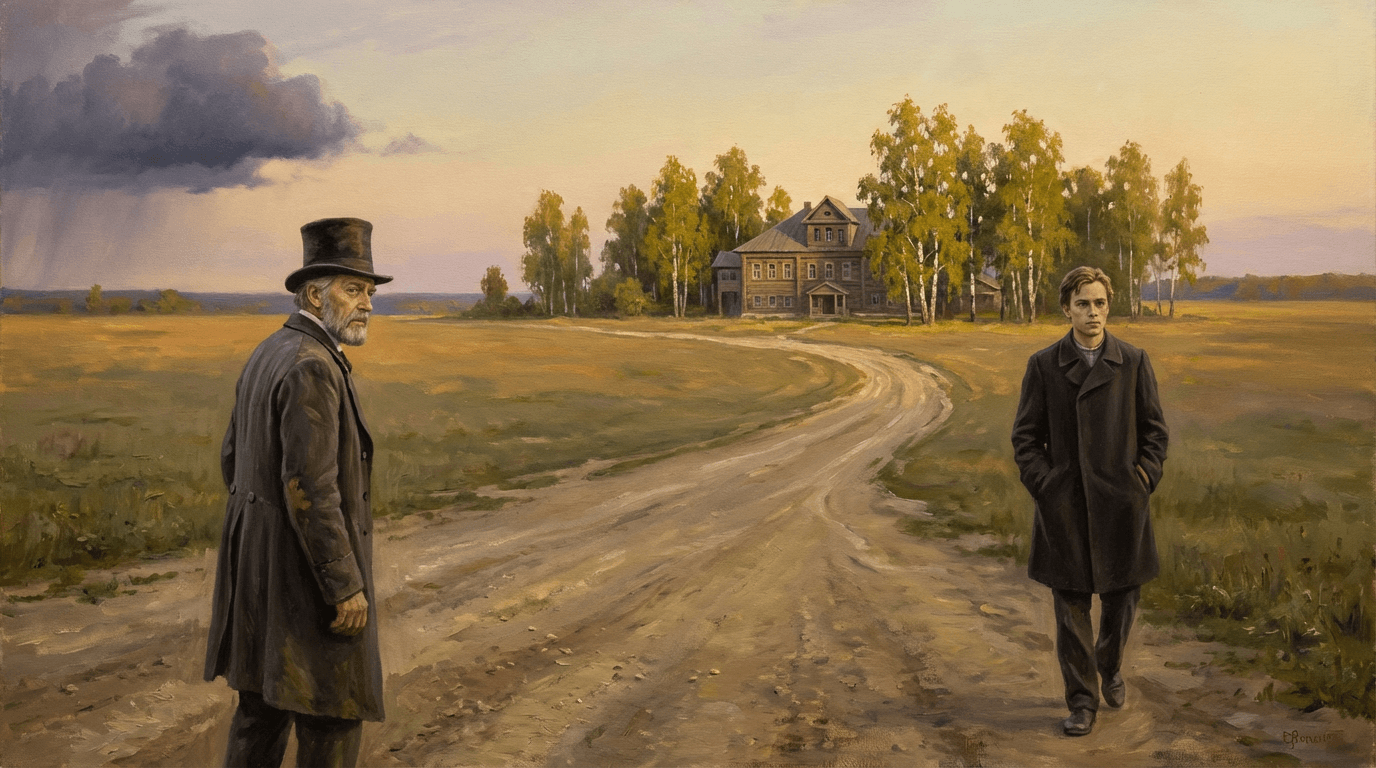
When Your Certainties Aren't Enough
In Fathers and Sons, Turgenev follows Bazarov's nihilism into the parts of life it cannot explain—love, rejection, and death—and watches it strain without breaking, which is its own kind of tragedy.
These 7 chapters reveal what genuine intellectual honesty requires when your framework runs out—and what survives when certainties don't.
The Pattern
Bazarov is the most intellectually formidable character in Fathers and Sons, and Turgenev treats his nihilism with genuine respect—not as adolescent posturing but as a coherent philosophical position with real explanatory power. The question the novel poses is not whether Bazarov is smart enough. He is. The question is whether any fixed worldview, however rigorous, can remain adequate to the full scope of human experience. Turgenev's answer is given through three encounters that his philosophy cannot absorb: falling in love with Anna (who doesn't behave according to his theory of women), being rejected by her (which his pride cannot process), and dying (which his nihilism correctly predicts but cannot console). Each encounter doesn't refute his ideas—it finds the gap between his framework and his humanity. Bazarov is admirable precisely because he doesn't abandon his philosophy when it fails him. He is not a hypocrite. He is someone who discovers, too late, that the instrument he built his life around is insufficient—not wrong, but insufficient. This is Turgenev's most precise and compassionate insight: the tragedy is not in the certainties being false. It is in their being incomplete.
The Map and the Territory
Bazarov's nihilism is a map—a very good map of the parts of human experience that can be measured, dissected, and explained. What maps cannot do is substitute for the territory. When Bazarov falls in love, his framework correctly identifies the physiological components and remains entirely useless for navigating the experience. The map was accurate. The territory was larger.
The Courage of the Incomplete
What makes Bazarov genuinely admirable—rather than simply tragic—is that he faces the limits of his worldview without flinching and without pretending. He does not suddenly find religion or sentimentality. He dies as he lived: clear-eyed, honest, and slightly irritated. Turgenev's portrait suggests that the most courageous intellectual position is not certainty but the willingness to hold your framework honestly, including its gaps.
The Journey Through Chapters
The Ideology in Practice
Bazarov's morning routine—dissecting frogs with local peasant children, talking to them as equals, engaging their curiosity about science—reveals what nihilism looks like lived rather than proclaimed. He is not merely cynical; he is genuinely committed to empirical reality, to honest inquiry, to cutting through pretense. His contempt for art and feeling is not pose—it is method. He is the most rigorous thinker in the novel. Turgenev presents this with full respect before beginning to pressure it.
"Bazarov was in the habit of saying that frogs have no prejudices."
Key Insight
Every worldview is most persuasive in its natural habitat—the domain where its tools work best. Bazarov's nihilism is genuinely powerful when applied to hypocrisy, false sentiment, and inherited tradition. The question Turgenev is setting up is not whether Bazarov is intelligent—he clearly is—but whether any single framework, however sharp, can account for all of human experience. The frog dissection is the last moment of perfect confidence before reality starts pushing back.
The First Crack: Anna Odintsova
Bazarov meets Anna Odintsova at a ball, and immediately she is different from anyone he's categorized before. She is intelligent enough to engage him seriously, self-possessed enough not to need his approval, and composed enough not to perform either admiration or hostility. He finds himself unsettled—trying harder than usual, talking more than he means to, aware of something he cannot name operating beneath his usual confidence.
"Odintsova struck him as different from the other women he had met."
Key Insight
The first sign that your certainties are under pressure is not an argument—it is an encounter with someone who doesn't fit the categories you've built. Bazarov has a theory of women, of aristocrats, of emotion. Anna doesn't behave according to any of it. He cannot dismiss her as vain, or weak, or defined by her circumstances. She is a genuine complication. Notice the person in your life who regularly doesn't fit your framework for them—that's where your framework is thin.
The Ideology Versus the Feeling
Living on Anna's estate, Bazarov begins to understand that he is falling in love—and he hates it. He dissects the feeling with clinical precision: it is chemical attraction, animal response, nothing more. His nihilism provides him a complete explanation. The explanation doesn't help at all. He cannot make the feeling stop by naming it correctly. The gap between his intellectual framework and his actual experience becomes a private torment he cannot admit to anyone, especially himself.
"He had a horror of all sentimentality. Fighting against it was his habit. But there was something in her which he could not fight."
Key Insight
The most sophisticated version of emotional avoidance is intellectualization—the ability to correctly name and explain a feeling without actually processing it. Bazarov knows exactly what is happening to him and cannot use that knowledge to escape it. Understanding your response in theoretical terms is not the same as experiencing it honestly. The certainty of the diagnosis does not cure the condition. This is what Turgenev means when he shows nihilism failing: not that the ideas are wrong, but that they are insufficient.
The Confession That Backfires
Bazarov finally tells Anna he loves her—awkwardly, almost defiantly, as if issuing a challenge rather than a declaration. Anna does not recoil. She listens, she is moved, and then she retreats. She is genuinely attracted to him but more committed to her comfortable, ordered life than to the disruption he represents. She refuses him gently but clearly. Bazarov, who has never experienced genuine rejection by anyone he respected, has no framework for absorbing it.
"She was frightened of him, and sorry for him, and fond of him."
Key Insight
There is a specific kind of confidence that has never been seriously tested—and it is extremely fragile. Bazarov has always been able to dismiss the people who rejected him as simply not understanding him. Anna understands him completely and still says no. This removes his escape route. The refusal is not from ignorance—it is from clear-eyed self-knowledge on her part. You cannot argue with someone who knows exactly what they're choosing and why. Bazarov's ideology leaves him completely unequipped for this.
The Retreat into Work
After his rejection, Bazarov announces he is leaving immediately. He retreats into scientific work with a kind of fury—dissecting, analyzing, refusing to acknowledge what happened. This is the strategy his ideology provides: when the non-rational intrudes, return to the rational. Work harder. Cut deeper. Naming things is the cure. But Turgenev shows the retreat not as strength but as flight—and the work, however rigorous, cannot stop what is happening to him internally.
"He threw himself into work with a kind of frenzy."
Key Insight
Work is one of the most socially acceptable ways to avoid experience. When Bazarov returns to his frogs after Anna, he is using the apparatus of his worldview—empirical rigor, scientific method—as emotional armor rather than intellectual tool. This is when a healthy methodology becomes a defense mechanism. The test is not whether the work is real—it is—but whether it's being used to engage with life or to avoid the parts of it the framework can't explain.
The Mortal Wound
Bazarov accidentally cuts himself while performing an autopsy on a typhus victim. He diagnoses himself with clinical accuracy: the wound will likely prove fatal. He goes to his father, who is a doctor, and tells him without drama. Both men know what it means. Bazarov faces death the same way he has faced everything—with the tools of his philosophy. He does not flinch. But the philosophy, having denied the significance of death, cannot console him for dying. He calls for Anna one more time.
"Take care of yourself. And bury me decently—without any particular ceremony."
Key Insight
Nihilism is excellent at cutting through illusion. It is less equipped for the moment when you need something more than clarity—when you need not truth but comfort, not analysis but presence. Bazarov's courage in the face of death is real and admirable. But the fact that he calls for Anna reveals what his ideology cannot give him: the thing we reach for when pure rational certainty runs out. He doesn't abandon his worldview. He simply discovers its edge.
What the Ideology Cannot Bury
Bazarov is dead. His parents visit his grave seasons after season, unable to stop. They were the people he was most impatient with, whose love he received most awkwardly, whose world he had entirely outgrown. And they are the ones who remain, tending the grave, unable to leave. The novel ends with this image—not with ideology, not with the argument between generations, but with a love that has no philosophical content and cannot be reasoned away.
"However passionate, sinning, and rebellious the heart hidden in the tomb, the flowers growing over it peep serenely at us with their innocent eyes."
Key Insight
Turgenev's final argument about certainties is not that they are wrong—it is that they are incomplete. Bazarov was right about almost everything he examined with his mind. But the things that proved most durable in the novel are exactly the ones his framework had no use for: his parents' love, Anna's grief, the persistence of feeling across every rational category he erected to contain it. A worldview that cannot account for what the old couple at the grave are doing is not wrong—it is just not finished.
Why This Matters Today
Every era produces its own version of Bazarov's certainty. The specific content changes—rationalism, materialism, productivity optimization, political ideology, self-help frameworks—but the structure is the same: a coherent system of beliefs that explains most of what you encounter, enforced with enough rigor that exceptions feel like noise rather than signal. The problem is not the system. The problem is the completeness claim.
Turgenev's portrait of Bazarov is one of the most honest treatments of intellectual confidence in all of literature—not because he makes Bazarov foolish, but because he makes him admirable and then shows the specific cost. The certainties weren't wrong. They were just not big enough for the life he was living. That distinction—between a framework being false and being incomplete—is subtle but crucial. False beliefs can be corrected. Incomplete frameworks require you to hold the gap.
The actionable lesson: identify one area of your life where your framework gives you a clean answer that still doesn't feel right. That dissonance between the correct explanation and the actual experience is the gap Turgenev is pointing at. You don't need to abandon the framework—just be honest that it doesn't close all the way.
Explore More Themes in Fathers and Sons
Navigating the Generation Gap
How to stay in relationship across irreconcilable worldviews
The Armor We Build Against Feeling
Why cynicism is a defense, and what it costs
The Art of Disagreeing Without Contempt
What the Bazarov-Pavel war teaches about ideological conflict
All Themes & Analysis
Return to the full book overview