
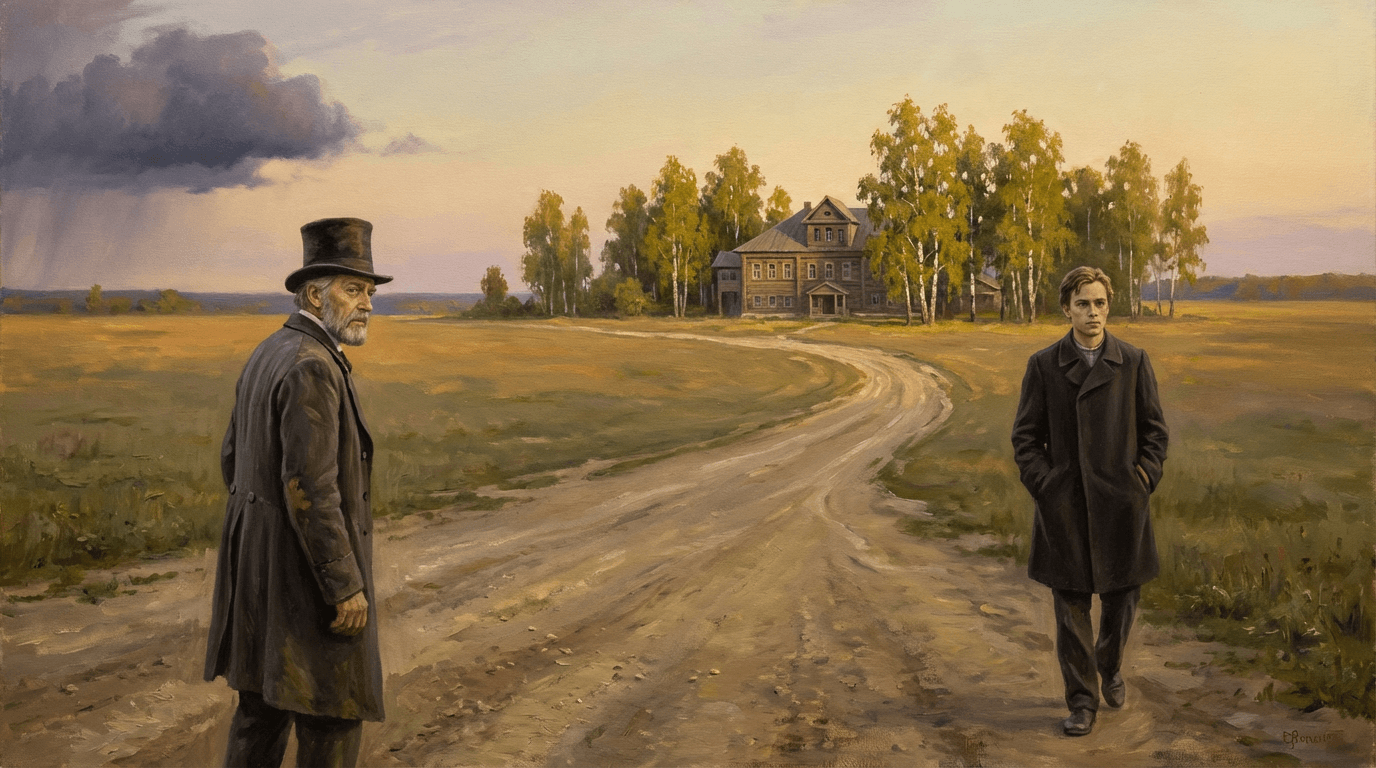
The Art of Disagreeing Without Contempt
In Fathers and Sons, Turgenev shows us the full anatomy of ideological conflict—how legitimate disagreement becomes contempt, how contempt becomes war, and what genuine argument across a deep divide actually requires.
These 6 chapters trace the Bazarov-Pavel war from first exchange to duel—and reveal the one conversation in the novel where two people finally speak honestly.
The Pattern
Bazarov and Pavel are not actually very different. Both are brilliant, both are committed to their principles, both have organized their identities around their worldview, and neither can conceive of being seriously wrong. This is why their arguments cannot produce anything—they are not genuinely engaging each other's ideas. They are using the other person as a surface to confirm their own position. The real argument between old Russia and new Russia never happens in this novel, because neither representative of those worldviews ever actually listens. What Turgenev gives us instead is a precise anatomy of how this failure operates: the escalation from debate to status contest to personal hostility to duel, each step logical given the previous one, none of them inevitable if either man had been willing to hold his own position less absolutely. The novel also gives us, briefly, what genuine discourse might look like—in Nikolai's halting openness and in Bazarov's final conversation with Anna. Both are small and fragile and too late. Turgenev seems to believe that honest exchange is possible but rare, and that the conditions required to produce it are almost never present when the stakes are high.
The Diagnostic Question
The test for whether an argument is productive is simple: ask whether either party is genuinely open to being wrong. Not performatively open—actually open, in the sense that hearing a sufficiently good argument would change their position. If the answer is no for both parties, the argument is not an argument. It is a war for status conducted using the language of reason. Bazarov and Pavel never pass this test. Nikolai does, which is why he is the one who actually changes.
Contempt as Conversation-Ender
Contempt—the belief that the other person's position is not worthy of serious engagement—is the most destructive element in any disagreement. It operates differently from anger or frustration because it refuses to grant the other party the dignity of opposition. Bazarov's contempt for Pavel is more corrosive than their actual arguments because it forecloses the possibility of genuine exchange before it begins. Pavel's cold disdain operates identically. Both men mistake contempt for clarity.
The Journey Through Chapters
The Breakfast Table War
The first serious exchange between Bazarov and Pavel goes from polite to hostile in minutes. The topic—nihilism, science, the value of tradition—is real enough. But both men are simultaneously arguing and performing. Bazarov wants to demolish Pavel's pretensions; Pavel wants to expose Bazarov's shallowness. Neither is actually trying to understand the other's position. They are engaged in a contest in which winning means the other person's humiliation, not the truth's emergence.
"A nihilist is a man who does not bow down before any authority, who does not take any principle on faith."
Key Insight
Ideological arguments most often fail because both parties have conflated the argument with the person. Bazarov is not trying to correct Pavel's thinking—he is trying to dismantle Pavel's identity. Pavel is not trying to learn from Bazarov—he is trying to preserve his authority. This is the diagnostic test for whether an argument is productive: ask whether either party is genuinely open to being wrong. If the answer is no for both, you are not watching a debate. You are watching a war for status.
Nikolai Tries to Bridge the Gap
While Bazarov and Pavel clash, Nikolai attempts something different: genuine openness to the new. He reads the books Arkady recommends, tries to understand nihilism, struggles to make sense of a world his son has accepted and he hasn't. He doesn't always succeed—sometimes the effort is painful and slightly comic—but the attempt is real. He is willing to be uncertain about his own position, which is exactly what neither Bazarov nor Pavel is willing to do.
"Nikolai Petrovitch felt perplexed. He had read much and was well acquainted with the latest literature, but he was always somewhat uncertain in his opinions."
Key Insight
Nikolai is the novel's quiet argument for what real intellectual humility looks like. He doesn't abandon his values or pretend to agree—but he holds them lightly enough to ask whether he might be missing something. This is rarer than it sounds. Genuine openness to a worldview that conflicts with yours requires acknowledging that you might be wrong in ways you can't yet see. Nikolai's willingness to do this, without dramatic conversion or self-abandonment, makes him the novel's most underrated character.
Madame Kukshin: The Parody of Disagreement
Bazarov and Arkady visit Madame Kukshin, a self-proclaimed progressive who performs dissent rather than practicing it. Her apartment is chaos, her opinions borrowed, her challenges to convention entirely theatrical. She uses the language of radical disagreement—with everything, with everyone—without any of its substance. Turgenev presents her as a precise parody: what happens when disagreement becomes a style rather than a genuine encounter with ideas.
"She was considered a progressive woman. She subscribed to several journals and read them carelessly."
Key Insight
There is a form of contrarianism that looks like independence but is actually its own kind of conformity—conformity to the performance of non-conformity. Madame Kukshin disagrees with everything because disagreement is her identity, not because she has carefully examined anything. The result is that her disagreements cost nothing and reveal nothing. Genuine disagreement is costly—it requires engagement with positions you find wrong, honest assessment of your own, and willingness to discover you were partly mistaken. Kukshin's version skips all of this.
The Governor's Ball: Hierarchy as Argument
At the provincial ball, Turgenev shows how social hierarchy functions as a substitute for argument. People defer to Matvei Ilyitch not because his ideas are better but because he has power. His opinions are treated as conclusions. The ideological conflicts playing out in the drawing rooms of the novel—between generations, between old Russia and new—are here replaced by pure social positioning. Nobody argues with the man who dispenses favor. Contempt operates silently.
"Matvei Ilyitch smiled condescendingly, as if he were bestowing a favor."
Key Insight
One of the most insidious forms of contempt in disagreement is the refusal to argue at all—treating the other person's position as beneath engagement. Matvei Ilyitch doesn't argue with the young radicals; he simply doesn't acknowledge them as interlocutors. This is contempt operating at a higher level than Pavel's hostility: it doesn't even grant the other party the dignity of opposition. When someone refuses to argue with you directly, they are not being polite—they are communicating that you don't merit an argument.
The Duel: When Arguments Become War
Pavel challenges Bazarov to a duel over an alleged breach of honor—though the real cause is the kiss he witnessed Bazarov give Fenichka, and the accumulated contempt of weeks of ideological combat. Both men recognize the absurdity of it. They proceed anyway. The duel is Turgenev's most precise image of what happens when disagreement has fully converted into war: the original argument has been forgotten, the personal stakes have escalated beyond the intellectual, and both parties are now committed to something neither actually believes in.
"Pavel Petrovitch challenged Bazarov—and Bazarov accepted the challenge. Both men recognized the farce. Both men proceeded."
Key Insight
The duel is the endpoint of the trajectory that began at the breakfast table. Bazarov and Pavel never had a genuine argument—they had a sequence of status contests that looked like arguments. Once you've established that pattern, the only escalation available is to stop pretending it's about ideas at all and fight directly. The tragedy is not the duel itself but what it reveals: two intelligent men who could have genuinely learned from each other, choosing performance over inquiry from the first exchange until the last.
Bazarov and Anna's Final Honest Conversation
Before Bazarov leaves for the last time, he and Anna have their most honest exchange. The emotional stakes are gone—he is no longer hoping for anything, she is no longer protecting against anything. What remains is two intelligent people talking clearly to each other for the first time. They analyze what happened between them with precision and even humor. It is the only conversation in the novel where neither party is performing, protecting, or winning—and it is also the shortest.
"They both felt that they had lost something, and that they had found something too."
Key Insight
Genuine honest exchange between people who disagree is almost always preceded by the removal of stakes—when both parties have stopped needing something from each other. Bazarov and Anna talk honestly only when it's too late for the honesty to change anything. This is not a coincidence. The thing that makes disagreement productive—genuine openness without agenda—is almost impossible to sustain when the outcome still matters. Turgenev's irony is that we most need this kind of conversation precisely when we're least able to have it.
Why This Matters Today
The Bazarov-Pavel dynamic has never been more legible than it is now. We have built media environments that reward the performance of certainty over the practice of inquiry, that incentivize contempt over engagement, and that make ideological opponents into enemies rather than interlocutors. The result is that we have vast quantities of argument and very little genuine discourse—an enormous amount of position-stating with almost no one actually listening.
Turgenev's observation—that the conditions for genuine disagreement are almost never present when stakes are high—is a design problem as much as a character problem. Bazarov and Pavel are not unusually bad at argument—they are perfectly normal people in an environment that has given them no incentive to listen. The breakfast table rewards performance. The duel rewards commitment. The honest conversation at the end happens in a setting where neither person needs anything from it. This is the key insight: the conditions you create for disagreement determine its quality more than the individuals' intentions.
The actionable lesson: identify one person in your life whose position you've been treating with contempt rather than engagement—someone whose ideas you've decided are beneath serious consideration. Then ask: what would it take to find the most intelligent version of their position and respond to that, rather than to the version that's easiest to dismiss? This is what Turgenev means by the art of disagreeing without contempt. It is a practice, not a temperament, and it begins with a choice.
Explore More Themes in Fathers and Sons
Navigating the Generation Gap
How to stay in relationship across irreconcilable worldviews
When Your Certainties Aren't Enough
What happens when ideology collides with love and death
The Armor We Build Against Feeling
Why cynicism is a defense, and what it costs
All Themes & Analysis
Return to the full book overview