
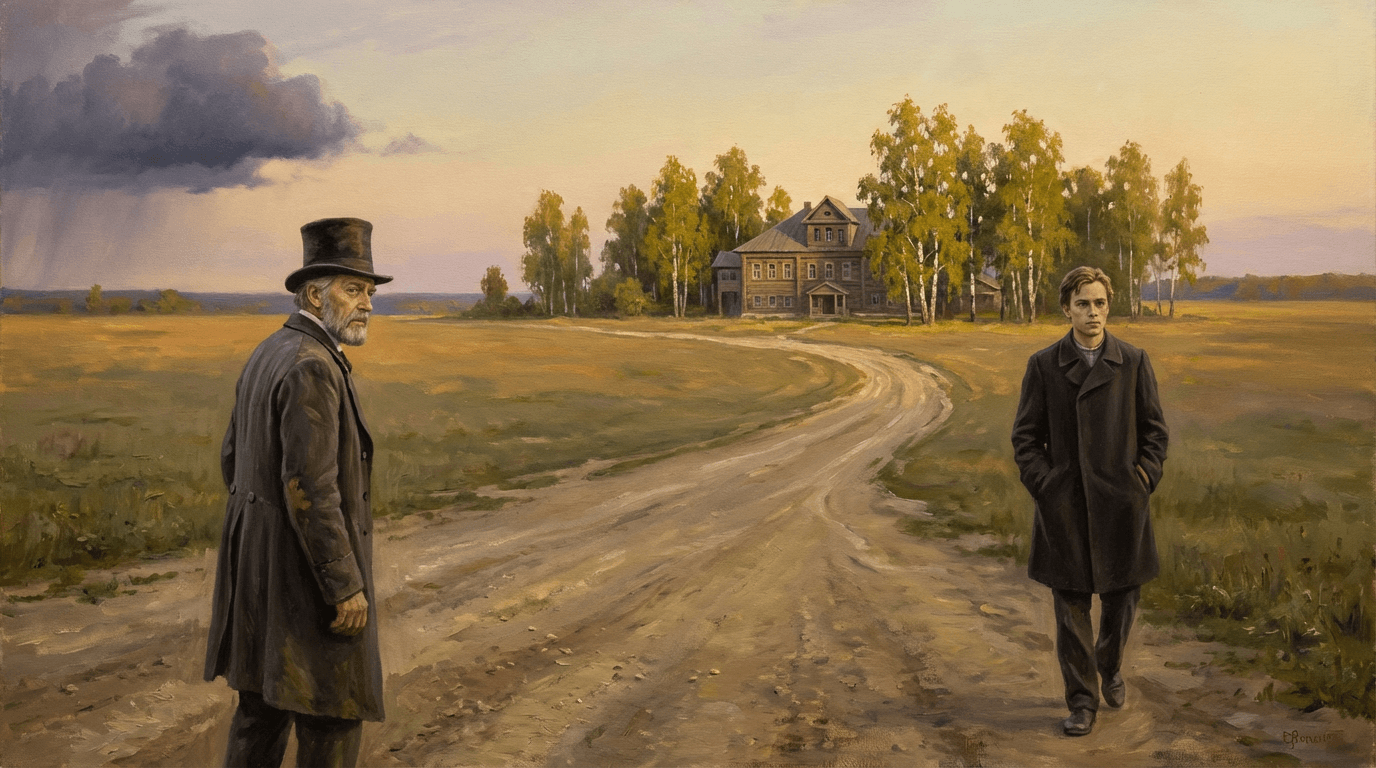
Navigating the Generation Gap
In Fathers and Sons, Turgenev maps the permanent war between generations with unusual fairness—showing both sides as partly right, partly blind, and unable to reach each other across a gap that is real.
These 7 chapters reveal how to stay in relationship with people whose world has hardened against yours—without surrendering who you've become.
The Pattern
Turgenev wrote Fathers and Sons in 1862, at a moment when Russia's generational divide felt like a civilizational crisis. Young radicals were rejecting everything the previous generation had built; the older generation was defending traditions it could barely articulate. He could have taken a side. Instead, he wrote a novel in which both sides are rendered with full humanity—their flaws visible, their legitimate grievances real, their love for each other persistent even as they fail each other. The pattern Turgenev identifies is this: generational conflict is not primarily about ideas. The ideas are proxies for something deeper—the child's need to become themselves apart from their parents, and the parent's need to remain relevant in the world their child is inheriting. When Bazarov dismisses Nikolai as "a man whose song has been sung," he is not primarily making a sociological observation. He is asserting that he, Bazarov, belongs to the future—which requires the past to be finished. Nikolai understands this, which is why the remark wounds him so specifically. The tragedy is that both things can be true: the old Russia is ending, and Nikolai's life was worth something. Turgenev insists on holding both.
The Unsaid Things
The generation gap in this novel is built primarily of things not said—Nikolai's secret about Fenichka, Arkady's discomfort with Bazarov's extremism, the parents' terror of being dismissed. Every conversation in the carriage, at the dinner table, and in the garden is shaped by what both parties are carefully not bringing up. The distance between generations is maintained not only by different beliefs, but by the failure of nerve that prevents the necessary conversations from happening.
Love That Cannot Reach
One of the novel's most painful insights is that deep love between parents and children does not guarantee connection. Bazarov's parents adore him with a totality that borders on worship—and he receives it with impatience and mild embarrassment. The love is not in question. The language is. They have developed their emotional vocabularies in different worlds and can no longer quite translate for each other, even when both parties desperately want to.
The Journey Through Chapters
The Son Returns Transformed
Arkady returns from university with Bazarov in tow, and the first collision is immediate—not dramatic, but revealing. He introduces his friend with a kind of ownership that signals how much his identity has shifted. Bazarov's casual dismissal of social niceties lands like a small insult on Nikolai, who is trying to be modern and accepting but clearly doesn't know how to receive this stranger his son has become.
"Arkady looked at his father, and for the first time in his life he seemed to realise how old he had grown."
Key Insight
The generational gap often announces itself not with an argument but with a tone. The child who has changed is performing their transformation for the parent; the parent is performing acceptance while privately grieving. Neither is being dishonest—both are doing the best they can with a situation that has no good script. The real distance isn't in the ideas; it's in the fact that the person who left is not quite the same person who returned.
What We Avoid Saying in the Carriage
The carriage ride home is a masterpiece of conversational avoidance. Nikolai chatters nervously about the estate; Arkady responds with half-attention. There is something Nikolai needs to tell his son—that he has taken a young woman, Fenichka, as a partner and has had a child with her—but he cannot find the words, or the moment, or the courage. The gap between them is not ideological. It is the simpler, harder gap of things left unsaid.
"Arkady glanced at his father, and they both smiled."
Key Insight
Generational estrangement is often less about ideology than about the accumulation of things never said. Parents hide truths they fear will lose them their children's respect; children hide judgments they fear will hurt the parents they still love. The avoidance on both sides is protective—and it widens the distance it is trying to close. The carriage ride shows what the generation gap actually feels like from the inside: two people who love each other, failing to reach each other.
Pavel as the Generation Gap Personified
Pavel Petrovitch, Arkady's uncle, enters the novel as a man who has made a complete aesthetic of his generation. Immaculately dressed, rigidly principled, cold to Bazarov on sight—he is the old Russia refusing to yield. His elegance is genuine but also armored; his principles real but also strategic. He doesn't just disagree with the new generation; he has organized his entire identity around the disagreement.
"Pavel Petrovitch bowed slightly to Bazarov, and slightly turned away."
Key Insight
Pavel represents what happens when a generation stops arguing from values and starts arguing from identity. When your worldview becomes who you are rather than what you believe, any challenge to it feels like an attack on your existence. This is why generational arguments so often become irresolvable—neither side is really debating ideas anymore. They're defending themselves. Turgenev draws Pavel with sympathy precisely because this rigidity has human costs: it has made him lonely, embittered, and unable to be moved by anything new.
The First Real Fight
At breakfast, Bazarov and Pavel have their first direct ideological clash. It escalates quickly—from a question about Germans to a full confrontation about nihilism, art, science, and what, if anything, is worth believing. Both men are brilliant. Both are certain. Neither listens to the other. Nikolai watches helplessly, desperately wanting peace; Arkady sides with his friend while privately feeling uncomfortable with how contemptuous Bazarov gets.
"A nihilist is a man who does not bow down before any authority, who does not take any principle on faith."
Key Insight
The first real generational fight reveals the structure of all the ones that follow: both parties are fighting a proxy war. Pavel and Bazarov are not really debating science and art—they are fighting about whether the old Russia or the new one deserves to exist. When arguments escalate this fast, it's because they're not actually about what they're ostensibly about. Ask what each person is really protecting—and you'll find something much more personal than the stated position.
The Man on the Shelf
Bazarov casually refers to Nikolai as 'a man whose song has been sung'—an obsolete figure who has nothing more to contribute. Arkady doesn't correct him. Nikolai overhears. He doesn't confront Bazarov; he retreats to his garden and grieves alone. The scene is quietly devastating: a good man who has tried his whole life to be fair, open-minded, and accepting, discovering that the new generation's verdict is simply that he has expired.
"'A man on the shelf'—Nikolai Petrovitch repeated to himself."
Key Insight
The cruelty of the generation gap is that it often operates through dismissal rather than attack. Nobody tells Nikolai he's wrong—they simply treat him as irrelevant. This is harder to argue with and harder to recover from. If you have ever been made to feel that your experience is outdated rather than wrong, you've felt what Nikolai feels. And if you have ever dismissed an older person as simply not getting it, Turgenev wants you to sit with what that costs them.
A Father Who Cannot Be Proud Enough
Bazarov visits his own parents, and we see the generation gap from the other direction. His father Vasili is overwhelmed with love and pride for his son—and completely unable to show it in a way Bazarov finds comfortable. He brags about him to everyone, solicits others' approval of him, follows him around offering small gestures of care. Bazarov is embarrassed, impatient, and tender all at once. The love between them is total. The distance between them is also total.
"Vasili Ivanitch wrung his son's hands once more, and murmured, 'What a fellow, what a fellow!'"
Key Insight
Parents who cannot reach their children often turn to third parties to carry the love—telling others how remarkable their child is, hoping the message gets back, hoping the admiration of strangers will build the bridge the relationship itself cannot. Bazarov cannot receive his father's adoration directly; Vasili cannot offer it in any form Bazarov can accept. This is not failure—it is the ordinary tragedy of parents and children whose emotional languages developed in different worlds.
What Survives the War
The novel's final chapter surveys what remains after Bazarov's death and the ideological battles that consumed the summer. Arkady has married Katia. Nikolai has married Fenichka. Pavel has left for Germany. The old and new Russia have not reconciled—they have simply moved on. What persists is not the ideology of either generation, but the quieter continuities: land, family, love, work. The Bazarovs visit their son's grave in silence.
"Can it be that their prayers and their tears are fruitless? Can it be that love, sacred devoted love, is not all-powerful? Oh no! However passionate, sinning, and rebellious the heart hidden in the tomb, the flowers growing over it peep serenely at us with their innocent eyes."
Key Insight
Turgenev's final argument about the generation gap is neither romantic nor cynical: most of what people fight about doesn't survive. The certainties of youth and the defenses of age both erode, and what remains is not what either side was defending—it's the ordinary human texture of lives built together over time. The Bazarovs at their son's grave are not defeated. They are simply people who loved someone and lost him, which is a category that transcends every generation.
Why This Matters Today
Turgenev named the generation gap. Before Fathers and Sons, the conflict between parents and children was understood as a personal failure—a breakdown in a specific family. Turgenev argued it was structural: every generation inherits a world its parents built for different circumstances, and every generation must partially reject that inheritance to build something of their own. The conflict is not a bug. It is what change looks like from the inside of a family.
What makes the novel so useful today is its insistence on symmetrical complexity. Bazarov is not the hero of the young against the old. Pavel is not the villain of tradition against progress. Nikolai is not simply a sad casualty. Each of them carries something real and something limited—which is exactly how it is in actual families. The child who has changed is not entirely right about the parent who hasn't. The parent who is confused by who their child has become is not simply afraid of the future.
The actionable lesson: identify one conversation you have been avoiding with someone from a different generation—something you haven't said because you expect dismissal, or because you fear the hurt it might cause. Turgenev's entire novel is an argument that the conversation you're avoiding is the one that matters. It won't resolve the gap. But it will keep the relationship alive across it.
Explore More Themes in Fathers and Sons
When Your Certainties Aren't Enough
What happens when ideology collides with love and death
The Armor We Build Against Feeling
Why cynicism is a defense, and what it costs
The Art of Disagreeing Without Contempt
What the Bazarov-Pavel war teaches about ideological conflict
All Themes & Analysis
Return to the full book overview