
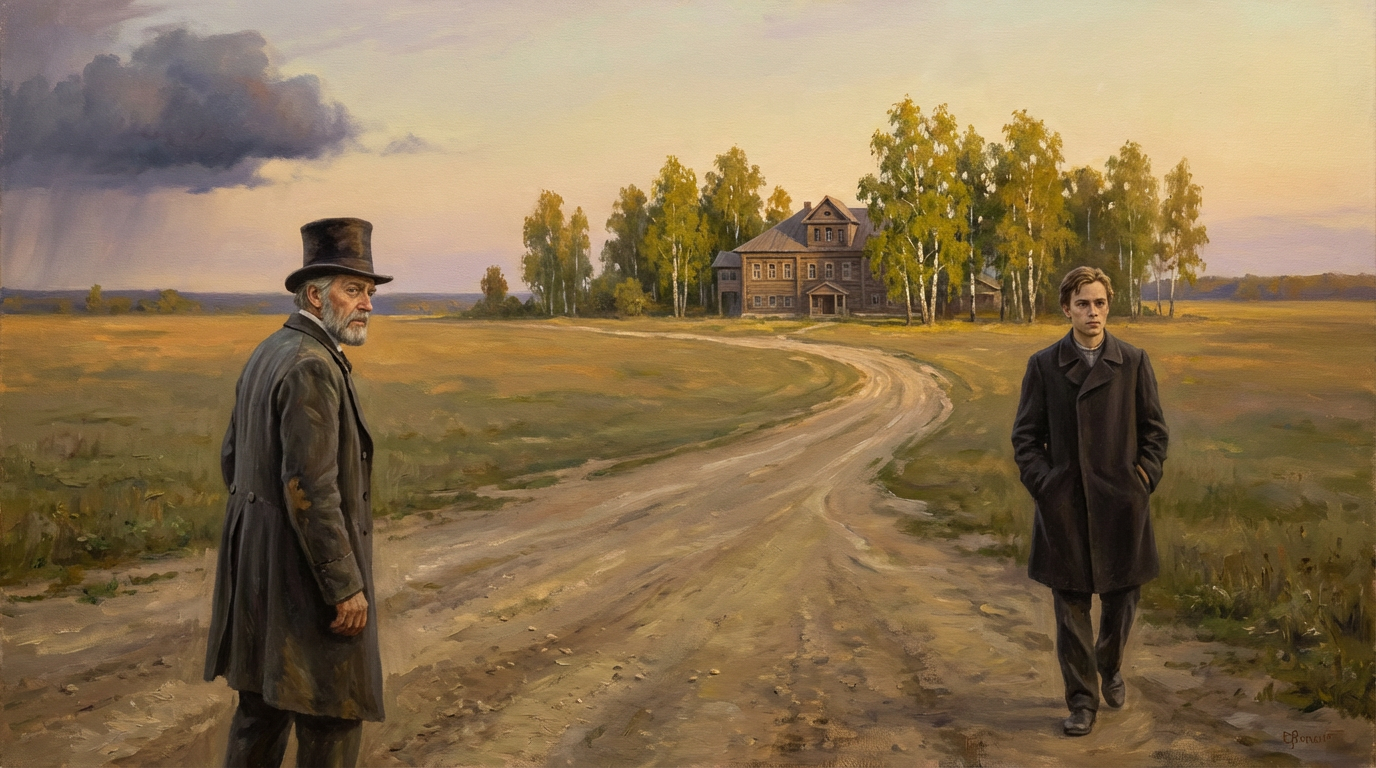
An excerpt from the original text.(complete · 2569 words)
"ike his brother, Paul Petrovitch Kirsanov received his early
education at home, and entered the Imperial Corps of Pages.
Distinguished from boyhood for his good looks, he had, in addition,
a nature of the self-confident, quizzical, amusingly sarcastic type
which never fails to please. As soon, therefore, as he had received
his officer's commission, he began to go everywhere in society, to
set the pace, to amuse himself, to play the rake, and to squander his
money. Yet these things somehow consorted well with his personality,
and women went nearly mad over him, while men called him 'Fate,' and
secretly detested him. Meanwhile he rented a flat with his brother, for
whom, in spite of their dissimilarity, he had a genuine affection. The
dissimilarity in question lay, among other things, in the fact that,
while Nikolai Petrovitch halted, had small, kindly, rather melancholy
features and narrow black eyes, and was of a disposition prone to
reading omnivorously, to bestirring himself but little, and to feeling
nervous when attending social functions, Paul Petrovitch never spent a
single evening at home, but was renowned for his physical dexterity and
daring (he it was who made gymnastics the rage among the gilded youth
of his day), and read, at most, five or six French novels. Indeed, by
the time that he reached his twenty-eighth year Paul had risen to be
a captain, and before him there seemed to lie a brilliant career; but
everything suddenly underwent a change, as shall be related forthwith.
"Among the society of St. Petersburg of that period there was
accustomed to appear, and to disappear, at irregular intervals a
certain Princess R. whose memory survives to this day. Though wedded to
a highly placed and very presentable (albeit slightly stupid) husband,
she had no children, and spent her time between making unexpected
visits abroad and unexpected returns to Russia. In short, she led a
very curious life, and the world in general accounted her a coquette,
in that she devoted herself to every sort of pleasure, and danced at
balls until she could dance no more, and laughed and jested with young
men whom she received before dinner in the half-light of a darkened
drawing-room. Yet, strangely enough, as the night advanced she would
fall to weeping and praying and wringing her hands, and, unable to
rest, would pace her room until break of day, or sit huddled, pale and
cold, over the Psalter. But no sooner would daylight have appeared than
she would once more become a woman of the world, and drive, and laugh,
and chatter, and fling herself upon anything which seemed to offer
any sort of distraction. Also, her power to charm was extraordinary;
for though no one could have called her a beauty (seeing that the one
good feature of her face lay in her eyes--and even then it was not the
small, grey eyes themselves which attracted, but the glance which they
emitted), she had hair of the colour and weight of gold which reached
to her knees. That glance!--it was a glance which could be careless to
the point of daring or meditative to the point of melancholy; a glance
so enigmatical that, even when her tongue was lisping fatuous nonsense,
there gleamed in her aspect something intangible and out of the common.
Finally, she dressed with exquisite taste.
"This woman Paul Petrovitch met at a ball; and at it he danced a
mazurka with her. Yet, though, during the dance, she uttered not a
single word of sense, he straightway fell in love with her, and, being
a man accustomed to conquests, attained his end in this case also.
Yet, strangely enough, the facility of his triumph in no way chilled
him, but led him on to become more and more resolutely, more and more
painfully, attached, and that though she was a woman in whom, even
after she had made the great surrender, there still remained something
as immutably veiled, as radically intangible, as before--something
which no one had yet succeeded in penetrating. What was in that soul
God alone knows. Almost would it seem as though she were subservient
to a mysterious force of which the existence was absolutely unknown
to her, but which sported with her as it willed, and whose whims
her mentality was powerless to control. At all events, her conduct
constituted a series of inconsistencies, and even the few letters which
she wrote to Paul Petrovitch--missives which would undoubtedly have
aroused her husband's suspicions had he seen them--were written to a
man who was practically a stranger to her. And in time her love began
to be succeeded by fits of despondency; she ceased to smile and jest
with the lover whom she had selected, and looked at him, and listened
to his voice, with reluctance. In fact, there were moments--for the
most part, unexpected moments--when this reluctance bordered upon chill
horror, and her face assumed a wild, corpse-like expression, and she
would shut herself up in her bedroom, whence her maid, with ear glued
to the keyhole, would hear issue sounds as of dull, hopeless sobbing.
Paul Petrovitch himself frequently found that, when returning home
after one of these tender interviews, there was naught within his
breast save the bitter, galling sensation which comes of final and
irrevocable failure. 'What more could I want?' he would say to himself
in his bewilderment; yet always he spoke with an aching heart.
"It happened that on one occasion he gave her a ring having a stone
carved in the figure of the Sphinx.
"'What?' she exclaimed. 'Do you offer me the Sphinx?'
"'I do,' he replied. 'The Sphinx is yourself.'
"'I?' she queried with a slow lift of her enigmatical eyes. 'You are
indeed flattering!'
"With the words went the ghost of a smile, while her eyes looked
stranger than ever.
"Even during the time that the Princess loved him things were difficult
for Paul Petrovitch; but when she cooled in her affection for him (as
soon happened) he came near to going out of his mind. Distracted with
jealousy, he allowed her no rest, but followed her to such an extent
that at length, worn out with his persistent overtures, she betook
herself on a tour abroad. Yet even then Paul Petrovitch listened to
neither the prayers of his friends nor the advice of his superior
officers, but, resigning his commission, set out on the Princess's
track. Thus four years were spent in hunting her down, and losing sight
of her again: and though, throughout, he felt ashamed of his conduct,
and disgusted with his lack of spirit, all was of no avail--her image,
the baffling, bewitching, alluring image which ever flitted before
his eyes, had implanted itself too deeply in his breast. At last--it
was at Baden--the pair once more came together; and though it seemed
that never had she loved him as she did now, before a month was over
another rupture had occurred, and, this time, a final one, as, with a
last flicker, the flame died down and went out. True, that the parting
would come he had foreseen; yet still he sought to be friends with her
(as though friendship with such a woman could have been possible!), and
only the fact that she quietly withdrew from Baden, and thenceforth
studiously avoided him, baffled his purpose. Returning to Russia, he
endeavoured to resume his former mode of life: but neither by hook nor
crook could he regain the old rut. As a man with a poisoned system
wanders hither and thither, so did he drive out, and retain all the
customs of a society habitué. Nay, he could even have boasted of
two or three new conquests. But no. What he wanted was obtainable
neither through himself nor others, since his whole power of initiative
was gone, and his head gradually growing grey. To sit at his club,
to consume his soul in jaundice and ennui, to engage in bachelor
disputes which failed to interest him--such was now become his sole
occupation. And, as we know, it is an occupation which constitutes the
worst of signs. Nor, for that matter, seems he to marriage to have
given a thought.
"Thus ten years elapsed in colourless, fruitless pursuits. Yet Paul
found time pass swiftly, indeed, with amazing swiftness, for nowhere
in the world does it fly as it does in Russia (in prison only is its
passage said to be still swifter); wherefore there came at length a
night when, while dining at his club, he heard that the Princess was
dead--that she had died in Paris in a state bordering upon insanity.
Rising from the table, he fell to pacing the rooms of the club with a
face like that of a corpse, and only at intervals halting to watch the
tables of the card-players; until, his usual time for returning home
having arrived, he departed. Soon after he had reached his flat there
was delivered for him a package containing the ring which he had given
to the Princess. The Sphinx on it was marked with a mark like the sign
of the cross, and enclosed also was a message to say that through the
cross had the enigma become solved.
"These things took place just at the time (early in '48) when Nikolai
Petrovitch had lost his wife, and removed to St. Petersburg; and
since, also, the period of Nikolai's marriage had coincided with the
earlier days of Paul's acquaintance with the Princess, Paul had not
seen his brother since the day when the latter had settled in the
country. True, on returning from abroad, Paul had paid Nikolai a visit
with the intention of staying with him for a couple of months, as a
congratulatory compliment on his happiness; but the visit had lasted
a week only, since the difference in the position of the two brothers
had been too great, and even now, though that difference had diminished
somewhat, owing to the fact that Nikolai Petrovitch had lost his wife,
and Paul Petrovitch his memories (after the Princess's death he made
it his rule to try and forget her)--even now, I say, there existed the
difference that, whereas Nikolai Petrovitch could look back upon a
life well spent, and had a son rising to manhood, Paul Petrovitch was
still a lonely bachelor, and, moreover, entering upon that dim, murky
period when regrets come to resemble hopes, and hopes are beginning to
resemble regrets, and youth is fled, and old age is fast approaching.
To Paul Petrovitch that period was particularly painful, in that, in
losing his past, he had lost his all.
"'I shall not invite you to come to Marino,' were Nikolai Petrovitch's
words to his brother. 'Even when my wife was alive, you found the place
tedious; and now it would kill you.'
"'Ah, but in those days I was young and foolish and full of vanity,'
replied Paul Petrovitch. 'Even though I may not have grown wiser, at
least am I quieter. So, if you should be willing, I will gladly come
and make your place my permanent home.'
"For answer Nikolai Petrovitch embraced him; and though a year and a
half elapsed before Paul Petrovitch decided to carry out his intention,
once settled on the estate, he has never left it--no, not even during
the three winters spent by Nikolai Petrovitch with his son in St.
Petersburg. Meanwhile he has taken to reading books--more especially
English books, and, in general, to ordering his life on the English
pattern. Rarely, also, does he call upon his neighbours, but confines
his excursions, for the most part, to attending election meetings,
where, as a rule, he holds his tongue, but occasionally amuses himself
by angering and alarming the older generation of landowners with
Liberal sallies. From the representatives of the younger generation he
holds entirely aloof. Yet both parties, though they reckon him haughty,
accord him respect. They do so because of his refined, aristocratic
manners, and of what they have heard concerning his former conquests,
and of the fact that he dresses with exquisite taste, that he always
occupies the best suites in the best hotels, that he dines sumptuously
every day, that once he took dinner with the Duke of Wellington at the
Court of Louis Philippe, that invariably he takes about with him a
silver nécessaire and a travelling bath, that he diffuses rare and
agreeable perfumes, that he is a first-rate and universally successful
whist-player, and that his honour is irreproachable. The ladies too
look upon him as a man of charming melancholy: but with their sex he
has long ceased to have anything to do.
"You see, then, Evgenii," wound up Arkady, "that you have judged my
uncle very unfairly. Moreover, I have omitted to say that several times
he has saved my father from ruin by making over to him the whole of
his money (for they do not share the estate), and that he is always
ready to help any one, and, in particular, that he stands up stoutly
for the peasants, even though, when speaking to them, he pulls a wry
face, and, before beginning the interview, scents himself well with
eau-de-Cologne."
"We all know what nerves like his mean," remarked Bazarov.
"Perhaps so. Yet his heart is in the right place; nor is he in any
way a fool. To myself especially has he given much useful advice,
especially on the subject of women."
"Ah, ha! 'Scalded with milk, one blows to cool another's water.' That
is a truism."
"Finally, and to put matters shortly," resumed Arkady, "he is a man
desperately unhappy, not one who ought to be despised."
"Who is despising him?" exclaimed Bazarov. "All that I say is that a
man who has staked his whole upon a woman's love, and, on losing the
throw, has turned crusty, and let himself drift to such an extent as
to become good for nothing--I say that such a man is not a man, a male
creature at all. He is unhappy, you say; and certainly you know him
better than I do; but it is clear also that he has not yet cleansed
himself of the fool. In other words, certain am I that, just because he
occasionally reads Galignani, and because, once a month, he saves a
peasant from distress for debt, he believes himself really to be a man
of action."
"But think of his upbringing!" expostulated Arkady. "Think of the
period in which he has lived his life!"
"His upbringing?" retorted Bazarov. "Why, a man ought to bring
himself up, even as I had to do. And with regard to his period,
why should I, or any other man, be dependent upon periods? Rather,
we ought to make periods dependent upon us. No, no, friend!
Sensuality and frivolity it is that are at fault. For of what do the
so-called mysterious relations between a man and a woman consist? As
physiologists, we know precisely of what they consist. And take the
anatomy of the eye. What in it justifies the guesswork whereof you
speak? Such talk is so much Romanticism and nonsense and unsoundness
and artificiality. Let us go and inspect that beetle."
And the two friends departed to Bazarov's room, where he had already
succeeded in creating a medical-surgical atmosphere which consorted
well with the smell of cheap tobacco.
Master this chapter. Complete your experience
Purchase the complete book to access all chapters and support classic literature
As an Amazon Associate, we earn a small commission from qualifying purchases at no additional cost to you.
Available in paperback, hardcover, and e-book formats
Let's Analyse the Pattern
When someone's inconsistency and unavailability becomes addictive, creating obsession that destroys the pursuer's capacity for genuine connection.
Why This Matters
Connect literature to life
This chapter teaches how to recognize when someone's inconsistent behavior is designed to keep you hooked and chasing.
Practice This Today
This week, notice when someone gives you just enough attention to keep you interested, then withdraws just enough to keep you guessing - that's the pattern.
Now let's explore the literary elements.
Key Quotes & Analysis
"women went nearly mad over him, while men called him 'Fate,' and secretly detested him"
Context: Describing Pavel's effect on society during his golden years
Shows how Pavel's success bred both admiration and resentment. Women desired him while men envied his effortless charm and success, calling him 'Fate' because he seemed destined for greatness.
In Today's Words:
All the women wanted him and all the guys hated him for it
"everything suddenly underwent a change"
Context: The moment Pavel's life took a devastating turn when he met Princess R.
This simple phrase captures how quickly a life can be derailed by love. Pavel went from having everything to losing it all because of one woman who became his obsession.
In Today's Words:
Then everything went to hell
"he followed her like a shadow"
Context: Describing how Pavel chased Princess R. across Europe after she left Russia
Shows the pathetic nature of Pavel's obsession. He abandoned his career, dignity, and identity to pursue someone who didn't want him, becoming a mere shadow of his former self.
In Today's Words:
He basically became her stalker
"The ring bore the image of a sphinx"
Context: When Pavel receives back the ring he gave Princess R. after her death
The sphinx represents the unsolvable mystery of their relationship. Even in death, she remains an enigma, and the returned ring symbolizes the futility of trying to understand her.
In Today's Words:
She was always a puzzle he couldn't solve
Thematic Threads
Class
In This Chapter
Pavel's aristocratic background gave him everything except the tools to handle real emotional challenge—his privilege made him vulnerable to Princess R.'s manipulations
Development
Evolved from earlier class tensions to show how privilege can be a weakness
In Your Life:
Your advantages in one area might leave you unprepared for challenges in another
Identity
In This Chapter
Pavel's entire sense of self became dependent on solving Princess R.'s mystery—when she left, he had no identity left to fall back on
Development
Building on Arkady's identity struggles, showing how external validation can hollow out the self
In Your Life:
You might be defining yourself through someone else's approval or attention
Obsession
In This Chapter
Pavel's four-year pursuit of Princess R. shows how obsession masquerades as love, destroying both parties
Development
Introduced here as the dark side of passion
In Your Life:
You might mistake intensity for intimacy in your own relationships
Trauma
In This Chapter
Pavel's current fastidious, bitter personality is revealed as armor protecting a devastating wound that never healed
Development
First glimpse into how past pain shapes present behavior
In Your Life:
Someone's difficult behavior might be their way of protecting an old hurt
Judgment
In This Chapter
Arkady defends Pavel against Bazarov's harsh criticism, arguing for compassion over contempt
Development
Continuing the theme of how we evaluate others without knowing their stories
In Your Life:
You might be too quick to judge someone whose pain you can't see
You now have the context. Time to form your own thoughts.
Discussion Questions
- 1
What specific behaviors and contradictions made Princess R. so captivating to Pavel, and how did this obsession destroy his military career and social life?
analysis • surface - 2
Why do you think Pavel continued chasing Princess R. across Europe even when she became cold and distant? What was he really pursuing?
analysis • medium - 3
Where do you see this pattern of 'chasing the impossible person' playing out in modern relationships, workplaces, or social media?
application • medium - 4
How would you advise someone who's caught in Pavel's situation - obsessed with someone who's emotionally unavailable but occasionally gives just enough attention to keep them hooked?
application • deep - 5
What does Pavel's story reveal about the difference between genuine love and addiction to the chase? How can someone tell which one they're experiencing?
reflection • deep
Critical Thinking Exercise
Map the Addiction Cycle
Draw a simple timeline of Pavel's relationship with Princess R., marking the moments when she pulled him closer and when she pushed him away. Notice how each push made him chase harder. Then think about a situation in your own life where someone's inconsistent behavior kept you hooked - a friend, romantic interest, boss, or family member. Map out their pattern of giving and withdrawing attention.
Consider:
- •Look for the specific moments when mixed signals intensified your interest rather than cooling it
- •Notice whether you were drawn to solving the 'mystery' of their behavior rather than enjoying consistent connection
- •Consider how much energy you spent trying to predict or control their responses to you
Journaling Prompt
Write about a time when you found yourself more attracted to someone's potential or mystery than to their actual consistent behavior. What made you finally recognize the pattern, and how did you break free from it?
Coming Up Next...
Chapter 8: Behind Closed Doors
The focus shifts to practical matters as Nikolai meets with his estate steward, but Pavel's presence during business discussions reveals more about the brothers' strained dynamic. The newly reorganized farm management system is struggling, setting up conflicts that will test family bonds.



