
What to expect ahead
What follows is a compact summary of each chapter in the book, designed to help you quickly grasp the core ideas while inviting you to continue into the full original text. Even when chapter text is presented here, these summaries are meant as a gateway to understanding, so your eventual reading of the complete book feels richer, deeper, and more fully appreciated.
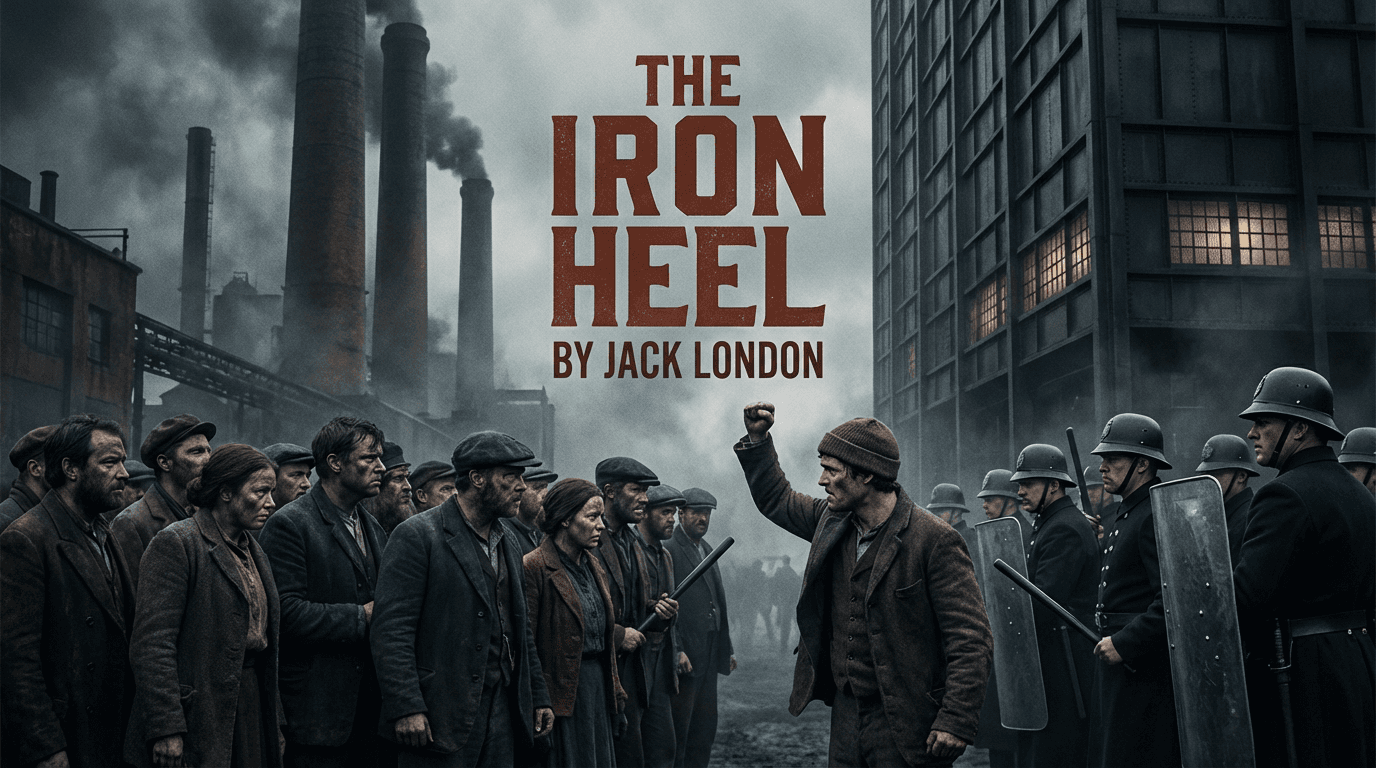
Jack London wrote The Iron Heel in 1908 — and then the twentieth century happened exactly as he predicted. This is a dystopian novel about a ruthless American oligarchy called the Iron Heel that seizes total control of the country: crushing labor unions, buying politicians, owning the courts, and grinding the working class into permanent poverty. It is told through the memoir of Avis Everhard, a privileged professor's daughter who falls in love with Ernest Everhard, a charismatic socialist revolutionary who sees the coming catastrophe clearly and fights it anyway.
What makes this book astonishing is its specificity. London didn't write vague warnings. He described in precise detail how concentrated corporate power corrupts democracy: the creation of a mercenary class to protect the wealthy, the manufacture of a prosperous middle tier to divide workers against themselves, the systematic destruction of independent press, and the use of foreign wars to redirect public anger. He wrote this before World War I. Before fascism. Before the rise of corporate media. Before Citizens United.
Ernest Everhard argues his case not with speeches but with relentless logic, dismantling his opponents' comfortable assumptions in real time. Avis watches her father — a man of science and reason — have his career destroyed by the oligarchy simply for being honest. The book follows their underground resistance movement as the Iron Heel tightens its grip over decades, through brutal repression, staged rebellions, and the slow erosion of everything that once made democratic life possible.
The Iron Heel is not comfortable reading. It does not promise that good people win. But it teaches you something no comfortable book can: how power actually works, what it costs to resist it, and why the people who see clearly are always the most dangerous to those in control. London's central question — whether ordinary people will choose security over freedom until it's too late to choose at all — has never stopped being relevant.
Essential Skills
Life skills and patterns this book helps you develop—drawn from its themes and characters.
Recognizing Power Structures
Learn to see who really holds power and how they maintain it — beyond elections and official institutions
Speaking Truth to Power
Find the courage to name what others won't, even when the personal cost is high
Long-Term Thinking
Understand how present conditions — inequality, media consolidation, institutional capture — create future consequences
Table of Contents
My Eagle
Avis Everhard sits in peaceful isolation, writing about her executed husband Ernest, a revolutionary...
The Challenge Accepted
Avis finds herself unexpectedly drawn to Ernest Everhard after their dinner confrontation, despite—o...
The Machine's Victims Speak
Avis investigates Jackson's workplace accident case and discovers a web of corruption that shakes he...
When Everyone Says No
Avis becomes obsessed with Jackson's case, unable to shake the image of his mangled arm and what it ...
The Bear Confronts the Masters
Ernest speaks at the elite Philomath Club, where the wealthiest and most powerful people gather mont...
Warning Signs and Power Plays
The establishment begins closing ranks against Avis's father and Ernest. University President Wilcox...
When Truth Becomes Madness
Bishop Morehouse has a life-changing moment of clarity while riding through the city at night. He se...
The Machine Breakers
At a dinner party hosted by Avis's father, Ernest faces off with a room full of small business owner...
The Mathematics of Collapse
Ernest delivers a devastating economic argument that leaves the dinner party stunned. Using simple m...
When Power Shows Its True Face
Avis watches her comfortable academic world collapse as her father becomes a target of systematic su...
Love in the Time of Oppression
The Oligarchy's retaliation against Avis's father begins in earnest when Mr. Wickson warns him to ab...
The Price of Speaking Truth
Avis encounters Bishop Morehouse after his mysterious disappearance, finding him transformed from we...
The Power of Collective Action
This chapter reveals how the ruling Plutocracy systematically destroys opposition through economic w...
The Iron Heel's Master Plan
Ernest sees the writing on the wall while his fellow revolutionaries remain optimistically blind. As...
The Last Days
The Iron Heel reveals its master strategy for preventing revolution: buying off the strongest labor ...
The End of Open Warfare
As Avis's father embraces proletarian life through various working-class jobs, finding joy in direct...
The Scarlet Livery
The Iron Heel springs its trap on the socialist congressmen through a carefully orchestrated false f...
Building Networks in Enemy Territory
Avis spends six months in prison as a 'suspect'—a chilling preview of how authoritarian systems oper...
Becoming Someone Else
Avis undergoes a complete transformation, learning to become an entirely different person—not just i...
Converting an Enemy
Avis reunites with Ernest after the massive jailbreak operation that freed fifty-one revolutionary c...
The System That Works
Avis reveals the terrifying efficiency of the Iron Heel's control system. The Oligarchy has created ...
The Chicago Trap
Avis and her fellow revolutionaries discover they've walked straight into a carefully orchestrated t...
The People of the Abyss
Avis witnesses the horrifying reality of revolution as the downtrodden masses of Chicago rise up in ...
Surviving the Aftermath
Avis awakens in the ruins of Chicago after the failed revolution, suffering from severe head trauma ...
When Revolution Breaks Apart
The revolutionary movement lies in ruins after their failed uprising. Avis and Ernest return to New ...
About Jack London
Published 1908
Jack London (1876–1916) didn't inherit his worldview — he lived it. Born into poverty in Oakland, California, he worked canneries, shoveled coal, sailed as a seaman, and rode freight trains across America before he ever sat down to write. He educated himself in public libraries, reading Darwin, Marx, and Spencer late into the night, forging a mind that could hold both brutal realism and radical hope at once.
He became one of the first American writers to earn a million dollars from his craft — and one of the loudest voices demanding the system that rewarded him be torn down. The Call of the Wild and White Fang made him famous. The Iron Heel, The People of the Abyss, and his essays on class and labor revealed what he actually believed: that capitalism was not the natural order but a choice, and a cruel one. He ran for mayor of Oakland twice on a socialist platform. He gave speeches, wrote manifestos, and bankrolled causes.
London died at forty — exhausted, in debt, and still writing. He left behind more than fifty books. What endures isn't the adventure. It's the fury underneath it: the conviction that ordinary people deserve better than what the world has given them.
Why This Author Matters Today
Jack London's insights into human nature, social constraints, and the search for authenticity remain powerfully relevant. Their work helps us understand the timeless tensions between individual desire and social expectation, making them an essential guide for navigating modern life's complexities.
Amplified Classics is different.
not a sparknotes, nor a cliffnotes
This is a retelling. The story is still told—completely. You walk with the characters, feel what they feel, discover what they discover. The meaning arrives because you experienced it, not because someone explained a summary.
Read this, then read the original. The prose will illuminate—you'll notice what makes the author that author, because you're no longer fighting to follow the story.
Read the original first, then read this. Something will click. You'll want to go back.
Either way, the door opens inward.
Get the Full Book
Purchase the complete book to access all chapters and support classic literature
As an Amazon Associate, we earn a small commission from qualifying purchases at no additional cost to you.
Available in paperback, hardcover, and e-book formats
You Might Also Like




Free to read • No account required