
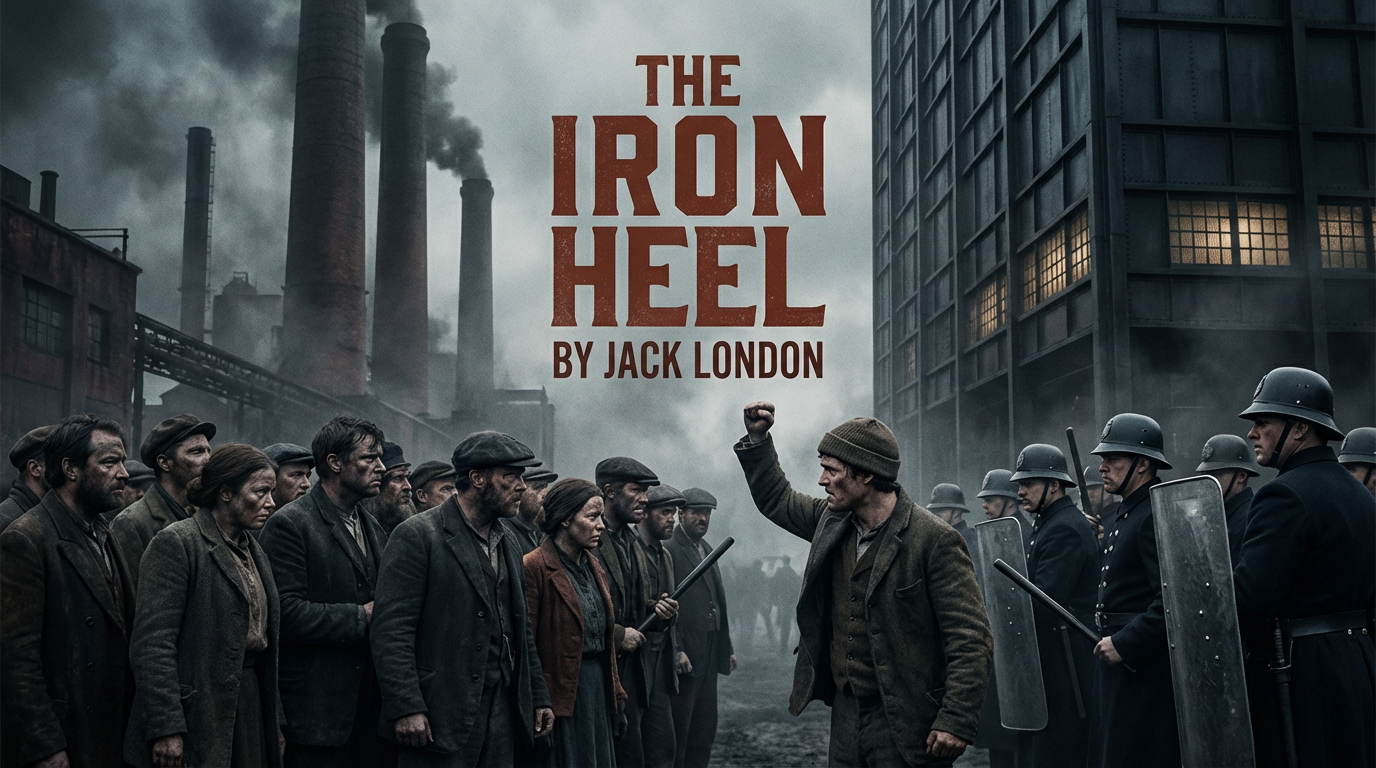
An excerpt from the original text.(complete · 3871 words)
ACKSON’S ARM
Little did I dream the fateful part Jackson’s arm was to play in my
life. Jackson himself did not impress me when I hunted him out. I found
him in a crazy, ramshackle[1] house down near the bay on the edge of
the marsh. Pools of stagnant water stood around the house, their
surfaces covered with a green and putrid-looking scum, while the stench
that arose from them was intolerable.
[1] An adjective descriptive of ruined and dilapidated houses in which
great numbers of the working people found shelter in those days. They
invariably paid rent, and, considering the value of such houses,
enormous rent, to the landlords.
I found Jackson the meek and lowly man he had been described. He was
making some sort of rattan-work, and he toiled on stolidly while I
talked with him. But in spite of his meekness and lowliness, I fancied
I caught the first note of a nascent bitterness in him when he said:
“They might a-given me a job as watchman,[2] anyway.”
[2] In those days thievery was incredibly prevalent. Everybody stole
property from everybody else. The lords of society stole legally or
else legalized their stealing, while the poorer classes stole
illegally. Nothing was safe unless guarded. Enormous numbers of men
were employed as watchmen to protect property. The houses of the
well-to-do were a combination of safe deposit vault and fortress. The
appropriation of the personal belongings of others by our own children
of to-day is looked upon as a rudimentary survival of the
theft-characteristic that in those early times was universal.
I got little out of him. He struck me as stupid, and yet the deftness
with which he worked with his one hand seemed to belie his stupidity.
This suggested an idea to me.
“How did you happen to get your arm caught in the machine?” I asked.
He looked at me in a slow and pondering way, and shook his head. “I
don’t know. It just happened.”
“Carelessness?” I prompted.
“No,” he answered, “I ain’t for callin’ it that. I was workin’
overtime, an’ I guess I was tired out some. I worked seventeen years in
them mills, an’ I’ve took notice that most of the accidents happens
just before whistle-blow.[3] I’m willin’ to bet that more accidents
happens in the hour before whistle-blow than in all the rest of the
day. A man ain’t so quick after workin’ steady for hours. I’ve seen too
many of ’em cut up an’ gouged an’ chawed not to know.”
[3] The laborers were called to work and dismissed by savage,
screaming, nerve-racking steam-whistles.
“Many of them?” I queried.
“Hundreds an’ hundreds, an’ children, too.”
With the exception of the terrible details, Jackson’s story of his
accident was the same as that I had already heard. When I asked him if
he had broken some rule of working the machinery, he shook his head.
“I chucked off the belt with my right hand,” he said, “an’ made a reach
for the flint with my left. I didn’t stop to see if the belt was off. I
thought my right hand had done it—only it didn’t. I reached quick, and
the belt wasn’t all the way off. And then my arm was chewed off.”
“It must have been painful,” I said sympathetically.
“The crunchin’ of the bones wasn’t nice,” was his answer.
His mind was rather hazy concerning the damage suit. Only one thing was
clear to him, and that was that he had not got any damages. He had a
feeling that the testimony of the foremen and the superintendent had
brought about the adverse decision of the court. Their testimony, as he
put it, “wasn’t what it ought to have ben.” And to them I resolved to
go.
One thing was plain, Jackson’s situation was wretched. His wife was in
ill health, and he was unable to earn, by his rattan-work and peddling,
sufficient food for the family. He was back in his rent, and the oldest
boy, a lad of eleven, had started to work in the mills.
“They might a-given me that watchman’s job,” were his last words as I
went away.
By the time I had seen the lawyer who had handled Jackson’s case, and
the two foremen and the superintendent at the mills who had testified,
I began to feel that there was something after all in Ernest’s
contention.
He was a weak and inefficient-looking man, the lawyer, and at sight of
him I did not wonder that Jackson’s case had been lost. My first
thought was that it had served Jackson right for getting such a lawyer.
But the next moment two of Ernest’s statements came flashing into my
consciousness: “The company employs very efficient lawyers” and
“Colonel Ingram is a shrewd lawyer.” I did some rapid thinking. It
dawned upon me that of course the company could afford finer legal
talent than could a workingman like Jackson. But this was merely a
minor detail. There was some very good reason, I was sure, why
Jackson’s case had gone against him.
“Why did you lose the case?” I asked.
The lawyer was perplexed and worried for a moment, and I found it in my
heart to pity the wretched little creature. Then he began to whine. I
do believe his whine was congenital. He was a man beaten at birth. He
whined about the testimony. The witnesses had given only the evidence
that helped the other side. Not one word could he get out of them that
would have helped Jackson. They knew which side their bread was
buttered on. Jackson was a fool. He had been brow-beaten and confused
by Colonel Ingram. Colonel Ingram was brilliant at cross-examination.
He had made Jackson answer damaging questions.
“How could his answers be damaging if he had the right on his side?” I
demanded.
“What’s right got to do with it?” he demanded back. “You see all those
books.” He moved his hand over the array of volumes on the walls of his
tiny office. “All my reading and studying of them has taught me that
law is one thing and right is another thing. Ask any lawyer. You go to
Sunday-school to learn what is right. But you go to those books to
learn . . . law.”
“Do you mean to tell me that Jackson had the right on his side and yet
was beaten?” I queried tentatively. “Do you mean to tell me that there
is no justice in Judge Caldwell’s court?”
The little lawyer glared at me a moment, and then the belligerence
faded out of his face.
“I hadn’t a fair chance,” he began whining again. “They made a fool out
of Jackson and out of me, too. What chance had I? Colonel Ingram is a
great lawyer. If he wasn’t great, would he have charge of the law
business of the Sierra Mills, of the Erston Land Syndicate, of the
Berkeley Consolidated, of the Oakland, San Leandro, and Pleasanton
Electric? He’s a corporation lawyer, and corporation lawyers are not
paid for being fools.[4] What do you think the Sierra Mills alone give
him twenty thousand dollars a year for? Because he’s worth twenty
thousand dollars a year to them, that’s what for. I’m not worth that
much. If I was, I wouldn’t be on the outside, starving and taking cases
like Jackson’s. What do you think I’d have got if I’d won Jackson’s
case?”
[4] The function of the corporation lawyer was to serve, by corrupt
methods, the money-grabbing propensities of the corporations. It is on
record that Theodore Roosevelt, at that time President of the United
States, said in 1905 A.D., in his address at Harvard Commencement:
“We all know that, as things actually are, many of the most
influential and most highly remunerated members of the Bar in every
centre of wealth, make it their special task to work out bold and
ingenious schemes by which their wealthy clients, individual or
corporate, can evade the laws which were made to regulate, in the
interests of the public, the uses of great wealth.”
“You’d have robbed him, most probably,” I answered.
“Of course I would,” he cried angrily. “I’ve got to live, haven’t
I?”[5]
[5] A typical illustration of the internecine strife that permeated
all society. Men preyed upon one another like ravening wolves. The big
wolves ate the little wolves, and in the social pack Jackson was one
of the least of the little wolves.
“He has a wife and children,” I chided.
“So have I a wife and children,” he retorted. “And there’s not a soul
in this world except myself that cares whether they starve or not.”
His face suddenly softened, and he opened his watch and showed me a
small photograph of a woman and two little girls pasted inside the
case.
“There they are. Look at them. We’ve had a hard time, a hard time. I
had hoped to send them away to the country if I’d won Jackson’s case.
They’re not healthy here, but I can’t afford to send them away.”
When I started to leave, he dropped back into his whine.
“I hadn’t the ghost of a chance. Colonel Ingram and Judge Caldwell are
pretty friendly. I’m not saying that if I’d got the right kind of
testimony out of their witnesses on cross-examination, that friendship
would have decided the case. And yet I must say that Judge Caldwell did
a whole lot to prevent my getting that very testimony. Why, Judge
Caldwell and Colonel Ingram belong to the same lodge and the same club.
They live in the same neighborhood—one I can’t afford. And their wives
are always in and out of each other’s houses. They’re always having
whist parties and such things back and forth.”
“And yet you think Jackson had the right of it?” I asked, pausing for
the moment on the threshold.
“I don’t think; I know it,” was his answer. “And at first I thought he
had some show, too. But I didn’t tell my wife. I didn’t want to
disappoint her. She had her heart set on a trip to the country hard
enough as it was.”
“Why did you not call attention to the fact that Jackson was trying to
save the machinery from being injured?” I asked Peter Donnelly, one of
the foremen who had testified at the trial.
He pondered a long time before replying. Then he cast an anxious look
about him and said:
“Because I’ve a good wife an’ three of the sweetest children ye ever
laid eyes on, that’s why.”
“I do not understand,” I said.
“In other words, because it wouldn’t a-ben healthy,” he answered.
“You mean—” I began.
But he interrupted passionately.
“I mean what I said. It’s long years I’ve worked in the mills. I began
as a little lad on the spindles. I worked up ever since. It’s by hard
work I got to my present exalted position. I’m a foreman, if you
please. An’ I doubt me if there’s a man in the mills that’d put out a
hand to drag me from drownin’. I used to belong to the union. But I’ve
stayed by the company through two strikes. They called me ‘scab.’
There’s not a man among ’em to-day to take a drink with me if I asked
him. D’ye see the scars on me head where I was struck with flying
bricks? There ain’t a child at the spindles but what would curse me
name. Me only friend is the company. It’s not me duty, but me bread an’
butter an’ the life of me children to stand by the mills. That’s why.”
“Was Jackson to blame?” I asked.
“He should a-got the damages. He was a good worker an’ never made
trouble.”
“Then you were not at liberty to tell the whole truth, as you had sworn
to do?”
He shook his head.
“The truth, the whole truth, and nothing but the truth?” I said
solemnly.
Again his face became impassioned, and he lifted it, not to me, but to
heaven.
“I’d let me soul an’ body burn in everlastin’ hell for them children of
mine,” was his answer.
Henry Dallas, the superintendent, was a vulpine-faced creature who
regarded me insolently and refused to talk. Not a word could I get from
him concerning the trial and his testimony. But with the other foreman
I had better luck. James Smith was a hard-faced man, and my heart sank
as I encountered him. He, too, gave me the impression that he was not a
free agent, and as we talked I began to see that he was mentally
superior to the average of his kind. He agreed with Peter Donnelly that
Jackson should have got damages, and he went farther and called the
action heartless and cold-blooded that had turned the worker adrift
after he had been made helpless by the accident. Also, he explained
that there were many accidents in the mills, and that the company’s
policy was to fight to the bitter end all consequent damage suits.
“It means hundreds of thousands a year to the stockholders,” he said;
and as he spoke I remembered the last dividend that had been paid my
father, and the pretty gown for me and the books for him that had been
bought out of that dividend. I remembered Ernest’s charge that my gown
was stained with blood, and my flesh began to crawl underneath my
garments.
“When you testified at the trial, you didn’t point out that Jackson
received his accident through trying to save the machinery from
damage?” I said.
“No, I did not,” was the answer, and his mouth set bitterly. “I
testified to the effect that Jackson injured himself by neglect and
carelessness, and that the company was not in any way to blame or
liable.”
“Was it carelessness?” I asked.
“Call it that, or anything you want to call it. The fact is, a man gets
tired after he’s been working for hours.”
I was becoming interested in the man. He certainly was of a superior
kind.
“You are better educated than most workingmen,” I said.
“I went through high school,” he replied. “I worked my way through
doing janitor-work. I wanted to go through the university. But my
father died, and I came to work in the mills.
“I wanted to become a naturalist,” he explained shyly, as though
confessing a weakness. “I love animals. But I came to work in the
mills. When I was promoted to foreman I got married, then the family
came, and . . . well, I wasn’t my own boss any more.”
“What do you mean by that?” I asked.
“I was explaining why I testified at the trial the way I did—why I
followed instructions.”
“Whose instructions?”
“Colonel Ingram. He outlined the evidence I was to give.”
“And it lost Jackson’s case for him.”
He nodded, and the blood began to rise darkly in his face.
“And Jackson had a wife and two children dependent on him.”
“I know,” he said quietly, though his face was growing darker.
“Tell me,” I went on, “was it easy to make yourself over from what you
were, say in high school, to the man you must have become to do such a
thing at the trial?”
The suddenness of his outburst startled and frightened me. He ripped[6]
out a savage oath, and clenched his fist as though about to strike me.
[6] It is interesting to note the virilities of language that were
common speech in that day, as indicative of the life, ‘red of claw and
fang,’ that was then lived. Reference is here made, of course, not to
the oath of Smith, but to the verb ripped used by Avis Everhard.
“I beg your pardon,” he said the next moment. “No, it was not easy. And
now I guess you can go away. You’ve got all you wanted out of me. But
let me tell you this before you go. It won’t do you any good to repeat
anything I’ve said. I’ll deny it, and there are no witnesses. I’ll deny
every word of it; and if I have to, I’ll do it under oath on the
witness stand.”
After my interview with Smith I went to my father’s office in the
Chemistry Building and there encountered Ernest. It was quite
unexpected, but he met me with his bold eyes and firm hand-clasp, and
with that curious blend of his awkwardness and ease. It was as though
our last stormy meeting was forgotten; but I was not in the mood to
have it forgotten.
“I have been looking up Jackson’s case,” I said abruptly.
He was all interested attention, and waited for me to go on, though I
could see in his eyes the certitude that my convictions had been
shaken.
“He seems to have been badly treated,” I confessed. “I—I—think some of
his blood is dripping from our roof-beams.”
“Of course,” he answered. “If Jackson and all his fellows were treated
mercifully, the dividends would not be so large.”
“I shall never be able to take pleasure in pretty gowns again,” I
added.
I felt humble and contrite, and was aware of a sweet feeling that
Ernest was a sort of father confessor. Then, as ever after, his
strength appealed to me. It seemed to radiate a promise of peace and
protection.
“Nor will you be able to take pleasure in sackcloth,” he said gravely.
“There are the jute mills, you know, and the same thing goes on there.
It goes on everywhere. Our boasted civilization is based upon blood,
soaked in blood, and neither you nor I nor any of us can escape the
scarlet stain. The men you talked with—who were they?”
I told him all that had taken place.
“And not one of them was a free agent,” he said. “They were all tied to
the merciless industrial machine. And the pathos of it and the tragedy
is that they are tied by their heartstrings. Their children—always the
young life that it is their instinct to protect. This instinct is
stronger than any ethic they possess. My father! He lied, he stole, he
did all sorts of dishonorable things to put bread into my mouth and
into the mouths of my brothers and sisters. He was a slave to the
industrial machine, and it stamped his life out, worked him to death.”
“But you,” I interjected. “You are surely a free agent.”
“Not wholly,” he replied. “I am not tied by my heartstrings. I am often
thankful that I have no children, and I dearly love children. Yet if I
married I should not dare to have any.”
“That surely is bad doctrine,” I cried.
“I know it is,” he said sadly. “But it is expedient doctrine. I am a
revolutionist, and it is a perilous vocation.”
I laughed incredulously.
“If I tried to enter your father’s house at night to steal his
dividends from the Sierra Mills, what would he do?”
“He sleeps with a revolver on the stand by the bed,” I answered. “He
would most probably shoot you.”
“And if I and a few others should lead a million and a half of men[7]
into the houses of all the well-to-do, there would be a great deal of
shooting, wouldn’t there?”
[7] This reference is to the socialist vote cast in the United States
in 1910. The rise of this vote clearly indicates the swift growth of
the party of revolution. Its voting strength in the United States in
1888 was 2068; in 1902, 127,713; in 1904, 435,040; in 1908, 1,108,427;
and in 1910, 1,688,211.
“Yes, but you are not doing that,” I objected.
“It is precisely what I am doing. And we intend to take, not the mere
wealth in the houses, but all the sources of that wealth, all the
mines, and railroads, and factories, and banks, and stores. That is the
revolution. It is truly perilous. There will be more shooting, I am
afraid, than even I dream of. But as I was saying, no one to-day is a
free agent. We are all caught up in the wheels and cogs of the
industrial machine. You found that you were, and that the men you
talked with were. Talk with more of them. Go and see Colonel Ingram.
Look up the reporters that kept Jackson’s case out of the papers, and
the editors that run the papers. You will find them all slaves of the
machine.”
A little later in our conversation I asked him a simple little question
about the liability of workingmen to accidents, and received a
statistical lecture in return.
“It is all in the books,” he said. “The figures have been gathered, and
it has been proved conclusively that accidents rarely occur in the
first hours of the morning work, but that they increase rapidly in the
succeeding hours as the workers grow tired and slower in both their
muscular and mental processes.
“Why, do you know that your father has three times as many chances for
safety of life and limb than has a working-man? He has. The
insurance[8] companies know. They will charge him four dollars and
twenty cents a year on a thousand-dollar accident policy, and for the
same policy they will charge a laborer fifteen dollars.”
[8] In the terrible wolf-struggle of those centuries, no man was
permanently safe, no matter how much wealth he amassed. Out of fear
for the welfare of their families, men devised the scheme of
insurance. To us, in this intelligent age, such a device is laughably
absurd and primitive. But in that age insurance was a very serious
matter. The amusing part of it is that the funds of the insurance
companies were frequently plundered and wasted by the very officials
who were intrusted with the management of them.
“And you?” I asked; and in the moment of asking I was aware of a
solicitude that was something more than slight.
“Oh, as a revolutionist, I have about eight chances to the workingman’s
one of being injured or killed,” he answered carelessly. “The insurance
companies charge the highly trained chemists that handle explosives
eight times what they charge the workingmen. I don’t think they’d
insure me at all. Why did you ask?”
My eyes fluttered, and I could feel the blood warm in my face. It was
not that he had caught me in my solicitude, but that I had caught
myself, and in his presence.
Just then my father came in and began making preparations to depart
with me. Ernest returned some books he had borrowed, and went away
first. But just as he was going, he turned and said:
“Oh, by the way, while you are ruining your own peace of mind and I am
ruining the Bishop’s, you’d better look up Mrs. Wickson and Mrs.
Pertonwaithe. Their husbands, you know, are the two principal
stockholders in the Mills. Like all the rest of humanity, those two
women are tied to the machine, but they are so tied that they sit on
top of it.”
Master this chapter. Complete your experience
Purchase the complete book to access all chapters and support classic literature
As an Amazon Associate, we earn a small commission from qualifying purchases at no additional cost to you.
Available in paperback, hardcover, and e-book formats
Let's Analyse the Pattern
Economic dependency forces good people to participate in systems they know are wrong, creating collective injustice through individual survival choices.
Why This Matters
Connect literature to life
This chapter teaches how to identify when organizations create conditions that force good people to participate in harmful practices through economic dependency.
Practice This Today
This week, notice when someone at work acts against their stated values - instead of judging them, ask what they might lose by doing the right thing.
Now let's explore the literary elements.
Key Quotes & Analysis
"They might a-given me a job as watchman, anyway."
Context: Jackson speaks quietly while making rattan crafts, showing the first hint of bitterness about his treatment
This simple statement reveals Jackson's modest expectations and the crushing reality of his situation. Even after losing his arm due to company negligence, he only asks for the most basic consideration - a job he could do with one arm.
In Today's Words:
The least they could do is give me some kind of work I can still handle.
"Law and justice are two different things."
Context: The lawyer explains to Avis why Jackson's case was hopeless from the start
This stark admission reveals the fundamental inequality in the legal system. The lawyer acknowledges that having the law on your side means nothing if you can't afford to fight for it properly.
In Today's Words:
What's right and what you can prove in court are completely different things.
"I've got a wife and children, and I can't afford to lose my job."
Context: Donnelly explains to Avis why he testified against Jackson despite knowing the truth
This quote captures the impossible position of working-class people caught between conscience and survival. Donnelly knows his testimony was wrong, but economic necessity forced his hand.
In Today's Words:
I have a family to feed - I can't risk getting fired for doing the right thing.
Thematic Threads
Class
In This Chapter
Avis discovers her comfortable life directly depends on workers' suffering—her father's dividends come from denying Jackson compensation
Development
Evolved from abstract class differences to personal moral reckoning
In Your Life:
You might realize your comfort comes at someone else's expense—cheap products, low wages, or environmental damage.
Moral Compromise
In This Chapter
Good men like Donnelly and Smith lie under oath because their families' survival depends on keeping their jobs
Development
Introduced here
In Your Life:
You might stay silent about workplace problems or family issues because speaking up threatens your security.
Systemic Corruption
In This Chapter
The legal system is rigged—expensive corporate lawyers versus struggling public defenders, coached testimony, predetermined outcomes
Development
Introduced here
In Your Life:
You might face 'David versus Goliath' situations where resources, not truth, determine outcomes.
Economic Dependency
In This Chapter
Every person's moral choices are constrained by their need for income—from foremen to lawyers to Avis herself
Development
Introduced here
In Your Life:
You might make choices based on what you can afford to lose rather than what's right.
Awakening
In This Chapter
Avis's investigation forces her to confront uncomfortable truths about her privileged position and moral blindness
Development
Deepened from earlier intellectual challenges to personal moral crisis
In Your Life:
You might have moments when you realize you've been part of a system you didn't fully understand.
You now have the context. Time to form your own thoughts.
Discussion Questions
- 1
Why did Peter Donnelly and James Smith lie under oath when they knew Jackson deserved compensation?
analysis • surface - 2
How does economic dependency create a system where good people participate in injustice?
analysis • medium - 3
Where do you see this pattern today - people staying silent about wrongdoing because they can't afford to lose their jobs?
application • medium - 4
If you discovered your comfortable life depended on someone else's suffering, how would you handle that knowledge?
application • deep - 5
What does this chapter reveal about the difference between individual morality and systemic injustice?
reflection • deep
Critical Thinking Exercise
Map Your Own Economic Pressures
Think about your current job or financial situation. List three things you might stay silent about or go along with because speaking up could cost you money. Then identify what economic pressures might be influencing the people around you - your boss, coworkers, family members. This isn't about judgment, but about understanding how money shapes moral choices.
Consider:
- •Consider both obvious pressures (losing your job) and subtle ones (missing promotions, social exclusion)
- •Think about how your own economic needs might make you complicit in systems you don't fully support
- •Notice how understanding these pressures in others can create empathy rather than judgment
Journaling Prompt
Write about a time when you had to choose between doing what felt right and protecting your financial security. What did you learn about yourself and the system you were operating within?
Coming Up Next...
Chapter 4: When Everyone Says No
Ernest suggests Avis continue her investigation by speaking with the wives of the mill's principal stockholders. These women, he hints, sit 'on top of the machine' rather than being crushed beneath it - but are they truly free, or just differently enslaved?



