
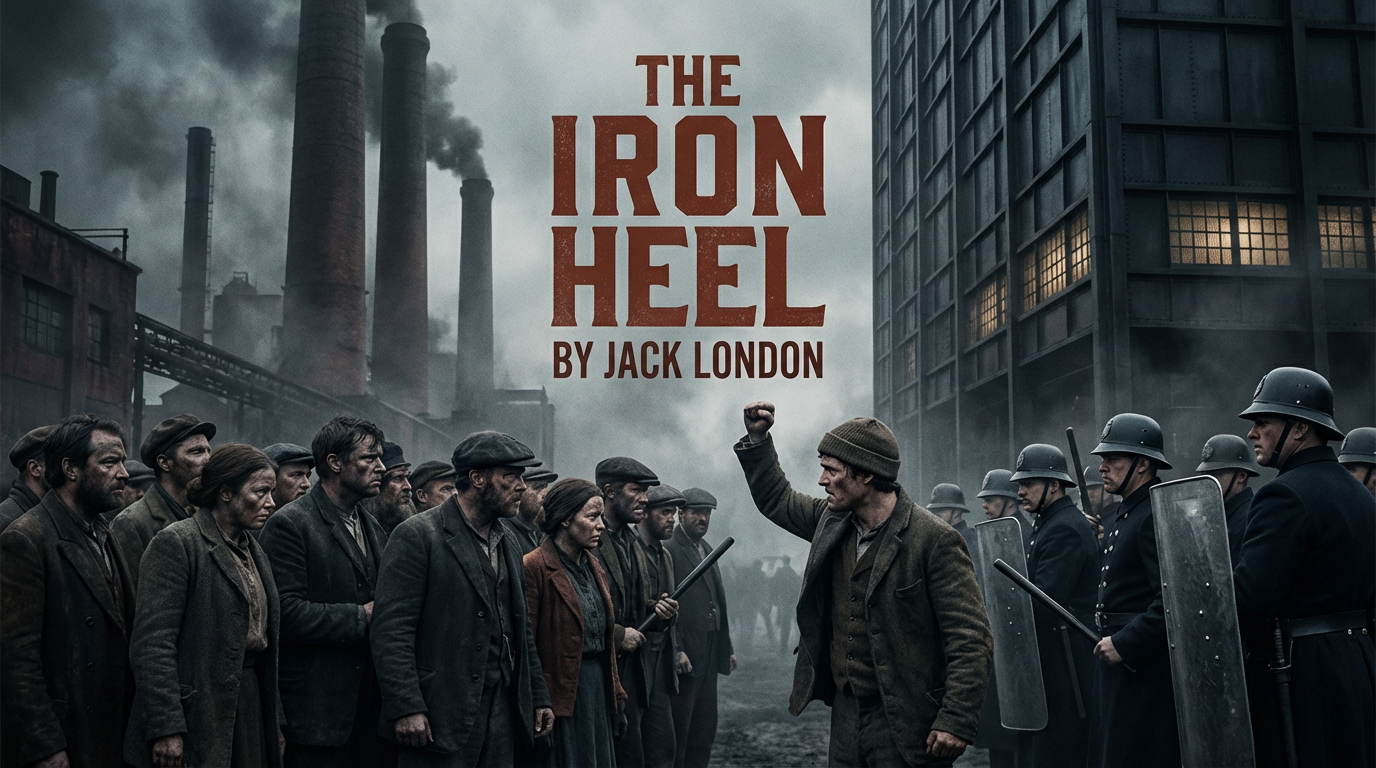
An excerpt from the original text.(complete · 3277 words)
THE VORTEX
Following like thunder claps upon the Business Men’s dinner, occurred
event after event of terrifying moment; and I, little I, who had lived
so placidly all my days in the quiet university town, found myself and
my personal affairs drawn into the vortex of the great world-affairs.
Whether it was my love for Ernest, or the clear sight he had given me
of the society in which I lived, that made me a revolutionist, I know
not; but a revolutionist I became, and I was plunged into a whirl of
happenings that would have been inconceivable three short months
before.
The crisis in my own fortunes came simultaneously with great crises in
society. First of all, father was discharged from the university. Oh,
he was not technically discharged. His resignation was demanded, that
was all. This, in itself, did not amount to much. Father, in fact, was
delighted. He was especially delighted because his discharge had been
precipitated by the publication of his book, “Economics and Education.”
It clinched his argument, he contended. What better evidence could be
advanced to prove that education was dominated by the capitalist class?
But this proof never got anywhere. Nobody knew he had been forced to
resign from the university. He was so eminent a scientist that such an
announcement, coupled with the reason for his enforced resignation,
would have created somewhat of a furor all over the world. The
newspapers showered him with praise and honor, and commended him for
having given up the drudgery of the lecture room in order to devote his
whole time to scientific research.
At first father laughed. Then he became angry—tonic angry. Then came
the suppression of his book. This suppression was performed secretly,
so secretly that at first we could not comprehend. The publication of
the book had immediately caused a bit of excitement in the country.
Father had been politely abused in the capitalist press, the tone of
the abuse being to the effect that it was a pity so great a scientist
should leave his field and invade the realm of sociology, about which
he knew nothing and wherein he had promptly become lost. This lasted
for a week, while father chuckled and said the book had touched a sore
spot on capitalism. And then, abruptly, the newspapers and the critical
magazines ceased saying anything about the book at all. Also, and with
equal suddenness, the book disappeared from the market. Not a copy was
obtainable from any bookseller. Father wrote to the publishers and was
informed that the plates had been accidentally injured. An
unsatisfactory correspondence followed. Driven finally to an
unequivocal stand, the publishers stated that they could not see their
way to putting the book into type again, but that they were willing to
relinquish their rights in it.
“And you won’t find another publishing house in the country to touch
it,” Ernest said. “And if I were you, I’d hunt cover right now. You’ve
merely got a foretaste of the Iron Heel.”
But father was nothing if not a scientist. He never believed in jumping
to conclusions. A laboratory experiment was no experiment if it were
not carried through in all its details. So he patiently went the round
of the publishing houses. They gave a multitude of excuses, but not one
house would consider the book.
When father became convinced that the book had actually been
suppressed, he tried to get the fact into the newspapers; but his
communications were ignored. At a political meeting of the socialists,
where many reporters were present, father saw his chance. He arose and
related the history of the suppression of the book. He laughed next day
when he read the newspapers, and then he grew angry to a degree that
eliminated all tonic qualities. The papers made no mention of the book,
but they misreported him beautifully. They twisted his words and
phrases away from the context, and turned his subdued and controlled
remarks into a howling anarchistic speech. It was done artfully. One
instance, in particular, I remember. He had used the phrase “social
revolution.” The reporter merely dropped out “social.” This was sent
out all over the country in an Associated Press despatch, and from all
over the country arose a cry of alarm. Father was branded as a nihilist
and an anarchist, and in one cartoon that was copied widely he was
portrayed waving a red flag at the head of a mob of long-haired,
wild-eyed men who bore in their hands torches, knives, and dynamite
bombs.
He was assailed terribly in the press, in long and abusive editorials,
for his anarchy, and hints were made of mental breakdown on his part.
This behavior, on the part of the capitalist press, was nothing new,
Ernest told us. It was the custom, he said, to send reporters to all
the socialist meetings for the express purpose of misreporting and
distorting what was said, in order to frighten the middle class away
from any possible affiliation with the proletariat. And repeatedly
Ernest warned father to cease fighting and to take to cover.
The socialist press of the country took up the fight, however, and
throughout the reading portion of the working class it was known that
the book had been suppressed. But this knowledge stopped with the
working class. Next, the “Appeal to Reason,” a big socialist publishing
house, arranged with father to bring out the book. Father was jubilant,
but Ernest was alarmed.
“I tell you we are on the verge of the unknown,” he insisted. “Big
things are happening secretly all around us. We can feel them. We do
not know what they are, but they are there. The whole fabric of society
is a-tremble with them. Don’t ask me. I don’t know myself. But out of
this flux of society something is about to crystallize. It is
crystallizing now. The suppression of the book is a precipitation. How
many books have been suppressed? We haven’t the least idea. We are in
the dark. We have no way of learning. Watch out next for the
suppression of the socialist press and socialist publishing houses. I’m
afraid it’s coming. We are going to be throttled.”
Ernest had his hand on the pulse of events even more closely than the
rest of the socialists, and within two days the first blow was struck.
The Appeal to Reason was a weekly, and its regular circulation
amongst the proletariat was seven hundred and fifty thousand. Also, it
very frequently got out special editions of from two to five millions.
These great editions were paid for and distributed by the small army of
voluntary workers who had marshalled around the Appeal. The first
blow was aimed at these special editions, and it was a crushing one. By
an arbitrary ruling of the Post Office, these editions were decided to
be not the regular circulation of the paper, and for that reason were
denied admission to the mails.
A week later the Post Office Department ruled that the paper was
seditious, and barred it entirely from the mails. This was a fearful
blow to the socialist propaganda. The Appeal was desperate. It
devised a plan of reaching its subscribers through the express
companies, but they declined to handle it. This was the end of the
Appeal. But not quite. It prepared to go on with its book publishing.
Twenty thousand copies of father’s book were in the bindery, and the
presses were turning off more. And then, without warning, a mob arose
one night, and, under a waving American flag, singing patriotic songs,
set fire to the great plant of the Appeal and totally destroyed it.
Now Girard, Kansas, was a quiet, peaceable town. There had never been
any labor troubles there. The Appeal paid union wages; and, in fact,
was the backbone of the town, giving employment to hundreds of men and
women. It was not the citizens of Girard that composed the mob. This
mob had risen up out of the earth apparently, and to all intents and
purposes, its work done, it had gone back into the earth. Ernest saw in
the affair the most sinister import.
“The Black Hundreds[1] are being organized in the United States,” he
said. “This is the beginning. There will be more of it. The Iron Heel
is getting bold.”
[1] The Black Hundreds were reactionary mobs organized by the
perishing Autocracy in the Russian Revolution. These reactionary
groups attacked the revolutionary groups, and also, at needed moments,
rioted and destroyed property so as to afford the Autocracy the
pretext of calling out the Cossacks.
And so perished father’s book. We were to see much of the Black
Hundreds as the days went by. Week by week more of the socialist papers
were barred from the mails, and in a number of instances the Black
Hundreds destroyed the socialist presses. Of course, the newspapers of
the land lived up to the reactionary policy of the ruling class, and
the destroyed socialist press was misrepresented and vilified, while
the Black Hundreds were represented as true patriots and saviours of
society. So convincing was all this misrepresentation that even sincere
ministers in the pulpit praised the Black Hundreds while regretting the
necessity of violence.
History was making fast. The fall elections were soon to occur, and
Ernest was nominated by the socialist party to run for Congress. His
chance for election was most favorable. The street-car strike in San
Francisco had been broken. And following upon it the teamsters’ strike
had been broken. These two defeats had been very disastrous to
organized labor. The whole Water Front Federation, along with its
allies in the structural trades, had backed up the teamsters, and all
had been smashed down ingloriously. It had been a bloody strike. The
police had broken countless heads with their riot clubs; and the death
list had been augmented by the turning loose of a machine-gun on the
strikers from the barns of the Marsden Special Delivery Company.
In consequence, the men were sullen and vindictive. They wanted blood,
and revenge. Beaten on their chosen field, they were ripe to seek
revenge by means of political action. They still maintained their labor
organization, and this gave them strength in the political struggle
that was on. Ernest’s chance for election grew stronger and stronger.
Day by day unions and more unions voted their support to the
socialists, until even Ernest laughed when the Undertakers’ Assistants
and the Chicken Pickers fell into line. Labor became mulish. While it
packed the socialist meetings with mad enthusiasm, it was impervious to
the wiles of the old-party politicians. The old-party orators were
usually greeted with empty halls, though occasionally they encountered
full halls where they were so roughly handled that more than once it
was necessary to call out the police reserves.
History was making fast. The air was vibrant with things happening and
impending. The country was on the verge of hard times,[2] caused by a
series of prosperous years wherein the difficulty of disposing abroad
of the unconsumed surplus had become increasingly difficult. Industries
were working short time; many great factories were standing idle
against the time when the surplus should be gone; and wages were being
cut right and left.
[2] Under the capitalist régime these periods of hard times were as
inevitable as they were absurd. Prosperity always brought calamity.
This, of course, was due to the excess of unconsumed profits that was
piled up.
Also, the great machinist strike had been broken. Two hundred thousand
machinists, along with their five hundred thousand allies in the
metalworking trades, had been defeated in as bloody a strike as had
ever marred the United States. Pitched battles had been fought with the
small armies of armed strike-breakers[3] put in the field by the
employers’ associations; the Black Hundreds, appearing in scores of
wide-scattered places, had destroyed property; and, in consequence, a
hundred thousand regular soldiers of the United States had been called
out to put a frightful end to the whole affair. A number of the labor
leaders had been executed; many others had been sentenced to prison,
while thousands of the rank and file of the strikers had been herded
into bull-pens[4] and abominably treated by the soldiers.
[3] Strike-breakers—these were, in purpose and practice and
everything except name, the private soldiers of the capitalists. They
were thoroughly organized and well armed, and they were held in
readiness to be hurled in special trains to any part of the country
where labor went on strike or was locked out by the employers. Only
those curious times could have given rise to the amazing spectacle of
one, Farley, a notorious commander of strike-breakers, who, in 1906,
swept across the United States in special trains from New York to San
Francisco with an army of twenty-five hundred men, fully armed and
equipped, to break a strike of the San Francisco street-car men. Such
an act was in direct violation of the laws of the land. The fact that
this act, and thousands of similar acts, went unpunished, goes to show
how completely the judiciary was the creature of the Plutocracy.
[4] Bull-pen—in a miners’ strike in Idaho, in the latter part of the
nineteenth century, it happened that many of the strikers were
confined in a bull-pen by the troops. The practice and the name
continued in the twentieth century.
The years of prosperity were now to be paid for. All markets were
glutted; all markets were falling; and amidst the general crumble of
prices the price of labor crumbled fastest of all. The land was
convulsed with industrial dissensions. Labor was striking here, there,
and everywhere; and where it was not striking, it was being turned out
by the capitalists. The papers were filled with tales of violence and
blood. And through it all the Black Hundreds played their part. Riot,
arson, and wanton destruction of property was their function, and well
they performed it. The whole regular army was in the field, called
there by the actions of the Black Hundreds.[5] All cities and towns
were like armed camps, and laborers were shot down like dogs. Out of
the vast army of the unemployed the strike-breakers were recruited; and
when the strike-breakers were worsted by the labor unions, the troops
always appeared and crushed the unions. Then there was the militia. As
yet, it was not necessary to have recourse to the secret militia law.
Only the regularly organized militia was out, and it was out
everywhere. And in this time of terror, the regular army was increased
an additional hundred thousand by the government.
[5] The name only, and not the idea, was imported from Russia. The
Black Hundreds were a development out of the secret agents of the
capitalists, and their use arose in the labor struggles of the
nineteenth century. There is no discussion of this. No less an
authority of the times than Carroll D. Wright, United States
Commissioner of Labor, is responsible for the statement. From his
book, entitled “The Battles of Labor,” is quoted the declaration that
“in some of the great historic strikes the employers themselves have
instigated acts of violence;” that manufacturers have deliberately
provoked strikes in order to get rid of surplus stock; and that
freight cars have been burned by employers’ agents during railroad
strikes in order to increase disorder. It was out of these secret
agents of the employers that the Black Hundreds arose; and it was
they, in turn, that later became that terrible weapon of the
Oligarchy, the agents-provocateurs.
Never had labor received such an all-around beating. The great captains
of industry, the oligarchs, had for the first time thrown their full
weight into the breach the struggling employers’ associations had made.
These associations were practically middle-class affairs, and now,
compelled by hard times and crashing markets, and aided by the great
captains of industry, they gave organized labor an awful and decisive
defeat. It was an all-powerful alliance, but it was an alliance of the
lion and the lamb, as the middle class was soon to learn.
Labor was bloody and sullen, but crushed. Yet its defeat did not put an
end to the hard times. The banks, themselves constituting one of the
most important forces of the Oligarchy, continued to call in credits.
The Wall Street[6] group turned the stock market into a maelstrom where
the values of all the land crumbled away almost to nothingness. And out
of all the rack and ruin rose the form of the nascent Oligarchy,
imperturbable, indifferent, and sure. Its serenity and certitude was
terrifying. Not only did it use its own vast power, but it used all the
power of the United States Treasury to carry out its plans.
[6] Wall Street—so named from a street in ancient New York, where
was situated the stock exchange, and where the irrational organization
of society permitted underhanded manipulation of all the industries of
the country.
The captains of industry had turned upon the middle class. The
employers’ associations, that had helped the captains of industry to
tear and rend labor, were now torn and rent by their quondam allies.
Amidst the crashing of the middle men, the small business men and
manufacturers, the trusts stood firm. Nay, the trusts did more than
stand firm. They were active. They sowed wind, and wind, and ever more
wind; for they alone knew how to reap the whirlwind and make a profit
out of it. And such profits! Colossal profits! Strong enough themselves
to weather the storm that was largely their own brewing, they turned
loose and plundered the wrecks that floated about them. Values were
pitifully and inconceivably shrunken, and the trusts added hugely to
their holdings, even extending their enterprises into many new
fields—and always at the expense of the middle class.
Thus the summer of 1912 witnessed the virtual death-thrust to the
middle class. Even Ernest was astounded at the quickness with which it
had been done. He shook his head ominously and looked forward without
hope to the fall elections.
“It’s no use,” he said. “We are beaten. The Iron Heel is here. I had
hoped for a peaceable victory at the ballot-box. I was wrong. Wickson
was right. We shall be robbed of our few remaining liberties; the Iron
Heel will walk upon our faces; nothing remains but a bloody revolution
of the working class. Of course we will win, but I shudder to think of
it.”
And from then on Ernest pinned his faith in revolution. In this he was
in advance of his party. His fellow-socialists could not agree with
him. They still insisted that victory could be gained through the
elections. It was not that they were stunned. They were too cool-headed
and courageous for that. They were merely incredulous, that was all.
Ernest could not get them seriously to fear the coming of the
Oligarchy. They were stirred by him, but they were too sure of their
own strength. There was no room in their theoretical social evolution
for an oligarchy, therefore the Oligarchy could not be.
“We’ll send you to Congress and it will be all right,” they told him at
one of our secret meetings.
“And when they take me out of Congress,” Ernest replied coldly, “and
put me against a wall, and blow my brains out—what then?”
“Then we’ll rise in our might,” a dozen voices answered at once.
“Then you’ll welter in your gore,” was his retort. “I’ve heard that
song sung by the middle class, and where is it now in its might?”
Master this chapter. Complete your experience
Purchase the complete book to access all chapters and support classic literature
As an Amazon Associate, we earn a small commission from qualifying purchases at no additional cost to you.
Available in paperback, hardcover, and e-book formats
Let's Analyse the Pattern
Powerful interests systematically take control of public institutions and turn them against their original purpose while maintaining the appearance of legitimacy.
Why This Matters
Connect literature to life
This chapter teaches how to spot when organizations designed to serve the public good have been repurposed to protect private interests instead.
Practice This Today
This week, notice when institutions make decisions that seem to contradict their stated mission—ask yourself who really benefits from these choices.
Now let's explore the literary elements.
Key Quotes & Analysis
"What better evidence could be advanced to prove that education was dominated by the capitalist class?"
Context: After being forced to resign for writing about educational control
He's thrilled his firing proves his thesis, but misses that proving a point means nothing if no one hears it. His academic mindset assumes rational evidence matters to people using raw power.
In Today's Words:
See? This proves I was right all along about how the system works!
"Nobody knew he had been forced to resign from the university."
Context: Describing how her father's suppression was kept quiet
The most effective censorship is invisible. By keeping the resignation quiet, the system avoids creating a martyr while still removing the threat. It's surgical suppression.
In Today's Words:
They fired him so quietly that nobody even knew it happened.
"The newspapers showered him with praise and honor, and commended him for having resigned his chair in order to devote his whole time to science."
Context: How the media spun her father's forced resignation
The press transforms suppression into voluntary choice, making the victim complicit in their own silencing. It's gaslighting on a social scale - rewriting reality to serve power.
In Today's Words:
The news made it sound like he quit to focus on his research, not that he was pushed out.
Thematic Threads
Power
In This Chapter
The Iron Heel reveals itself as an organized force that controls information, education, and economic systems rather than just individual businesses
Development
Evolved from Ernest's warnings about oligarchy to concrete demonstration of coordinated suppression across all institutions
In Your Life:
You might notice this when your workplace suddenly changes policies that seem to benefit management at workers' expense, or when local news stops covering certain stories.
Information Control
In This Chapter
Newspapers deliberately misquote to create false narratives, publishers mysteriously refuse reprints, and socialist publications face coordinated destruction
Development
Developed from earlier discussions of media bias to active manipulation and suppression of dissenting voices
In Your Life:
You see this when social media algorithms hide posts about labor organizing, or when local papers avoid reporting on certain company practices.
Class Betrayal
In This Chapter
The middle class that supported crushing organized labor now finds itself targeted by the same trusts it helped empower
Development
Expanded from individual examples to systematic elimination of the middle class as a buffer between rich and poor
In Your Life:
This happens when you support policies that hurt other workers, only to find those same policies eventually used against you.
Awakening
In This Chapter
Avis and her family finally understand they're facing organized suppression, not just disagreement or bad luck
Development
Progressed from Avis's initial disbelief to recognition of systematic patterns of control
In Your Life:
You experience this when you realize that workplace problems aren't just 'bad management' but part of a deliberate strategy to weaken worker power.
Isolation
In This Chapter
Even fellow socialists can't grasp how completely the rules have changed, leaving Ernest and others increasingly alone in their understanding
Development
Built from Ernest's early warnings being dismissed to his growing realization that peaceful change is impossible
In Your Life:
You feel this when you try to warn friends about workplace changes or political developments that they can't yet see clearly.
You now have the context. Time to form your own thoughts.
Discussion Questions
- 1
How did Avis's father go from respected professor to 'dangerous anarchist' without changing his actual message?
analysis • surface - 2
Why did the Iron Heel target newspapers, publishers, and universities instead of just fighting the socialists directly?
analysis • medium - 3
Where do you see institutions today that seem to work against their stated mission? What might explain this contradiction?
application • medium - 4
If you suspected your workplace, school, or local organization was being influenced by outside interests, how would you document and respond to that pressure?
application • deep - 5
What does this chapter reveal about the difference between having formal rights (like free speech) and being able to actually exercise them?
reflection • deep
Critical Thinking Exercise
Map the Influence Network
Choose an institution you interact with regularly (your workplace, your child's school, a local newspaper, your healthcare system). Draw a simple diagram showing who funds it, who makes the key decisions, and what outside pressures it faces. Then identify one decision this institution has made recently that seemed to contradict its stated mission.
Consider:
- •Follow the money - who pays the bills often determines the priorities
- •Look for patterns across similar institutions making similar changes
- •Consider both obvious pressures (advertisers, donors) and subtle ones (professional networks, regulatory threats)
Journaling Prompt
Write about a time when you realized an organization you trusted was working against your interests. How did you recognize it, and what did you do about it?
Coming Up Next...
Chapter 11: Love in the Time of Oppression
With the political system revealed as a sham and peaceful resistance crushed, Ernest and Avis must decide how far they're willing to go in their fight against the Iron Heel. The next phase of their struggle will test everything they believe about justice, sacrifice, and the price of revolution.



