
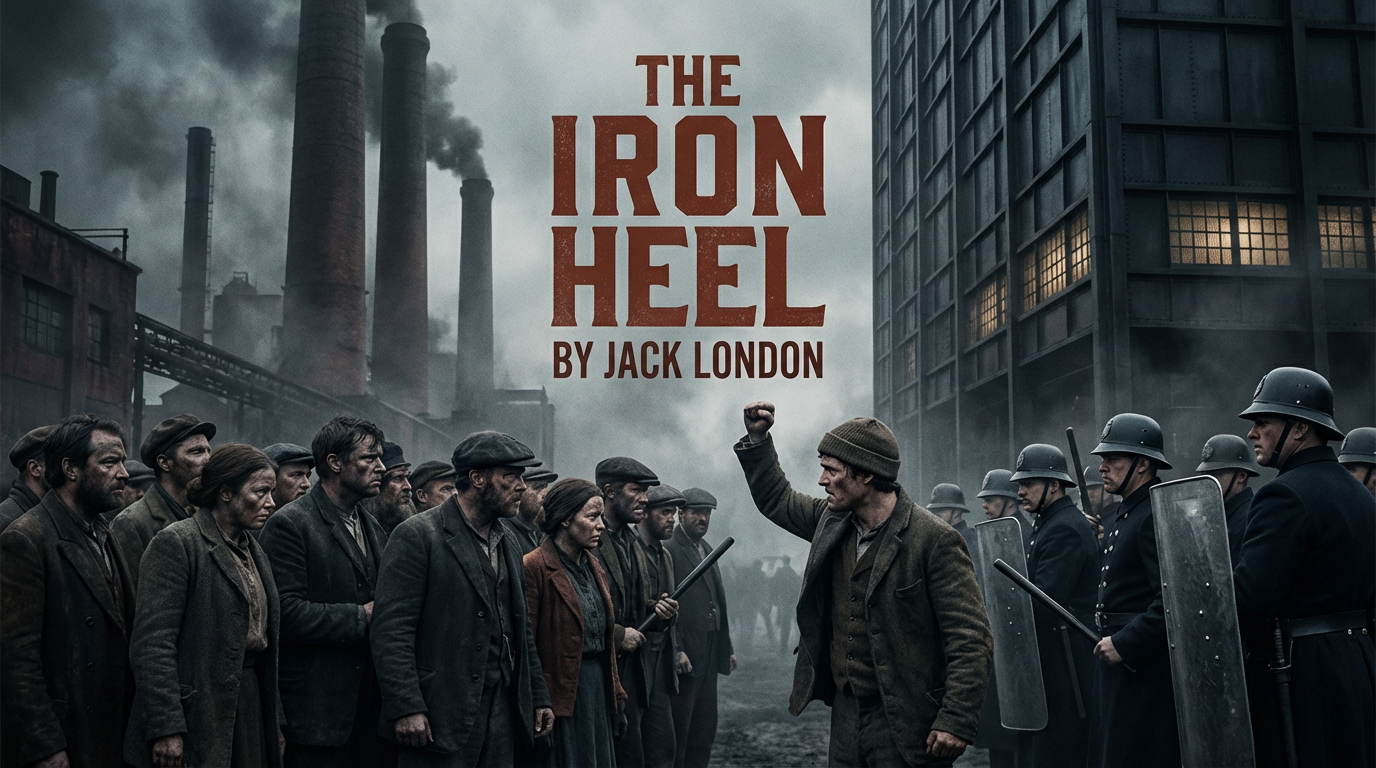
An excerpt from the original text.(complete · 5824 words)
THE MATHEMATICS OF A DREAM
In the midst of the consternation his revelation had produced, Ernest
began again to speak.
“You have said, a dozen of you to-night, that socialism is impossible.
You have asserted the impossible, now let me demonstrate the
inevitable. Not only is it inevitable that you small capitalists shall
pass away, but it is inevitable that the large capitalists, and the
trusts also, shall pass away. Remember, the tide of evolution never
flows backward. It flows on and on, and it flows from competition to
combination, and from little combination to large combination, and from
large combination to colossal combination, and it flows on to
socialism, which is the most colossal combination of all.
“You tell me that I dream. Very good. I’ll give you the mathematics of
my dream; and here, in advance, I challenge you to show that my
mathematics are wrong. I shall develop the inevitability of the
breakdown of the capitalist system, and I shall demonstrate
mathematically why it must break down. Here goes, and bear with me if
at first I seem irrelevant.
“Let us, first of all, investigate a particular industrial process, and
whenever I state something with which you disagree, please interrupt
me. Here is a shoe factory. This factory takes leather and makes it
into shoes. Here is one hundred dollars’ worth of leather. It goes
through the factory and comes out in the form of shoes, worth, let us
say, two hundred dollars. What has happened? One hundred dollars has
been added to the value of the leather. How was it added? Let us see.
“Capital and labor added this value of one hundred dollars. Capital
furnished the factory, the machines, and paid all the expenses. Labor
furnished labor. By the joint effort of capital and labor one hundred
dollars of value was added. Are you all agreed so far?”
Heads nodded around the table in affirmation.
“Labor and capital having produced this one hundred dollars, now
proceed to divide it. The statistics of this division are fractional;
so let us, for the sake of convenience, make them roughly approximate.
Capital takes fifty dollars as its share, and labor gets in wages fifty
dollars as its share. We will not enter into the squabbling over the
division.[1] No matter how much squabbling takes place, in one
percentage or another the division is arranged. And take notice here,
that what is true of this particular industrial process is true of all
industrial processes. Am I right?”
[1] Everhard here clearly develops the cause of all the labor troubles
of that time. In the division of the joint-product, capital wanted all
it could get, and labor wanted all it could get. This quarrel over the
division was irreconcilable. So long as the system of capitalistic
production existed, labor and capital continued to quarrel over the
division of the joint-product. It is a ludicrous spectacle to us, but
we must not forget that we have seven centuries’ advantage over those
that lived in that time.
Again the whole table agreed with Ernest.
“Now, suppose labor, having received its fifty dollars, wanted to buy
back shoes. It could only buy back fifty dollars’ worth. That’s clear,
isn’t it?
“And now we shift from this particular process to the sum total of all
industrial processes in the United States, which includes the leather
itself, raw material, transportation, selling, everything. We will say,
for the sake of round figures, that the total production of wealth in
the United States in one year is four billion dollars. Then labor has
received in wages, during the same period, two billion dollars. Four
billion dollars has been produced. How much of this can labor buy back?
Two billions. There is no discussion of this, I am sure. For that
matter, my percentages are mild. Because of a thousand capitalistic
devices, labor cannot buy back even half of the total product.
“But to return. We will say labor buys back two billions. Then it
stands to reason that labor can consume only two billions. There are
still two billions to be accounted for, which labor cannot buy back and
consume.”
“Labor does not consume its two billions, even,” Mr. Kowalt spoke up.
“If it did, it would not have any deposits in the savings banks.”
“Labor’s deposits in the savings banks are only a sort of reserve fund
that is consumed as fast as it accumulates. These deposits are saved
for old age, for sickness and accident, and for funeral expenses. The
savings bank deposit is simply a piece of the loaf put back on the
shelf to be eaten next day. No, labor consumes all of the total product
that its wages will buy back.
“Two billions are left to capital. After it has paid its expenses, does
it consume the remainder? Does capital consume all of its two
billions?”
Ernest stopped and put the question point blank to a number of the men.
They shook their heads.
“I don’t know,” one of them frankly said.
“Of course you do,” Ernest went on. “Stop and think a moment. If
capital consumed its share, the sum total of capital could not
increase. It would remain constant. If you will look at the economic
history of the United States, you will see that the sum total of
capital has continually increased. Therefore capital does not consume
its share. Do you remember when England owned so much of our railroad
bonds? As the years went by, we bought back those bonds. What does that
mean? That part of capital’s unconsumed share bought back the bonds.
What is the meaning of the fact that to-day the capitalists of the
United States own hundreds and hundreds of millions of dollars of
Mexican bonds, Russian bonds, Italian bonds, Grecian bonds? The meaning
is that those hundreds and hundreds of millions were part of capital’s
share which capital did not consume. Furthermore, from the very
beginning of the capitalist system, capital has never consumed all of
its share.
“And now we come to the point. Four billion dollars of wealth is
produced in one year in the United States. Labor buys back and consumes
two billions. Capital does not consume the remaining two billions.
There is a large balance left over unconsumed. What is done with this
balance? What can be done with it? Labor cannot consume any of it, for
labor has already spent all its wages. Capital will not consume this
balance, because, already, according to its nature, it has consumed all
it can. And still remains the balance. What can be done with it? What
is done with it?”
“It is sold abroad,” Mr. Kowalt volunteered.
“The very thing,” Ernest agreed. “Because of this balance arises our
need for a foreign market. This is sold abroad. It has to be sold
abroad. There is no other way of getting rid of it. And that unconsumed
surplus, sold abroad, becomes what we call our favorable balance of
trade. Are we all agreed so far?”
“Surely it is a waste of time to elaborate these A B C’s of commerce,”
Mr. Calvin said tartly. “We all understand them.”
“And it is by these A B C’s I have so carefully elaborated that I shall
confound you,” Ernest retorted. “There’s the beauty of it. And I’m
going to confound you with them right now. Here goes.
“The United States is a capitalist country that has developed its
resources. According to its capitalist system of industry, it has an
unconsumed surplus that must be got rid of, and that must be got rid of
abroad.[2] What is true of the United States is true of every other
capitalist country with developed resources. Every one of such
countries has an unconsumed surplus. Don’t forget that they have
already traded with one another, and that these surpluses yet remain.
Labor in all these countries has spent its wages, and cannot buy any of
the surpluses. Capital in all these countries has already consumed all
it is able according to its nature. And still remain the surpluses.
They cannot dispose of these surpluses to one another. How are they
going to get rid of them?”
[2] Theodore Roosevelt, President of the United States a few years
prior to this time, made the following public declaration: “A more
liberal and extensive reciprocity in the purchase and sale of
commodities is necessary, so that the overproduction of the United
States can be satisfactorily disposed of to foreign countries.” Of
course, this overproduction he mentions was the profits of the
capitalist system over and beyond the consuming power of the
capitalists. It was at this time that Senator Mark Hanna said: “The
production of wealth in the United States is one-third larger annually
than its consumption.” Also a fellow-Senator, Chauncey Depew, said:
“The American people produce annually two billions more wealth than
they consume.”
“Sell them to countries with undeveloped resources,” Mr. Kowalt
suggested.
“The very thing. You see, my argument is so clear and simple that in
your own minds you carry it on for me. And now for the next step.
Suppose the United States disposes of its surplus to a country with
undeveloped resources like, say, Brazil. Remember this surplus is over
and above trade, which articles of trade have been consumed. What,
then, does the United States get in return from Brazil?”
“Gold,” said Mr. Kowalt.
“But there is only so much gold, and not much of it, in the world,”
Ernest objected.
“Gold in the form of securities and bonds and so forth,” Mr. Kowalt
amended.
“Now you’ve struck it,” Ernest said. “From Brazil the United States, in
return for her surplus, gets bonds and securities. And what does that
mean? It means that the United States is coming to own railroads in
Brazil, factories, mines, and lands in Brazil. And what is the meaning
of that in turn?”
Mr. Kowalt pondered and shook his head.
“I’ll tell you,” Ernest continued. “It means that the resources of
Brazil are being developed. And now, the next point. When Brazil, under
the capitalist system, has developed her resources, she will herself
have an unconsumed surplus. Can she get rid of this surplus to the
United States? No, because the United States has herself a surplus. Can
the United States do what she previously did—get rid of her surplus to
Brazil? No, for Brazil now has a surplus, too.
“What happens? The United States and Brazil must both seek out other
countries with undeveloped resources, in order to unload the surpluses
on them. But by the very process of unloading the surpluses, the
resources of those countries are in turn developed. Soon they have
surpluses, and are seeking other countries on which to unload. Now,
gentlemen, follow me. The planet is only so large. There are only so
many countries in the world. What will happen when every country in the
world, down to the smallest and last, with a surplus in its hands,
stands confronting every other country with surpluses in their hands?”
He paused and regarded his listeners. The bepuzzlement in their faces
was delicious. Also, there was awe in their faces. Out of abstractions
Ernest had conjured a vision and made them see it. They were seeing it
then, as they sat there, and they were frightened by it.
“We started with A B C, Mr. Calvin,” Ernest said slyly. “I have now
given you the rest of the alphabet. It is very simple. That is the
beauty of it. You surely have the answer forthcoming. What, then, when
every country in the world has an unconsumed surplus? Where will your
capitalist system be then?”
But Mr. Calvin shook a troubled head. He was obviously questing back
through Ernest’s reasoning in search of an error.
“Let me briefly go over the ground with you again,” Ernest said. “We
began with a particular industrial process, the shoe factory. We found
that the division of the joint product that took place there was
similar to the division that took place in the sum total of all
industrial processes. We found that labor could buy back with its wages
only so much of the product, and that capital did not consume all of
the remainder of the product. We found that when labor had consumed to
the full extent of its wages, and when capital had consumed all it
wanted, there was still left an unconsumed surplus. We agreed that this
surplus could only be disposed of abroad. We agreed, also, that the
effect of unloading this surplus on another country would be to develop
the resources of that country, and that in a short time that country
would have an unconsumed surplus. We extended this process to all the
countries on the planet, till every country was producing every year,
and every day, an unconsumed surplus, which it could dispose of to no
other country. And now I ask you again, what are we going to do with
those surpluses?”
Still no one answered.
“Mr. Calvin?” Ernest queried.
“It beats me,” Mr. Calvin confessed.
“I never dreamed of such a thing,” Mr. Asmunsen said. “And yet it does
seem clear as print.”
It was the first time I had ever heard Karl Marx’s[3] doctrine of
surplus value elaborated, and Ernest had done it so simply that I, too,
sat puzzled and dumbfounded.
[3] Karl Marx—the great intellectual hero of Socialism. A German Jew
of the nineteenth century. A contemporary of John Stuart Mill. It
seems incredible to us that whole generations should have elapsed
after the enunciation of Marx’s economic discoveries, in which time he
was sneered at by the world’s accepted thinkers and scholars. Because
of his discoveries he was banished from his native country, and he
died an exile in England.
“I’ll tell you a way to get rid of the surplus,” Ernest said. “Throw it
into the sea. Throw every year hundreds of millions of dollars’ worth
of shoes and wheat and clothing and all the commodities of commerce
into the sea. Won’t that fix it?”
“It will certainly fix it,” Mr. Calvin answered. “But it is absurd for
you to talk that way.”
Ernest was upon him like a flash.
“Is it a bit more absurd than what you advocate, you machine-breaker,
returning to the antediluvian ways of your forefathers? What do you
propose in order to get rid of the surplus? You would escape the
problem of the surplus by not producing any surplus. And how do you
propose to avoid producing a surplus? By returning to a primitive
method of production, so confused and disorderly and irrational, so
wasteful and costly, that it will be impossible to produce a surplus.”
Mr. Calvin swallowed. The point had been driven home. He swallowed
again and cleared his throat.
“You are right,” he said. “I stand convicted. It is absurd. But we’ve
got to do something. It is a case of life and death for us of the
middle class. We refuse to perish. We elect to be absurd and to return
to the truly crude and wasteful methods of our forefathers. We will put
back industry to its pre-trust stage. We will break the machines. And
what are you going to do about it?”
“But you can’t break the machines,” Ernest replied. “You cannot make
the tide of evolution flow backward. Opposed to you are two great
forces, each of which is more powerful than you of the middle class.
The large capitalists, the trusts, in short, will not let you turn
back. They don’t want the machines destroyed. And greater than the
trusts, and more powerful, is labor. It will not let you destroy the
machines. The ownership of the world, along with the machines, lies
between the trusts and labor. That is the battle alignment. Neither
side wants the destruction of the machines. But each side wants to
possess the machines. In this battle the middle class has no place. The
middle class is a pygmy between two giants. Don’t you see, you poor
perishing middle class, you are caught between the upper and nether
millstones, and even now has the grinding begun.
“I have demonstrated to you mathematically the inevitable breakdown of
the capitalist system. When every country stands with an unconsumed and
unsalable surplus on its hands, the capitalist system will break down
under the terrific structure of profits that it itself has reared. And
in that day there won’t be any destruction of the machines. The
struggle then will be for the ownership of the machines. If labor wins,
your way will be easy. The United States, and the whole world for that
matter, will enter upon a new and tremendous era. Instead of being
crushed by the machines, life will be made fairer, and happier, and
nobler by them. You of the destroyed middle class, along with
labor—there will be nothing but labor then; so you, and all the rest of
labor, will participate in the equitable distribution of the products
of the wonderful machines. And we, all of us, will make new and more
wonderful machines. And there won’t be any unconsumed surplus, because
there won’t be any profits.”
“But suppose the trusts win in this battle over the ownership of the
machines and the world?” Mr. Kowalt asked.
“Then,” Ernest answered, “you, and labor, and all of us, will be
crushed under the iron heel of a despotism as relentless and terrible
as any despotism that has blackened the pages of the history of man.
That will be a good name for that despotism, the Iron Heel.”[4]
[4] The earliest known use of that name to designate the Oligarchy.
There was a long pause, and every man at the table meditated in ways
unwonted and profound.
“But this socialism of yours is a dream,” Mr. Calvin said; and
repeated, “a dream.”
“I’ll show you something that isn’t a dream, then,” Ernest answered.
“And that something I shall call the Oligarchy. You call it the
Plutocracy. We both mean the same thing, the large capitalists or the
trusts. Let us see where the power lies today. And in order to do so,
let us apportion society into its class divisions.
“There are three big classes in society. First comes the Plutocracy,
which is composed of wealthy bankers, railway magnates, corporation
directors, and trust magnates. Second, is the middle class, your class,
gentlemen, which is composed of farmers, merchants, small
manufacturers, and professional men. And third and last comes my class,
the proletariat, which is composed of the wage-workers.[5]
[5] This division of society made by Everhard is in accordance with
that made by Lucien Sanial, one of the statistical authorities of that
time. His calculation of the membership of these divisions by
occupation, from the United States Census of 1900, is as follows:
Plutocratic class, 250,251; Middle class, 8,429,845; and Proletariat
class, 20,393,137.
“You cannot but grant that the ownership of wealth constitutes
essential power in the United States to-day. How is this wealth owned
by these three classes? Here are the figures. The Plutocracy owns
sixty-seven billions of wealth. Of the total number of persons engaged
in occupations in the United States, only nine-tenths of one per cent
are from the Plutocracy, yet the Plutocracy owns seventy per cent of
the total wealth. The middle class owns twenty-four billions.
Twenty-nine per cent of those in occupations are from the middle class,
and they own twenty-five per cent of the total wealth. Remains the
proletariat. It owns four billions. Of all persons in occupations,
seventy per cent come from the proletariat; and the proletariat owns
four per cent of the total wealth. Where does the power lie,
gentlemen?”
“From your own figures, we of the middle class are more powerful than
labor,” Mr. Asmunsen remarked.
“Calling us weak does not make you stronger in the face of the strength
of the Plutocracy,” Ernest retorted. “And furthermore, I’m not done
with you. There is a greater strength than wealth, and it is greater
because it cannot be taken away. Our strength, the strength of the
proletariat, is in our muscles, in our hands to cast ballots, in our
fingers to pull triggers. This strength we cannot be stripped of. It is
the primitive strength, it is the strength that is to life germane, it
is the strength that is stronger than wealth, and that wealth cannot
take away.
“But your strength is detachable. It can be taken away from you. Even
now the Plutocracy is taking it away from you. In the end it will take
it all away from you. And then you will cease to be the middle class.
You will descend to us. You will become proletarians. And the beauty of
it is that you will then add to our strength. We will hail you
brothers, and we will fight shoulder to shoulder in the cause of
humanity.
“You see, labor has nothing concrete of which to be despoiled. Its
share of the wealth of the country consists of clothes and household
furniture, with here and there, in very rare cases, an unencumbered
home. But you have the concrete wealth, twenty-four billions of it, and
the Plutocracy will take it away from you. Of course, there is the
large likelihood that the proletariat will take it away first. Don’t
you see your position, gentlemen? The middle class is a wobbly little
lamb between a lion and a tiger. If one doesn’t get you, the other
will. And if the Plutocracy gets you first, why it’s only a matter of
time when the Proletariat gets the Plutocracy.
“Even your present wealth is not a true measure of your power. The
strength of your wealth at this moment is only an empty shell. That is
why you are crying out your feeble little battle-cry, ‘Return to the
ways of our fathers.’ You are aware of your impotency. You know that
your strength is an empty shell. And I’ll show you the emptiness of it.
“What power have the farmers? Over fifty per cent are thralls by virtue
of the fact that they are merely tenants or are mortgaged. And all of
them are thralls by virtue of the fact that the trusts already own or
control (which is the same thing only better)—own and control all the
means of marketing the crops, such as cold storage, railroads,
elevators, and steamship lines. And, furthermore, the trusts control
the markets. In all this the farmers are without power. As regards
their political and governmental power, I’ll take that up later, along
with the political and governmental power of the whole middle class.
“Day by day the trusts squeeze out the farmers as they squeezed out Mr.
Calvin and the rest of the dairymen. And day by day are the merchants
squeezed out in the same way. Do you remember how, in six months, the
Tobacco Trust squeezed out over four hundred cigar stores in New York
City alone? Where are the old-time owners of the coal fields? You know
today, without my telling you, that the Railroad Trust owns or controls
the entire anthracite and bituminous coal fields. Doesn’t the Standard
Oil Trust[6] own a score of the ocean lines? And does it not also
control copper, to say nothing of running a smelter trust as a little
side enterprise? There are ten thousand cities in the United States
to-night lighted by the companies owned or controlled by Standard Oil,
and in as many cities all the electric transportation,—urban, suburban,
and interurban,—is in the hands of Standard Oil. The small capitalists
who were in these thousands of enterprises are gone. You know that.
It’s the same way that you are going.
[6] Standard Oil and Rockefeller—see footnote [10]
“The small manufacturer is like the farmer; and small manufacturers and
farmers to-day are reduced, to all intents and purposes, to feudal
tenure. For that matter, the professional men and the artists are at
this present moment villeins in everything but name, while the
politicians are henchmen. Why do you, Mr. Calvin, work all your nights
and days to organize the farmers, along with the rest of the middle
class, into a new political party? Because the politicians of the old
parties will have nothing to do with your atavistic ideas; and with
your atavistic ideas, they will have nothing to do because they are
what I said they are, henchmen, retainers of the Plutocracy.
“I spoke of the professional men and the artists as villeins. What else
are they? One and all, the professors, the preachers, and the editors,
hold their jobs by serving the Plutocracy, and their service consists
of propagating only such ideas as are either harmless to or
commendatory of the Plutocracy. Whenever they propagate ideas that
menace the Plutocracy, they lose their jobs, in which case, if they
have not provided for the rainy day, they descend into the proletariat
and either perish or become working-class agitators. And don’t forget
that it is the press, the pulpit, and the university that mould public
opinion, set the thought-pace of the nation. As for the artists, they
merely pander to the little less than ignoble tastes of the Plutocracy.
“But after all, wealth in itself is not the real power; it is the means
to power, and power is governmental. Who controls the government
to-day? The proletariat with its twenty millions engaged in
occupations? Even you laugh at the idea. Does the middle class, with
its eight million occupied members? No more than the proletariat. Who,
then, controls the government? The Plutocracy, with its paltry quarter
of a million of occupied members. But this quarter of a million does
not control the government, though it renders yeoman service. It is the
brain of the Plutocracy that controls the government, and this brain
consists of seven[7] small and powerful groups of men. And do not
forget that these groups are working to-day practically in unison.
[7] Even as late as 1907, it was considered that eleven groups
dominated the country, but this number was reduced by the amalgamation
of the five railroad groups into a supreme combination of all the
railroads. These five groups so amalgamated, along with their
financial and political allies, were (1) James J. Hill with his
control of the Northwest; (2) the Pennsylvania railway group, Schiff
financial manager, with big banking firms of Philadelphia and New
York; (3) Harriman, with Frick for counsel and Odell as political
lieutenant, controlling the central continental, Southwestern and
Southern Pacific Coast lines of transportation; (4) the Gould family
railway interests; and (5) Moore, Reid, and Leeds, known as the “Rock
Island crowd.” These strong oligarchs arose out of the conflict of
competition and travelled the inevitable road toward combination.
“Let me point out the power of but one of them, the railroad group. It
employs forty thousand lawyers to defeat the people in the courts. It
issues countless thousands of free passes to judges, bankers, editors,
ministers, university men, members of state legislatures, and of
Congress. It maintains luxurious lobbies[8] at every state capital, and
at the national capital; and in all the cities and towns of the land it
employs an immense army of pettifoggers and small politicians whose
business is to attend primaries, pack conventions, get on juries, bribe
judges, and in every way to work for its interests.[9]
[8] Lobby—a peculiar institution for bribing, bulldozing, and
corrupting the legislators who were supposed to represent the people’s
interests.
[9] A decade before this speech of Everhard’s, the New York Board of
Trade issued a report from which the following is quoted: “The
railroads control absolutely the legislatures of a majority of the
states of the Union; they make and unmake United States Senators,
congressmen, and governors, and are practically dictators of the
governmental policy of the United States.”
“Gentlemen, I have merely sketched the power of one of the seven groups
that constitute the brain of the Plutocracy.[10] Your twenty-four
billions of wealth does not give you twenty-five cents’ worth of
governmental power. It is an empty shell, and soon even the empty shell
will be taken away from you. The Plutocracy has all power in its hands
to-day. It to-day makes the laws, for it owns the Senate, Congress, the
courts, and the state legislatures. And not only that. Behind law must
be force to execute the law. To-day the Plutocracy makes the law, and
to enforce the law it has at its beck and call the police, the army,
the navy, and, lastly, the militia, which is you, and me, and all of
us.”
[10] Rockefeller began as a member of the proletariat, and through
thrift and cunning succeeded in developing the first perfect trust,
namely that known as Standard Oil. We cannot forbear giving the
following remarkable page from the history of the times, to show how
the need for reinvestment of the Standard Oil surplus crushed out
small capitalists and hastened the breakdown of the capitalist system.
David Graham Phillips was a radical writer of the period, and the
quotation, by him, is taken from a copy of the Saturday Evening
Post, dated October 4, 1902 A.D. This is the only copy of this
publication that has come down to us, and yet, from its appearance and
content, we cannot but conclude that it was one of the popular
periodicals with a large circulation. The quotation here follows:
“About ten years ago Rockefeller’s income was given as thirty
millions by an excellent authority. He had reached the limit of
profitable investment of profits in the oil industry. Here, then,
were these enormous sums in cash pouring in—more than $2,000,000 a
month for John Davison Rockefeller alone. The problem of
reinvestment became more serious. It became a nightmare. The oil
income was swelling, swelling, and the number of sound investments
limited, even more limited than it is now. It was through no
special eagerness for more gains that the Rockefellers began to
branch out from oil into other things. They were forced, swept on
by this inrolling tide of wealth which their monopoly magnet
irresistibly attracted. They developed a staff of investment
seekers and investigators. It is said that the chief of this staff
has a salary of $125,000 a year.
“The first conspicuous excursion and incursion of the Rockefellers
was into the railway field. By 1895 they controlled one-fifth of
the railway mileage of the country. What do they own or, through
dominant ownership, control to-day? They are powerful in all the
great railways of New York, north, east, and west, except one,
where their share is only a few millions. They are in most of the
great railways radiating from Chicago. They dominate in several of
the systems that extend to the Pacific. It is their votes that make
Mr. Morgan so potent, though, it may be added, they need his brains
more than he needs their votes— at present, and the combination of
the two constitutes in large measure the ‘community of interest.’
“But railways could not alone absorb rapidly enough those mighty
floods of gold. Presently John D. Rockefeller’s $2,500,000 a month
had increased to four, to five, to six millions a month, to
$75,000,000 a year. Illuminating oil was becoming all profit. The
reinvestments of income were adding their mite of many annual
millions.
“The Rockefellers went into gas and electricity when those
industries had developed to the safe investment stage. And now a
large part of the American people must begin to enrich the
Rockefellers as soon as the sun goes down, no matter what form of
illuminant they use. They went into farm mortgages. It is said that
when prosperity a few years ago enabled the farmers to rid
themselves of their mortgages, John D. Rockefeller was moved almost
to tears; eight millions which he had thought taken care of for
years to come at a good interest were suddenly dumped upon his
doorstep and there set up a-squawking for a new home. This
unexpected addition to his worriments in finding places for the
progeny of his petroleum and their progeny and their progeny’s
progeny was too much for the equanimity of a man without a
digestion. . . .
“The Rockefellers went into mines—iron and coal and copper and
lead; into other industrial companies; into street railways, into
national, state, and municipal bonds; into steamships and
steamboats and telegraphy; into real estate, into skyscrapers and
residences and hotels and business blocks; into life insurance,
into banking. There was soon literally no field of industry where
their millions were not at work. . . .
“The Rockefeller bank—the National City Bank—is by itself far and
away the biggest bank in the United States. It is exceeded in the
world only by the Bank of England and the Bank of France. The
deposits average more than one hundred millions a day; and it
dominates the call loan market on Wall Street and the stock market.
But it is not alone; it is the head of the Rockefeller chain of
banks, which includes fourteen banks and trust companies in New
York City, and banks of great strength and influence in every large
money center in the country.
“John D. Rockefeller owns Standard Oil stock worth between four and
five hundred millions at the market quotations. He has a hundred
millions in the steel trust, almost as much in a single western
railway system, half as much in a second, and so on and on and on
until the mind wearies of the cataloguing. His income last year was
about $100,000,000— it is doubtful if the incomes of all the
Rothschilds together make a greater sum. And it is going up by
leaps and bounds.”
Little discussion took place after this, and the dinner soon broke up.
All were quiet and subdued, and leave-taking was done with low voices.
It seemed almost that they were scared by the vision of the times they
had seen.
“The situation is, indeed, serious,” Mr. Calvin said to Ernest. “I have
little quarrel with the way you have depicted it. Only I disagree with
you about the doom of the middle class. We shall survive, and we shall
overthrow the trusts.”
“And return to the ways of your fathers,” Ernest finished for him.
“Even so,” Mr. Calvin answered gravely. “I know it’s a sort of
machine-breaking, and that it is absurd. But then life seems absurd
to-day, what of the machinations of the Plutocracy. And at any rate,
our sort of machine-breaking is at least practical and possible, which
your dream is not. Your socialistic dream is . . . well, a dream. We
cannot follow you.”
“I only wish you fellows knew a little something about evolution and
sociology,” Ernest said wistfully, as they shook hands. “We would be
saved so much trouble if you did.”
Master this chapter. Complete your experience
Purchase the complete book to access all chapters and support classic literature
As an Amazon Associate, we earn a small commission from qualifying purchases at no additional cost to you.
Available in paperback, hardcover, and e-book formats
Let's Analyse the Pattern
When you present undeniable evidence that threatens people's comfortable beliefs, they punish you rather than thank you for the insight.
Why This Matters
Connect literature to life
This chapter teaches how to recognize when institutions fear truth more than they value solutions.
Practice This Today
This week, notice when presenting facts creates defensiveness rather than discussion - that's a power dynamic, not a communication problem.
Now let's explore the literary elements.
Key Quotes & Analysis
"Not only is it inevitable that you small capitalists shall pass away, but it is inevitable that the large capitalists, and the trusts also, shall pass away."
Context: Ernest begins his mathematical demonstration of capitalism's inevitable collapse
This quote reveals Ernest's systematic approach to revolution - he's not just angry, he's logical. He shows that even the powerful trusts are temporary, caught in the same contradictions that will destroy smaller capitalists.
In Today's Words:
Your small business is doomed, but so are the big corporations - the whole system is breaking down.
"I'll give you the mathematics of my dream; and here, in advance, I challenge you to show that my mathematics are wrong."
Context: Ernest prepares to prove his argument with economic facts rather than ideology
Ernest weaponizes logic against people who benefit from keeping economics mysterious. By demanding they disprove his math, he shifts the burden of proof and exposes their ignorance of their own system.
In Today's Words:
I'm going to show you the numbers, and I dare you to prove me wrong with facts instead of feelings.
"What has happened? One hundred dollars has been added to the value of the leather."
Context: Ernest begins his shoe factory example to demonstrate surplus value
This simple example cuts through economic jargon to show how wealth is actually created - through labor. Ernest makes complex economic theory accessible while building toward his devastating conclusion about overproduction.
In Today's Words:
The workers created that extra hundred dollars of value - so where does it go?
Thematic Threads
Class
In This Chapter
Ernest mathematically proves the middle class has no real power, trapped between giant trusts and organized labor
Development
Evolved from earlier social observations to concrete economic proof of powerlessness
In Your Life:
You might recognize this when you realize your job title sounds important but you have zero influence over actual decisions.
Truth
In This Chapter
Mathematical facts become weapons that terrify rather than enlighten the dinner party guests
Development
Introduced here as Ernest shifts from philosophical arguments to undeniable numerical proof
In Your Life:
You've experienced this when presenting clear evidence of a problem only to be treated as the problem yourself.
Power
In This Chapter
Seven groups secretly control everything while the middle class owns nothing but illusions of influence
Development
Builds on earlier themes by revealing the specific oligarchy structure behind social inequality
In Your Life:
You see this when you realize the 'decision makers' you deal with are just following orders from people you'll never meet.
Fear
In This Chapter
Calvin admits their plan to 'break the machines' is absurd but necessary for survival
Development
Introduced here as desperate fear driving irrational but understandable responses to powerlessness
In Your Life:
You might recognize this in your own impulse to retreat to 'simpler times' when modern complexity feels overwhelming.
Economics
In This Chapter
Workers can only buy back half of what they produce, creating inevitable system collapse
Development
Introduced here as the mathematical foundation underlying all previous social observations
In Your Life:
You experience this every time your paycheck can't buy what your labor helped produce.
You now have the context. Time to form your own thoughts.
Discussion Questions
- 1
What specific evidence does Ernest use to prove capitalism must collapse, and why can't the businessmen argue against it?
analysis • surface - 2
Why do the dinner guests react with fear rather than gratitude when Ernest shows them the mathematical truth about their economic system?
analysis • medium - 3
Think about a time when someone presented you with uncomfortable facts backed by solid evidence. How did you react, and why?
reflection • medium - 4
If you were in Ernest's position, knowing your truth-telling would create fear and hostility, how would you approach sharing this information differently?
application • deep - 5
What does this chapter reveal about why people often 'shoot the messenger' instead of dealing with uncomfortable truths?
analysis • deep
Critical Thinking Exercise
Map Your Own Truth-Telling Moment
Think of a situation where you have uncomfortable facts that others need to hear - maybe about workplace safety, family finances, or a friend's relationship. Write down the evidence you have, predict how people will react, and design a strategy for sharing this information that protects you while still getting the message across.
Consider:
- •People's identity and comfort zone are often more important to them than facts
- •The messenger usually pays a price, so calculate if you can afford the backlash
- •Timing and framing can make the difference between being heard and being dismissed
Journaling Prompt
Write about a time when someone told you a hard truth with evidence you couldn't deny. How did you react initially, and how do you feel about their honesty now? What does this teach you about being both a truth-teller and a truth-receiver?
Coming Up Next...
Chapter 10: When Power Shows Its True Face
The dinner party's aftermath reveals the true scope of the oligarchy's power as Ernest and Avis witness the machinery of oppression in action. The theoretical becomes terrifyingly real.



