
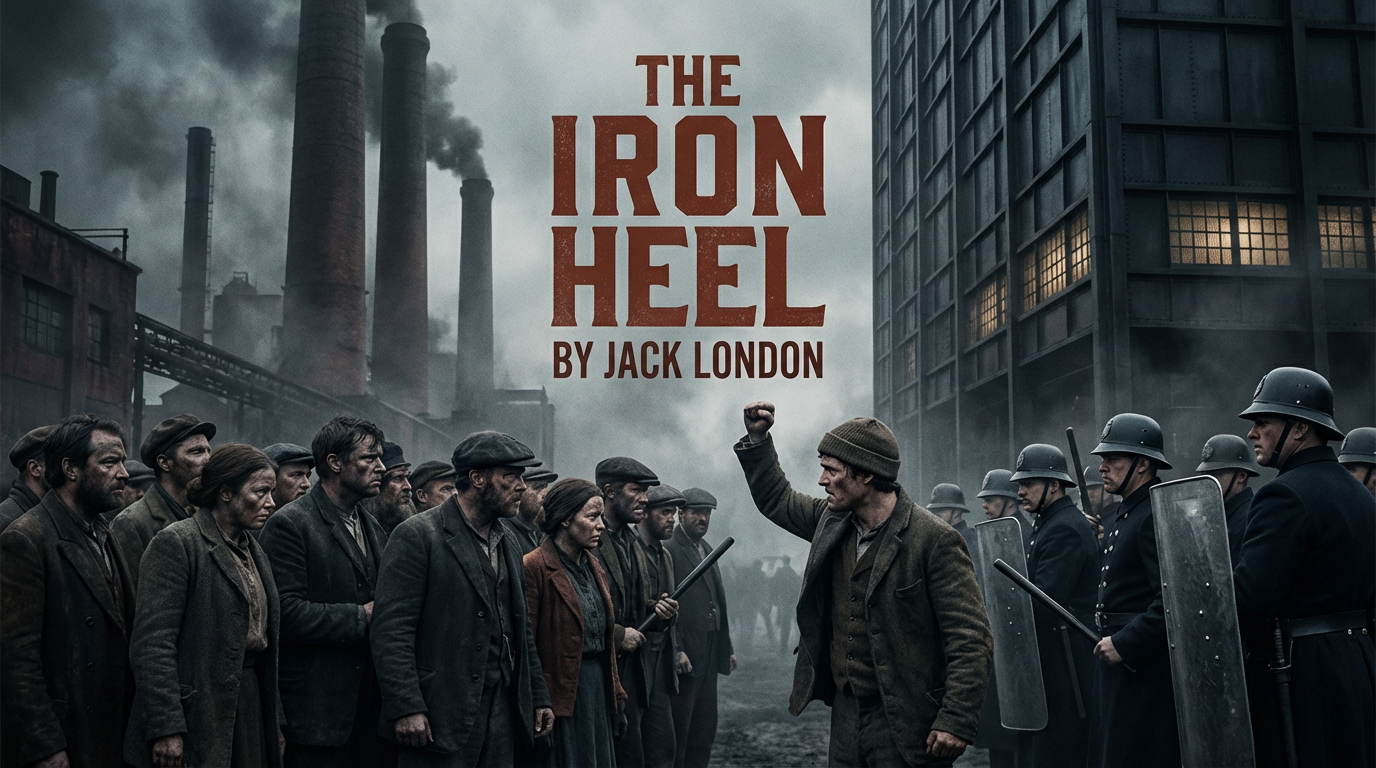
An excerpt from the original text.(complete · 4935 words)
THE MACHINE BREAKERS
It was just before Ernest ran for Congress, on the socialist ticket,
that father gave what he privately called his “Profit and Loss” dinner.
Ernest called it the dinner of the Machine Breakers. In point of fact,
it was merely a dinner for business men—small business men, of course.
I doubt if one of them was interested in any business the total
capitalization of which exceeded a couple of hundred thousand dollars.
They were truly representative middle-class business men.
There was Owen, of Silverberg, Owen & Company—a large grocery firm with
several branch stores. We bought our groceries from them. There were
both partners of the big drug firm of Kowalt & Washburn, and Mr.
Asmunsen, the owner of a large granite quarry in Contra Costa County.
And there were many similar men, owners or part-owners in small
factories, small businesses and small industries—small capitalists, in
short.
They were shrewd-faced, interesting men, and they talked with
simplicity and clearness. Their unanimous complaint was against the
corporations and trusts. Their creed was, “Bust the Trusts.” All
oppression originated in the trusts, and one and all told the same tale
of woe. They advocated government ownership of such trusts as the
railroads and telegraphs, and excessive income taxes, graduated with
ferocity, to destroy large accumulations. Likewise they advocated, as a
cure for local ills, municipal ownership of such public utilities as
water, gas, telephones, and street railways.
Especially interesting was Mr. Asmunsen’s narrative of his tribulations
as a quarry owner. He confessed that he never made any profits out of
his quarry, and this, in spite of the enormous volume of business that
had been caused by the destruction of San Francisco by the big
earthquake. For six years the rebuilding of San Francisco had been
going on, and his business had quadrupled and octupled, and yet he was
no better off.
“The railroad knows my business just a little bit better than I do,” he
said. “It knows my operating expenses to a cent, and it knows the terms
of my contracts. How it knows these things I can only guess. It must
have spies in my employ, and it must have access to the parties to all
my contracts. For look you, when I place a big contract, the terms of
which favor me a goodly profit, the freight rate from my quarry to
market is promptly raised. No explanation is made. The railroad gets my
profit. Under such circumstances I have never succeeded in getting the
railroad to reconsider its raise. On the other hand, when there have
been accidents, increased expenses of operating, or contracts with less
profitable terms, I have always succeeded in getting the railroad to
lower its rate. What is the result? Large or small, the railroad always
gets my profits.”
“What remains to you over and above,” Ernest interrupted to ask, “would
roughly be the equivalent of your salary as a manager did the railroad
own the quarry.”
“The very thing,” Mr. Asmunsen replied. “Only a short time ago I had my
books gone through for the past ten years. I discovered that for those
ten years my gain was just equivalent to a manager’s salary. The
railroad might just as well have owned my quarry and hired me to run
it.”
“But with this difference,” Ernest laughed; “the railroad would have
had to assume all the risk which you so obligingly assumed for it.”
“Very true,” Mr. Asmunsen answered sadly.
Having let them have their say, Ernest began asking questions right and
left. He began with Mr. Owen.
“You started a branch store here in Berkeley about six months ago?”
“Yes,” Mr. Owen answered.
“And since then I’ve noticed that three little corner groceries have
gone out of business. Was your branch store the cause of it?”
Mr. Owen affirmed with a complacent smile. “They had no chance against
us.”
“Why not?”
“We had greater capital. With a large business there is always less
waste and greater efficiency.”
“And your branch store absorbed the profits of the three small ones. I
see. But tell me, what became of the owners of the three stores?”
“One is driving a delivery wagon for us. I don’t know what happened to
the other two.”
Ernest turned abruptly on Mr. Kowalt.
“You sell a great deal at cut-rates.[1] What have become of the owners
of the small drug stores that you forced to the wall?”
[1] A lowering of selling price to cost, and even to less than cost.
Thus, a large company could sell at a loss for a longer period than a
small company, and so drive the small company out of business. A
common device of competition.
“One of them, Mr. Haasfurther, has charge now of our prescription
department,” was the answer.
“And you absorbed the profits they had been making?”
“Surely. That is what we are in business for.”
“And you?” Ernest said suddenly to Mr. Asmunsen. “You are disgusted
because the railroad has absorbed your profits?”
Mr. Asmunsen nodded.
“What you want is to make profits yourself?”
Again Mr. Asmunsen nodded.
“Out of others?”
There was no answer.
“Out of others?” Ernest insisted.
“That is the way profits are made,” Mr. Asmunsen replied curtly.
“Then the business game is to make profits out of others, and to
prevent others from making profits out of you. That’s it, isn’t it?”
Ernest had to repeat his question before Mr. Asmunsen gave an answer,
and then he said:
“Yes, that’s it, except that we do not object to the others making
profits so long as they are not extortionate.”
“By extortionate you mean large; yet you do not object to making large
profits yourself? . . . Surely not?”
And Mr. Asmunsen amiably confessed to the weakness. There was one other
man who was quizzed by Ernest at this juncture, a Mr. Calvin, who had
once been a great dairy-owner.
“Some time ago you were fighting the Milk Trust,” Ernest said to him;
“and now you are in Grange politics.[2] How did it happen?”
[2] Many efforts were made during this period to organize the
perishing farmer class into a political party, the aim of which was to
destroy the trusts and corporations by drastic legislation. All such
attempts ended in failure.
“Oh, I haven’t quit the fight,” Mr. Calvin answered, and he looked
belligerent enough. “I’m fighting the Trust on the only field where it
is possible to fight—the political field. Let me show you. A few years
ago we dairymen had everything our own way.”
“But you competed among yourselves?” Ernest interrupted.
“Yes, that was what kept the profits down. We did try to organize, but
independent dairymen always broke through us. Then came the Milk
Trust.”
“Financed by surplus capital from Standard Oil,”[3] Ernest said.
[3] The first successful great trust—almost a generation in advance of
the rest.
“Yes,” Mr. Calvin acknowledged. “But we did not know it at the time.
Its agents approached us with a club. “Come in and be fat,” was their
proposition, “or stay out and starve.” Most of us came in. Those that
didn’t, starved. Oh, it paid us . . . at first. Milk was raised a cent
a quart. One-quarter of this cent came to us. Three-quarters of it went
to the Trust. Then milk was raised another cent, only we didn’t get any
of that cent. Our complaints were useless. The Trust was in control. We
discovered that we were pawns. Finally, the additional quarter of a
cent was denied us. Then the Trust began to squeeze us out. What could
we do? We were squeezed out. There were no dairymen, only a Milk
Trust.”
“But with milk two cents higher, I should think you could have
competed,” Ernest suggested slyly.
“So we thought. We tried it.” Mr. Calvin paused a moment. “It broke us.
The Trust could put milk upon the market more cheaply than we. It could
sell still at a slight profit when we were selling at actual loss. I
dropped fifty thousand dollars in that venture. Most of us went
bankrupt.[4] The dairymen were wiped out of existence.”
[4] Bankruptcy—a peculiar institution that enabled an individual, who
had failed in competitive industry, to forego paying his debts. The
effect was to ameliorate the too savage conditions of the
fang-and-claw social struggle.
“So the Trust took your profits away from you,” Ernest said, “and
you’ve gone into politics in order to legislate the Trust out of
existence and get the profits back?”
Mr. Calvin’s face lighted up. “That is precisely what I say in my
speeches to the farmers. That’s our whole idea in a nutshell.”
“And yet the Trust produces milk more cheaply than could the
independent dairymen?” Ernest queried.
“Why shouldn’t it, with the splendid organization and new machinery its
large capital makes possible?”
“There is no discussion,” Ernest answered. “It certainly should, and,
furthermore, it does.”
Mr. Calvin here launched out into a political speech in exposition of
his views. He was warmly followed by a number of the others, and the
cry of all was to destroy the trusts.
“Poor simple folk,” Ernest said to me in an undertone. “They see
clearly as far as they see, but they see only to the ends of their
noses.”
A little later he got the floor again, and in his characteristic way
controlled it for the rest of the evening.
“I have listened carefully to all of you,” he began, “and I see plainly
that you play the business game in the orthodox fashion. Life sums
itself up to you in profits. You have a firm and abiding belief that
you were created for the sole purpose of making profits. Only there is
a hitch. In the midst of your own profit-making along comes the trust
and takes your profits away from you. This is a dilemma that interferes
somehow with the aim of creation, and the only way out, as it seems to
you, is to destroy that which takes from you your profits.
“I have listened carefully, and there is only one name that will
epitomize you. I shall call you that name. You are machine-breakers. Do
you know what a machine-breaker is? Let me tell you. In the eighteenth
century, in England, men and women wove cloth on hand-looms in their
own cottages. It was a slow, clumsy, and costly way of weaving cloth,
this cottage system of manufacture. Along came the steam-engine and
labor-saving machinery. A thousand looms assembled in a large factory,
and driven by a central engine wove cloth vastly more cheaply than
could the cottage weavers on their hand-looms. Here in the factory was
combination, and before it competition faded away. The men and women
who had worked the hand-looms for themselves now went into the
factories and worked the machine-looms, not for themselves, but for the
capitalist owners. Furthermore, little children went to work on the
machine-looms, at lower wages, and displaced the men. This made hard
times for the men. Their standard of living fell. They starved. And
they said it was all the fault of the machines. Therefore, they
proceeded to break the machines. They did not succeed, and they were
very stupid.
“Yet you have not learned their lesson. Here are you, a century and a
half later, trying to break machines. By your own confession the trust
machines do the work more efficiently and more cheaply than you can.
That is why you cannot compete with them. And yet you would break those
machines. You are even more stupid than the stupid workmen of England.
And while you maunder about restoring competition, the trusts go on
destroying you.
“One and all you tell the same story,—the passing away of competition
and the coming on of combination. You, Mr. Owen, destroyed competition
here in Berkeley when your branch store drove the three small groceries
out of business. Your combination was more effective. Yet you feel the
pressure of other combinations on you, the trust combinations, and you
cry out. It is because you are not a trust. If you were a grocery trust
for the whole United States, you would be singing another song. And the
song would be, ‘Blessed are the trusts.’ And yet again, not only is
your small combination not a trust, but you are aware yourself of its
lack of strength. You are beginning to divine your own end. You feel
yourself and your branch stores a pawn in the game. You see the
powerful interests rising and growing more powerful day by day; you
feel their mailed hands descending upon your profits and taking a pinch
here and a pinch there—the railroad trust, the oil trust, the steel
trust, the coal trust; and you know that in the end they will destroy
you, take away from you the last per cent of your little profits.
“You, sir, are a poor gamester. When you squeezed out the three small
groceries here in Berkeley by virtue of your superior combination, you
swelled out your chest, talked about efficiency and enterprise, and
sent your wife to Europe on the profits you had gained by eating up the
three small groceries. It is dog eat dog, and you ate them up. But, on
the other hand, you are being eaten up in turn by the bigger dogs,
wherefore you squeal. And what I say to you is true of all of you at
this table. You are all squealing. You are all playing the losing game,
and you are all squealing about it.
“But when you squeal you don’t state the situation flatly, as I have
stated it. You don’t say that you like to squeeze profits out of
others, and that you are making all the row because others are
squeezing your profits out of you. No, you are too cunning for that.
You say something else. You make small-capitalist political speeches
such as Mr. Calvin made. What did he say? Here are a few of his phrases
I caught: ‘Our original principles are all right,’ ‘What this country
requires is a return to fundamental American methods—free opportunity
for all,’ ‘The spirit of liberty in which this nation was born,’ ‘Let
us return to the principles of our forefathers.’
“When he says ‘free opportunity for all,’ he means free opportunity to
squeeze profits, which freedom of opportunity is now denied him by the
great trusts. And the absurd thing about it is that you have repeated
these phrases so often that you believe them. You want opportunity to
plunder your fellow-men in your own small way, but you hypnotize
yourselves into thinking you want freedom. You are piggish and
acquisitive, but the magic of your phrases leads you to believe that
you are patriotic. Your desire for profits, which is sheer selfishness,
you metamorphose into altruistic solicitude for suffering humanity.
Come on now, right here amongst ourselves, and be honest for once. Look
the matter in the face and state it in direct terms.”
There were flushed and angry faces at the table, and withal a measure
of awe. They were a little frightened at this smooth-faced young
fellow, and the swing and smash of his words, and his dreadful trait of
calling a spade a spade. Mr. Calvin promptly replied.
“And why not?” he demanded. “Why can we not return to the ways of our
fathers when this republic was founded? You have spoken much truth, Mr.
Everhard, unpalatable though it has been. But here amongst ourselves
let us speak out. Let us throw off all disguise and accept the truth as
Mr. Everhard has flatly stated it. It is true that we smaller
capitalists are after profits, and that the trusts are taking our
profits away from us. It is true that we want to destroy the trusts in
order that our profits may remain to us. And why can we not do it? Why
not? I say, why not?”
“Ah, now we come to the gist of the matter,” Ernest said with a pleased
expression. “I’ll try to tell you why not, though the telling will be
rather hard. You see, you fellows have studied business, in a small
way, but you have not studied social evolution at all. You are in the
midst of a transition stage now in economic evolution, but you do not
understand it, and that’s what causes all the confusion. Why cannot you
return? Because you can’t. You can no more make water run up hill than
can you cause the tide of economic evolution to flow back in its
channel along the way it came. Joshua made the sun stand still upon
Gibeon, but you would outdo Joshua. You would make the sun go backward
in the sky. You would have time retrace its steps from noon to morning.
“In the face of labor-saving machinery, of organized production, of the
increased efficiency of combination, you would set the economic sun
back a whole generation or so to the time when there were no great
capitalists, no great machinery, no railroads—a time when a host of
little capitalists warred with each other in economic anarchy, and when
production was primitive, wasteful, unorganized, and costly. Believe
me, Joshua’s task was easier, and he had Jehovah to help him. But God
has forsaken you small capitalists. The sun of the small capitalists is
setting. It will never rise again. Nor is it in your power even to make
it stand still. You are perishing, and you are doomed to perish utterly
from the face of society.
“This is the fiat of evolution. It is the word of God. Combination is
stronger than competition. Primitive man was a puny creature hiding in
the crevices of the rocks. He combined and made war upon his
carnivorous enemies. They were competitive beasts. Primitive man was a
combinative beast, and because of it he rose to primacy over all the
animals. And man has been achieving greater and greater combinations
ever since. It is combination versus competition, a thousand
centuries long struggle, in which competition has always been worsted.
Whoso enlists on the side of competition perishes.”
“But the trusts themselves arose out of competition,” Mr. Calvin
interrupted.
“Very true,” Ernest answered. “And the trusts themselves destroyed
competition. That, by your own word, is why you are no longer in the
dairy business.”
The first laughter of the evening went around the table, and even Mr.
Calvin joined in the laugh against himself.
“And now, while we are on the trusts,” Ernest went on, “let us settle a
few things. I shall make certain statements, and if you disagree with
them, speak up. Silence will mean agreement. Is it not true that a
machine-loom will weave more cloth and weave more cheaply than a
hand-loom?” He paused, but nobody spoke up. “Is it not then highly
irrational to break the machine-loom and go back to the clumsy and more
costly hand-loom method of weaving?” Heads nodded in acquiescence. “Is
it not true that that known as a trust produces more efficiently and
cheaply than can a thousand competing small concerns?” Still no one
objected. “Then is it not irrational to destroy that cheap and
efficient combination?”
No one answered for a long time. Then Mr. Kowalt spoke.
“What are we to do, then?” he demanded. “To destroy the trusts is the
only way we can see to escape their domination.”
Ernest was all fire and aliveness on the instant.
“I’ll show you another way!” he cried. “Let us not destroy those
wonderful machines that produce efficiently and cheaply. Let us control
them. Let us profit by their efficiency and cheapness. Let us run them
for ourselves. Let us oust the present owners of the wonderful
machines, and let us own the wonderful machines ourselves. That,
gentlemen, is socialism, a greater combination than the trusts, a
greater economic and social combination than any that has as yet
appeared on the planet. It is in line with evolution. We meet
combination with greater combination. It is the winning side. Come on
over with us socialists and play on the winning side.”
Here arose dissent. There was a shaking of heads, and mutterings arose.
“All right, then, you prefer to be anachronisms,” Ernest laughed. “You
prefer to play atavistic rôles. You are doomed to perish as all
atavisms perish. Have you ever asked what will happen to you when
greater combinations than even the present trusts arise? Have you ever
considered where you will stand when the great trusts themselves
combine into the combination of combinations—into the social, economic,
and political trust?”
He turned abruptly and irrelevantly upon Mr. Calvin.
“Tell me,” Ernest said, “if this is not true. You are compelled to form
a new political party because the old parties are in the hands of the
trusts. The chief obstacle to your Grange propaganda is the trusts.
Behind every obstacle you encounter, every blow that smites you, every
defeat that you receive, is the hand of the trusts. Is this not so?
Tell me.”
Mr. Calvin sat in uncomfortable silence.
“Go ahead,” Ernest encouraged.
“It is true,” Mr. Calvin confessed. “We captured the state legislature
of Oregon and put through splendid protective legislation, and it was
vetoed by the governor, who was a creature of the trusts. We elected a
governor of Colorado, and the legislature refused to permit him to take
office. Twice we have passed a national income tax, and each time the
supreme court smashed it as unconstitutional. The courts are in the
hands of the trusts. We, the people, do not pay our judges
sufficiently. But there will come a time—”
“When the combination of the trusts will control all legislation, when
the combination of the trusts will itself be the government,” Ernest
interrupted.
“Never! never!” were the cries that arose. Everybody was excited and
belligerent.
“Tell me,” Ernest demanded, “what will you do when such a time comes?”
“We will rise in our strength!” Mr. Asmunsen cried, and many voices
backed his decision.
“That will be civil war,” Ernest warned them.
“So be it, civil war,” was Mr. Asmunsen’s answer, with the cries of all
the men at the table behind him. “We have not forgotten the deeds of
our forefathers. For our liberties we are ready to fight and die.”
Ernest smiled.
“Do not forget,” he said, “that we had tacitly agreed that liberty in
your case, gentlemen, means liberty to squeeze profits out of others.”
The table was angry, now, fighting angry; but Ernest controlled the
tumult and made himself heard.
“One more question. When you rise in your strength, remember, the
reason for your rising will be that the government is in the hands of
the trusts. Therefore, against your strength the government will turn
the regular army, the navy, the militia, the police—in short, the whole
organized war machinery of the United States. Where will your strength
be then?”
Dismay sat on their faces, and before they could recover, Ernest struck
again.
“Do you remember, not so long ago, when our regular army was only fifty
thousand? Year by year it has been increased until to-day it is three
hundred thousand.”
Again he struck.
“Nor is that all. While you diligently pursued that favorite phantom of
yours, called profits, and moralized about that favorite fetich of
yours, called competition, even greater and more direful things have
been accomplished by combination. There is the militia.”
“It is our strength!” cried Mr. Kowalt. “With it we would repel the
invasion of the regular army.”
“You would go into the militia yourself,” was Ernest’s retort, “and be
sent to Maine, or Florida, or the Philippines, or anywhere else, to
drown in blood your own comrades civil-warring for their liberties.
While from Kansas, or Wisconsin, or any other state, your own comrades
would go into the militia and come here to California to drown in blood
your own civil-warring.”
Now they were really shocked, and they sat wordless, until Mr. Owen
murmured:
“We would not go into the militia. That would settle it. We would not
be so foolish.”
Ernest laughed outright.
“You do not understand the combination that has been effected. You
could not help yourself. You would be drafted into the militia.”
“There is such a thing as civil law,” Mr. Owen insisted.
“Not when the government suspends civil law. In that day when you speak
of rising in your strength, your strength would be turned against
yourself. Into the militia you would go, willy-nilly. Habeas corpus, I
heard some one mutter just now. Instead of habeas corpus you would get
post mortems. If you refused to go into the militia, or to obey after
you were in, you would be tried by drumhead court martial and shot down
like dogs. It is the law.”
“It is not the law!” Mr. Calvin asserted positively. “There is no such
law. Young man, you have dreamed all this. Why, you spoke of sending
the militia to the Philippines. That is unconstitutional. The
Constitution especially states that the militia cannot be sent out of
the country.”
“What’s the Constitution got to do with it?” Ernest demanded. “The
courts interpret the Constitution, and the courts, as Mr. Asmunsen
agreed, are the creatures of the trusts. Besides, it is as I have said,
the law. It has been the law for years, for nine years, gentlemen.”
“That we can be drafted into the militia?” Mr. Calvin asked
incredulously. “That they can shoot us by drumhead court martial if we
refuse?”
“Yes,” Ernest answered, “precisely that.”
“How is it that we have never heard of this law?” my father asked, and
I could see that it was likewise new to him.
“For two reasons,” Ernest said. “First, there has been no need to
enforce it. If there had, you’d have heard of it soon enough. And
secondly, the law was rushed through Congress and the Senate secretly,
with practically no discussion. Of course, the newspapers made no
mention of it. But we socialists knew about it. We published it in our
papers. But you never read our papers.”
“I still insist you are dreaming,” Mr. Calvin said stubbornly. “The
country would never have permitted it.”
“But the country did permit it,” Ernest replied. “And as for my
dreaming—” he put his hand in his pocket and drew out a small
pamphlet—“tell me if this looks like dream-stuff.”
He opened it and began to read:
“‘Section One, be it enacted, and so forth and so forth, that the
militia shall consist of every able-bodied male citizen of the
respective states, territories, and District of Columbia, who is more
than eighteen and less than forty-five years of age.’
“‘Section Seven, that any officer or enlisted man’—remember Section
One, gentlemen, you are all enlisted men—‘that any enlisted man of the
militia who shall refuse or neglect to present himself to such
mustering officer upon being called forth as herein prescribed, shall
be subject to trial by court martial, and shall be punished as such
court martial shall direct.’
“‘Section Eight, that courts martial, for the trial of officers or men
of the militia, shall be composed of militia officers only.’
“‘Section Nine, that the militia, when called into the actual service
of the United States, shall be subject to the same rules and articles
of war as the regular troops of the United States.’
“There you are gentlemen, American citizens, and fellow-militiamen.
Nine years ago we socialists thought that law was aimed against labor.
But it would seem that it was aimed against you, too. Congressman
Wiley, in the brief discussion that was permitted, said that the bill
‘provided for a reserve force to take the mob by the throat’—you’re the
mob, gentlemen—‘and protect at all hazards life, liberty, and
property.’ And in the time to come, when you rise in your strength,
remember that you will be rising against the property of the trusts,
and the liberty of the trusts, according to the law, to squeeze you.
Your teeth are pulled, gentlemen. Your claws are trimmed. In the day
you rise in your strength, toothless and clawless, you will be as
harmless as any army of clams.”
“I don’t believe it!” Kowalt cried. “There is no such law. It is a
canard got up by you socialists.”
“This bill was introduced in the House of Representatives on July 30,
1902,” was the reply. “It was introduced by Representative Dick of
Ohio. It was rushed through. It was passed unanimously by the Senate on
January 14, 1903. And just seven days afterward was approved by the
President of the United States.”[5]
[5] Everhard was right in the essential particulars, though his date
of the introduction of the bill is in error. The bill was introduced
on June 30, and not on July 30. The Congressional Record is here in
Ardis, and a reference to it shows mention of the bill on the
following dates: June 30, December 9, 15, 16, and 17, 1902, and
January 7 and 14, 1903. The ignorance evidenced by the business men at
the dinner was nothing unusual. Very few people knew of the existence
of this law. E. Untermann, a revolutionist, in July, 1903, published a
pamphlet at Girard, Kansas, on the “Militia Bill.” This pamphlet had a
small circulation among workingmen; but already had the segregation of
classes proceeded so far, that the members of the middle class never
heard of the pamphlet at all, and so remained in ignorance of the law.
Master this chapter. Complete your experience
Purchase the complete book to access all chapters and support classic literature
As an Amazon Associate, we earn a small commission from qualifying purchases at no additional cost to you.
Available in paperback, hardcover, and e-book formats
Let's Analyse the Pattern
People who succeed using certain methods suddenly condemn those same methods when used against them by more powerful players.
Why This Matters
Connect literature to life
This chapter teaches how to spot when people rewrite the rules of fairness based on their current position in the hierarchy.
Practice This Today
This week, notice when someone complains about tactics they've used themselves - the supervisor who gossips but calls it 'unprofessional' in others, the coworker who cuts corners but criticizes others' shortcuts.
Now let's explore the literary elements.
Key Quotes & Analysis
"You are machine-breakers. Do you know what a machine-breaker is? Let me tell you. In the eighteenth century, in England, men and women wove cloth on hand-looms in their own cottages. It was a slow, clumsy, and costly way of weaving cloth, this cottage system of manufacture. Along came the factories, with their superior organization and machinery. The cottage weavers could not compete. What did they do? They broke the machines."
Context: Ernest explains why the businessmen's desire to 'bust the trusts' is backwards thinking
This reveals Ernest's core argument that fighting efficiency and progress is futile. The businessmen want to destroy superior systems instead of adapting or taking control of them for everyone's benefit.
In Today's Words:
You're like people who want to ban self-checkout machines instead of figuring out how to make technology work for everyone
"You have been destroying competition right along. You have been doing this for years. Every one of you. Mr. Owen destroyed competition in his neighborhood when he drove the small grocers out of business."
Context: Ernest points out the businessmen's hypocrisy in complaining about trusts while having destroyed smaller competitors themselves
This exposes how people often fight for their right to exploit others while calling it freedom. The businessmen want protection from bigger players but offered none to those they crushed.
In Today's Words:
You're complaining about Walmart putting you out of business, but you put the corner store out of business first
"In 1903 the militia law was passed. It is still on the statute books. Under it, every able-bodied man in the United States is automatically a soldier. In time of need he can be called to military duty. Refuse, and he can be shot."
Context: Ernest reveals a secret law that makes the businessmen's dreams of armed resistance impossible
This shows how those in power have already rigged the game to prevent meaningful resistance. The businessmen's 'strength' would literally be turned against them by the very system they want to preserve.
In Today's Words:
The government already has laws that can turn your neighbors into soldiers against you if you try to revolt
Thematic Threads
Class
In This Chapter
Small business owners occupy a precarious middle position - powerful enough to crush individual competitors but powerless against corporate trusts
Development
Builds on earlier exploration of class divisions, showing how middle-class interests differ from both workers and oligarchs
In Your Life:
You might find yourself caught between management and labor, with different interests than both groups.
Identity
In This Chapter
The businessmen's self-image as independent entrepreneurs prevents them from seeing their own role in the system they now condemn
Development
Continues the theme of how people's identities blind them to uncomfortable truths about their position
In Your Life:
Your professional identity might prevent you from admitting how you actually got ahead or succeeded.
Power
In This Chapter
Ernest reveals the secret militia law showing how apparent strength can be turned into weakness by those who truly hold power
Development
Deepens the exploration of how real power operates - often invisibly and through legal mechanisms
In Your Life:
The systems you think give you security or leverage might actually be controlled by others who can use them against you.
Resistance
In This Chapter
The businessmen's plan to 'bust the trusts' is revealed as both hypocritical and futile given existing power structures
Development
Introduced here - explores how resistance movements can be misdirected or co-opted
In Your Life:
Your attempts to fight unfair treatment might be targeting the wrong level of the system or using ineffective methods.
Progress
In This Chapter
Ernest frames the trusts as inevitable technological and organizational progress that cannot be reversed
Development
Builds on earlier themes about adaptation versus resistance to social and economic change
In Your Life:
You might be fighting changes in your industry or workplace that are actually inevitable and need to be adapted to rather than resisted.
You now have the context. Time to form your own thoughts.
Discussion Questions
- 1
What specific complaints did the small business owners have about the big trusts, and how does Ernest expose the contradiction in their position?
analysis • surface - 2
Why does Ernest call these businessmen 'machine breakers,' and what does this reveal about their understanding of economic progress?
analysis • medium - 3
Where do you see this same pattern today - people who used certain tactics to succeed but then complain when others use those same tactics against them?
application • medium - 4
How would you respond if you found yourself in the position of these businessmen - being outcompeted by someone using your own successful strategies?
application • deep - 5
What does this chapter reveal about how people protect their self-image when their success methods are turned against them?
reflection • deep
Critical Thinking Exercise
The Rules You Live By
Think of a strategy or approach you've used to get ahead in work, relationships, or life - maybe you worked longer hours than colleagues, found ways to save money others didn't, or used your network to get opportunities. Now imagine someone bigger or more connected using that exact same approach to outcompete you. Write down both perspectives: how you'd describe your method when you used it, and how you'd describe their method when they use it against you.
Consider:
- •Notice the different language you use to describe the same behavior
- •Consider whether your success actually came from the method itself or from circumstances
- •Think about what rules you'd want everyone to follow, including yourself
Journaling Prompt
Write about a time when you felt someone else was 'cheating' or being unfair, but they were actually using tactics similar to ones you'd used before. How did you reconcile this contradiction?
Coming Up Next...
Chapter 9: The Mathematics of Collapse
Ernest has shattered the businessmen's illusions about their power and options, but now he must show them the mathematical inevitability of their doom. The next chapter promises to reveal the cold, hard numbers behind capitalism's self-destruction.



