
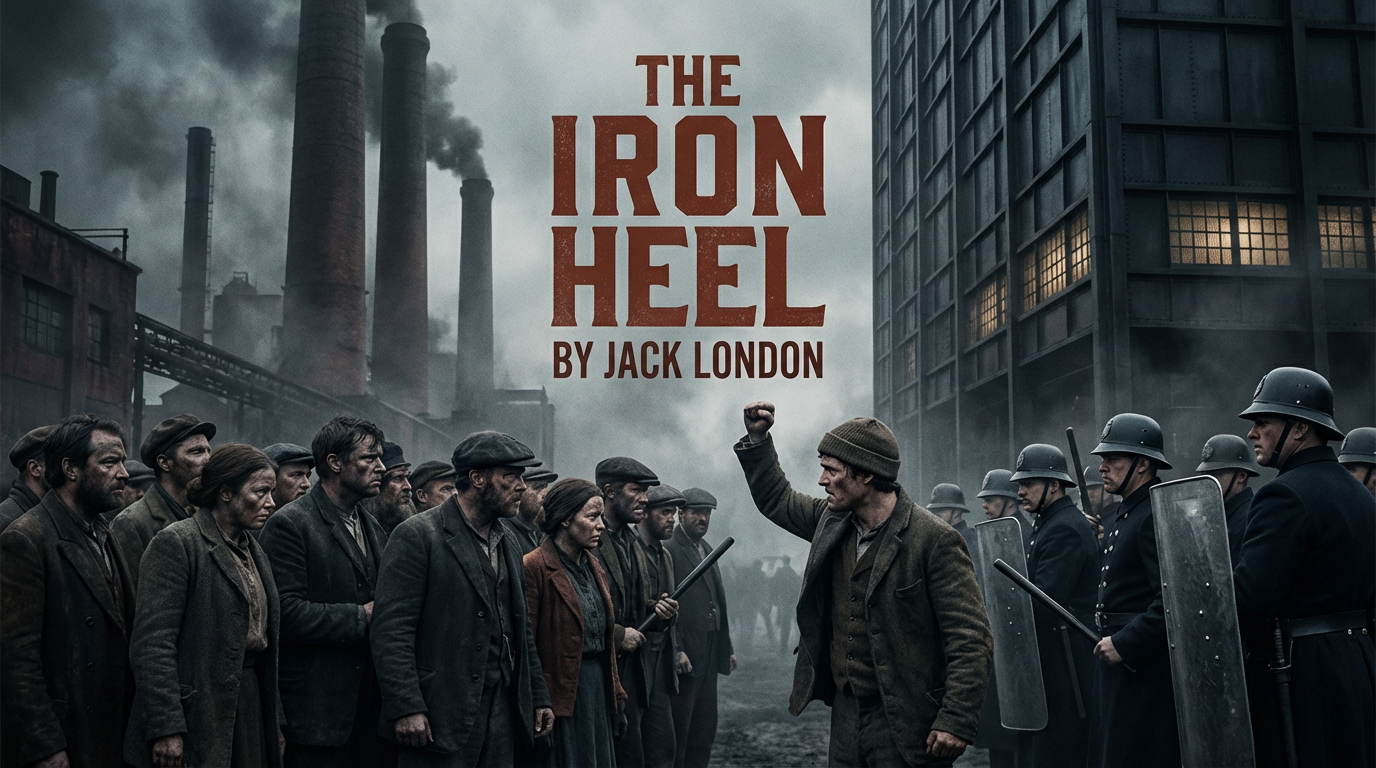
An excerpt from the original text.(complete · 2185 words)
HE BISHOP’S VISION
“The Bishop is out of hand,” Ernest wrote me. “He is clear up in the
air. Tonight he is going to begin putting to rights this very miserable
world of ours. He is going to deliver his message. He has told me so,
and I cannot dissuade him. To-night he is chairman of the I.P.H.,[1]
and he will embody his message in his introductory remarks.
[1] There is no clew to the name of the organization for which these
initials stand.
“May I bring you to hear him? Of course, he is foredoomed to futility.
It will break your heart—it will break his; but for you it will be an
excellent object lesson. You know, dear heart, how proud I am because
you love me. And because of that I want you to know my fullest value, I
want to redeem, in your eyes, some small measure of my unworthiness.
And so it is that my pride desires that you shall know my thinking is
correct and right. My views are harsh; the futility of so noble a soul
as the Bishop will show you the compulsion for such harshness. So come
to-night. Sad though this night’s happening will be, I feel that it
will but draw you more closely to me.”
The I.P.H. held its convention that night in San Francisco.[2] This
convention had been called to consider public immorality and the remedy
for it. Bishop Morehouse presided. He was very nervous as he sat on the
platform, and I could see the high tension he was under. By his side
were Bishop Dickinson; H. H. Jones, the head of the ethical department
in the University of California; Mrs. W. W. Hurd, the great charity
organizer; Philip Ward, the equally great philanthropist; and several
lesser luminaries in the field of morality and charity. Bishop
Morehouse arose and abruptly began:
[2] It took but a few minutes to cross by ferry from Berkeley to San
Francisco. These, and the other bay cities, practically composed one
community.
“I was in my brougham, driving through the streets. It was night-time.
Now and then I looked through the carriage windows, and suddenly my
eyes seemed to be opened, and I saw things as they really are. At first
I covered my eyes with my hands to shut out the awful sight, and then,
in the darkness, the question came to me: What is to be done? What is
to be done? A little later the question came to me in another way: What
would the Master do? And with the question a great light seemed to fill
the place, and I saw my duty sun-clear, as Saul saw his on the way to
Damascus.
“I stopped the carriage, got out, and, after a few minutes’
conversation, persuaded two of the public women to get into the
brougham with me. If Jesus was right, then these two unfortunates were
my sisters, and the only hope of their purification was in my affection
and tenderness.
“I live in one of the loveliest localities of San Francisco. The house
in which I live cost a hundred thousand dollars, and its furnishings,
books, and works of art cost as much more. The house is a mansion. No,
it is a palace, wherein there are many servants. I never knew what
palaces were good for. I had thought they were to live in. But now I
know. I took the two women of the street to my palace, and they are
going to stay with me. I hope to fill every room in my palace with such
sisters as they.”
The audience had been growing more and more restless and unsettled, and
the faces of those that sat on the platform had been betraying greater
and greater dismay and consternation. And at this point Bishop
Dickinson arose, and with an expression of disgust on his face, fled
from the platform and the hall. But Bishop Morehouse, oblivious to all,
his eyes filled with his vision, continued:
“Oh, sisters and brothers, in this act of mine I find the solution of
all my difficulties. I didn’t know what broughams were made for, but
now I know. They are made to carry the weak, the sick, and the aged;
they are made to show honor to those who have lost the sense even of
shame.
“I did not know what palaces were made for, but now I have found a use
for them. The palaces of the Church should be hospitals and nurseries
for those who have fallen by the wayside and are perishing.”
He made a long pause, plainly overcome by the thought that was in him,
and nervous how best to express it.
“I am not fit, dear brethren, to tell you anything about morality. I
have lived in shame and hypocrisies too long to be able to help others;
but my action with those women, sisters of mine, shows me that the
better way is easy to find. To those who believe in Jesus and his
gospel there can be no other relation between man and man than the
relation of affection. Love alone is stronger than sin—stronger than
death. I therefore say to the rich among you that it is their duty to
do what I have done and am doing. Let each one of you who is prosperous
take into his house some thief and treat him as his brother, some
unfortunate and treat her as his sister, and San Francisco will need no
police force and no magistrates; the prisons will be turned into
hospitals, and the criminal will disappear with his crime.
“We must give ourselves and not our money alone. We must do as Christ
did; that is the message of the Church today. We have wandered far from
the Master’s teaching. We are consumed in our own flesh-pots. We have
put mammon in the place of Christ. I have here a poem that tells the
whole story. I should like to read it to you. It was written by an
erring soul who yet saw clearly.[3] It must not be mistaken for an
attack upon the Catholic Church. It is an attack upon all churches,
upon the pomp and splendor of all churches that have wandered from the
Master’s path and hedged themselves in from his lambs. Here it is:
“The silver trumpets rang across the Dome;
The people knelt upon the ground with awe;
And borne upon the necks of men I saw,
Like some great God, the Holy Lord of Rome.
“Priest-like, he wore a robe more white than foam,
And, king-like, swathed himself in royal red,
Three crowns of gold rose high upon his head;
In splendor and in light the Pope passed home.
“My heart stole back across wide wastes of years
To One who wandered by a lonely sea;
And sought in vain for any place of rest:
‘Foxes have holes, and every bird its nest,
I, only I, must wander wearily,
And bruise my feet, and drink wine salt with tears.’”
[3] Oscar Wilde, one of the lords of language of the nineteenth
century of the Christian Era.
The audience was agitated, but unresponsive. Yet Bishop Morehouse was
not aware of it. He held steadily on his way.
“And so I say to the rich among you, and to all the rich, that bitterly
you oppress the Master’s lambs. You have hardened your hearts. You have
closed your ears to the voices that are crying in the land—the voices
of pain and sorrow that you will not hear but that some day will be
heard. And so I say—”
But at this point H. H. Jones and Philip Ward, who had already risen
from their chairs, led the Bishop off the platform, while the audience
sat breathless and shocked.
Ernest laughed harshly and savagely when he had gained the street. His
laughter jarred upon me. My heart seemed ready to burst with suppressed
tears.
“He has delivered his message,” Ernest cried. “The manhood and the
deep-hidden, tender nature of their Bishop burst out, and his Christian
audience, that loved him, concluded that he was crazy! Did you see them
leading him so solicitously from the platform? There must have been
laughter in hell at the spectacle.”
“Nevertheless, it will make a great impression, what the Bishop did and
said to-night,” I said.
“Think so?” Ernest queried mockingly.
“It will make a sensation,” I asserted. “Didn’t you see the reporters
scribbling like mad while he was speaking?”
“Not a line of which will appear in to-morrow’s papers.”
“I can’t believe it,” I cried.
“Just wait and see,” was the answer. “Not a line, not a thought that he
uttered. The daily press? The daily suppressage!”
“But the reporters,” I objected. “I saw them.”
“Not a word that he uttered will see print. You have forgotten the
editors. They draw their salaries for the policy they maintain. Their
policy is to print nothing that is a vital menace to the established.
The Bishop’s utterance was a violent assault upon the established
morality. It was heresy. They led him from the platform to prevent him
from uttering more heresy. The newspapers will purge his heresy in the
oblivion of silence. The press of the United States? It is a parasitic
growth that battens on the capitalist class. Its function is to serve
the established by moulding public opinion, and right well it serves
it.
“Let me prophesy. To-morrow’s papers will merely mention that the
Bishop is in poor health, that he has been working too hard, and that
he broke down last night. The next mention, some days hence, will be to
the effect that he is suffering from nervous prostration and has been
given a vacation by his grateful flock. After that, one of two things
will happen: either the Bishop will see the error of his way and return
from his vacation a well man in whose eyes there are no more visions,
or else he will persist in his madness, and then you may expect to see
in the papers, couched pathetically and tenderly, the announcement of
his insanity. After that he will be left to gibber his visions to
padded walls.”
“Now there you go too far!” I cried out.
“In the eyes of society it will truly be insanity,” he replied. “What
honest man, who is not insane, would take lost women and thieves into
his house to dwell with him sisterly and brotherly? True, Christ died
between two thieves, but that is another story. Insanity? The mental
processes of the man with whom one disagrees, are always wrong.
Therefore the mind of the man is wrong. Where is the line between wrong
mind and insane mind? It is inconceivable that any sane man can
radically disagree with one’s most sane conclusions.
“There is a good example of it in this evening’s paper. Mary McKenna
lives south of Market Street. She is a poor but honest woman. She is
also patriotic. But she has erroneous ideas concerning the American
flag and the protection it is supposed to symbolize. And here’s what
happened to her. Her husband had an accident and was laid up in
hospital three months. In spite of taking in washing, she got behind in
her rent. Yesterday they evicted her. But first, she hoisted an
American flag, and from under its folds she announced that by virtue of
its protection they could not turn her out on to the cold street. What
was done? She was arrested and arraigned for insanity. To-day she was
examined by the regular insanity experts. She was found insane. She was
consigned to the Napa Asylum.”
“But that is far-fetched,” I objected. “Suppose I should disagree with
everybody about the literary style of a book. They wouldn’t send me to
an asylum for that.”
“Very true,” he replied. “But such divergence of opinion would
constitute no menace to society. Therein lies the difference. The
divergence of opinion on the parts of Mary McKenna and the Bishop do
menace society. What if all the poor people should refuse to pay rent
and shelter themselves under the American flag? Landlordism would go
crumbling. The Bishop’s views are just as perilous to society. Ergo, to
the asylum with him.”
But still I refused to believe.
“Wait and see,” Ernest said, and I waited.
Next morning I sent out for all the papers. So far Ernest was right.
Not a word that Bishop Morehouse had uttered was in print. Mention was
made in one or two of the papers that he had been overcome by his
feelings. Yet the platitudes of the speakers that followed him were
reported at length.
Several days later the brief announcement was made that he had gone
away on a vacation to recover from the effects of overwork. So far so
good, but there had been no hint of insanity, nor even of nervous
collapse. Little did I dream the terrible road the Bishop was destined
to travel—the Gethsemane and crucifixion that Ernest had pondered
about.
Master this chapter. Complete your experience
Purchase the complete book to access all chapters and support classic literature
As an Amazon Associate, we earn a small commission from qualifying purchases at no additional cost to you.
Available in paperback, hardcover, and e-book formats
Let's Analyse the Pattern
When dangerous truths emerge, power structures respond not by debate but by controlling what narrative reaches the public.
Why This Matters
Connect literature to life
This chapter teaches how institutions erase inconvenient truths by controlling what gets reported and remembered.
Practice This Today
This week, notice when workplace problems get reframed as individual issues instead of systemic ones - 'you're stressed' instead of 'we're understaffed.'
Now let's explore the literary elements.
Key Quotes & Analysis
"It will break your heart—it will break his; but for you it will be an excellent object lesson."
Context: Ernest warns Avis about what will happen to the Bishop when he tries to speak truth to power
This shows Ernest's cold realism about how the system destroys good people who challenge it. He uses the Bishop's inevitable suffering as a teaching moment about how power really works.
In Today's Words:
This is going to destroy him, but you need to see how they silence people who tell the truth.
"My message is simple. It is the message of Christ. I shall fill my house with the halt and the lame, with the degraded and despised."
Context: The Bishop announces his plan to actually follow Jesus's teachings by helping society's outcasts
This represents genuine Christian compassion put into practice, which becomes revolutionary when it challenges social hierarchies. The Bishop's simple faith threatens the established order.
In Today's Words:
I'm going to actually do what Jesus said and help the people everyone else ignores.
"The newspapers will say you are suffering from overwork and that you have had a breakdown."
Context: Ernest predicts exactly how the media will handle the Bishop's radical message
This shows how narrative control works - rather than engage with dangerous ideas, the system discredits the messenger. Ernest's accurate prediction proves this is a systematic method of suppression.
In Today's Words:
They'll say you're having a mental health crisis instead of reporting what you actually said.
Thematic Threads
Truth Suppression
In This Chapter
The Bishop's radical Christian message is completely erased from newspaper coverage, replaced with bland platitudes
Development
Builds on earlier themes of how the Iron Heel maintains control through information manipulation
In Your Life:
You might see this when your workplace concerns get reframed as 'attitude problems' rather than legitimate issues
Authentic Faith
In This Chapter
Bishop Morehouse's genuine Christian awakening leads him to embrace society's outcasts, shocking his fellow religious leaders
Development
Introduced here as contrast between performative and genuine spiritual practice
In Your Life:
You might face this tension between what your community preaches and what authentic compassion actually requires
Social Isolation
In This Chapter
The Bishop becomes completely isolated from his former peers the moment he acts on his genuine beliefs
Development
Expands the class conflict theme to show how speaking truth isolates you from your social group
In Your Life:
You might experience this when standing up for what's right costs you friendships or professional relationships
Institutional Coordination
In This Chapter
Religious leaders, media outlets, and social networks all respond in lockstep to contain the Bishop's message
Development
Reveals how different power structures work together to maintain control, building on earlier Iron Heel themes
In Your Life:
You might notice this when multiple institutions in your life seem to coordinate responses to shut down uncomfortable conversations
Predictable Patterns
In This Chapter
Ernest accurately predicts exactly how the establishment will respond to the Bishop's awakening
Development
Continues Ernest's role as pattern-recognizer who can forecast systemic responses
In Your Life:
You might develop this skill of predicting how institutions will respond when their stability is threatened
You now have the context. Time to form your own thoughts.
Discussion Questions
- 1
What exactly did Bishop Morehouse decide to do after his night ride through the city, and how did his fellow religious leaders react?
analysis • surface - 2
Why did the newspapers completely ignore the Bishop's radical speech while reporting on other speakers from the same event?
analysis • medium - 3
Where have you seen someone's message get ignored or twisted rather than directly challenged when they spoke uncomfortable truths?
application • medium - 4
If you witnessed something at work or in your community that needed to be addressed publicly, how would you prepare for the potential backlash?
application • deep - 5
What does this chapter reveal about why people often stay silent about problems they clearly see?
reflection • deep
Critical Thinking Exercise
Predict the Response Pattern
Think of a situation where someone you know raised a legitimate concern but got pushback. Map out exactly what happened: Who responded? How did they respond? What narrative did they create about the person instead of addressing the issue? Then predict what would happen if someone raised a similar concern in your workplace, family, or community today.
Consider:
- •Notice whether people argued against the concern or attacked the person raising it
- •Look for how the narrative shifted from the issue to the messenger's character or motives
- •Consider which institutions or people have incentives to maintain the current situation
Journaling Prompt
Write about a time when you stayed silent about something important because you predicted negative consequences. What specific responses were you afraid of, and how accurate were those predictions?
Coming Up Next...
Chapter 8: The Machine Breakers
The focus shifts to another form of resistance as workers begin to fight back against the machines that are stealing their livelihoods. But their desperate acts of rebellion may play right into the hands of those they're trying to defeat.



