
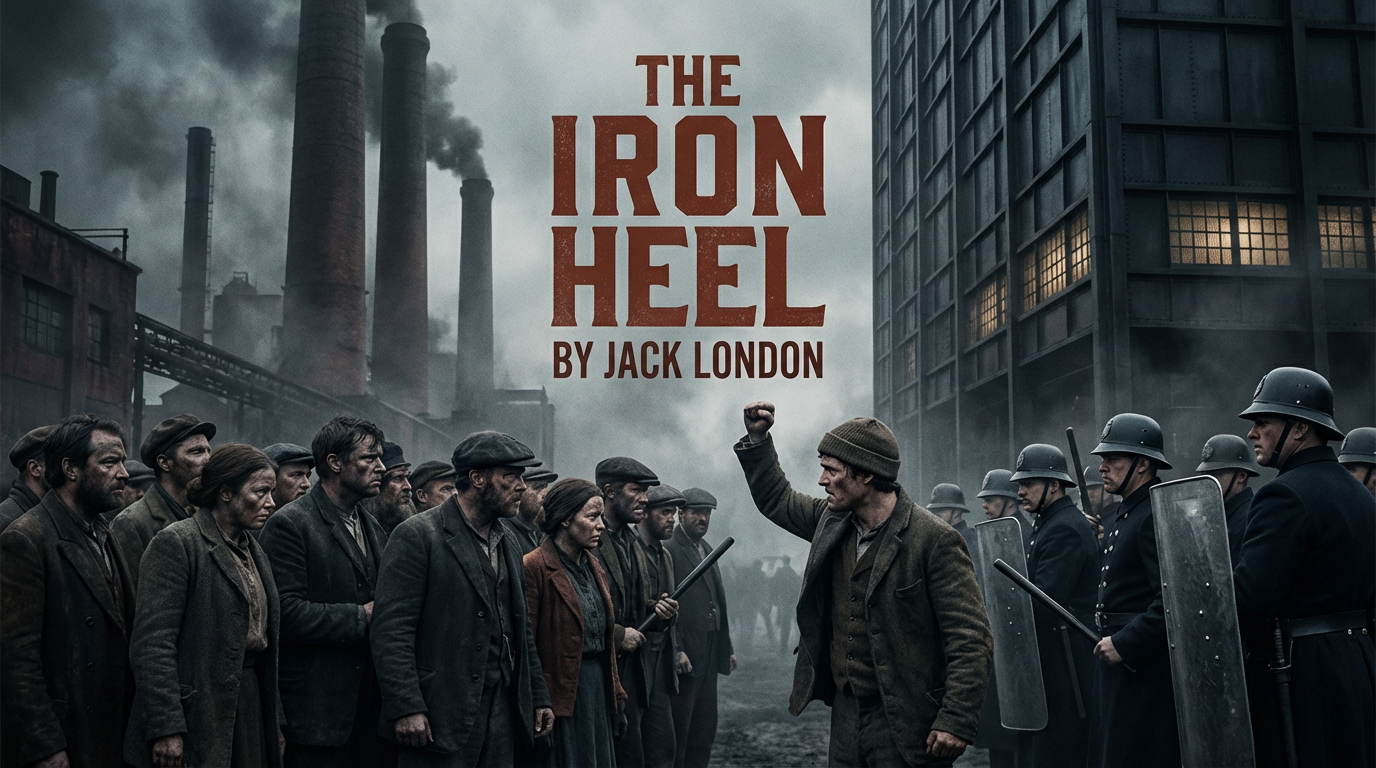
An excerpt from the original text.(complete · 2627 words)
THE GREAT ADVENTURE
Mr. Wickson did not send for father. They met by chance on the
ferry-boat to San Francisco, so that the warning he gave father was not
premeditated. Had they not met accidentally, there would not have been
any warning. Not that the outcome would have been different, however.
Father came of stout old Mayflower[1] stock, and the blood was
imperative in him.
[1] One of the first ships that carried colonies to America, after the
discovery of the New World. Descendants of these original colonists
were for a while inordinately proud of their genealogy; but in time
the blood became so widely diffused that it ran in the veins
practically of all Americans.
“Ernest was right,” he told me, as soon as he had returned home.
“Ernest is a very remarkable young man, and I’d rather see you his wife
than the wife of Rockefeller himself or the King of England.”
“What’s the matter?” I asked in alarm.
“The Oligarchy is about to tread upon our faces—yours and mine. Wickson
as much as told me so. He was very kind—for an oligarch. He offered to
reinstate me in the university. What do you think of that? He, Wickson,
a sordid money-grabber, has the power to determine whether I shall or
shall not teach in the university of the state. But he offered me even
better than that—offered to make me president of some great college of
physical sciences that is being planned—the Oligarchy must get rid of
its surplus somehow, you see.
“‘Do you remember what I told that socialist lover of your daughter’s?’
he said. ‘I told him that we would walk upon the faces of the working
class. And so we shall. As for you, I have for you a deep respect as a
scientist; but if you throw your fortunes in with the working
class—well, watch out for your face, that is all.’ And then he turned
and left me.”
“It means we’ll have to marry earlier than you planned,” was Ernest’s
comment when we told him.
I could not follow his reasoning, but I was soon to learn it. It was at
this time that the quarterly dividend of the Sierra Mills was paid—or,
rather, should have been paid, for father did not receive his. After
waiting several days, father wrote to the secretary. Promptly came the
reply that there was no record on the books of father’s owning any
stock, and a polite request for more explicit information.
“I’ll make it explicit enough, confound him,” father declared, and
departed for the bank to get the stock in question from his
safe-deposit box.
“Ernest is a very remarkable man,” he said when he got back and while I
was helping him off with his overcoat. “I repeat, my daughter, that
young man of yours is a very remarkable young man.”
I had learned, whenever he praised Ernest in such fashion, to expect
disaster.
“They have already walked upon my face,” father explained. “There was
no stock. The box was empty. You and Ernest will have to get married
pretty quickly.”
Father insisted on laboratory methods. He brought the Sierra Mills into
court, but he could not bring the books of the Sierra Mills into court.
He did not control the courts, and the Sierra Mills did. That explained
it all. He was thoroughly beaten by the law, and the bare-faced robbery
held good.
It is almost laughable now, when I look back on it, the way father was
beaten. He met Wickson accidentally on the street in San Francisco, and
he told Wickson that he was a damned scoundrel. And then father was
arrested for attempted assault, fined in the police court, and bound
over to keep the peace. It was all so ridiculous that when he got home
he had to laugh himself. But what a furor was raised in the local
papers! There was grave talk about the bacillus of violence that
infected all men who embraced socialism; and father, with his long and
peaceful life, was instanced as a shining example of how the bacillus
of violence worked. Also, it was asserted by more than one paper that
father’s mind had weakened under the strain of scientific study, and
confinement in a state asylum for the insane was suggested. Nor was
this merely talk. It was an imminent peril. But father was wise enough
to see it. He had the Bishop’s experience to lesson from, and he
lessoned well. He kept quiet no matter what injustice was perpetrated
on him, and really, I think, surprised his enemies.
There was the matter of the house—our home. A mortgage was foreclosed
on it, and we had to give up possession. Of course there wasn’t any
mortgage, and never had been any mortgage. The ground had been bought
outright, and the house had been paid for when it was built. And house
and lot had always been free and unencumbered. Nevertheless there was
the mortgage, properly and legally drawn up and signed, with a record
of the payments of interest through a number of years. Father made no
outcry. As he had been robbed of his money, so was he now robbed of his
home. And he had no recourse. The machinery of society was in the hands
of those who were bent on breaking him. He was a philosopher at heart,
and he was no longer even angry.
“I am doomed to be broken,” he said to me; “but that is no reason that
I should not try to be shattered as little as possible. These old bones
of mine are fragile, and I’ve learned my lesson. God knows I don’t want
to spend my last days in an insane asylum.”
Which reminds me of Bishop Morehouse, whom I have neglected for many
pages. But first let me tell of my marriage. In the play of events, my
marriage sinks into insignificance, I know, so I shall barely mention
it.
“Now we shall become real proletarians,” father said, when we were
driven from our home. “I have often envied that young man of yours for
his actual knowledge of the proletariat. Now I shall see and learn for
myself.”
Father must have had strong in him the blood of adventure. He looked
upon our catastrophe in the light of an adventure. No anger nor
bitterness possessed him. He was too philosophic and simple to be
vindictive, and he lived too much in the world of mind to miss the
creature comforts we were giving up. So it was, when we moved to San
Francisco into four wretched rooms in the slum south of Market Street,
that he embarked upon the adventure with the joy and enthusiasm of a
child—combined with the clear sight and mental grasp of an
extraordinary intellect. He really never crystallized mentally. He had
no false sense of values. Conventional or habitual values meant nothing
to him. The only values he recognized were mathematical and scientific
facts. My father was a great man. He had the mind and the soul that
only great men have. In ways he was even greater than Ernest, than whom
I have known none greater.
Even I found some relief in our change of living. If nothing else, I
was escaping from the organized ostracism that had been our increasing
portion in the university town ever since the enmity of the nascent
Oligarchy had been incurred. And the change was to me likewise
adventure, and the greatest of all, for it was love-adventure. The
change in our fortunes had hastened my marriage, and it was as a wife
that I came to live in the four rooms on Pell Street, in the San
Francisco slum.
And this out of all remains: I made Ernest happy. I came into his
stormy life, not as a new perturbing force, but as one that made toward
peace and repose. I gave him rest. It was the guerdon of my love for
him. It was the one infallible token that I had not failed. To bring
forgetfulness, or the light of gladness, into those poor tired eyes of
his—what greater joy could have blessed me than that?
Those dear tired eyes. He toiled as few men ever toiled, and all his
lifetime he toiled for others. That was the measure of his manhood. He
was a humanist and a lover. And he, with his incarnate spirit of
battle, his gladiator body and his eagle spirit—he was as gentle and
tender to me as a poet. He was a poet. A singer in deeds. And all his
life he sang the song of man. And he did it out of sheer love of man,
and for man he gave his life and was crucified.
And all this he did with no hope of future reward. In his conception of
things there was no future life. He, who fairly burnt with immortality,
denied himself immortality—such was the paradox of him. He, so warm in
spirit, was dominated by that cold and forbidding philosophy,
materialistic monism. I used to refute him by telling him that I
measured his immortality by the wings of his soul, and that I should
have to live endless aeons in order to achieve the full measurement.
Whereat he would laugh, and his arms would leap out to me, and he would
call me his sweet metaphysician; and the tiredness would pass out of
his eyes, and into them would flood the happy love-light that was in
itself a new and sufficient advertisement of his immortality.
Also, he used to call me his dualist, and he would explain how Kant, by
means of pure reason, had abolished reason, in order to worship God.
And he drew the parallel and included me guilty of a similar act. And
when I pleaded guilty, but defended the act as highly rational, he but
pressed me closer and laughed as only one of God’s own lovers could
laugh. I was wont to deny that heredity and environment could explain
his own originality and genius, any more than could the cold groping
finger of science catch and analyze and classify that elusive essence
that lurked in the constitution of life itself.
I held that space was an apparition of God, and that soul was a
projection of the character of God; and when he called me his sweet
metaphysician, I called him my immortal materialist. And so we loved
and were happy; and I forgave him his materialism because of his
tremendous work in the world, performed without thought of soul-gain
thereby, and because of his so exceeding modesty of spirit that
prevented him from having pride and regal consciousness of himself and
his soul.
But he had pride. How could he have been an eagle and not have pride?
His contention was that it was finer for a finite mortal speck of life
to feel Godlike, than for a god to feel godlike; and so it was that he
exalted what he deemed his mortality. He was fond of quoting a fragment
from a certain poem. He had never seen the whole poem, and he had tried
vainly to learn its authorship. I here give the fragment, not alone
because he loved it, but because it epitomized the paradox that he was
in the spirit of him, and his conception of his spirit. For how can a
man, with thrilling, and burning, and exaltation, recite the following
and still be mere mortal earth, a bit of fugitive force, an evanescent
form? Here it is:
“Joy upon joy and gain upon gain
Are the destined rights of my birth,
And I shout the praise of my endless days
To the echoing edge of the earth.
Though I suffer all deaths that a man can die
To the uttermost end of time,
I have deep-drained this, my cup of bliss,
In every age and clime—
“The froth of Pride, the tang of Power,
The sweet of Womanhood!
I drain the lees upon my knees,
For oh, the draught is good;
I drink to Life, I drink to Death,
And smack my lips with song,
For when I die, another ‘I’ shall pass the cup along.
“The man you drove from Eden’s grove
Was I, my Lord, was I,
And I shall be there when the earth and the air
Are rent from sea to sky;
For it is my world, my gorgeous world,
The world of my dearest woes,
From the first faint cry of the newborn
To the rack of the woman’s throes.
“Packed with the pulse of an unborn race,
Torn with a world’s desire,
The surging flood of my wild young blood
Would quench the judgment fire.
I am Man, Man, Man, from the tingling flesh
To the dust of my earthly goal,
From the nestling gloom of the pregnant womb
To the sheen of my naked soul.
Bone of my bone and flesh of my flesh
The whole world leaps to my will,
And the unslaked thirst of an Eden cursed
Shall harrow the earth for its fill.
Almighty God, when I drain life’s glass
Of all its rainbow gleams,
The hapless plight of eternal night
Shall be none too long for my dreams.
“The man you drove from Eden’s grove
Was I, my Lord, was I,
And I shall be there when the earth and the air
Are rent from sea to sky;
For it is my world, my gorgeous world,
The world of my dear delight,
From the brightest gleam of the Arctic stream
To the dusk of my own love-night.”
Ernest always overworked. His wonderful constitution kept him up; but
even that constitution could not keep the tired look out of his eyes.
His dear, tired eyes! He never slept more than four and one-half hours
a night; yet he never found time to do all the work he wanted to do. He
never ceased from his activities as a propagandist, and was always
scheduled long in advance for lectures to workingmen’s organizations.
Then there was the campaign. He did a man’s full work in that alone.
With the suppression of the socialist publishing houses, his meagre
royalties ceased, and he was hard-put to make a living; for he had to
make a living in addition to all his other labor. He did a great deal
of translating for the magazines on scientific and philosophic
subjects; and, coming home late at night, worn out from the strain of
the campaign, he would plunge into his translating and toil on well
into the morning hours. And in addition to everything, there was his
studying. To the day of his death he kept up his studies, and he
studied prodigiously.
And yet he found time in which to love me and make me happy. But this
was accomplished only through my merging my life completely into his. I
learned shorthand and typewriting, and became his secretary. He
insisted that I succeeded in cutting his work in half; and so it was
that I schooled myself to understand his work. Our interests became
mutual, and we worked together and played together.
And then there were our sweet stolen moments in the midst of our
work—just a word, or caress, or flash of love-light; and our moments
were sweeter for being stolen. For we lived on the heights, where the
air was keen and sparkling, where the toil was for humanity, and where
sordidness and selfishness never entered. We loved love, and our love
was never smirched by anything less than the best. And this out of all
remains: I did not fail. I gave him rest—he who worked so hard for
others, my dear, tired-eyed mortalist.
Master this chapter. Complete your experience
Purchase the complete book to access all chapters and support classic literature
As an Amazon Associate, we earn a small commission from qualifying purchases at no additional cost to you.
Available in paperback, hardcover, and e-book formats
Let's Analyse the Pattern
When someone refuses to compromise their values under pressure, the system escalates attacks on their security, reputation, and sanity to break them and warn others.
Why This Matters
Connect literature to life
This chapter teaches how institutional power responds to individual resistance through predictable escalation patterns.
Practice This Today
This week, notice when someone faces consequences for speaking up - watch for the pattern of financial pressure, reputation attacks, and isolation tactics.
Now let's explore the literary elements.
Key Quotes & Analysis
"Ernest is a very remarkable young man, and I'd rather see you his wife than the wife of Rockefeller himself or the King of England."
Context: He says this after his meeting with Wickson, recognizing Ernest's worth despite their impending poverty.
This shows how the father values character over wealth or status. Even facing destruction, he measures worth by principles rather than money or power.
In Today's Words:
I'd rather you marry someone with integrity than the richest or most powerful person in the world.
"He, Wickson, a sordid money-grabber, has the power to determine whether I shall or shall not teach in the university of the state."
Context: He's explaining to Avis how the Oligarchy controls even public institutions.
This reveals the corruption of supposedly public institutions. A private businessman controls state university hiring, showing how money trumps democratic governance.
In Today's Words:
Some greedy businessman gets to decide if I can teach at a public university - that's how messed up this system is.
"My greatest joy was in the knowledge that I brought rest and peace to his tired eyes."
Context: She describes her happiness in caring for Ernest after his exhausting days of political work.
This shows how love can flourish even under oppression. Avis finds meaning not in material comfort but in supporting someone fighting for justice.
In Today's Words:
My biggest happiness was knowing I could help him relax after his brutal days fighting for what's right.
Thematic Threads
Systematic Oppression
In This Chapter
The Oligarchy uses coordinated attacks—financial, legal, and social—to destroy Avis's father completely
Development
Evolved from earlier economic manipulation to total life destruction
In Your Life:
You might see this when speaking up at work leads to sudden scrutiny of your performance and social isolation.
Principled Integrity
In This Chapter
Avis's father treats their downfall as a philosophical adventure, maintaining dignity while losing everything
Development
Builds on earlier themes of moral courage under pressure
In Your Life:
You face this choice when staying true to your values costs you money, relationships, or security.
Love Under Pressure
In This Chapter
Avis and Ernest's relationship deepens as they face poverty together, finding joy in simple partnership
Development
Shows how genuine connection can flourish despite external hardship
In Your Life:
You might discover this when financial stress or crisis reveals who truly supports you.
Character Assassination
In This Chapter
Newspapers paint Avis's father as mentally unstable, threatening institutionalization to silence him
Development
Introduced here as the Oligarchy's most sophisticated weapon
In Your Life:
You see this when someone labels you 'crazy' or 'difficult' for pointing out real problems.
Partnership in Purpose
In This Chapter
Avis becomes Ernest's secretary and partner, finding meaning in supporting his exhausting political work
Development
Shows how shared values can create fulfilling collaboration
In Your Life:
You experience this when you find deep satisfaction in supporting someone whose mission you believe in.
You now have the context. Time to form your own thoughts.
Discussion Questions
- 1
What specific steps did the Oligarchy take to destroy Avis's father after he refused their warning?
analysis • surface - 2
Why did the Oligarchy use newspapers to paint Avis's father as mentally unstable rather than simply ruining him financially?
analysis • medium - 3
Where have you seen this pattern of escalating consequences for people who refuse to compromise their principles?
application • medium - 4
How would you prepare yourself and your family if you knew taking a principled stand might trigger systematic retaliation?
application • deep - 5
What does Avis's father's calm response to losing everything reveal about finding meaning in struggle itself?
reflection • deep
Critical Thinking Exercise
Map Your Vulnerability Points
Think of a principle you hold strongly - something you believe is right even if it's unpopular at work, in your family, or community. Map out all the ways someone could pressure you to abandon this principle. What are your financial vulnerabilities? Your reputation concerns? Your relationships that could be threatened? This isn't about becoming paranoid, but about understanding your pressure points so you can prepare strategically.
Consider:
- •Consider both direct attacks (job loss, social isolation) and indirect ones (family stress, character assassination)
- •Think about which vulnerabilities you could strengthen ahead of time and which you'd have to accept as risks
- •Remember that recognizing these patterns isn't about avoiding all principled stands, but making them more strategically
Journaling Prompt
Write about a time when you compromised a principle to avoid consequences. What would you do differently now, knowing these patterns of systematic pressure?
Coming Up Next...
Chapter 12: The Price of Speaking Truth
The story returns to Bishop Morehouse, whose own confrontation with the Oligarchy's power has taken a different path. His experience will reveal another way the ruling class deals with those who dare to speak for the oppressed.



