
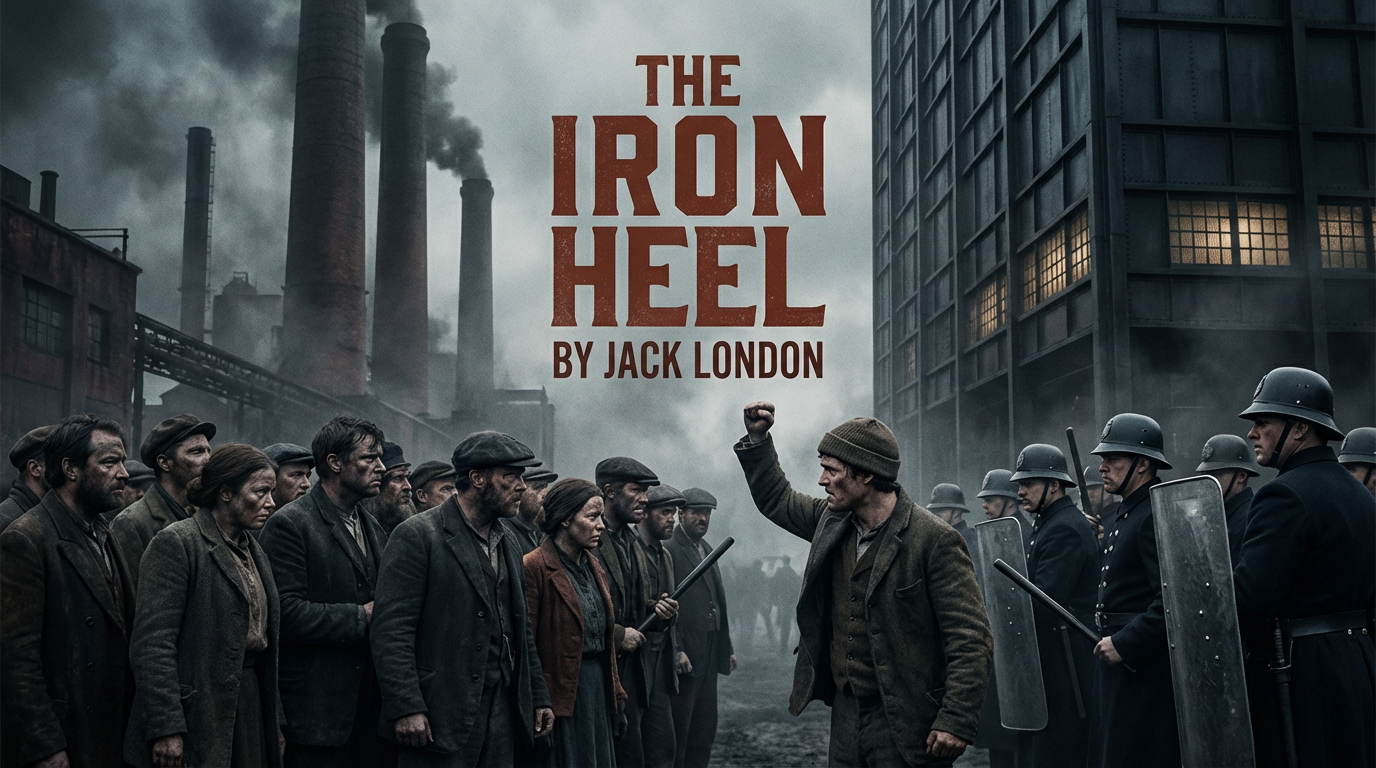
An excerpt from the original text.(complete · 2166 words)
THE ROARING ABYSMAL BEAST
During the long period of our stay in the refuge, we were kept closely
in touch with what was happening in the world without, and we were
learning thoroughly the strength of the Oligarchy with which we were at
war. Out of the flux of transition the new institutions were forming
more definitely and taking on the appearance and attributes of
permanence. The oligarchs had succeeded in devising a governmental
machine, as intricate as it was vast, that worked—and this despite all
our efforts to clog and hamper.
This was a surprise to many of the revolutionists. They had not
conceived it possible. Nevertheless the work of the country went on.
The men toiled in the mines and fields—perforce they were no more than
slaves. As for the vital industries, everything prospered. The members
of the great labor castes were contented and worked on merrily. For the
first time in their lives they knew industrial peace. No more were they
worried by slack times, strike and lockout, and the union label. They
lived in more comfortable homes and in delightful cities of their
own—delightful compared with the slums and ghettos in which they had
formerly dwelt. They had better food to eat, less hours of labor, more
holidays, and a greater amount and variety of interests and pleasures.
And for their less fortunate brothers and sisters, the unfavored
laborers, the driven people of the abyss, they cared nothing. An age of
selfishness was dawning upon mankind. And yet this is not altogether
true. The labor castes were honeycombed by our agents—men whose eyes
saw, beyond the belly-need, the radiant figure of liberty and
brotherhood.
Another great institution that had taken form and was working smoothly
was the Mercenaries. This body of soldiers had been evolved out of the
old regular army and was now a million strong, to say nothing of the
colonial forces. The Mercenaries constituted a race apart. They dwelt
in cities of their own which were practically self-governed, and they
were granted many privileges. By them a large portion of the perplexing
surplus was consumed. They were losing all touch and sympathy with the
rest of the people, and, in fact, were developing their own class
morality and consciousness. And yet we had thousands of our agents
among them.[1]
[1] The Mercenaries, in the last days of the Iron Heel, played an
important rôle. They constituted the balance of power in the struggles
between the labor castes and the oligarchs, and now to one side and
now to the other, threw their strength according to the play of
intrigue and conspiracy.
The oligarchs themselves were going through a remarkable and, it must
be confessed, unexpected development. As a class, they disciplined
themselves. Every member had his work to do in the world, and this work
he was compelled to do. There were no more idle-rich young men. Their
strength was used to give united strength to the Oligarchy. They served
as leaders of troops and as lieutenants and captains of industry. They
found careers in applied science, and many of them became great
engineers. They went into the multitudinous divisions of the
government, took service in the colonial possessions, and by tens of
thousands went into the various secret services. They were, I may say,
apprenticed to education, to art, to the church, to science, to
literature; and in those fields they served the important function of
moulding the thought-processes of the nation in the direction of the
perpetuity of the Oligarchy.
They were taught, and later they in turn taught, that what they were
doing was right. They assimilated the aristocratic idea from the moment
they began, as children, to receive impressions of the world. The
aristocratic idea was woven into the making of them until it became
bone of them and flesh of them. They looked upon themselves as
wild-animal trainers, rulers of beasts. From beneath their feet rose
always the subterranean rumbles of revolt. Violent death ever stalked
in their midst; bomb and knife and bullet were looked upon as so many
fangs of the roaring abysmal beast they must dominate if humanity were
to persist. They were the saviours of humanity, and they regarded
themselves as heroic and sacrificing laborers for the highest good.
They, as a class, believed that they alone maintained civilization. It
was their belief that if ever they weakened, the great beast would
ingulf them and everything of beauty and wonder and joy and good in its
cavernous and slime-dripping maw. Without them, anarchy would reign and
humanity would drop backward into the primitive night out of which it
had so painfully emerged. The horrid picture of anarchy was held always
before their child’s eyes until they, in turn, obsessed by this
cultivated fear, held the picture of anarchy before the eyes of the
children that followed them. This was the beast to be stamped upon, and
the highest duty of the aristocrat was to stamp upon it. In short, they
alone, by their unremitting toil and sacrifice, stood between weak
humanity and the all-devouring beast; and they believed it, firmly
believed it.
I cannot lay too great stress upon this high ethical righteousness of
the whole oligarch class. This has been the strength of the Iron Heel,
and too many of the comrades have been slow or loath to realize it.
Many of them have ascribed the strength of the Iron Heel to its system
of reward and punishment. This is a mistake. Heaven and hell may be the
prime factors of zeal in the religion of a fanatic; but for the great
majority of the religious, heaven and hell are incidental to right and
wrong. Love of the right, desire for the right, unhappiness with
anything less than the right—in short, right conduct, is the prime
factor of religion. And so with the Oligarchy. Prisons, banishment and
degradation, honors and palaces and wonder-cities, are all incidental.
The great driving force of the oligarchs is the belief that they are
doing right. Never mind the exceptions, and never mind the oppression
and injustice in which the Iron Heel was conceived. All is granted. The
point is that the strength of the Oligarchy today lies in its satisfied
conception of its own righteousness.[2]
[2] Out of the ethical incoherency and inconsistency of capitalism,
the oligarchs emerged with a new ethics, coherent and definite, sharp
and severe as steel, the most absurd and unscientific and at the same
time the most potent ever possessed by any tyrant class. The oligarchs
believed their ethics, in spite of the fact that biology and evolution
gave them the lie; and, because of their faith, for three centuries
they were able to hold back the mighty tide of human progress—a
spectacle, profound, tremendous, puzzling to the metaphysical
moralist, and one that to the materialist is the cause of many doubts
and reconsiderations.
For that matter, the strength of the Revolution, during these frightful
twenty years, has resided in nothing else than the sense of
righteousness. In no other way can be explained our sacrifices and
martyrdoms. For no other reason did Rudolph Mendenhall flame out his
soul for the Cause and sing his wild swan-song that last night of life.
For no other reason did Hurlbert die under torture, refusing to the
last to betray his comrades. For no other reason has Anna Roylston
refused blessed motherhood. For no other reason has John Carlson been
the faithful and unrewarded custodian of the Glen Ellen Refuge. It does
not matter, young or old, man or woman, high or low, genius or clod, go
where one will among the comrades of the Revolution, the motor-force
will be found to be a great and abiding desire for the right.
But I have run away from my narrative. Ernest and I well understood,
before we left the refuge, how the strength of the Iron Heel was
developing. The labor castes, the Mercenaries, and the great hordes of
secret agents and police of various sorts were all pledged to the
Oligarchy. In the main, and ignoring the loss of liberty, they were
better off than they had been. On the other hand, the great helpless
mass of the population, the people of the abyss, was sinking into a
brutish apathy of content with misery. Whenever strong proletarians
asserted their strength in the midst of the mass, they were drawn away
from the mass by the oligarchs and given better conditions by being
made members of the labor castes or of the Mercenaries. Thus discontent
was lulled and the proletariat robbed of its natural leaders.
The condition of the people of the abyss was pitiable. Common school
education, so far as they were concerned, had ceased. They lived like
beasts in great squalid labor-ghettos, festering in misery and
degradation. All their old liberties were gone. They were labor-slaves.
Choice of work was denied them. Likewise was denied them the right to
move from place to place, or the right to bear or possess arms. They
were not land serfs like the farmers. They were machine-serfs and
labor-serfs. When unusual needs arose for them, such as the building of
the great highways and air-lines, of canals, tunnels, subways, and
fortifications, levies were made on the labor-ghettos, and tens of
thousands of serfs, willy-nilly, were transported to the scene of
operations. Great armies of them are toiling now at the building of
Ardis, housed in wretched barracks where family life cannot exist, and
where decency is displaced by dull bestiality. In all truth, there in
the labor-ghettos is the roaring abysmal beast the oligarchs fear so
dreadfully—but it is the beast of their own making. In it they will not
let the ape and tiger die.
And just now the word has gone forth that new levies are being imposed
for the building of Asgard, the projected wonder-city that will far
exceed Ardis when the latter is completed.[3] We of the Revolution will
go on with that great work, but it will not be done by the miserable
serfs. The walls and towers and shafts of that fair city will arise to
the sound of singing, and into its beauty and wonder will be woven, not
sighs and groans, but music and laughter.
[3] Ardis was completed in 1942 A.D., Asgard was not completed until
1984 A.D. It was fifty-two years in the building, during which time a
permanent army of half a million serfs was employed. At times these
numbers swelled to over a million—without any account being taken of
the hundreds of thousands of the labor castes and the artists.
Ernest was madly impatient to be out in the world and doing, for our
ill-fated First Revolt, that had miscarried in the Chicago Commune, was
ripening fast. Yet he possessed his soul with patience, and during this
time of his torment, when Hadly, who had been brought for the purpose
from Illinois, made him over into another man[4] he revolved great
plans in his head for the organization of the learned proletariat, and
for the maintenance of at least the rudiments of education amongst the
people of the abyss—all this of course in the event of the First Revolt
being a failure.
[4] Among the Revolutionists were many surgeons, and in vivisection
they attained marvellous proficiency. In Avis Everhard’s words, they
could literally make a man over. To them the elimination of scars and
disfigurements was a trivial detail. They changed the features with
such microscopic care that no traces were left of their handiwork. The
nose was a favorite organ to work upon. Skin-grafting and
hair-transplanting were among their commonest devices. The changes in
expression they accomplished were wizard-like. Eyes and eyebrows,
lips, mouths, and ears, were radically altered. By cunning operations
on tongue, throat, larynx, and nasal cavities a man’s whole
enunciation and manner of speech could be changed. Desperate times
give need for desperate remedies, and the surgeons of the Revolution
rose to the need. Among other things, they could increase an adult’s
stature by as much as four or five inches and decrease it by one or
two inches. What they did is to-day a lost art. We have no need for
it.
It was not until January, 1917, that we left the refuge. All had been
arranged. We took our place at once as agents-provocateurs in the
scheme of the Iron Heel. I was supposed to be Ernest’s sister. By
oligarchs and comrades on the inside who were high in authority, place
had been made for us, we were in possession of all necessary documents,
and our pasts were accounted for. With help on the inside, this was not
difficult, for in that shadow-world of secret service identity was
nebulous. Like ghosts the agents came and went, obeying commands,
fulfilling duties, following clews, making their reports often to
officers they never saw or cooperating with other agents they had never
seen before and would never see again.
Master this chapter. Complete your experience
Purchase the complete book to access all chapters and support classic literature
As an Amazon Associate, we earn a small commission from qualifying purchases at no additional cost to you.
Available in paperback, hardcover, and e-book formats
Let's Analyse the Pattern
Systems of oppression that sustain themselves by convincing each level they're morally justified in their role.
Why This Matters
Connect literature to life
This chapter teaches how to identify when moral certainty is being used to justify systematic harm by examining who benefits and who bears the real costs.
Practice This Today
This week, notice when someone uses moral language to defend a policy—ask yourself who isn't being heard in this conversation and who actually pays the price.
Now let's explore the literary elements.
Key Quotes & Analysis
"An age of selfishness was dawning upon mankind."
Context: Describing how the privileged labor castes ignore the suffering of those below them
This reveals how the Iron Heel's strategy works - by giving some workers comfort, they create indifference to others' suffering. The system turns potential allies against each other through selective privilege.
In Today's Words:
People were starting to only care about themselves and their own comfort.
"They had not conceived it possible that such a governmental machine could work."
Context: Explaining how revolutionaries underestimated the Iron Heel's efficiency
This shows how oppressive systems can be surprisingly effective when they're well-designed. The revolutionaries' shock reveals they didn't understand how sophisticated modern control could become.
In Today's Words:
The rebels couldn't believe the system would actually function this well.
"For the first time in their lives they knew industrial peace."
Context: Describing the contentment of the privileged labor castes
This ironic 'peace' comes at the cost of freedom and solidarity. London shows how stability can be achieved through division rather than justice, making it harder to organize resistance.
In Today's Words:
Finally, they didn't have to worry about losing their jobs or going on strike.
Thematic Threads
Moral Certainty
In This Chapter
The oligarchs believe they're heroically saving civilization from chaos, making their oppression feel righteous
Development
Evolved from earlier economic arguments to reveal the deeper psychological foundation of power
In Your Life:
You might see this when authority figures use moral language to justify decisions that primarily benefit themselves.
Systemic Blindness
In This Chapter
Each level of society only sees their own experience, missing how the whole system creates suffering below
Development
Built on earlier themes of class isolation to show how perspective shapes reality
In Your Life:
You might recognize this when you're comfortable with a system that you don't see harming others.
Manufactured Consent
In This Chapter
Privileged workers and mercenaries defend the system because they have just enough stake to feel grateful
Development
Deepens earlier themes about how power maintains itself through strategic benefits
In Your Life:
You might experience this when small perks or status make you defend a workplace that exploits others.
Strategic Promotion
In This Chapter
Natural leaders from the underclass are promoted into higher castes, leaving the masses leaderless
Development
Introduces a new mechanism of control through co-optation rather than suppression
In Your Life:
You might see this when talented people from struggling communities are offered individual advancement instead of systemic change.
Identity Transformation
In This Chapter
Ernest undergoes surgical transformation to become a secret agent, literally changing who he is
Development
Culminates earlier themes about how revolutionary action requires personal sacrifice
In Your Life:
You might face this when standing up for your values requires changing how others see you or how you see yourself.
You now have the context. Time to form your own thoughts.
Discussion Questions
- 1
Why does Avis find the Iron Heel's three-tier system so terrifying, even though it seems to work efficiently?
analysis • surface - 2
What makes the oligarchs more dangerous than typical villains - why is their moral certainty scarier than simple greed?
analysis • medium - 3
Where do you see this pattern today - people with power making harmful decisions while genuinely believing they're doing good?
application • medium - 4
How would you identify when you're being given moral-sounding reasons for decisions that actually benefit someone else?
application • deep - 5
What does this chapter reveal about how good intentions can become tools of oppression?
reflection • deep
Critical Thinking Exercise
Follow the Hidden Costs
Think of a recent decision at your workplace, school, or community that was presented as 'necessary' or 'for everyone's good.' Map out who actually benefits, who pays the real costs, and whose voices weren't heard in the decision-making process. Look beyond the official explanation to see the power dynamics underneath.
Consider:
- •Notice the gap between stated reasons and actual outcomes
- •Ask who wasn't consulted before the decision was made
- •Consider whether the people making the decision face any of the negative consequences
Journaling Prompt
Write about a time when you realized that something presented as 'good for everyone' actually served specific interests. How did you recognize the pattern, and what did you do about it?
Coming Up Next...
Chapter 22: The Chicago Trap
Ernest and Avis emerge from hiding as undercover agents, ready to infiltrate the Iron Heel's secret operations. But their first mission will thrust them into the heart of a revolutionary uprising that will test everything they've learned about the enemy's true strength.



