
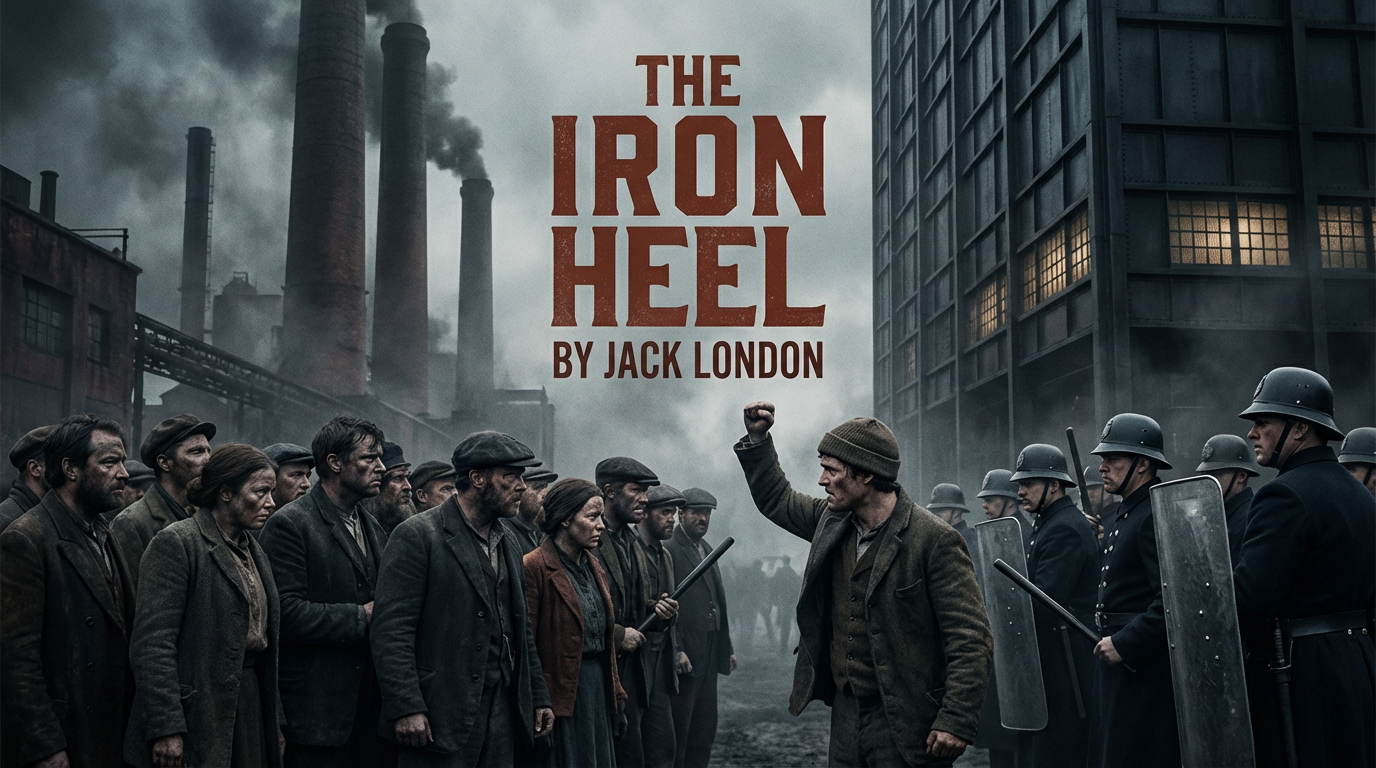
An excerpt from the original text.(complete · 4240 words)
THE CHICAGO COMMUNE
As agents-provocateurs, not alone were we able to travel a great deal,
but our very work threw us in contact with the proletariat and with our
comrades, the revolutionists. Thus we were in both camps at the same
time, ostensibly serving the Iron Heel and secretly working with all
our might for the Cause. There were many of us in the various secret
services of the Oligarchy, and despite the shakings-up and
reorganizations the secret services have undergone, they have never
been able to weed all of us out.
Ernest had largely planned the First Revolt, and the date set had been
somewhere early in the spring of 1918. In the fall of 1917 we were not
ready; much remained to be done, and when the Revolt was precipitated,
of course it was doomed to failure. The plot of necessity was
frightfully intricate, and anything premature was sure to destroy it.
This the Iron Heel foresaw and laid its schemes accordingly.
We had planned to strike our first blow at the nervous system of the
Oligarchy. The latter had remembered the general strike, and had
guarded against the defection of the telegraphers by installing
wireless stations, in the control of the Mercenaries. We, in turn, had
countered this move. When the signal was given, from every refuge, all
over the land, and from the cities, and towns, and barracks, devoted
comrades were to go forth and blow up the wireless stations. Thus at
the first shock would the Iron Heel be brought to earth and lie
practically dismembered.
At the same moment, other comrades were to blow up the bridges and
tunnels and disrupt the whole network of railroads. Still further,
other groups of comrades, at the signal, were to seize the officers of
the Mercenaries and the police, as well as all Oligarchs of unusual
ability or who held executive positions. Thus would the leaders of the
enemy be removed from the field of the local battles that would
inevitably be fought all over the land.
Many things were to occur simultaneously when the signal went forth.
The Canadian and Mexican patriots, who were far stronger than the Iron
Heel dreamed, were to duplicate our tactics. Then there were comrades
(these were the women, for the men would be busy elsewhere) who were to
post the proclamations from our secret presses. Those of us in the
higher employ of the Iron Heel were to proceed immediately to make
confusion and anarchy in all our departments. Inside the Mercenaries
were thousands of our comrades. Their work was to blow up the magazines
and to destroy the delicate mechanism of all the war machinery. In the
cities of the Mercenaries and of the labor castes similar programmes of
disruption were to be carried out.
In short, a sudden, colossal, stunning blow was to be struck. Before
the paralyzed Oligarchy could recover itself, its end would have come.
It would have meant terrible times and great loss of life, but no
revolutionist hesitates at such things. Why, we even depended much, in
our plan, on the unorganized people of the abyss. They were to be
loosed on the palaces and cities of the masters. Never mind the
destruction of life and property. Let the abysmal brute roar and the
police and Mercenaries slay. The abysmal brute would roar anyway, and
the police and Mercenaries would slay anyway. It would merely mean that
various dangers to us were harmlessly destroying one another. In the
meantime we would be doing our own work, largely unhampered, and
gaining control of all the machinery of society.
Such was our plan, every detail of which had to be worked out in
secret, and, as the day drew near, communicated to more and more
comrades. This was the danger point, the stretching of the conspiracy.
But that danger-point was never reached. Through its spy-system the
Iron Heel got wind of the Revolt and prepared to teach us another of
its bloody lessons. Chicago was the devoted city selected for the
instruction, and well were we instructed.
Chicago[1] was the ripest of all—Chicago which of old time was the city
of blood and which was to earn anew its name. There the revolutionary
spirit was strong. Too many bitter strikes had been curbed there in the
days of capitalism for the workers to forget and forgive. Even the
labor castes of the city were alive with revolt. Too many heads had
been broken in the early strikes. Despite their changed and favorable
conditions, their hatred for the master class had not died. This spirit
had infected the Mercenaries, of which three regiments in particular
were ready to come over to us en masse.
[1] Chicago was the industrial inferno of the nineteenth century A.D.
A curious anecdote has come down to us of John Burns, a great English
labor leader and one time member of the British Cabinet. In Chicago,
while on a visit to the United States, he was asked by a newspaper
reporter for his opinion of that city. “Chicago,” he answered, “is a
pocket edition of hell.” Some time later, as he was going aboard his
steamer to sail to England, he was approached by another reporter, who
wanted to know if he had changed his opinion of Chicago. “Yes, I
have,” was his reply. “My present opinion is that hell is a pocket
edition of Chicago.”
Chicago had always been the storm-centre of the conflict between labor
and capital, a city of street-battles and violent death, with a
class-conscious capitalist organization and a class-conscious workman
organization, where, in the old days, the very school-teachers were
formed into labor unions and affiliated with the hod-carriers and
brick-layers in the American Federation of Labor. And Chicago became
the storm-centre of the premature First Revolt.
The trouble was precipitated by the Iron Heel. It was cleverly done.
The whole population, including the favored labor castes, was given a
course of outrageous treatment. Promises and agreements were broken,
and most drastic punishments visited upon even petty offenders. The
people of the abyss were tormented out of their apathy. In fact, the
Iron Heel was preparing to make the abysmal beast roar. And hand in
hand with this, in all precautionary measures in Chicago, the Iron Heel
was inconceivably careless. Discipline was relaxed among the
Mercenaries that remained, while many regiments had been withdrawn and
sent to various parts of the country.
It did not take long to carry out this programme—only several weeks. We
of the Revolution caught vague rumors of the state of affairs, but had
nothing definite enough for an understanding. In fact, we thought it
was a spontaneous spirit of revolt that would require careful curbing
on our part, and never dreamed that it was deliberately
manufactured—and it had been manufactured so secretly, from the very
innermost circle of the Iron Heel, that we had got no inkling. The
counter-plot was an able achievement, and ably carried out.
I was in New York when I received the order to proceed immediately to
Chicago. The man who gave me the order was one of the oligarchs, I
could tell that by his speech, though I did not know his name nor see
his face. His instructions were too clear for me to make a mistake.
Plainly I read between the lines that our plot had been discovered,
that we had been countermined. The explosion was ready for the flash of
powder, and countless agents of the Iron Heel, including me, either on
the ground or being sent there, were to supply that flash. I flatter
myself that I maintained my composure under the keen eye of the
oligarch, but my heart was beating madly. I could almost have shrieked
and flown at his throat with my naked hands before his final,
cold-blooded instructions were given.
Once out of his presence, I calculated the time. I had just the moments
to spare, if I were lucky, to get in touch with some local leader
before catching my train. Guarding against being trailed, I made a rush
of it for the Emergency Hospital. Luck was with me, and I gained access
at once to comrade Galvin, the surgeon-in-chief. I started to gasp out
my information, but he stopped me.
“I already know,” he said quietly, though his Irish eyes were flashing.
“I knew what you had come for. I got the word fifteen minutes ago, and
I have already passed it along. Everything shall be done here to keep
the comrades quiet. Chicago is to be sacrificed, but it shall be
Chicago alone.”
“Have you tried to get word to Chicago?” I asked.
He shook his head. “No telegraphic communication. Chicago is shut off.
It’s going to be hell there.”
He paused a moment, and I saw his white hands clinch. Then he burst
out:
“By God! I wish I were going to be there!”
“There is yet a chance to stop it,” I said, “if nothing happens to the
train and I can get there in time. Or if some of the other
secret-service comrades who have learned the truth can get there in
time.”
“You on the inside were caught napping this time,” he said.
I nodded my head humbly.
“It was very secret,” I answered. “Only the inner chiefs could have
known up to to-day. We haven’t yet penetrated that far, so we couldn’t
escape being kept in the dark. If only Ernest were here. Maybe he is in
Chicago now, and all is well.”
Dr. Galvin shook his head. “The last news I heard of him was that he
had been sent to Boston or New Haven. This secret service for the enemy
must hamper him a lot, but it’s better than lying in a refuge.”
I started to go, and Galvin wrung my hand.
“Keep a stout heart,” were his parting words. “What if the First Revolt
is lost? There will be a second, and we will be wiser then. Good-by and
good luck. I don’t know whether I’ll ever see you again. It’s going to
be hell there, but I’d give ten years of my life for your chance to be
in it.”
The Twentieth Century[2] left New York at six in the evening, and was
supposed to arrive at Chicago at seven next morning. But it lost time
that night. We were running behind another train. Among the travellers
in my Pullman was comrade Hartman, like myself in the secret service of
the Iron Heel. He it was who told me of the train that immediately
preceded us. It was an exact duplicate of our train, though it
contained no passengers. The idea was that the empty train should
receive the disaster were an attempt made to blow up the Twentieth
Century. For that matter there were very few people on the train—only a
baker’s dozen in our car.
[2] This was reputed to be the fastest train in the world then. It was
quite a famous train.
“There must be some big men on board,” Hartman concluded. “I noticed a
private car on the rear.”
Night had fallen when we made our first change of engine, and I walked
down the platform for a breath of fresh air and to see what I could
see. Through the windows of the private car I caught a glimpse of three
men whom I recognized. Hartman was right. One of the men was General
Altendorff; and the other two were Mason and Vanderbold, the brains of
the inner circle of the Oligarchy’s secret service.
It was a quiet moonlight night, but I tossed restlessly and could not
sleep. At five in the morning I dressed and abandoned my bed.
I asked the maid in the dressing-room how late the train was, and she
told me two hours. She was a mulatto woman, and I noticed that her face
was haggard, with great circles under the eyes, while the eyes
themselves were wide with some haunting fear.
“What is the matter?” I asked.
“Nothing, miss; I didn’t sleep well, I guess,” was her reply.
I looked at her closely, and tried her with one of our signals. She
responded, and I made sure of her.
“Something terrible is going to happen in Chicago,” she said. “There’s
that fake[3] train in front of us. That and the troop-trains have made
us late.”
[3] False.
“Troop-trains?” I queried.
She nodded her head. “The line is thick with them. We’ve been passing
them all night. And they’re all heading for Chicago. And bringing them
over the air-line—that means business.
“I’ve a lover in Chicago,” she added apologetically. “He’s one of us,
and he’s in the Mercenaries, and I’m afraid for him.”
Poor girl. Her lover was in one of the three disloyal regiments.
Hartman and I had breakfast together in the dining car, and I forced
myself to eat. The sky had clouded, and the train rushed on like a
sullen thunderbolt through the gray pall of advancing day. The very
negroes that waited on us knew that something terrible was impending.
Oppression sat heavily upon them; the lightness of their natures had
ebbed out of them; they were slack and absent-minded in their service,
and they whispered gloomily to one another in the far end of the car
next to the kitchen. Hartman was hopeless over the situation.
“What can we do?” he demanded for the twentieth time, with a helpless
shrug of the shoulders.
He pointed out of the window. “See, all is ready. You can depend upon
it that they’re holding them like this, thirty or forty miles outside
the city, on every road.”
He had reference to troop-trains on the side-track. The soldiers were
cooking their breakfasts over fires built on the ground beside the
track, and they looked up curiously at us as we thundered past without
slackening our terrific speed.
All was quiet as we entered Chicago. It was evident nothing had
happened yet. In the suburbs the morning papers came on board the
train. There was nothing in them, and yet there was much in them for
those skilled in reading between the lines that it was intended the
ordinary reader should read into the text. The fine hand of the Iron
Heel was apparent in every column. Glimmerings of weakness in the armor
of the Oligarchy were given. Of course, there was nothing definite. It
was intended that the reader should feel his way to these glimmerings.
It was cleverly done. As fiction, those morning papers of October 27th
were masterpieces.
The local news was missing. This in itself was a masterstroke. It
shrouded Chicago in mystery, and it suggested to the average Chicago
reader that the Oligarchy did not dare give the local news. Hints that
were untrue, of course, were given of insubordination all over the
land, crudely disguised with complacent references to punitive measures
to be taken. There were reports of numerous wireless stations that had
been blown up, with heavy rewards offered for the detection of the
perpetrators. Of course no wireless stations had been blown up. Many
similar outrages, that dovetailed with the plot of the revolutionists,
were given. The impression to be made on the minds of the Chicago
comrades was that the general Revolt was beginning, albeit with a
confusing miscarriage in many details. It was impossible for one
uninformed to escape the vague yet certain feeling that all the land
was ripe for the revolt that had already begun to break out.
It was reported that the defection of the Mercenaries in California had
become so serious that half a dozen regiments had been disbanded and
broken, and that their members with their families had been driven from
their own city and on into the labor-ghettos. And the California
Mercenaries were in reality the most faithful of all to their salt! But
how was Chicago, shut off from the rest of the world, to know? Then
there was a ragged telegram describing an outbreak of the populace in
New York City, in which the labor castes were joining, concluding with
the statement (intended to be accepted as a bluff[4]) that the troops
had the situation in hand.
[4] A lie.
And as the oligarchs had done with the morning papers, so had they done
in a thousand other ways. These we learned afterward, as, for example,
the secret messages of the oligarchs, sent with the express purpose of
leaking to the ears of the revolutionists, that had come over the
wires, now and again, during the first part of the night.
“I guess the Iron Heel won’t need our services,” Hartman remarked,
putting down the paper he had been reading, when the train pulled into
the central depot. “They wasted their time sending us here. Their plans
have evidently prospered better than they expected. Hell will break
loose any second now.”
He turned and looked down the train as we alighted.
“I thought so,” he muttered. “They dropped that private car when the
papers came aboard.”
Hartman was hopelessly depressed. I tried to cheer him up, but he
ignored my effort and suddenly began talking very hurriedly, in a low
voice, as we passed through the station. At first I could not
understand.
“I have not been sure,” he was saying, “and I have told no one. I have
been working on it for weeks, and I cannot make sure. Watch out for
Knowlton. I suspect him. He knows the secrets of a score of our
refuges. He carries the lives of hundreds of us in his hands, and I
think he is a traitor. It’s more a feeling on my part than anything
else. But I thought I marked a change in him a short while back. There
is the danger that he has sold us out, or is going to sell us out. I am
almost sure of it. I wouldn’t whisper my suspicions to a soul, but,
somehow, I don’t think I’ll leave Chicago alive. Keep your eye on
Knowlton. Trap him. Find out. I don’t know anything more. It is only an
intuition, and so far I have failed to find the slightest clew.” We
were just stepping out upon the sidewalk. “Remember,” Hartman concluded
earnestly. “Keep your eyes upon Knowlton.”
And Hartman was right. Before a month went by Knowlton paid for his
treason with his life. He was formally executed by the comrades in
Milwaukee.
All was quiet on the streets—too quiet. Chicago lay dead. There was no
roar and rumble of traffic. There were not even cabs on the streets.
The surface cars and the elevated were not running. Only occasionally,
on the sidewalks, were there stray pedestrians, and these pedestrians
did not loiter. They went their ways with great haste and definiteness,
withal there was a curious indecision in their movements, as though
they expected the buildings to topple over on them or the sidewalks to
sink under their feet or fly up in the air. A few gamins, however, were
around, in their eyes a suppressed eagerness in anticipation of
wonderful and exciting things to happen.
From somewhere, far to the south, the dull sound of an explosion came
to our ears. That was all. Then quiet again, though the gamins had
startled and listened, like young deer, at the sound. The doorways to
all the buildings were closed; the shutters to the shops were up. But
there were many police and watchmen in evidence, and now and again
automobile patrols of the Mercenaries slipped swiftly past.
Hartman and I agreed that it was useless to report ourselves to the
local chiefs of the secret service. Our failure so to report would be
excused, we knew, in the light of subsequent events. So we headed for
the great labor-ghetto on the South Side in the hope of getting in
contact with some of the comrades. Too late! We knew it. But we could
not stand still and do nothing in those ghastly, silent streets. Where
was Ernest? I was wondering. What was happening in the cities of the
labor castes and Mercenaries? In the fortresses?
As if in answer, a great screaming roar went up, dim with distance,
punctuated with detonation after detonation.
“It’s the fortresses,” Hartman said. “God pity those three regiments!”
At a crossing we noticed, in the direction of the stockyards, a
gigantic pillar of smoke. At the next crossing several similar smoke
pillars were rising skyward in the direction of the West Side. Over the
city of the Mercenaries we saw a great captive war-balloon that burst
even as we looked at it, and fell in flaming wreckage toward the earth.
There was no clew to that tragedy of the air. We could not determine
whether the balloon had been manned by comrades or enemies. A vague
sound came to our ears, like the bubbling of a gigantic caldron a long
way off, and Hartman said it was machine-guns and automatic rifles.
And still we walked in immediate quietude. Nothing was happening where
we were. The police and the automobile patrols went by, and once half a
dozen fire-engines, returning evidently from some conflagration. A
question was called to the fireman by an officer in an automobile, and
we heard one shout in reply: “No water! They’ve blown up the mains!”
“We’ve smashed the water supply,” Hartman cried excitedly to me. “If we
can do all this in a premature, isolated, abortive attempt, what can’t
we do in a concerted, ripened effort all over the land?”
The automobile containing the officer who had asked the question darted
on. Suddenly there was a deafening roar. The machine, with its human
freight, lifted in an upburst of smoke, and sank down a mass of
wreckage and death.
Hartman was jubilant. “Well done! well done!” he was repeating, over
and over, in a whisper. “The proletariat gets its lesson to-day, but it
gives one, too.”
Police were running for the spot. Also, another patrol machine had
halted. As for myself, I was in a daze. The suddenness of it was
stunning. How had it happened? I knew not how, and yet I had been
looking directly at it. So dazed was I for the moment that I was
scarcely aware of the fact that we were being held up by the police. I
abruptly saw that a policeman was in the act of shooting Hartman. But
Hartman was cool and was giving the proper passwords. I saw the
levelled revolver hesitate, then sink down, and heard the disgusted
grunt of the policeman. He was very angry, and was cursing the whole
secret service. It was always in the way, he was averring, while
Hartman was talking back to him and with fitting secret-service pride
explaining to him the clumsiness of the police.
The next moment I knew how it had happened. There was quite a group
about the wreck, and two men were just lifting up the wounded officer
to carry him to the other machine. A panic seized all of them, and they
scattered in every direction, running in blind terror, the wounded
officer, roughly dropped, being left behind. The cursing policeman
alongside of me also ran, and Hartman and I ran, too, we knew not why,
obsessed with the same blind terror to get away from that particular
spot.
Nothing really happened then, but everything was explained. The flying
men were sheepishly coming back, but all the while their eyes were
raised apprehensively to the many-windowed, lofty buildings that
towered like the sheer walls of a canyon on each side of the street.
From one of those countless windows the bomb had been thrown, but which
window? There had been no second bomb, only a fear of one.
Thereafter we looked with speculative comprehension at the windows. Any
of them contained possible death. Each building was a possible
ambuscade. This was warfare in that modern jungle, a great city. Every
street was a canyon, every building a mountain. We had not changed much
from primitive man, despite the war automobiles that were sliding by.
Turning a corner, we came upon a woman. She was lying on the pavement,
in a pool of blood. Hartman bent over and examined her. As for myself,
I turned deathly sick. I was to see many dead that day, but the total
carnage was not to affect me as did this first forlorn body lying there
at my feet abandoned on the pavement. “Shot in the breast,” was
Hartman’s report. Clasped in the hollow of her arm, as a child might be
clasped, was a bundle of printed matter. Even in death she seemed loath
to part with that which had caused her death; for when Hartman had
succeeded in withdrawing the bundle, we found that it consisted of
large printed sheets, the proclamations of the revolutionists.
“A comrade,” I said.
But Hartman only cursed the Iron Heel, and we passed on. Often we were
halted by the police and patrols, but our passwords enabled us to
proceed. No more bombs fell from the windows, the last pedestrians
seemed to have vanished from the streets, and our immediate quietude
grew more profound; though the gigantic caldron continued to bubble in
the distance, dull roars of explosions came to us from all directions,
and the smoke-pillars were towering more ominously in the heavens.
Master this chapter. Complete your experience
Purchase the complete book to access all chapters and support classic literature
As an Amazon Associate, we earn a small commission from qualifying purchases at no additional cost to you.
Available in paperback, hardcover, and e-book formats
Let's Analyse the Pattern
Those in power create the very problems they claim to solve, turning genuine grievances into weapons against the grieved.
Why This Matters
Connect literature to life
This chapter teaches how to recognize when problems are deliberately created by those who later claim to solve them.
Practice This Today
This week, notice when someone offers to fix a problem they had the power to prevent—ask yourself who really benefits from the 'solution.'
Now let's explore the literary elements.
Key Quotes & Analysis
"As agents-provocateurs, not alone were we able to travel a great deal, but our very work threw us in contact with the proletariat and with our comrades, the revolutionists."
Context: She's explaining how she and other revolutionaries infiltrated the oligarchy's secret service
This shows the dangerous double life revolutionaries must live - pretending to serve their oppressors while secretly working against them. It reveals how resistance movements must use the system's own tools against it.
In Today's Words:
We had to play both sides - acting like we worked for the bosses while really helping the workers organize.
"The plot of necessity was frightfully intricate, and anything premature was sure to destroy it."
Context: She's describing why the revolution failed when it started too early
This captures how complex social change really is - you can't just get angry and revolt. Real change requires careful planning, timing, and coordination that can be easily disrupted.
In Today's Words:
Our plan was super complicated, and if we moved too fast, the whole thing would fall apart.
"This the Iron Heel foresaw and laid its schemes accordingly."
Context: Realizing that the oligarchy anticipated and planned for the revolutionaries' moves
Shows how those in power are always thinking several steps ahead, using their resources to predict and counter opposition movements. The game is rigged from the start.
In Today's Words:
The people in charge saw this coming and set us up to fail.
Thematic Threads
Manipulation
In This Chapter
The Iron Heel orchestrates the revolution it claims to oppose, using the revolutionaries' own passion against them
Development
Evolved from earlier subtle control to complete orchestration of opposition
In Your Life:
You might see this when someone creates problems they later heroically solve, making you grateful for their intervention.
Class
In This Chapter
The working class uprising is turned into a tool for their own oppression, their genuine grievances weaponized
Development
Shows how class struggle can be co-opted and redirected by those with superior resources and planning
In Your Life:
Your legitimate workplace complaints might be used to justify policies that hurt you more than help.
Power
In This Chapter
True power lies not in stopping opposition but in controlling it, making resistance serve the system
Development
Reveals the ultimate expression of systemic power—turning rebellion into reinforcement
In Your Life:
You might find your efforts to change a system actually strengthening it when you don't understand who's really pulling the strings.
Sacrifice
In This Chapter
Avis rushes into the trap knowing it's a trap, choosing to warn others despite the personal cost
Development
Shows how genuine moral courage persists even when tactics are compromised
In Your Life:
You might face moments where doing the right thing serves someone else's agenda, but you do it anyway because it's right.
Recognition
In This Chapter
Avis sees the trap clearly but cannot escape its logic—knowledge doesn't automatically equal freedom
Development
Demonstrates the gap between understanding manipulation and being able to counter it
In Your Life:
You might recognize you're being manipulated but feel trapped by circumstances that make resistance seem impossible.
You now have the context. Time to form your own thoughts.
Discussion Questions
- 1
How did the Iron Heel turn the revolutionaries' planned uprising into a trap?
analysis • surface - 2
Why would those in power deliberately create the very crisis they claim to solve?
analysis • medium - 3
Where do you see this 'manufactured crisis' pattern in workplaces, politics, or family situations today?
application • medium - 4
If you suspected you were walking into a manufactured crisis, how would you protect yourself while still addressing the real problem?
application • deep - 5
What does this chapter reveal about how genuine anger and righteous causes can be weaponized against the people who feel them?
reflection • deep
Critical Thinking Exercise
Map the Manufactured Crisis
Think of a current situation in your workplace, community, or the news where problems seem to keep getting worse despite people trying to fix them. Draw a simple timeline showing who had the power to prevent the crisis, what actions (or lack of action) made it worse, and who benefits from the ongoing chaos. Look for the pattern: Create problem → Let it escalate → Offer solution that increases your power.
Consider:
- •Who has the resources to solve this problem but hasn't used them?
- •Does the proposed solution give more control to the people who could have prevented the crisis?
- •Are the people suffering being blamed for problems they didn't create?
Journaling Prompt
Write about a time when you realized someone was creating drama or problems they later positioned themselves to solve. How did you handle it, and what would you do differently now?
Coming Up Next...
Chapter 23: The People of the Abyss
As Chicago burns and the trap closes around the revolutionaries, Avis will witness the true horror of what happens when the people of the abyss are finally unleashed. The Iron Heel's lesson in terror is about to reach its bloody climax.



