
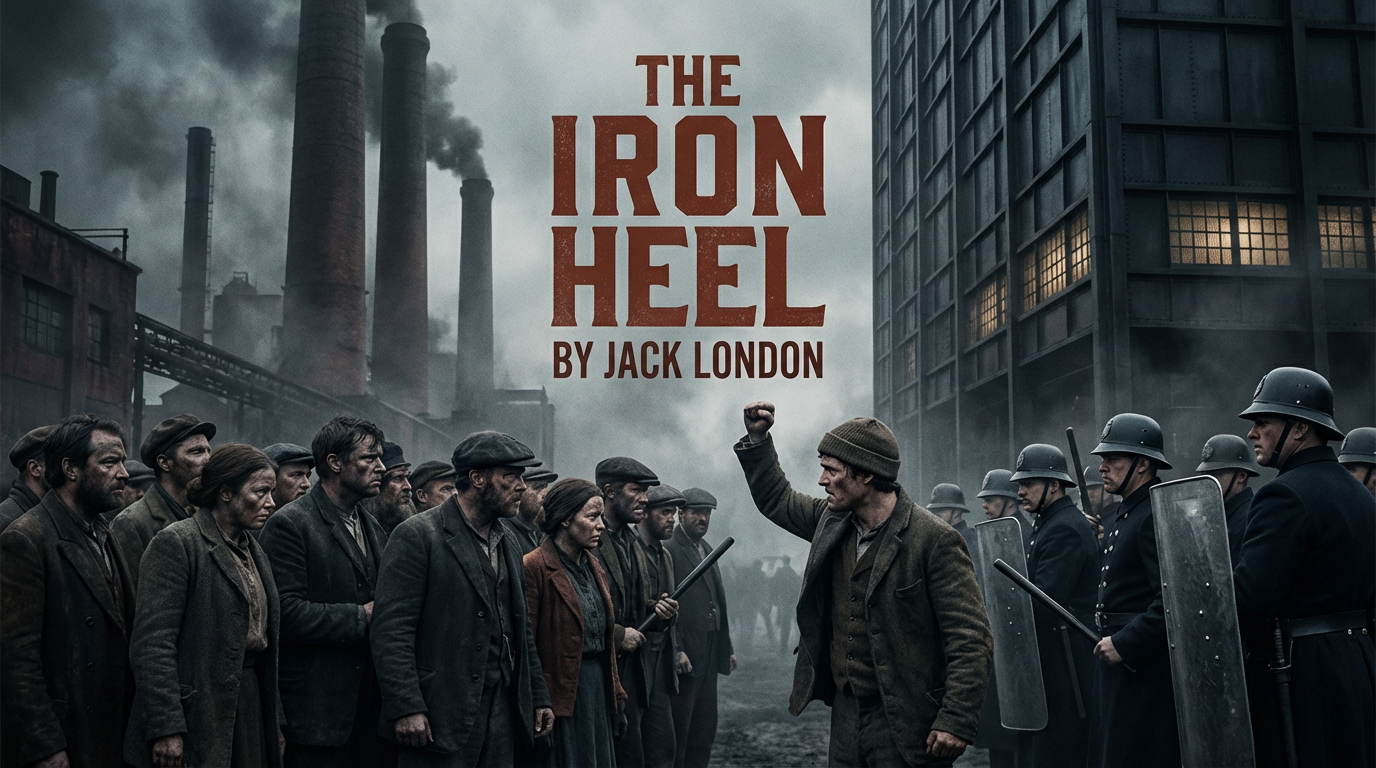
An excerpt from the original text.(complete · 4784 words)
THE PEOPLE OF THE ABYSS
Suddenly a change came over the face of things. A tingle of excitement
ran along the air. Automobiles fled past, two, three, a dozen, and from
them warnings were shouted to us. One of the machines swerved wildly at
high speed half a block down, and the next moment, already left well
behind it, the pavement was torn into a great hole by a bursting bomb.
We saw the police disappearing down the cross-streets on the run, and
knew that something terrible was coming. We could hear the rising roar
of it.
“Our brave comrades are coming,” Hartman said.
We could see the front of their column filling the street from gutter
to gutter, as the last war-automobile fled past. The machine stopped
for a moment just abreast of us. A soldier leaped from it, carrying
something carefully in his hands. This, with the same care, he
deposited in the gutter. Then he leaped back to his seat and the
machine dashed on, took the turn at the corner, and was gone from
sight. Hartman ran to the gutter and stooped over the object.
“Keep back,” he warned me.
I could see he was working rapidly with his hands. When he returned to
me the sweat was heavy on his forehead.
“I disconnected it,” he said, “and just in the nick of time. The
soldier was clumsy. He intended it for our comrades, but he didn’t give
it enough time. It would have exploded prematurely. Now it won’t
explode at all.”
Everything was happening rapidly now. Across the street and half a
block down, high up in a building, I could see heads peering out. I had
just pointed them out to Hartman, when a sheet of flame and smoke ran
along that portion of the face of the building where the heads had
appeared, and the air was shaken by the explosion. In places the stone
facing of the building was torn away, exposing the iron construction
beneath. The next moment similar sheets of flame and smoke smote the
front of the building across the street opposite it. Between the
explosions we could hear the rattle of the automatic pistols and
rifles. For several minutes this mid-air battle continued, then died
out. It was patent that our comrades were in one building, that
Mercenaries were in the other, and that they were fighting across the
street. But we could not tell which was which—which building contained
our comrades and which the Mercenaries.
By this time the column on the street was almost on us. As the front of
it passed under the warring buildings, both went into action again—one
building dropping bombs into the street, being attacked from across the
street, and in return replying to that attack. Thus we learned which
building was held by our comrades, and they did good work, saving those
in the street from the bombs of the enemy.
Hartman gripped my arm and dragged me into a wide entrance.
“They’re not our comrades,” he shouted in my ear.
The inner doors to the entrance were locked and bolted. We could not
escape. The next moment the front of the column went by. It was not a
column, but a mob, an awful river that filled the street, the people of
the abyss, mad with drink and wrong, up at last and roaring for the
blood of their masters. I had seen the people of the abyss before, gone
through its ghettos, and thought I knew it; but I found that I was now
looking on it for the first time. Dumb apathy had vanished. It was now
dynamic—a fascinating spectacle of dread. It surged past my vision in
concrete waves of wrath, snarling and growling, carnivorous, drunk with
whiskey from pillaged warehouses, drunk with hatred, drunk with lust
for blood—men, women, and children, in rags and tatters, dim ferocious
intelligences with all the godlike blotted from their features and all
the fiendlike stamped in, apes and tigers, anaemic consumptives and
great hairy beasts of burden, wan faces from which vampire society had
sucked the juice of life, bloated forms swollen with physical grossness
and corruption, withered hags and death’s-heads bearded like
patriarchs, festering youth and festering age, faces of fiends,
crooked, twisted, misshapen monsters blasted with the ravages of
disease and all the horrors of chronic innutrition—the refuse and the
scum of life, a raging, screaming, screeching, demoniacal horde.
And why not? The people of the abyss had nothing to lose but the misery
and pain of living. And to gain?—nothing, save one final, awful glut of
vengeance. And as I looked the thought came to me that in that rushing
stream of human lava were men, comrades and heroes, whose mission had
been to rouse the abysmal beast and to keep the enemy occupied in
coping with it.
And now a strange thing happened to me. A transformation came over me.
The fear of death, for myself and for others, left me. I was strangely
exalted, another being in another life. Nothing mattered. The Cause for
this one time was lost, but the Cause would be here to-morrow, the same
Cause, ever fresh and ever burning. And thereafter, in the orgy of
horror that raged through the succeeding hours, I was able to take a
calm interest. Death meant nothing, life meant nothing. I was an
interested spectator of events, and, sometimes swept on by the rush,
was myself a curious participant. For my mind had leaped to a star-cool
altitude and grasped a passionless transvaluation of values. Had it not
done this, I know that I should have died.
Half a mile of the mob had swept by when we were discovered. A woman in
fantastic rags, with cheeks cavernously hollow and with narrow black
eyes like burning gimlets, caught a glimpse of Hartman and me. She let
out a shrill shriek and bore in upon us. A section of the mob tore
itself loose and surged in after her. I can see her now, as I write
these lines, a leap in advance, her gray hair flying in thin tangled
strings, the blood dripping down her forehead from some wound in the
scalp, in her right hand a hatchet, her left hand, lean and wrinkled, a
yellow talon, gripping the air convulsively. Hartman sprang in front of
me. This was no time for explanations. We were well dressed, and that
was enough. His fist shot out, striking the woman between her burning
eyes. The impact of the blow drove her backward, but she struck the
wall of her on-coming fellows and bounced forward again, dazed and
helpless, the brandished hatchet falling feebly on Hartman’s shoulder.
The next moment I knew not what was happening. I was overborne by the
crowd. The confined space was filled with shrieks and yells and curses.
Blows were falling on me. Hands were ripping and tearing at my flesh
and garments. I felt that I was being torn to pieces. I was being borne
down, suffocated. Some strong hand gripped my shoulder in the thick of
the press and was dragging fiercely at me. Between pain and pressure I
fainted. Hartman never came out of that entrance. He had shielded me
and received the first brunt of the attack. This had saved me, for the
jam had quickly become too dense for anything more than the mad
gripping and tearing of hands.
I came to in the midst of wild movement. All about me was the same
movement. I had been caught up in a monstrous flood that was sweeping
me I knew not whither. Fresh air was on my cheek and biting sweetly in
my lungs. Faint and dizzy, I was vaguely aware of a strong arm around
my body under the arms, and half-lifting me and dragging me along.
Feebly my own limbs were helping me. In front of me I could see the
moving back of a man’s coat. It had been slit from top to bottom along
the centre seam, and it pulsed rhythmically, the slit opening and
closing regularly with every leap of the wearer. This phenomenon
fascinated me for a time, while my senses were coming back to me. Next
I became aware of stinging cheeks and nose, and could feel blood
dripping on my face. My hat was gone. My hair was down and flying, and
from the stinging of the scalp I managed to recollect a hand in the
press of the entrance that had torn at my hair. My chest and arms were
bruised and aching in a score of places.
My brain grew clearer, and I turned as I ran and looked at the man who
was holding me up. He it was who had dragged me out and saved me. He
noticed my movement.
“It’s all right!” he shouted hoarsely. “I knew you on the instant.”
I failed to recognize him, but before I could speak I trod upon
something that was alive and that squirmed under my foot. I was swept
on by those behind and could not look down and see, and yet I knew that
it was a woman who had fallen and who was being trampled into the
pavement by thousands of successive feet.
“It’s all right,” he repeated. “I’m Garthwaite.”
He was bearded and gaunt and dirty, but I succeeded in remembering him
as the stalwart youth that had spent several months in our Glen Ellen
refuge three years before. He passed me the signals of the Iron Heel’s
secret service, in token that he, too, was in its employ.
“I’ll get you out of this as soon as I can get a chance,” he assured
me. “But watch your footing. On your life don’t stumble and go down.”
All things happened abruptly on that day, and with an abruptness that
was sickening the mob checked itself. I came in violent collision with
a large woman in front of me (the man with the split coat had
vanished), while those behind collided against me. A devilish
pandemonium reigned,—shrieks, curses, and cries of death, while above
all rose the churning rattle of machine-guns and the put-a-put,
put-a-put of rifles. At first I could make out nothing. People were
falling about me right and left. The woman in front doubled up and went
down, her hands on her abdomen in a frenzied clutch. A man was
quivering against my legs in a death-struggle.
It came to me that we were at the head of the column. Half a mile of it
had disappeared—where or how I never learned. To this day I do not know
what became of that half-mile of humanity—whether it was blotted out by
some frightful bolt of war, whether it was scattered and destroyed
piecemeal, or whether it escaped. But there we were, at the head of the
column instead of in its middle, and we were being swept out of life by
a torrent of shrieking lead.
As soon as death had thinned the jam, Garthwaite, still grasping my
arm, led a rush of survivors into the wide entrance of an office
building. Here, at the rear, against the doors, we were pressed by a
panting, gasping mass of creatures. For some time we remained in this
position without a change in the situation.
“I did it beautifully,” Garthwaite was lamenting to me. “Ran you right
into a trap. We had a gambler’s chance in the street, but in here there
is no chance at all. It’s all over but the shouting. Vive la
Revolution!”
Then, what he expected, began. The Mercenaries were killing without
quarter. At first, the surge back upon us was crushing, but as the
killing continued the pressure was eased. The dead and dying went down
and made room. Garthwaite put his mouth to my ear and shouted, but in
the frightful din I could not catch what he said. He did not wait. He
seized me and threw me down. Next he dragged a dying woman over on top
of me, and, with much squeezing and shoving, crawled in beside me and
partly over me. A mound of dead and dying began to pile up over us, and
over this mound, pawing and moaning, crept those that still survived.
But these, too, soon ceased, and a semi-silence settled down, broken by
groans and sobs and sounds of strangulation.
I should have been crushed had it not been for Garthwaite. As it was,
it seemed inconceivable that I could bear the weight I did and live.
And yet, outside of pain, the only feeling I possessed was one of
curiosity. How was it going to end? What would death be like? Thus did
I receive my red baptism in that Chicago shambles. Prior to that, death
to me had been a theory; but ever afterward death has been a simple
fact that does not matter, it is so easy.
But the Mercenaries were not content with what they had done. They
invaded the entrance, killing the wounded and searching out the unhurt
that, like ourselves, were playing dead. I remember one man they
dragged out of a heap, who pleaded abjectly until a revolver shot cut
him short. Then there was a woman who charged from a heap, snarling and
shooting. She fired six shots before they got her, though what damage
she did we could not know. We could follow these tragedies only by the
sound. Every little while flurries like this occurred, each flurry
culminating in the revolver shot that put an end to it. In the
intervals we could hear the soldiers talking and swearing as they
rummaged among the carcasses, urged on by their officers to hurry up.
At last they went to work on our heap, and we could feel the pressure
diminish as they dragged away the dead and wounded. Garthwaite began
uttering aloud the signals. At first he was not heard. Then he raised
his voice.
“Listen to that,” we heard a soldier say. And next the sharp voice of
an officer. “Hold on there! Careful as you go!”
Oh, that first breath of air as we were dragged out! Garthwaite did the
talking at first, but I was compelled to undergo a brief examination to
prove service with the Iron Heel.
“Agents-provocateurs all right,” was the officer’s conclusion. He was a
beardless young fellow, a cadet, evidently, of some great oligarch
family.
“It’s a hell of a job,” Garthwaite grumbled. “I’m going to try and
resign and get into the army. You fellows have a snap.”
“You’ve earned it,” was the young officer’s answer. “I’ve got some
pull, and I’ll see if it can be managed. I can tell them how I found
you.”
He took Garthwaite’s name and number, then turned to me.
“And you?”
“Oh, I’m going to be married,” I answered lightly, “and then I’ll be
out of it all.”
And so we talked, while the killing of the wounded went on. It is all a
dream, now, as I look back on it; but at the time it was the most
natural thing in the world. Garthwaite and the young officer fell into
an animated conversation over the difference between so-called modern
warfare and the present street-fighting and sky-scraper fighting that
was taking place all over the city. I followed them intently, fixing up
my hair at the same time and pinning together my torn skirts. And all
the time the killing of the wounded went on. Sometimes the revolver
shots drowned the voices of Garthwaite and the officer, and they were
compelled to repeat what they had been saying.
I lived through three days of the Chicago Commune, and the vastness of
it and of the slaughter may be imagined when I say that in all that
time I saw practically nothing outside the killing of the people of the
abyss and the mid-air fighting between sky-scrapers. I really saw
nothing of the heroic work done by the comrades. I could hear the
explosions of their mines and bombs, and see the smoke of their
conflagrations, and that was all. The mid-air part of one great deed I
saw, however, and that was the balloon attacks made by our comrades on
the fortresses. That was on the second day. The three disloyal
regiments had been destroyed in the fortresses to the last man. The
fortresses were crowded with Mercenaries, the wind blew in the right
direction, and up went our balloons from one of the office buildings in
the city.
Now Biedenbach, after he left Glen Ellen, had invented a most powerful
explosive—“expedite” he called it. This was the weapon the balloons
used. They were only hot-air balloons, clumsily and hastily made, but
they did the work. I saw it all from the top of an office building. The
first balloon missed the fortresses completely and disappeared into the
country; but we learned about it afterward. Burton and O’Sullivan were
in it. As they were descending they swept across a railroad directly
over a troop-train that was heading at full speed for Chicago. They
dropped their whole supply of expedite upon the locomotive. The
resulting wreck tied the line up for days. And the best of it was that,
released from the weight of expedite, the balloon shot up into the air
and did not come down for half a dozen miles, both heroes escaping
unharmed.
The second balloon was a failure. Its flight was lame. It floated too
low and was shot full of holes before it could reach the fortresses.
Herford and Guinness were in it, and they were blown to pieces along
with the field into which they fell. Biedenbach was in despair—we heard
all about it afterward—and he went up alone in the third balloon. He,
too, made a low flight, but he was in luck, for they failed seriously
to puncture his balloon. I can see it now as I did then, from the lofty
top of the building—that inflated bag drifting along the air, and that
tiny speck of a man clinging on beneath. I could not see the fortress,
but those on the roof with me said he was directly over it. I did not
see the expedite fall when he cut it loose. But I did see the balloon
suddenly leap up into the sky. An appreciable time after that the great
column of the explosion towered in the air, and after that, in turn, I
heard the roar of it. Biedenbach the gentle had destroyed a fortress.
Two other balloons followed at the same time. One was blown to pieces
in the air, the expedite exploding, and the shock of it disrupted the
second balloon, which fell prettily into the remaining fortress. It
couldn’t have been better planned, though the two comrades in it
sacrificed their lives.
But to return to the people of the abyss. My experiences were confined
to them. They raged and slaughtered and destroyed all over the city
proper, and were in turn destroyed; but never once did they succeed in
reaching the city of the oligarchs over on the west side. The oligarchs
had protected themselves well. No matter what destruction was wreaked
in the heart of the city, they, and their womenkind and children, were
to escape hurt. I am told that their children played in the parks
during those terrible days and that their favorite game was an
imitation of their elders stamping upon the proletariat.
But the Mercenaries found it no easy task to cope with the people of
the abyss and at the same time fight with the comrades. Chicago was
true to her traditions, and though a generation of revolutionists was
wiped out, it took along with it pretty close to a generation of its
enemies. Of course, the Iron Heel kept the figures secret, but, at a
very conservative estimate, at least one hundred and thirty thousand
Mercenaries were slain. But the comrades had no chance. Instead of the
whole country being hand in hand in revolt, they were all alone, and
the total strength of the Oligarchy could have been directed against
them if necessary. As it was, hour after hour, day after day, in
endless train-loads, by hundreds of thousands, the Mercenaries were
hurled into Chicago.
And there were so many of the people of the abyss! Tiring of the
slaughter, a great herding movement was begun by the soldiers, the
intent of which was to drive the street mobs, like cattle, into Lake
Michigan. It was at the beginning of this movement that Garthwaite and
I had encountered the young officer. This herding movement was
practically a failure, thanks to the splendid work of the comrades.
Instead of the great host the Mercenaries had hoped to gather together,
they succeeded in driving no more than forty thousand of the wretches
into the lake. Time and again, when a mob of them was well in hand and
being driven along the streets to the water, the comrades would create
a diversion, and the mob would escape through the consequent hole torn
in the encircling net.
Garthwaite and I saw an example of this shortly after meeting with the
young officer. The mob of which we had been a part, and which had been
put in retreat, was prevented from escaping to the south and east by
strong bodies of troops. The troops we had fallen in with had held it
back on the west. The only outlet was north, and north it went toward
the lake, driven on from east and west and south by machine-gun fire
and automatics. Whether it divined that it was being driven toward the
lake, or whether it was merely a blind squirm of the monster, I do not
know; but at any rate the mob took a cross street to the west, turned
down the next street, and came back upon its track, heading south
toward the great ghetto.
Garthwaite and I at that time were trying to make our way westward to
get out of the territory of street-fighting, and we were caught right
in the thick of it again. As we came to the corner we saw the howling
mob bearing down upon us. Garthwaite seized my arm and we were just
starting to run, when he dragged me back from in front of the wheels of
half a dozen war automobiles, equipped with machine-guns, that were
rushing for the spot. Behind them came the soldiers with their
automatic rifles. By the time they took position, the mob was upon
them, and it looked as though they would be overwhelmed before they
could get into action.
Here and there a soldier was discharging his rifle, but this scattered
fire had no effect in checking the mob. On it came, bellowing with
brute rage. It seemed the machine-guns could not get started. The
automobiles on which they were mounted blocked the street, compelling
the soldiers to find positions in, between, and on the sidewalks. More
and more soldiers were arriving, and in the jam we were unable to get
away. Garthwaite held me by the arm, and we pressed close against the
front of a building.
The mob was no more than twenty-five feet away when the machine-guns
opened up; but before that flaming sheet of death nothing could live.
The mob came on, but it could not advance. It piled up in a heap, a
mound, a huge and growing wave of dead and dying. Those behind urged
on, and the column, from gutter to gutter, telescoped upon itself.
Wounded creatures, men and women, were vomited over the top of that
awful wave and fell squirming down the face of it till they threshed
about under the automobiles and against the legs of the soldiers. The
latter bayoneted the struggling wretches, though one I saw who gained
his feet and flew at a soldier’s throat with his teeth. Together they
went down, soldier and slave, into the welter.
The firing ceased. The work was done. The mob had been stopped in its
wild attempt to break through. Orders were being given to clear the
wheels of the war-machines. They could not advance over that wave of
dead, and the idea was to run them down the cross street. The soldiers
were dragging the bodies away from the wheels when it happened. We
learned afterward how it happened. A block distant a hundred of our
comrades had been holding a building. Across roofs and through
buildings they made their way, till they found themselves looking down
upon the close-packed soldiers. Then it was counter-massacre.
Without warning, a shower of bombs fell from the top of the building.
The automobiles were blown to fragments, along with many soldiers. We,
with the survivors, swept back in mad retreat. Half a block down
another building opened fire on us. As the soldiers had carpeted the
street with dead slaves, so, in turn, did they themselves become
carpet. Garthwaite and I bore charmed lives. As we had done before, so
again we sought shelter in an entrance. But he was not to be caught
napping this time. As the roar of the bombs died away, he began peering
out.
“The mob’s coming back!” he called to me. “We’ve got to get out of
this!”
We fled, hand in hand, down the bloody pavement, slipping and sliding,
and making for the corner. Down the cross street we could see a few
soldiers still running. Nothing was happening to them. The way was
clear. So we paused a moment and looked back. The mob came on slowly.
It was busy arming itself with the rifles of the slain and killing the
wounded. We saw the end of the young officer who had rescued us. He
painfully lifted himself on his elbow and turned loose with his
automatic pistol.
“There goes my chance of promotion,” Garthwaite laughed, as a woman
bore down on the wounded man, brandishing a butcher’s cleaver. “Come
on. It’s the wrong direction, but we’ll get out somehow.”
And we fled eastward through the quiet streets, prepared at every cross
street for anything to happen. To the south a monster conflagration was
filling the sky, and we knew that the great ghetto was burning. At last
I sank down on the sidewalk. I was exhausted and could go no farther. I
was bruised and sore and aching in every limb; yet I could not escape
smiling at Garthwaite, who was rolling a cigarette and saying:
“I know I’m making a mess of rescuing you, but I can’t get head nor
tail of the situation. It’s all a mess. Every time we try to break out,
something happens and we’re turned back. We’re only a couple of blocks
now from where I got you out of that entrance. Friend and foe are all
mixed up. It’s chaos. You can’t tell who is in those darned buildings.
Try to find out, and you get a bomb on your head. Try to go peaceably
on your way, and you run into a mob and are killed by machine-guns, or
you run into the Mercenaries and are killed by your own comrades from a
roof. And on the top of it all the mob comes along and kills you, too.”
He shook his head dolefully, lighted his cigarette, and sat down beside
me.
“And I’m that hungry,” he added, “I could eat cobblestones.”
The next moment he was on his feet again and out in the street prying
up a cobblestone. He came back with it and assaulted the window of a
store behind us.
“It’s ground floor and no good,” he explained as he helped me through
the hole he had made; “but it’s the best we can do. You get a nap and
I’ll reconnoitre. I’ll finish this rescue all right, but I want time,
time, lots of it—and something to eat.”
It was a harness store we found ourselves in, and he fixed me up a
couch of horse blankets in the private office well to the rear. To add
to my wretchedness a splitting headache was coming on, and I was only
too glad to close my eyes and try to sleep.
“I’ll be back,” were his parting words. “I don’t hope to get an auto,
but I’ll surely bring some grub,[1] anyway.”
[1] Food.
And that was the last I saw of Garthwaite for three years. Instead of
coming back, he was carried away to a hospital with a bullet through
his lungs and another through the fleshy part of his neck.
Master this chapter. Complete your experience
Purchase the complete book to access all chapters and support classic literature
As an Amazon Associate, we earn a small commission from qualifying purchases at no additional cost to you.
Available in paperback, hardcover, and e-book formats
Let's Analyse the Pattern
Extreme suffering strips away humanity, causing people to destroy everything around them while leaving the real sources of their pain untouched.
Why This Matters
Connect literature to life
This chapter teaches how to distinguish between productive resistance and destructive chaos that ultimately serves those in power.
Practice This Today
This week, notice when workplace frustration gets directed at coworkers instead of management, or when family stress creates fights between people who should be allies.
Now let's explore the literary elements.
Key Quotes & Analysis
"Our brave comrades are coming"
Context: He says this as they see the mob of desperate poor people approaching
The irony is devastating - these aren't 'brave comrades' but broken, savage people driven mad by suffering. Hartman's idealistic language shows how revolutionaries can be blind to ugly realities.
In Today's Words:
Here come our people - but they're not the heroes we thought they'd be
"Keep back, I disconnected it"
Context: After defusing a bomb meant to kill the approaching revolutionaries
This shows the random, deadly chaos of urban warfare where bombs are planted carelessly and could kill anyone. It also shows Hartman's skill and dedication to protecting people.
In Today's Words:
Stay away, I just stopped that thing from blowing us all up
"The people of the abyss"
Context: Avis's description of the mob of desperate poor people
This phrase captures London's view that extreme poverty creates something less than human - people so broken by suffering that they've become monsters. It's both sympathetic and horrifying.
In Today's Words:
The completely forgotten and broken people at the bottom of society
Thematic Threads
Class
In This Chapter
The ruling class remains safely isolated while the poor destroy each other in meaningless violence
Development
Evolved from theoretical discussions to visceral reality of class warfare
In Your Life:
You might notice how workplace conflicts often target peers instead of the policies that create the stress
Dehumanization
In This Chapter
Extreme suffering transforms people into unrecognizable monsters driven only by vengeance
Development
Shows the ultimate endpoint of the systematic brutalization described earlier
In Your Life:
You might see how prolonged mistreatment can make you or others act in ways that feel foreign to your true self
Survival
In This Chapter
Avis develops emotional detachment as a psychological defense mechanism against trauma
Development
Her survival instincts override her previous idealism and moral certainties
In Your Life:
You might recognize how you shut down emotionally during overwhelming crises as a way to keep functioning
Sacrifice
In This Chapter
Hartman gives his life to save Avis, showing how crisis reveals true character
Development
Contrasts noble sacrifice with the mindless violence surrounding it
In Your Life:
You might think about who would truly have your back when everything falls apart
Power
In This Chapter
The Iron Heel uses the chaos to justify even greater oppression and control
Development
Reveals how those in power benefit from the violence they help create
In Your Life:
You might notice how authority figures use crises they helped cause to grab more control
You now have the context. Time to form your own thoughts.
Discussion Questions
- 1
What does Avis witness when the 'people of the abyss' rise up in Chicago, and how does their behavior differ from what we might expect from revolutionaries?
analysis • surface - 2
Why do you think the starving masses turn to random destruction rather than targeting the actual sources of their oppression?
analysis • medium - 3
Where do you see this pattern today—people who are suffering turning their anger on each other instead of addressing the real problem?
application • medium - 4
When you're facing serious stress or mistreatment, how can you avoid falling into the trap of hurting innocent people around you?
application • deep - 5
What does this chapter reveal about how extreme suffering changes people, and why might those in power actually benefit from desperate people acting this way?
reflection • deep
Critical Thinking Exercise
Trace the Anger Back to Its Source
Think of a situation where you've seen people lash out at the wrong targets—maybe coworkers taking frustration out on each other instead of addressing bad management, or family members fighting over money problems instead of tackling the real financial issues. Map out what's really happening: Who has the actual power? Who's getting hurt? Who benefits when the powerless fight each other?
Consider:
- •Look for who stays safe while others fight
- •Notice how the real problem gets ignored when people turn on each other
- •Consider how this pattern might be serving someone's interests
Journaling Prompt
Write about a time when you were so frustrated or hurt that you took it out on someone who didn't deserve it. What was the real source of your pain, and how might you handle similar situations differently in the future?
Coming Up Next...
Chapter 24: Surviving the Aftermath
Avis faces the psychological aftermath of surviving the Chicago massacre, but her ordeal is far from over. The nightmare continues as she must navigate the final stages of the failed revolution and confront what comes next.



