
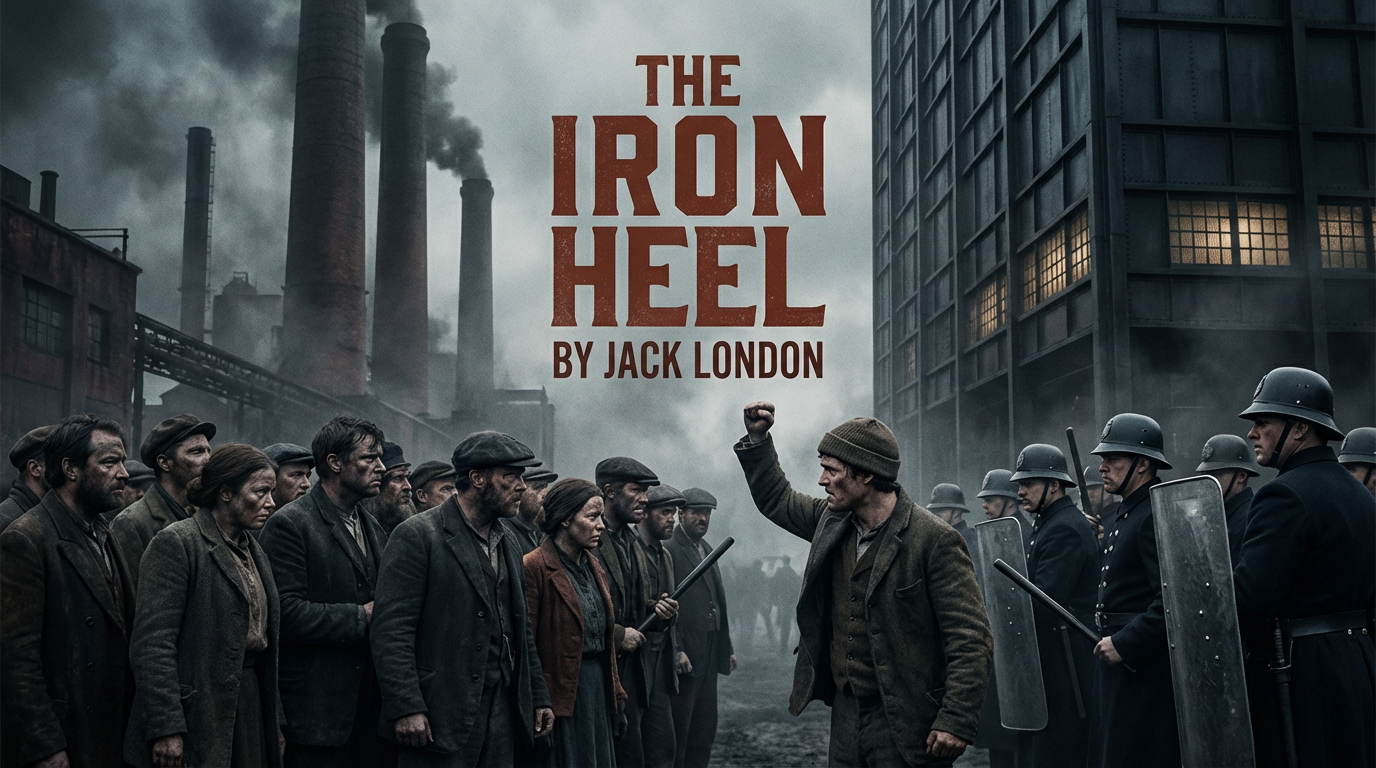
An excerpt from the original text.(complete · 2197 words)
NIGHTMARE
I had not closed my eyes the night before on the Twentieth Century, and
what of that and of my exhaustion I slept soundly. When I first awoke,
it was night. Garthwaite had not returned. I had lost my watch and had
no idea of the time. As I lay with my eyes closed, I heard the same
dull sound of distant explosions. The inferno was still raging. I crept
through the store to the front. The reflection from the sky of vast
conflagrations made the street almost as light as day. One could have
read the finest print with ease. From several blocks away came the
crackle of small hand-bombs and the churning of machine-guns, and from
a long way off came a long series of heavy explosions. I crept back to
my horse blankets and slept again.
When next I awoke, a sickly yellow light was filtering in on me. It was
dawn of the second day. I crept to the front of the store. A smoke
pall, shot through with lurid gleams, filled the sky. Down the opposite
side of the street tottered a wretched slave. One hand he held tightly
against his side, and behind him he left a bloody trail. His eyes roved
everywhere, and they were filled with apprehension and dread. Once he
looked straight across at me, and in his face was all the dumb pathos
of the wounded and hunted animal. He saw me, but there was no kinship
between us, and with him, at least, no sympathy of understanding; for
he cowered perceptibly and dragged himself on. He could expect no aid
in all God’s world. He was a helot in the great hunt of helots that the
masters were making. All he could hope for, all he sought, was some
hole to crawl away in and hide like any animal. The sharp clang of a
passing ambulance at the corner gave him a start. Ambulances were not
for such as he. With a groan of pain he threw himself into a doorway. A
minute later he was out again and desperately hobbling on.
I went back to my horse blankets and waited an hour for Garthwaite. My
headache had not gone away. On the contrary, it was increasing. It was
by an effort of will only that I was able to open my eyes and look at
objects. And with the opening of my eyes and the looking came
intolerable torment. Also, a great pulse was beating in my brain. Weak
and reeling, I went out through the broken window and down the street,
seeking to escape, instinctively and gropingly, from the awful
shambles. And thereafter I lived nightmare. My memory of what happened
in the succeeding hours is the memory one would have of nightmare. Many
events are focussed sharply on my brain, but between these indelible
pictures I retain are intervals of unconsciousness. What occurred in
those intervals I know not, and never shall know.
I remember stumbling at the corner over the legs of a man. It was the
poor hunted wretch that had dragged himself past my hiding-place. How
distinctly do I remember his poor, pitiful, gnarled hands as he lay
there on the pavement—hands that were more hoof and claw than hands,
all twisted and distorted by the toil of all his days, with on the
palms a horny growth of callous a half inch thick. And as I picked
myself up and started on, I looked into the face of the thing and saw
that it still lived; for the eyes, dimly intelligent, were looking at
me and seeing me.
After that came a kindly blank. I knew nothing, saw nothing, merely
tottered on in my quest for safety. My next nightmare vision was a
quiet street of the dead. I came upon it abruptly, as a wanderer in the
country would come upon a flowing stream. Only this stream I gazed upon
did not flow. It was congealed in death. From pavement to pavement, and
covering the sidewalks, it lay there, spread out quite evenly, with
only here and there a lump or mound of bodies to break the surface.
Poor driven people of the abyss, hunted helots—they lay there as the
rabbits in California after a drive.[1] Up the street and down I
looked. There was no movement, no sound. The quiet buildings looked
down upon the scene from their many windows. And once, and once only, I
saw an arm that moved in that dead stream. I swear I saw it move, with
a strange writhing gesture of agony, and with it lifted a head, gory
with nameless horror, that gibbered at me and then lay down again and
moved no more.
[1] In those days, so sparsely populated was the land that wild
animals often became pests. In California the custom of rabbit-driving
obtained. On a given day all the farmers in a locality would assemble
and sweep across the country in converging lines, driving the rabbits
by scores of thousands into a prepared enclosure, where they were
clubbed to death by men and boys.
I remember another street, with quiet buildings on either side, and the
panic that smote me into consciousness as again I saw the people of the
abyss, but this time in a stream that flowed and came on. And then I
saw there was nothing to fear. The stream moved slowly, while from it
arose groans and lamentations, cursings, babblings of senility,
hysteria, and insanity; for these were the very young and the very old,
the feeble and the sick, the helpless and the hopeless, all the
wreckage of the ghetto. The burning of the great ghetto on the South
Side had driven them forth into the inferno of the street-fighting, and
whither they wended and whatever became of them I did not know and
never learned.[2]
[2] It was long a question of debate, whether the burning of the South
Side ghetto was accidental, or whether it was done by the Mercenaries;
but it is definitely settled now that the ghetto was fired by the
Mercenaries under orders from their chiefs.
I have faint memories of breaking a window and hiding in some shop to
escape a street mob that was pursued by soldiers. Also, a bomb burst
near me, once, in some still street, where, look as I would, up and
down, I could see no human being. But my next sharp recollection begins
with the crack of a rifle and an abrupt becoming aware that I am being
fired at by a soldier in an automobile. The shot missed, and the next
moment I was screaming and motioning the signals. My memory of riding
in the automobile is very hazy, though this ride, in turn, is broken by
one vivid picture. The crack of the rifle of the soldier sitting beside
me made me open my eyes, and I saw George Milford, whom I had known in
the Pell Street days, sinking slowly down to the sidewalk. Even as he
sank the soldier fired again, and Milford doubled in, then flung his
body out, and fell sprawling. The soldier chuckled, and the automobile
sped on.
The next I knew after that I was awakened out of a sound sleep by a man
who walked up and down close beside me. His face was drawn and
strained, and the sweat rolled down his nose from his forehead. One
hand was clutched tightly against his chest by the other hand, and
blood dripped down upon the floor as he walked. He wore the uniform of
the Mercenaries. From without, as through thick walls, came the muffled
roar of bursting bombs. I was in some building that was locked in
combat with some other building.
A surgeon came in to dress the wounded soldier, and I learned that it
was two in the afternoon. My headache was no better, and the surgeon
paused from his work long enough to give me a powerful drug that would
depress the heart and bring relief. I slept again, and the next I knew
I was on top of the building. The immediate fighting had ceased, and I
was watching the balloon attack on the fortresses. Some one had an arm
around me and I was leaning close against him. It came to me quite as a
matter of course that this was Ernest, and I found myself wondering how
he had got his hair and eyebrows so badly singed.
It was by the merest chance that we had found each other in that
terrible city. He had had no idea that I had left New York, and, coming
through the room where I lay asleep, could not at first believe that it
was I. Little more I saw of the Chicago Commune. After watching the
balloon attack, Ernest took me down into the heart of the building,
where I slept the afternoon out and the night. The third day we spent
in the building, and on the fourth, Ernest having got permission and an
automobile from the authorities, we left Chicago.
My headache was gone, but, body and soul, I was very tired. I lay back
against Ernest in the automobile, and with apathetic eyes watched the
soldiers trying to get the machine out of the city. Fighting was still
going on, but only in isolated localities. Here and there whole
districts were still in possession of the comrades, but such districts
were surrounded and guarded by heavy bodies of troops. In a hundred
segregated traps were the comrades thus held while the work of
subjugating them went on. Subjugation meant death, for no quarter was
given, and they fought heroically to the last man.[3]
[3] Numbers of the buildings held out over a week, while one held out
eleven days. Each building had to be stormed like a fort, and the
Mercenaries fought their way upward floor by floor. It was deadly
fighting. Quarter was neither given nor taken, and in the fighting the
revolutionists had the advantage of being above. While the
revolutionists were wiped out, the loss was not one-sided. The proud
Chicago proletariat lived up to its ancient boast. For as many of
itself as were killed, it killed that many of the enemy.
Whenever we approached such localities, the guards turned us back and
sent us around. Once, the only way past two strong positions of the
comrades was through a burnt section that lay between. From either side
we could hear the rattle and roar of war, while the automobile picked
its way through smoking ruins and tottering walls. Often the streets
were blocked by mountains of debris that compelled us to go around. We
were in a labyrinth of ruin, and our progress was slow.
The stockyards (ghetto, plant, and everything) were smouldering ruins.
Far off to the right a wide smoke haze dimmed the sky,—the town of
Pullman, the soldier chauffeur told us, or what had been the town of
Pullman, for it was utterly destroyed. He had driven the machine out
there, with despatches, on the afternoon of the third day. Some of the
heaviest fighting had occurred there, he said, many of the streets
being rendered impassable by the heaps of the dead.
Swinging around the shattered walls of a building, in the stockyards
district, the automobile was stopped by a wave of dead. It was for all
the world like a wave tossed up by the sea. It was patent to us what
had happened. As the mob charged past the corner, it had been swept, at
right angles and point-blank range, by the machine-guns drawn up on the
cross street. But disaster had come to the soldiers. A chance bomb must
have exploded among them, for the mob, checked until its dead and dying
formed the wave, had white-capped and flung forward its foam of living,
fighting slaves. Soldiers and slaves lay together, torn and mangled,
around and over the wreckage of the automobiles and guns.
Ernest sprang out. A familiar pair of shoulders in a cotton shirt and a
familiar fringe of white hair had caught his eye. I did not watch him,
and it was not until he was back beside me and we were speeding on that
he said:
“It was Bishop Morehouse.”
Soon we were in the green country, and I took one last glance back at
the smoke-filled sky. Faint and far came the low thud of an explosion.
Then I turned my face against Ernest’s breast and wept softly for the
Cause that was lost. Ernest’s arm about me was eloquent with love.
“For this time lost, dear heart,” he said, “but not forever. We have
learned. To-morrow the Cause will rise again, strong with wisdom and
discipline.”
The automobile drew up at a railroad station. Here we would catch a
train to New York. As we waited on the platform, three trains thundered
past, bound west to Chicago. They were crowded with ragged, unskilled
laborers, people of the abyss.
“Slave-levies for the rebuilding of Chicago,” Ernest said. “You see,
the Chicago slaves are all killed.”
Master this chapter. Complete your experience
Purchase the complete book to access all chapters and support classic literature
As an Amazon Associate, we earn a small commission from qualifying purchases at no additional cost to you.
Available in paperback, hardcover, and e-book formats
Let's Analyse the Pattern
The ability to process overwhelming loss while maintaining forward vision and extracting lessons for future action.
Why This Matters
Connect literature to life
This chapter teaches how to mentally survive overwhelming devastation while maintaining the capacity for future action.
Practice This Today
This week, notice when your mind fragments difficult experiences into manageable pieces—this isn't weakness, it's survival processing that allows you to keep functioning.
Now let's explore the literary elements.
Key Quotes & Analysis
"One hand he held tightly against his side, and behind him he left a bloody trail. His eyes roved everywhere, and they were filled with apprehension and dread."
Context: Avis describes watching a wounded slave crawl down the street seeking help
This image captures the complete breakdown of human compassion under the Iron Heel's system. The wounded man is alone, afraid, and abandoned - showing how the ruling class has created a world without mercy or mutual aid.
In Today's Words:
He was hurt bad, bleeding everywhere, looking around scared like a hunted animal with nowhere safe to go.
"In his face was all the dumb pathos of the wounded and hunted animal. He saw me, but there was no kinship between us."
Context: Avis realizes she cannot help the wounded slave without endangering herself
This moment shows how oppressive systems destroy human solidarity. Even though both are suffering, they cannot help each other because the system has made compassion dangerous. It's a profound statement about how tyranny isolates people.
In Today's Words:
He looked at me like a hurt animal, and even though we both knew we should help each other, we couldn't risk it.
"The dead were lying in the streets like a frozen river that had been broken into chunks and piled high."
Context: Avis describes the massive number of corpses filling Chicago's streets
This devastating image shows the scale of the slaughter and dehumanizes the victims by comparing them to broken ice. It reveals how violence on this scale overwhelms our ability to see individual human tragedy.
In Today's Words:
There were so many bodies in the streets they looked like chunks of ice piled up after a flood.
Thematic Threads
Class
In This Chapter
The revolution's failure reveals how class warfare destroys everyone—wealthy and poor alike lie dead in the streets, while new slaves are already being imported to rebuild
Development
Evolved from theoretical class conflict to its devastating practical consequences
In Your Life:
You might see this when workplace conflicts escalate beyond anyone's benefit, destroying the entire team or department.
Identity
In This Chapter
Avis's head trauma fragments her sense of self—she experiences reality in disconnected pieces, struggling to maintain coherent identity amid chaos
Development
Her identity crisis deepens from social awakening to complete psychological disorientation
In Your Life:
You might experience this during major life transitions when everything familiar disappears and you question who you really are.
Personal Growth
In This Chapter
Ernest demonstrates growth through his ability to process devastating loss while immediately planning future action, showing maturity beyond mere survival
Development
His evolution from idealistic revolutionary to strategic survivor who learns from defeat
In Your Life:
You might recognize this when you can acknowledge your failures without being paralyzed by them, using setbacks as education.
Human Relationships
In This Chapter
Avis and Ernest's reunion amid the ruins shows how genuine bonds survive even catastrophic circumstances, providing anchor points in chaos
Development
Their relationship has been tested by revolution and proven resilient through shared trauma
In Your Life:
You might see this in relationships that survive major crises—job loss, illness, family tragedy—emerging stronger through shared struggle.
Social Expectations
In This Chapter
All social norms have collapsed—the dead lie unburied, survivors scavenge like animals, and basic human dignity disappears under survival pressure
Development
Complete breakdown of the social structures that seemed permanent in earlier chapters
In Your Life:
You might experience this during emergencies when normal politeness and social rules become irrelevant to immediate survival needs.
You now have the context. Time to form your own thoughts.
Discussion Questions
- 1
How does Avis's head injury affect her ability to process what she's seeing in the ruins of Chicago?
analysis • surface - 2
Why does Ernest immediately start talking about 'lessons learned' when surrounded by so much death and destruction?
analysis • medium - 3
Where do you see this pattern of surviving catastrophe while planning the next phase in healthcare workers, emergency responders, or other professions today?
application • medium - 4
When facing your own devastating losses, how would you balance processing grief with maintaining forward momentum?
application • deep - 5
What does this chapter reveal about the difference between giving up and strategically retreating to fight another day?
reflection • deep
Critical Thinking Exercise
Map Your Recovery Strategy
Think of a major setback you've experienced or might face (job loss, relationship ending, health crisis, financial disaster). Create a two-column chart: in the left column, list what you lost or would lose. In the right column, identify what you learned or could learn from that experience. Then write one concrete next step you took or would take to move forward.
Consider:
- •Notice how acknowledging loss and planning forward can happen simultaneously
- •Consider who in your life serves as your 'Ernest' - someone who helps you see beyond immediate devastation
- •Think about how extracting lessons differs from getting stuck in blame or regret
Journaling Prompt
Write about a time when you had to keep functioning during a crisis. How did you balance processing what was happening with taking care of immediate responsibilities? What did that experience teach you about your own resilience?
Coming Up Next...
Chapter 25: When Revolution Breaks Apart
In the final chapter, we learn what became of the revolutionary cause and whether Ernest's optimism about future victory was justified. The story concludes with a look at how the Iron Heel's triumph reshaped society.



