
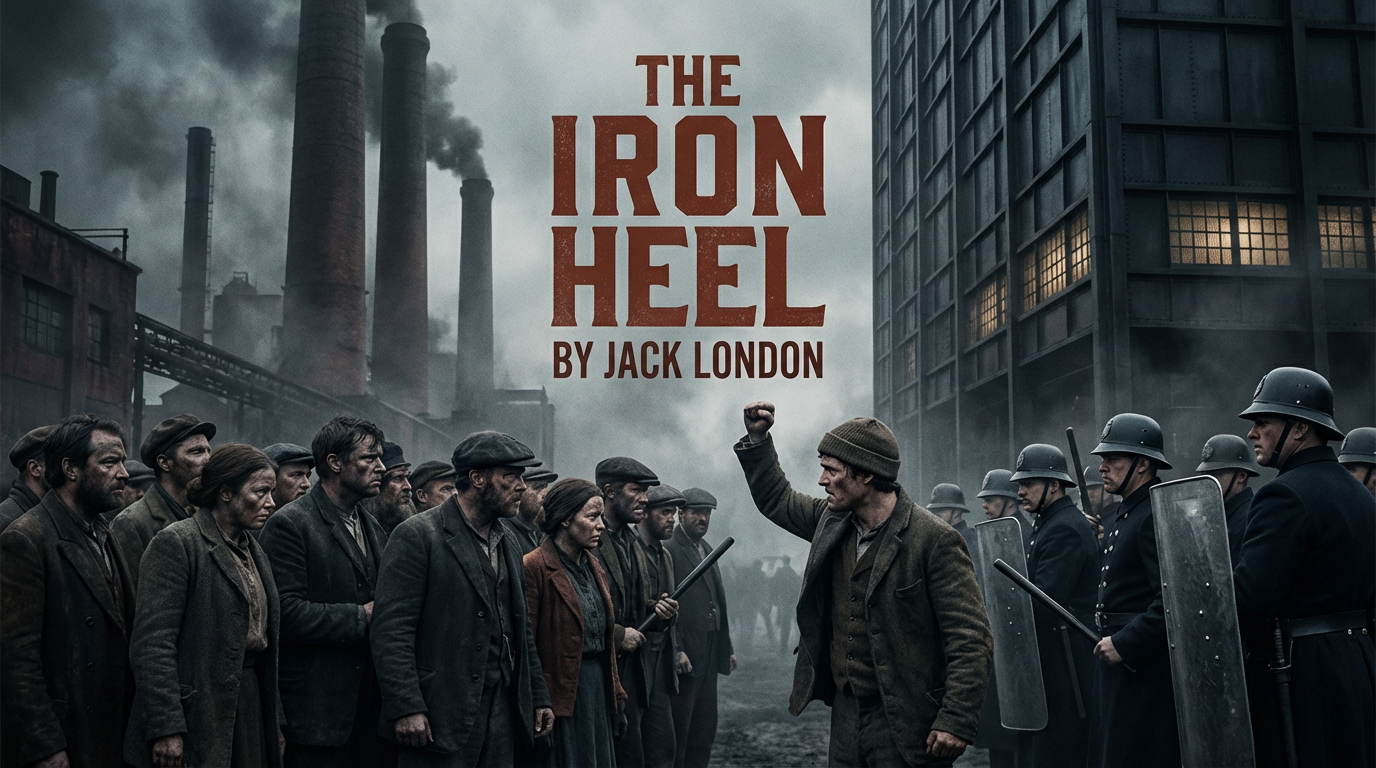
An excerpt from the original text.(complete · 3484 words)
THE TERRORISTS
It was not until Ernest and I were back in New York, and after weeks
had elapsed, that we were able to comprehend thoroughly the full sweep
of the disaster that had befallen the Cause. The situation was bitter
and bloody. In many places, scattered over the country, slave revolts
and massacres had occurred. The roll of the martyrs increased mightily.
Countless executions took place everywhere. The mountains and waste
regions were filled with outlaws and refugees who were being hunted
down mercilessly. Our own refuges were packed with comrades who had
prices on their heads. Through information furnished by its spies,
scores of our refuges were raided by the soldiers of the Iron Heel.
Many of the comrades were disheartened, and they retaliated with
terroristic tactics. The set-back to their hopes made them despairing
and desperate. Many terrorist organizations unaffiliated with us sprang
into existence and caused us much trouble.[1] These misguided people
sacrificed their own lives wantonly, very often made our own plans go
astray, and retarded our organization.
[1] The annals of this short-lived era of despair make bloody reading.
Revenge was the ruling motive, and the members of the terroristic
organizations were careless of their own lives and hopeless about the
future. The Danites, taking their name from the avenging angels of the
Mormon mythology, sprang up in the mountains of the Great West and
spread over the Pacific Coast from Panama to Alaska. The Valkyries
were women. They were the most terrible of all. No woman was eligible
for membership who had not lost near relatives at the hands of the
Oligarchy. They were guilty of torturing their prisoners to death.
Another famous organization of women was The Widows of War. A
companion organization to the Valkyries was the Berserkers. These men
placed no value whatever upon their own lives, and it was they who
totally destroyed the great Mercenary city of Bellona along with its
population of over a hundred thousand souls. The Bedlamites and the
Helldamites were twin slave organizations, while a new religious sect
that did not flourish long was called The Wrath of God. Among others,
to show the whimsicality of their deadly seriousness, may be mentioned
the following: The Bleeding Hearts, Sons of the Morning, the Morning
Stars, The Flamingoes, The Triple Triangles, The Three Bars, The
Rubonics, The Vindicators, The Comanches, and the Erebusites.
And through it all moved the Iron Heel, impassive and deliberate,
shaking up the whole fabric of the social structure in its search for
the comrades, combing out the Mercenaries, the labor castes, and all
its secret services, punishing without mercy and without malice,
suffering in silence all retaliations that were made upon it, and
filling the gaps in its fighting line as fast as they appeared. And
hand in hand with this, Ernest and the other leaders were hard at work
reorganizing the forces of the Revolution. The magnitude of the task
may be understood when it is taken into.[2]
[2] This is the end of the Everhard Manuscript. It breaks off abruptly
in the middle of a sentence. She must have received warning of the
coming of the Mercenaries, for she had time safely to hide the
Manuscript before she fled or was captured. It is to be regretted that
she did not live to complete her narrative, for then, undoubtedly,
would have been cleared away the mystery that has shrouded for seven
centuries the execution of Ernest Everhard.
*** END OF THE PROJECT GUTENBERG EBOOK THE IRON HEEL ***
Updated editions will replace the previous one—the old editions will
be renamed.
Creating the works from print editions not protected by U.S. copyright
law means that no one owns a United States copyright in these works,
so the Foundation (and you!) can copy and distribute it in the United
States without permission and without paying copyright
royalties. Special rules, set forth in the General Terms of Use part
of this license, apply to copying and distributing Project
Gutenberg™ electronic works to protect the PROJECT GUTENBERG™
concept and trademark. Project Gutenberg is a registered trademark,
and may not be used if you charge for an eBook, except by following
the terms of the trademark license, including paying royalties for use
of the Project Gutenberg trademark. If you do not charge anything for
copies of this eBook, complying with the trademark license is very
easy. You may use this eBook for nearly any purpose such as creation
of derivative works, reports, performances and research. Project
Gutenberg eBooks may be modified and printed and given away—you may
do practically ANYTHING in the United States with eBooks not protected
by U.S. copyright law. Redistribution is subject to the trademark
license, especially commercial redistribution.
START: FULL LICENSE
THE FULL PROJECT GUTENBERG™ LICENSE
PLEASE READ THIS BEFORE YOU DISTRIBUTE OR USE THIS WORK
To protect the Project Gutenberg™ mission of promoting the free
distribution of electronic works, by using or distributing this work
(or any other work associated in any way with the phrase “Project
Gutenberg”), you agree to comply with all the terms of the Full
Project Gutenberg License available with this file or online at
www.gutenberg.org/license.
Section 1. General Terms of Use and Redistributing Project Gutenberg
electronic works
1.A. By reading or using any part of this Project Gutenberg
electronic work, you indicate that you have read, understand, agree to
and accept all the terms of this license and intellectual property
(trademark/copyright) agreement. If you do not agree to abide by all
the terms of this agreement, you must cease using and return or
destroy all copies of Project Gutenberg electronic works in your
possession. If you paid a fee for obtaining a copy of or access to a
Project Gutenberg electronic work and you do not agree to be bound
by the terms of this agreement, you may obtain a refund from the person
or entity to whom you paid the fee as set forth in paragraph 1.E.8.
1.B. “Project Gutenberg” is a registered trademark. It may only be
used on or associated in any way with an electronic work by people who
agree to be bound by the terms of this agreement. There are a few
things that you can do with most Project Gutenberg electronic works
even without complying with the full terms of this agreement. See
paragraph 1.C below. There are a lot of things you can do with Project
Gutenberg electronic works if you follow the terms of this
agreement and help preserve free future access to Project Gutenberg
electronic works. See paragraph 1.E below.
1.C. The Project Gutenberg Literary Archive Foundation (“the
Foundation” or PGLAF), owns a compilation copyright in the collection
of Project Gutenberg electronic works. Nearly all the individual
works in the collection are in the public domain in the United
States. If an individual work is unprotected by copyright law in the
United States and you are located in the United States, we do not
claim a right to prevent you from copying, distributing, performing,
displaying or creating derivative works based on the work as long as
all references to Project Gutenberg are removed. Of course, we hope
that you will support the Project Gutenberg mission of promoting
free access to electronic works by freely sharing Project Gutenberg
works in compliance with the terms of this agreement for keeping the
Project Gutenberg name associated with the work. You can easily
comply with the terms of this agreement by keeping this work in the
same format with its attached full Project Gutenberg License when
you share it without charge with others.
1.D. The copyright laws of the place where you are located also govern
what you can do with this work. Copyright laws in most countries are
in a constant state of change. If you are outside the United States,
check the laws of your country in addition to the terms of this
agreement before downloading, copying, displaying, performing,
distributing or creating derivative works based on this work or any
other Project Gutenberg work. The Foundation makes no
representations concerning the copyright status of any work in any
country other than the United States.
1.E. Unless you have removed all references to Project Gutenberg:
1.E.1. The following sentence, with active links to, or other
immediate access to, the full Project Gutenberg License must appear
prominently whenever any copy of a Project Gutenberg work (any work
on which the phrase “Project Gutenberg” appears, or with which the
phrase “Project Gutenberg” is associated) is accessed, displayed,
performed, viewed, copied or distributed:
This eBook is for the use of anyone anywhere in the United States and most
other parts of the world at no cost and with almost no restrictions
whatsoever. You may copy it, give it away or re-use it under the terms
of the Project Gutenberg™ License included with this eBook or online
at www.gutenberg.org. If you
are not located in the United States, you will have to check the laws
of the country where you are located before using this eBook.
1.E.2. If an individual Project Gutenberg electronic work is
derived from texts not protected by U.S. copyright law (does not
contain a notice indicating that it is posted with permission of the
copyright holder), the work can be copied and distributed to anyone in
the United States without paying any fees or charges. If you are
redistributing or providing access to a work with the phrase “Project
Gutenberg” associated with or appearing on the work, you must comply
either with the requirements of paragraphs 1.E.1 through 1.E.7 or
obtain permission for the use of the work and the Project Gutenberg
trademark as set forth in paragraphs 1.E.8 or 1.E.9.
1.E.3. If an individual Project Gutenberg electronic work is posted
with the permission of the copyright holder, your use and distribution
must comply with both paragraphs 1.E.1 through 1.E.7 and any
additional terms imposed by the copyright holder. Additional terms
will be linked to the Project Gutenberg License for all works
posted with the permission of the copyright holder found at the
beginning of this work.
1.E.4. Do not unlink or detach or remove the full Project Gutenberg
License terms from this work, or any files containing a part of this
work or any other work associated with Project Gutenberg.
1.E.5. Do not copy, display, perform, distribute or redistribute this
electronic work, or any part of this electronic work, without
prominently displaying the sentence set forth in paragraph 1.E.1 with
active links or immediate access to the full terms of the Project
Gutenberg License.
1.E.6. You may convert to and distribute this work in any binary,
compressed, marked up, nonproprietary or proprietary form, including
any word processing or hypertext form. However, if you provide access
to or distribute copies of a Project Gutenberg work in a format
other than “Plain Vanilla ASCII” or other format used in the official
version posted on the official Project Gutenberg website
(www.gutenberg.org), you must, at no additional cost, fee or expense
to the user, provide a copy, a means of exporting a copy, or a means
of obtaining a copy upon request, of the work in its original “Plain
Vanilla ASCII” or other form. Any alternate format must include the
full Project Gutenberg License as specified in paragraph 1.E.1.
1.E.7. Do not charge a fee for access to, viewing, displaying,
performing, copying or distributing any Project Gutenberg works
unless you comply with paragraph 1.E.8 or 1.E.9.
1.E.8. You may charge a reasonable fee for copies of or providing
access to or distributing Project Gutenberg electronic works
provided that:
• You pay a royalty fee of 20% of the gross profits you derive from
the use of Project Gutenberg works calculated using the method
you already use to calculate your applicable taxes. The fee is owed
to the owner of the Project Gutenberg trademark, but he has
agreed to donate royalties under this paragraph to the Project
Gutenberg Literary Archive Foundation. Royalty payments must be paid
within 60 days following each date on which you prepare (or are
legally required to prepare) your periodic tax returns. Royalty
payments should be clearly marked as such and sent to the Project
Gutenberg Literary Archive Foundation at the address specified in
Section 4, “Information about donations to the Project Gutenberg
Literary Archive Foundation.”
• You provide a full refund of any money paid by a user who notifies
you in writing (or by e-mail) within 30 days of receipt that s/he
does not agree to the terms of the full Project Gutenberg™
License. You must require such a user to return or destroy all
copies of the works possessed in a physical medium and discontinue
all use of and all access to other copies of Project Gutenberg™
works.
• You provide, in accordance with paragraph 1.F.3, a full refund of
any money paid for a work or a replacement copy, if a defect in the
electronic work is discovered and reported to you within 90 days of
receipt of the work.
• You comply with all other terms of this agreement for free
distribution of Project Gutenberg™ works.
1.E.9. If you wish to charge a fee or distribute a Project
Gutenberg™ electronic work or group of works on different terms than
are set forth in this agreement, you must obtain permission in writing
from the Project Gutenberg Literary Archive Foundation, the manager of
the Project Gutenberg™ trademark. Contact the Foundation as set
forth in Section 3 below.
1.F.
1.F.1. Project Gutenberg volunteers and employees expend considerable
effort to identify, do copyright research on, transcribe and proofread
works not protected by U.S. copyright law in creating the Project
Gutenberg™ collection. Despite these efforts, Project Gutenberg™
electronic works, and the medium on which they may be stored, may
contain “Defects,” such as, but not limited to, incomplete, inaccurate
or corrupt data, transcription errors, a copyright or other
intellectual property infringement, a defective or damaged disk or
other medium, a computer virus, or computer codes that damage or
cannot be read by your equipment.
1.F.2. LIMITED WARRANTY, DISCLAIMER OF DAMAGES - Except for the “Right
of Replacement or Refund” described in paragraph 1.F.3, the Project
Gutenberg Literary Archive Foundation, the owner of the Project
Gutenberg™ trademark, and any other party distributing a Project
Gutenberg™ electronic work under this agreement, disclaim all
liability to you for damages, costs and expenses, including legal
fees. YOU AGREE THAT YOU HAVE NO REMEDIES FOR NEGLIGENCE, STRICT
LIABILITY, BREACH OF WARRANTY OR BREACH OF CONTRACT EXCEPT THOSE
PROVIDED IN PARAGRAPH 1.F.3. YOU AGREE THAT THE FOUNDATION, THE
TRADEMARK OWNER, AND ANY DISTRIBUTOR UNDER THIS AGREEMENT WILL NOT BE
LIABLE TO YOU FOR ACTUAL, DIRECT, INDIRECT, CONSEQUENTIAL, PUNITIVE OR
INCIDENTAL DAMAGES EVEN IF YOU GIVE NOTICE OF THE POSSIBILITY OF SUCH
DAMAGE.
1.F.3. LIMITED RIGHT OF REPLACEMENT OR REFUND - If you discover a
defect in this electronic work within 90 days of receiving it, you can
receive a refund of the money (if any) you paid for it by sending a
written explanation to the person you received the work from. If you
received the work on a physical medium, you must return the medium
with your written explanation. The person or entity that provided you
with the defective work may elect to provide a replacement copy in
lieu of a refund. If you received the work electronically, the person
or entity providing it to you may choose to give you a second
opportunity to receive the work electronically in lieu of a refund. If
the second copy is also defective, you may demand a refund in writing
without further opportunities to fix the problem.
1.F.4. Except for the limited right of replacement or refund set forth
in paragraph 1.F.3, this work is provided to you ‘AS-IS’, WITH NO
OTHER WARRANTIES OF ANY KIND, EXPRESS OR IMPLIED, INCLUDING BUT NOT
LIMITED TO WARRANTIES OF MERCHANTABILITY OR FITNESS FOR ANY PURPOSE.
1.F.5. Some states do not allow disclaimers of certain implied
warranties or the exclusion or limitation of certain types of
damages. If any disclaimer or limitation set forth in this agreement
violates the law of the state applicable to this agreement, the
agreement shall be interpreted to make the maximum disclaimer or
limitation permitted by the applicable state law. The invalidity or
unenforceability of any provision of this agreement shall not void the
remaining provisions.
1.F.6. INDEMNITY - You agree to indemnify and hold the Foundation, the
trademark owner, any agent or employee of the Foundation, anyone
providing copies of Project Gutenberg™ electronic works in
accordance with this agreement, and any volunteers associated with the
production, promotion and distribution of Project Gutenberg™
electronic works, harmless from all liability, costs and expenses,
including legal fees, that arise directly or indirectly from any of
the following which you do or cause to occur: (a) distribution of this
or any Project Gutenberg work, (b) alteration, modification, or
additions or deletions to any Project Gutenberg work, and (c) any
Defect you cause.
Section 2. Information about the Mission of Project Gutenberg
Project Gutenberg is synonymous with the free distribution of
electronic works in formats readable by the widest variety of
computers including obsolete, old, middle-aged and new computers. It
exists because of the efforts of hundreds of volunteers and donations
from people in all walks of life.
Volunteers and financial support to provide volunteers with the
assistance they need are critical to reaching Project Gutenberg’s
goals and ensuring that the Project Gutenberg collection will
remain freely available for generations to come. In 2001, the Project
Gutenberg Literary Archive Foundation was created to provide a secure
and permanent future for Project Gutenberg and future
generations. To learn more about the Project Gutenberg Literary
Archive Foundation and how your efforts and donations can help, see
Sections 3 and 4 and the Foundation information page at www.gutenberg.org.
Section 3. Information about the Project Gutenberg Literary Archive Foundation
The Project Gutenberg Literary Archive Foundation is a non-profit
501(c)(3) educational corporation organized under the laws of the
state of Mississippi and granted tax exempt status by the Internal
Revenue Service. The Foundation’s EIN or federal tax identification
number is 64-6221541. Contributions to the Project Gutenberg Literary
Archive Foundation are tax deductible to the full extent permitted by
U.S. federal laws and your state’s laws.
The Foundation’s business office is located at 41 Watchung Plaza #516,
Montclair NJ 07042, USA, +1 (862) 621-9288. Email contact links and up
to date contact information can be found at the Foundation’s website
and official page at www.gutenberg.org/contact
Section 4. Information about Donations to the Project Gutenberg
Literary Archive Foundation
Project Gutenberg™ depends upon and cannot survive without widespread
public support and donations to carry out its mission of
increasing the number of public domain and licensed works that can be
freely distributed in machine-readable form accessible by the widest
array of equipment including outdated equipment. Many small donations
($1 to $5,000) are particularly important to maintaining tax exempt
status with the IRS.
The Foundation is committed to complying with the laws regulating
charities and charitable donations in all 50 states of the United
States. Compliance requirements are not uniform and it takes a
considerable effort, much paperwork and many fees to meet and keep up
with these requirements. We do not solicit donations in locations
where we have not received written confirmation of compliance. To SEND
DONATIONS or determine the status of compliance for any particular state
visit www.gutenberg.org/donate.
While we cannot and do not solicit contributions from states where we
have not met the solicitation requirements, we know of no prohibition
against accepting unsolicited donations from donors in such states who
approach us with offers to donate.
International donations are gratefully accepted, but we cannot make
any statements concerning tax treatment of donations received from
outside the United States. U.S. laws alone swamp our small staff.
Please check the Project Gutenberg web pages for current donation
methods and addresses. Donations are accepted in a number of other
ways including checks, online payments and credit card donations. To
donate, please visit: www.gutenberg.org/donate.
Section 5. General Information About Project Gutenberg electronic works
Professor Michael S. Hart was the originator of the Project
Gutenberg concept of a library of electronic works that could be
freely shared with anyone. For forty years, he produced and
distributed Project Gutenberg eBooks with only a loose network of
volunteer support.
Project Gutenberg eBooks are often created from several printed
editions, all of which are confirmed as not protected by copyright in
the U.S. unless a copyright notice is included. Thus, we do not
necessarily keep eBooks in compliance with any particular paper
edition.
Most people start at our website which has the main PG search
facility: www.gutenberg.org.
This website includes information about Project Gutenberg,
including how to make donations to the Project Gutenberg Literary
Archive Foundation, how to help produce our new eBooks, and how to
subscribe to our email newsletter to hear about new eBooks.
Master this chapter. Complete your experience
Purchase the complete book to access all chapters and support classic literature
As an Amazon Associate, we earn a small commission from qualifying purchases at no additional cost to you.
Available in paperback, hardcover, and e-book formats
Let's Analyse the Pattern
When justified anger transforms into destructive vengeance that ultimately serves the oppressor's interests by providing justification for increased brutality.
Why This Matters
Connect literature to life
This chapter teaches how to recognize when righteous anger transforms into self-defeating behavior that actually serves your opponent's interests.
Practice This Today
This week, notice when you feel that surge of righteous anger - pause and ask: 'Will this action advance my actual goals, or just make me feel better right now?'
Now let's explore the literary elements.
Key Quotes & Analysis
"The set-back to their hopes made them despairing and desperate."
Context: Avis explains why revolutionaries turned to terrorism after their defeat
This shows how defeat doesn't just end movements - it can transform them into something destructive. When people lose hope in organized change, they often turn to violence that actually helps their enemies by justifying harsher crackdowns.
In Today's Words:
When people feel completely hopeless, they'll do anything just to hurt back, even if it makes things worse.
"These misguided people sacrificed their own lives wantonly, very often made our own plans go astray, and retarded our organization."
Context: Avis describing how terrorist groups hurt the revolutionary cause
This reveals the bitter irony that the terrorists, born from the revolution's failure, actually make future success impossible. Their random violence gives the Iron Heel justification for more oppression and turns public opinion against all resistance.
In Today's Words:
These people throwing their lives away for revenge are actually making it harder for the rest of us to create real change.
"Revenge was the ruling motive, and the members of the terroristic organizations were careless of their own lives and hopeless about the future."
Context: Describing the mindset of the terrorist groups that emerged after the revolution's defeat
This captures how trauma transforms people's entire worldview. When systematic change seems impossible, some people abandon strategy for pure emotional release, not caring about consequences or effectiveness.
In Today's Words:
They just wanted to hurt someone back and didn't care if they lived or died doing it.
Thematic Threads
Trauma Response
In This Chapter
The revolutionaries' defeat transforms them from strategic fighters into vengeful terrorists, their trauma driving them toward self-destructive violence
Development
Evolved from earlier hope and organization into complete psychological breakdown
In Your Life:
You might see this when workplace mistreatment makes you lash out at innocent coworkers instead of addressing the real problem.
Strategic Thinking
In This Chapter
The splinter groups abandon careful planning for immediate emotional satisfaction, destroying their own cause through poorly targeted violence
Development
Complete reversal from the earlier disciplined revolutionary organization
In Your Life:
You might recognize this when you're so angry about an injustice that you want to 'burn it all down' instead of finding ways to actually win.
Oppressor Psychology
In This Chapter
The Iron Heel remains methodical and patient, using the revolutionaries' emotional responses to justify increased brutality and maintain power
Development
Continuation of their calculated approach, now benefiting from their enemies' mistakes
In Your Life:
You might see this when authority figures use your emotional reactions as justification for treating you worse.
Cause Corruption
In This Chapter
Noble revolutionary ideals become excuses for torture and mass murder, with groups like the Valkyries losing all connection to their original purpose
Development
Final degradation of the pure revolutionary spirit shown in earlier chapters
In Your Life:
You might notice this when your legitimate grievances become reasons to hurt people who aren't actually responsible for your problems.
Documentation
In This Chapter
Avis's manuscript ends abruptly as she hides her writings from approaching soldiers, preserving the record even as everything else collapses
Development
Her role as chronicler becomes her final act of resistance
In Your Life:
You might find this relevant when documenting workplace abuse or family dysfunction—sometimes the record is the only thing that survives.
You now have the context. Time to form your own thoughts.
Discussion Questions
- 1
After their failed uprising, what happened to the revolutionary movement and how did the surviving groups change their methods?
analysis • surface - 2
Why did groups like the Valkyries and Berserkers actually hurt their own cause, even though they were fighting against oppression?
analysis • medium - 3
Where do you see this pattern today - people responding to injustice in ways that give their opponents more power over them?
application • medium - 4
When you've been treated unfairly, how do you tell the difference between strategic action that helps your cause and emotional reaction that might backfire?
application • deep - 5
What does this chapter reveal about how trauma and defeat can transform people's values and judgment?
reflection • deep
Critical Thinking Exercise
Strategic vs. Emotional Response Analysis
Think of a recent situation where you felt angry about unfair treatment - at work, in your family, or in your community. Write down three possible responses: one purely emotional, one strategic, and one that combines both. For each response, predict what the other side would do next and whether it would help or hurt your long-term goals.
Consider:
- •Consider how your opponent might use your emotional response as justification for their actions
- •Think about whether your response builds allies or pushes potential supporters away
- •Ask yourself if this action moves you closer to what you actually want or just makes you feel better temporarily
Journaling Prompt
Write about a time when your anger about unfair treatment led you to act in a way that ultimately gave the other side more ammunition against you. What would you do differently now?



