
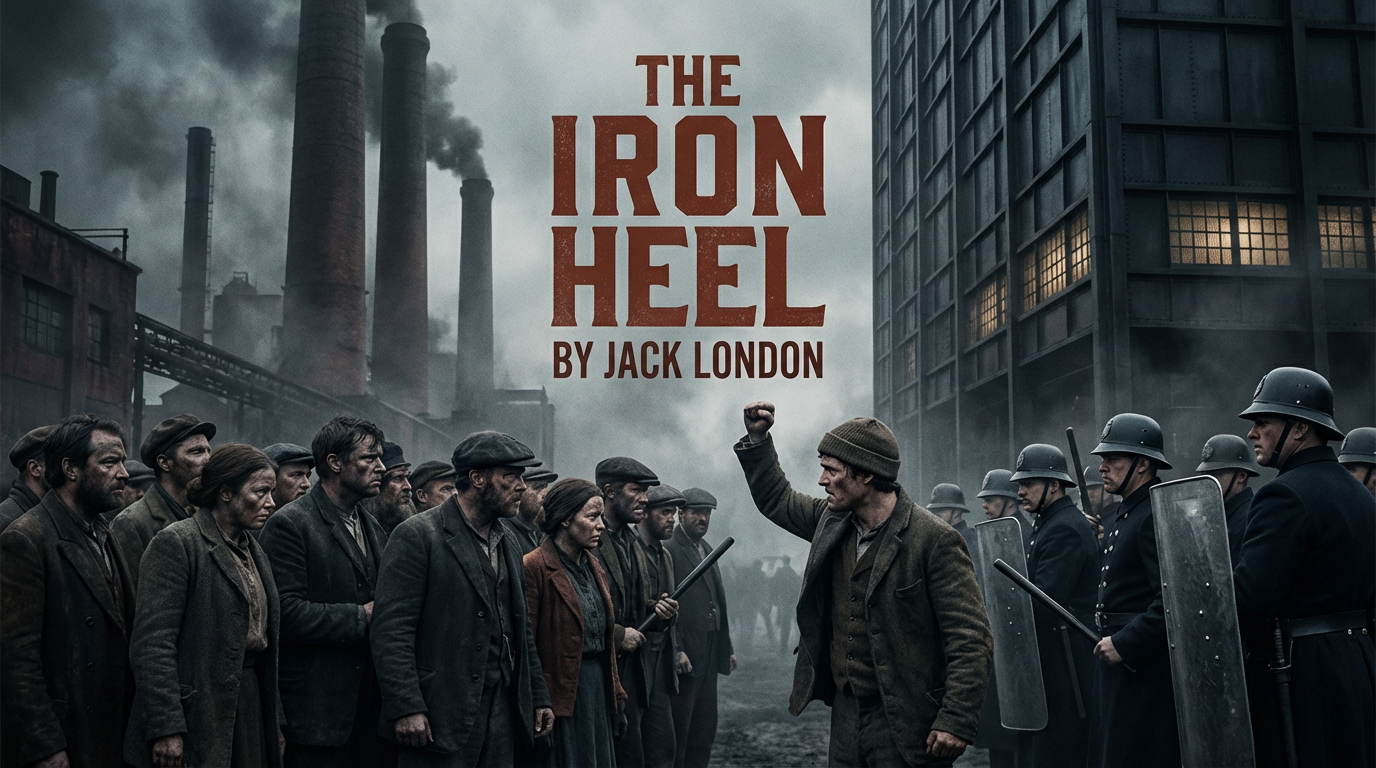
An excerpt from the original text.(complete · 3225 words)
THE GENERAL STRIKE
Of course Ernest was elected to Congress in the great socialist
landslide that took place in the fall of 1912. One great factor that
helped to swell the socialist vote was the destruction of Hearst.[1]
This the Plutocracy found an easy task. It cost Hearst eighteen million
dollars a year to run his various papers, and this sum, and more, he
got back from the middle class in payment for advertising. The source
of his financial strength lay wholly in the middle class. The trusts
did not advertise.[2] To destroy Hearst, all that was necessary was to
take away from him his advertising.
[1] William Randolph Hearst—a young California millionaire who
became the most powerful newspaper owner in the country. His
newspapers were published in all the large cities, and they appealed
to the perishing middle class and to the proletariat. So large was his
following that he managed to take possession of the empty shell of the
old Democratic Party. He occupied an anomalous position, preaching an
emasculated socialism combined with a nondescript sort of petty
bourgeois capitalism. It was oil and water, and there was no hope for
him, though for a short period he was a source of serious apprehension
to the Plutocrats.
[2] The cost of advertising was amazing in those helter- skelter
times. Only the small capitalists competed, and therefore they did the
advertising. There being no competition where there was a trust, there
was no need for the trusts to advertise.
The whole middle class had not yet been exterminated. The sturdy
skeleton of it remained; but it was without power. The small
manufacturers and small business men who still survived were at the
complete mercy of the Plutocracy. They had no economic nor political
souls of their own. When the fiat of the Plutocracy went forth, they
withdrew their advertisements from the Hearst papers.
Hearst made a gallant fight. He brought his papers out at a loss of a
million and a half each month. He continued to publish the
advertisements for which he no longer received pay. Again the fiat of
the Plutocracy went forth, and the small business men and manufacturers
swamped him with a flood of notices that he must discontinue running
their old advertisements. Hearst persisted. Injunctions were served on
him. Still he persisted. He received six months’ imprisonment for
contempt of court in disobeying the injunctions, while he was
bankrupted by countless damage suits. He had no chance. The Plutocracy
had passed sentence on him. The courts were in the hands of the
Plutocracy to carry the sentence out. And with Hearst crashed also to
destruction the Democratic Party that he had so recently captured.
With the destruction of Hearst and the Democratic Party, there were
only two paths for his following to take. One was into the Socialist
Party; the other was into the Republican Party. Then it was that we
socialists reaped the fruit of Hearst’s pseudo-socialistic preaching;
for the great Majority of his followers came over to us.
The expropriation of the farmers that took place at this time would
also have swelled our vote had it not been for the brief and futile
rise of the Grange Party. Ernest and the socialist leaders fought
fiercely to capture the farmers; but the destruction of the socialist
press and publishing houses constituted too great a handicap, while the
mouth-to-mouth propaganda had not yet been perfected. So it was that
politicians like Mr. Calvin, who were themselves farmers long since
expropriated, captured the farmers and threw their political strength
away in a vain campaign.
“The poor farmers,” Ernest once laughed savagely; “the trusts have them
both coming and going.”
And that was really the situation. The seven great trusts, working
together, had pooled their enormous surpluses and made a farm trust.
The railroads, controlling rates, and the bankers and stock exchange
gamesters, controlling prices, had long since bled the farmers into
indebtedness. The bankers, and all the trusts for that matter, had
likewise long since loaned colossal amounts of money to the farmers.
The farmers were in the net. All that remained to be done was the
drawing in of the net. This the farm trust proceeded to do.
The hard times of 1912 had already caused a frightful slump in the farm
markets. Prices were now deliberately pressed down to bankruptcy, while
the railroads, with extortionate rates, broke the back of the
farmer-camel. Thus the farmers were compelled to borrow more and more,
while they were prevented from paying back old loans. Then ensued the
great foreclosing of mortgages and enforced collection of notes. The
farmers simply surrendered the land to the farm trust. There was
nothing else for them to do. And having surrendered the land, the
farmers next went to work for the farm trust, becoming managers,
superintendents, foremen, and common laborers. They worked for wages.
They became villeins, in short—serfs bound to the soil by a living
wage. They could not leave their masters, for their masters composed
the Plutocracy. They could not go to the cities, for there, also, the
Plutocracy was in control. They had but one alternative,—to leave the
soil and become vagrants, in brief, to starve. And even there they were
frustrated, for stringent vagrancy laws were passed and rigidly
enforced.
Of course, here and there, farmers, and even whole communities of
farmers, escaped expropriation by virtue of exceptional conditions. But
they were merely strays and did not count, and they were gathered in
anyway during the following year.[3]
[3] The destruction of the Roman yeomanry proceeded far less rapidly
than the destruction of the American farmers and small capitalists.
There was momentum in the twentieth century, while there was
practically none in ancient Rome.
Numbers of the farmers, impelled by an insane lust for the soil,
and willing to show what beasts they could become, tried to escape
expropriation by withdrawing from any and all market-dealing. They
sold nothing. They bought nothing. Among themselves a primitive
barter began to spring up. Their privation and hardships were
terrible, but they persisted. It became quite a movement, in fact.
The manner in which they were beaten was unique and logical and
simple. The Plutocracy, by virtue of its possession of the
government, raised their taxes. It was the weak joint in their
armor. Neither buying nor selling, they had no money, and in the
end their land was sold to pay the taxes.
Thus it was that in the fall of 1912 the socialist leaders, with the
exception of Ernest, decided that the end of capitalism had come. What
of the hard times and the consequent vast army of the unemployed; what
of the destruction of the farmers and the middle class; and what of the
decisive defeat administered all along the line to the labor unions;
the socialists were really justified in believing that the end of
capitalism had come and in themselves throwing down the gauntlet to the
Plutocracy.
Alas, how we underestimated the strength of the enemy! Everywhere the
socialists proclaimed their coming victory at the ballot-box, while, in
unmistakable terms, they stated the situation. The Plutocracy accepted
the challenge. It was the Plutocracy, weighing and balancing, that
defeated us by dividing our strength. It was the Plutocracy, through
its secret agents, that raised the cry that socialism was sacrilegious
and atheistic; it was the Plutocracy that whipped the churches, and
especially the Catholic Church, into line, and robbed us of a portion
of the labor vote. And it was the Plutocracy, through its secret agents
of course, that encouraged the Grange Party and even spread it to the
cities into the ranks of the dying middle class.
Nevertheless the socialist landslide occurred. But, instead of a
sweeping victory with chief executive officers and majorities in all
legislative bodies, we found ourselves in the minority. It is true, we
elected fifty Congressmen; but when they took their seats in the spring
of 1913, they found themselves without power of any sort. Yet they were
more fortunate than the Grangers, who captured a dozen state
governments, and who, in the spring, were not permitted to take
possession of the captured offices. The incumbents refused to retire,
and the courts were in the hands of the Oligarchy. But this is too far
in advance of events. I have yet to tell of the stirring times of the
winter of 1912.
The hard times at home had caused an immense decrease in consumption.
Labor, out of work, had no wages with which to buy. The result was that
the Plutocracy found a greater surplus than ever on its hands. This
surplus it was compelled to dispose of abroad, and, what of its
colossal plans, it needed money. Because of its strenuous efforts to
dispose of the surplus in the world market, the Plutocracy clashed with
Germany. Economic clashes were usually succeeded by wars, and this
particular clash was no exception. The great German war-lord prepared,
and so did the United States prepare.
The war-cloud hovered dark and ominous. The stage was set for a
world-catastrophe, for in all the world were hard times, labor
troubles, perishing middle classes, armies of unemployed, clashes of
economic interests in the world-market, and mutterings and rumblings of
the socialist revolution.[4]
[4] For a long time these mutterings and rumblings had been heard. As
far back as 1906 A.D., Lord Avebury, an Englishman, uttered the
following in the House of Lords: “The unrest in Europe, the spread of
socialism, and the ominous rise of Anarchism, are warnings to the
governments and the ruling classes that the condition of the working
classes in Europe is becoming intolerable, and that if a revolution is
to be avoided some steps must be taken to increase wages, reduce the
hours of labor, and lower the prices of the necessaries of life.” The
Wall Street Journal, a stock gamesters’ publication, in commenting
upon Lord Avebury’s speech, said: “These words were spoken by an
aristocrat and a member of the most conservative body in all Europe.
That gives them all the more significance. They contain more valuable
political economy than is to be found in most of the books. They sound
a note of warning. Take heed, gentlemen of the war and navy
departments!”
At the same time, Sydney Brooks, writing in America, in Harper’s
Weekly, said: “You will not hear the socialists mentioned in
Washington. Why should you? The politicians are always the last
people in this country to see what is going on under their noses.
They will jeer at me when I prophesy, and prophesy with the utmost
confidence, that at the next presidential election the socialists
will poll over a million votes.”
The Oligarchy wanted the war with Germany. And it wanted the war for a
dozen reasons. In the juggling of events such a war would cause, in the
reshuffling of the international cards and the making of new treaties
and alliances, the Oligarchy had much to gain. And, furthermore, the
war would consume many national surpluses, reduce the armies of
unemployed that menaced all countries, and give the Oligarchy a
breathing space in which to perfect its plans and carry them out. Such
a war would virtually put the Oligarchy in possession of the
world-market. Also, such a war would create a large standing army that
need never be disbanded, while in the minds of the people would be
substituted the issue, “America versus Germany,” in place of
“Socialism versus Oligarchy.”
And truly the war would have done all these things had it not been for
the socialists. A secret meeting of the Western leaders was held in our
four tiny rooms in Pell Street. Here was first considered the stand the
socialists were to take. It was not the first time we had put our foot
down upon war,[5] but it was the first time we had done so in the
United States. After our secret meeting we got in touch with the
national organization, and soon our code cables were passing back and
forth across the Atlantic between us and the International Bureau.
[5] It was at the very beginning of the twentieth century A.D., that
the international organization of the socialists finally formulated
their long-maturing policy on war. Epitomized their doctrine was:
“Why should the workingmen of one country fight with the workingmen
of another country for the benefit of their capitalist masters?”
On May 21, 1905 A.D., when war threatened between Austria and
Italy, the socialists of Italy, Austria, and Hungary held a
conference at Trieste, and threatened a general strike of the
workingmen of both countries in case war was declared. This was
repeated the following year, when the “Morocco Affair” threatened
to involve France, Germany, and England.
The German socialists were ready to act with us. There were over five
million of them, many of them in the standing army, and, in addition,
they were on friendly terms with the labor unions. In both countries
the socialists came out in bold declaration against the war and
threatened the general strike. And in the meantime they made
preparation for the general strike. Furthermore, the revolutionary
parties in all countries gave public utterance to the socialist
principle of international peace that must be preserved at all hazards,
even to the extent of revolt and revolution at home.
The general strike was the one great victory we American socialists
won. On the 4th of December the American minister was withdrawn from
the German capital. That night a German fleet made a dash on Honolulu,
sinking three American cruisers and a revenue cutter, and bombarding
the city. Next day both Germany and the United States declared war, and
within an hour the socialists called the general strike in both
countries.
For the first time the German war-lord faced the men of his empire who
made his empire go. Without them he could not run his empire. The
novelty of the situation lay in that their revolt was passive. They did
not fight. They did nothing. And by doing nothing they tied their
war-lord’s hands. He would have asked for nothing better than an
opportunity to loose his war-dogs on his rebellious proletariat. But
this was denied him. He could not loose his war-dogs. Neither could he
mobilize his army to go forth to war, nor could he punish his
recalcitrant subjects. Not a wheel moved in his empire. Not a train
ran, not a telegraphic message went over the wires, for the
telegraphers and railroad men had ceased work along with the rest of
the population.
And as it was in Germany, so it was in the United States. At last
organized labor had learned its lesson. Beaten decisively on its own
chosen field, it had abandoned that field and come over to the
political field of the socialists; for the general strike was a
political strike. Besides, organized labor had been so badly beaten
that it did not care. It joined in the general strike out of sheer
desperation. The workers threw down their tools and left their tasks by
the millions. Especially notable were the machinists. Their heads were
bloody, their organization had apparently been destroyed, yet out they
came, along with their allies in the metal-working trades.
Even the common laborers and all unorganized labor ceased work. The
strike had tied everything up so that nobody could work. Besides, the
women proved to be the strongest promoters of the strike. They set
their faces against the war. They did not want their men to go forth to
die. Then, also, the idea of the general strike caught the mood of the
people. It struck their sense of humor. The idea was infectious. The
children struck in all the schools, and such teachers as came, went
home again from deserted class rooms. The general strike took the form
of a great national picnic. And the idea of the solidarity of labor, so
evidenced, appealed to the imagination of all. And, finally, there was
no danger to be incurred by the colossal frolic. When everybody was
guilty, how was anybody to be punished?
The United States was paralyzed. No one knew what was happening. There
were no newspapers, no letters, no despatches. Every community was as
completely isolated as though ten thousand miles of primeval wilderness
stretched between it and the rest of the world. For that matter, the
world had ceased to exist. And for a week this state of affairs was
maintained.
In San Francisco we did not know what was happening even across the bay
in Oakland or Berkeley. The effect on one’s sensibilities was weird,
depressing. It seemed as though some great cosmic thing lay dead. The
pulse of the land had ceased to beat. Of a truth the nation had died.
There were no wagons rumbling on the streets, no factory whistles, no
hum of electricity in the air, no passing of street cars, no cries of
news-boys—nothing but persons who at rare intervals went by like
furtive ghosts, themselves oppressed and made unreal by the silence.
And during that week of silence the Oligarchy was taught its lesson.
And well it learned the lesson. The general strike was a warning. It
should never occur again. The Oligarchy would see to that.
At the end of the week, as had been prearranged, the telegraphers of
Germany and the United States returned to their posts. Through them the
socialist leaders of both countries presented their ultimatum to the
rulers. The war should be called off, or the general strike would
continue. It did not take long to come to an understanding. The war was
declared off, and the populations of both countries returned to their
tasks.
It was this renewal of peace that brought about the alliance between
Germany and the United States. In reality, this was an alliance between
the Emperor and the Oligarchy, for the purpose of meeting their common
foe, the revolutionary proletariat of both countries. And it was this
alliance that the Oligarchy afterward so treacherously broke when the
German socialists rose and drove the war-lord from his throne. It was
the very thing the Oligarchy had played for—the destruction of its
great rival in the world-market. With the German Emperor out of the
way, Germany would have no surplus to sell abroad. By the very nature
of the socialist state, the German population would consume all that it
produced. Of course, it would trade abroad certain things it produced
for things it did not produce; but this would be quite different from
an unconsumable surplus.
“I’ll wager the Oligarchy finds justification,” Ernest said, when its
treachery to the German Emperor became known. “As usual, the Oligarchy
will believe it has done right.”
And sure enough. The Oligarchy’s public defence for the act was that it
had done it for the sake of the American people whose interests it was
looking out for. It had flung its hated rival out of the world-market
and enabled us to dispose of our surplus in that market.
“And the howling folly of it is that we are so helpless that such
idiots really are managing our interests,” was Ernest’s comment. “They
have enabled us to sell more abroad, which means that we’ll be
compelled to consume less at home.”
Master this chapter. Complete your experience
Purchase the complete book to access all chapters and support classic literature
As an Amazon Associate, we earn a small commission from qualifying purchases at no additional cost to you.
Available in paperback, hardcover, and e-book formats
Let's Analyse the Pattern
When faced with organized resistance that threatens their fundamental power, competing authorities will temporarily unite to eliminate the common threat.
Why This Matters
Connect literature to life
This chapter teaches how to recognize when competing authorities unite against challenges to their shared power structure.
Practice This Today
This week, notice when managers who normally compete suddenly agree when workers organize, or when rival companies coordinate responses to labor complaints.
Now let's explore the literary elements.
Key Quotes & Analysis
"The source of his financial strength lay wholly in the middle class. The trusts did not advertise."
Context: Explaining how the Plutocracy identified Hearst's weakness before destroying him
This reveals the strategic thinking of the ruling class - they don't attack enemies directly but analyze their economic dependencies. Hearst seemed powerful but relied entirely on middle-class advertising revenue, making him vulnerable to coordinated pressure.
In Today's Words:
They figured out where his money really came from and cut him off at the source.
"To destroy Hearst, all that was necessary was to take away from him his advertising."
Context: Describing the Plutocracy's simple but effective strategy
This demonstrates how economic warfare works - find the pressure point and squeeze. No violence, no dramatic confrontation, just systematic financial strangulation. It's more efficient than traditional political opposition.
In Today's Words:
They didn't need to fight him - they just had to make him go broke.
"The general strike was the one great victory we American socialists won."
Context: Reflecting on the successful coordination between German and American workers to stop the war
This shows the immense power of organized labor when it acts collectively across national boundaries. The strike demonstrates that workers control the actual functioning of society - when they stop, everything stops. It's both a moment of triumph and a warning.
In Today's Words:
For once, working people actually used their real power and it worked perfectly.
Thematic Threads
Class Solidarity
In This Chapter
The ruling classes of Germany and America instantly cooperate when workers demonstrate real power through the general strike
Development
Evolution from individual resistance to collective action showing its true potential
In Your Life:
You might see this when coworkers finally band together and management suddenly takes notice of issues they've ignored for months.
Economic Warfare
In This Chapter
The Plutocracy destroys opposition through financial strangulation—cutting Hearst's advertising revenue and foreclosing on farms
Development
Expansion from earlier chapters showing how economic pressure replaces direct violence
In Your Life:
You might experience this when speaking up at work leads to subtle retaliation like reduced hours or being excluded from opportunities.
Strategic Deception
In This Chapter
The socialists celebrate the Oligarchy's moves as signs of capitalism's collapse, missing the trap being set
Development
Continuation of the theme where good intentions meet calculated manipulation
In Your Life:
You might fall into this when you think your employer's cost-cutting measures will lead to positive changes, not realizing they're consolidating control.
Power Recognition
In This Chapter
The general strike reveals the immense power workers possess when they act collectively and strategically
Development
Climactic demonstration of themes building throughout the book about organized resistance
In Your Life:
You might discover this when you and your neighbors finally coordinate to address a community problem that seemed impossible to solve individually.
Adaptive Control
In This Chapter
The Oligarchy learns from the strike's success and begins planning to ensure such effective resistance never happens again
Development
Introduction of how power structures evolve to counter successful resistance
In Your Life:
You might see this when a workplace policy change you fought for gets implemented but with new restrictions that limit its effectiveness.
You now have the context. Time to form your own thoughts.
Discussion Questions
- 1
When the German and American workers went on strike, what actually happened to both countries during that week?
analysis • surface - 2
Why did the German and American governments immediately call off their war after experiencing the general strike?
analysis • medium - 3
Think about your workplace or community - when have you seen competing groups suddenly unite against a common threat to their authority?
application • medium - 4
If you were organizing workers or trying to change policies at your job, how would you prepare for the moment when management coordinates against you?
application • deep - 5
What does this chapter reveal about when people in power will put aside their differences to protect their position?
reflection • deep
Critical Thinking Exercise
Map the Alliance Shift
Think of a situation where you've seen apparent enemies become allies when faced with a challenge to their shared power. Draw or describe the before and after: who was competing initially, what threat emerged, and how they coordinated their response. Then identify what this teaches you about navigating similar situations in your own life.
Consider:
- •Look for patterns where competition stops when authority itself is questioned
- •Consider how this applies to workplace dynamics, family situations, or community politics
- •Think about what strategies work when you're facing coordinated opposition
Journaling Prompt
Write about a time when you challenged a system and were surprised by who united against you. What would you do differently now, knowing that competing powers often coordinate when their shared authority is threatened?
Coming Up Next...
Chapter 14: The Iron Heel's Master Plan
The Oligarchy has learned from the general strike that organized labor poses an existential threat to their power. Now they begin implementing their final solution to eliminate this threat permanently, launching what will become known as the Beginning of the End.



