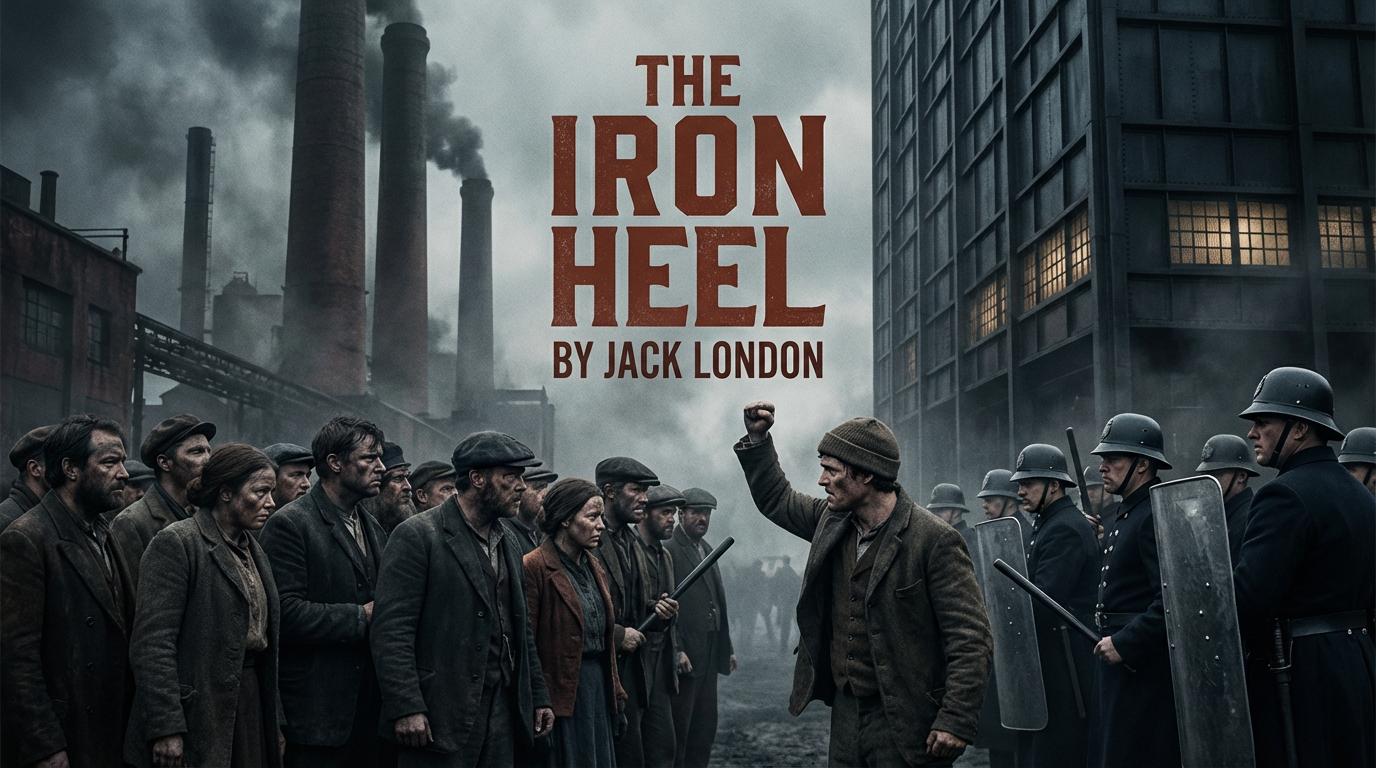
An excerpt from the original text.(complete · 2836 words)
THE BEGINNING OF THE END
As early as January, 1913, Ernest saw the true trend of affairs, but he
could not get his brother leaders to see the vision of the Iron Heel
that had arisen in his brain. They were too confident. Events were
rushing too rapidly to culmination. A crisis had come in world affairs.
The American Oligarchy was practically in possession of the
world-market, and scores of countries were flung out of that market
with unconsumable and unsalable surpluses on their hands. For such
countries nothing remained but reorganization. They could not continue
their method of producing surpluses. The capitalistic system, so far as
they were concerned, had hopelessly broken down.
The reorganization of these countries took the form of revolution. It
was a time of confusion and violence. Everywhere institutions and
governments were crashing. Everywhere, with the exception of two or
three countries, the erstwhile capitalist masters fought bitterly for
their possessions. But the governments were taken away from them by the
militant proletariat. At last was being realized Karl Marx’s classic:
“The knell of private capitalist property sounds. The expropriators are
expropriated.” And as fast as capitalistic governments crashed,
cooperative commonwealths arose in their place.
“Why does the United States lag behind?”; “Get busy, you American
revolutionists!”; “What’s the matter with America?”—were the messages
sent to us by our successful comrades in other lands. But we could not
keep up. The Oligarchy stood in the way. Its bulk, like that of some
huge monster, blocked our path.
“Wait till we take office in the spring,” we answered. “Then you’ll
see.”
Behind this lay our secret. We had won over the Grangers, and in the
spring a dozen states would pass into their hands by virtue of the
elections of the preceding fall. At once would be instituted a dozen
cooperative commonwealth states. After that, the rest would be easy.
“But what if the Grangers fail to get possession?” Ernest demanded. And
his comrades called him a calamity howler.
But this failure to get possession was not the chief danger that Ernest
had in mind. What he foresaw was the defection of the great labor
unions and the rise of the castes.
“Ghent has taught the oligarchs how to do it,” Ernest said. “I’ll wager
they’ve made a text-book out of his ‘Benevolent Feudalism.’”[1]
[1] “Our Benevolent Feudalism,” a book published in 1902 A.D., by W.
J. Ghent. It has always been insisted that Ghent put the idea of the
Oligarchy into the minds of the great capitalists. This belief
persists throughout the literature of the three centuries of the Iron
Heel, and even in the literature of the first century of the
Brotherhood of Man. To-day we know better, but our knowledge does not
overcome the fact that Ghent remains the most abused innocent man in
all history.
Never shall I forget the night when, after a hot discussion with half a
dozen labor leaders, Ernest turned to me and said quietly: “That
settles it. The Iron Heel has won. The end is in sight.”
This little conference in our home was unofficial; but Ernest, like the
rest of his comrades, was working for assurances from the labor leaders
that they would call out their men in the next general strike.
O’Connor, the president of the Association of Machinists, had been
foremost of the six leaders present in refusing to give such assurance.
“You have seen that you were beaten soundly at your old tactics of
strike and boycott,” Ernest urged.
O’Connor and the others nodded their heads.
“And you saw what a general strike would do,” Ernest went on. “We
stopped the war with Germany. Never was there so fine a display of the
solidarity and the power of labor. Labor can and will rule the world.
If you continue to stand with us, we’ll put an end to the reign of
capitalism. It is your only hope. And what is more, you know it. There
is no other way out. No matter what you do under your old tactics, you
are doomed to defeat, if for no other reason because the masters
control the courts.”[2]
[2] As a sample of the decisions of the courts adverse to labor, the
following instances are given. In the coal- mining regions the
employment of children was notorious. In 1905 A.D., labor succeeded in
getting a law passed in Pennsylvania providing that proof of the age
of the child and of certain educational qualifications must accompany
the oath of the parent. This was promptly declared unconstitutional by
the Luzerne County Court, on the ground that it violated the
Fourteenth Amendment in that it discriminated between individuals of
the same class—namely, children above fourteen years of age and
children below. The state court sustained the decision. The New York
Court of Special Sessions, in 1905 A.D., declared unconstitutional the
law prohibiting minors and women from working in factories after nine
o’clock at night, the ground taken being that such a law was “class
legislation.” Again, the bakers of that time were terribly overworked.
The New York Legislature passed a law restricting work in bakeries to
ten hours a day. In 1906 A.D., the Supreme Court of the United States
declared this law to be unconstitutional. In part the decision read:
“There is no reasonable ground for interfering with the liberty of
persons or the right of free contract by determining the hours of
labor in the occupation of a baker.”
“You run ahead too fast,” O’Connor answered. “You don’t know all the
ways out. There is another way out. We know what we’re about. We’re
sick of strikes. They’ve got us beaten that way to a frazzle. But I
don’t think we’ll ever need to call our men out again.”
“What is your way out?” Ernest demanded bluntly.
O’Connor laughed and shook his head. “I can tell you this much: We’ve
not been asleep. And we’re not dreaming now.”
“There’s nothing to be afraid of, or ashamed of, I hope,” Ernest
challenged.
“I guess we know our business best,” was the retort.
“It’s a dark business, from the way you hide it,” Ernest said with
growing anger.
“We’ve paid for our experience in sweat and blood, and we’ve earned all
that’s coming to us,” was the reply. “Charity begins at home.”
“If you’re afraid to tell me your way out, I’ll tell it to you.”
Ernest’s blood was up. “You’re going in for grab-sharing. You’ve made
terms with the enemy, that’s what you’ve done. You’ve sold out the
cause of labor, of all labor. You are leaving the battle-field like
cowards.”
“I’m not saying anything,” O’Connor answered sullenly. “Only I guess we
know what’s best for us a little bit better than you do.”
“And you don’t care a cent for what is best for the rest of labor. You
kick it into the ditch.”
“I’m not saying anything,” O’Connor replied, “except that I’m president
of the Machinists’ Association, and it’s my business to consider the
interests of the men I represent, that’s all.”
And then, when the labor leaders had left, Ernest, with the calmness of
defeat, outlined to me the course of events to come.
“The socialists used to foretell with joy,” he said, “the coming of the
day when organized labor, defeated on the industrial field, would come
over on to the political field. Well, the Iron Heel has defeated the
labor unions on the industrial field and driven them over to the
political field; and instead of this being joyful for us, it will be a
source of grief. The Iron Heel learned its lesson. We showed it our
power in the general strike. It has taken steps to prevent another
general strike.”
“But how?” I asked.
“Simply by subsidizing the great unions. They won’t join in the next
general strike. Therefore it won’t be a general strike.”
“But the Iron Heel can’t maintain so costly a programme forever,” I
objected.
“Oh, it hasn’t subsidized all of the unions. That’s not necessary. Here
is what is going to happen. Wages are going to be advanced and hours
shortened in the railroad unions, the iron and steel workers unions,
and the engineer and machinist unions. In these unions more favorable
conditions will continue to prevail. Membership in these unions will
become like seats in Paradise.”
“Still I don’t see,” I objected. “What is to become of the other
unions? There are far more unions outside of this combination than in
it.”
“The other unions will be ground out of existence—all of them. For,
don’t you see, the railway men, machinists and engineers, iron and
steel workers, do all of the vitally essential work in our machine
civilization. Assured of their faithfulness, the Iron Heel can snap its
fingers at all the rest of labor. Iron, steel, coal, machinery, and
transportation constitute the backbone of the whole industrial fabric.”
“But coal?” I queried. “There are nearly a million coal miners.”
They are practically unskilled labor. They will not count. Their wages
will go down and their hours will increase. They will be slaves like
all the rest of us, and they will become about the most bestial of all
of us. They will be compelled to work, just as the farmers are
compelled to work now for the masters who robbed them of their land.
And the same with all the other unions outside the combination. Watch
them wobble and go to pieces, and their members become slaves driven to
toil by empty stomachs and the law of the land.
“Do you know what will happen to Farley[3] and his strike-breakers?
I’ll tell you. Strike-breaking as an occupation will cease. There won’t
be any more strikes. In place of strikes will be slave revolts. Farley
and his gang will be promoted to slave-driving. Oh, it won’t be called
that; it will be called enforcing the law of the land that compels the
laborers to work. It simply prolongs the fight, this treachery of the
big unions. Heaven only knows now where and when the Revolution will
triumph.”
[3] James Farley—a notorious strike-breaker of the period. A man more
courageous than ethical, and of undeniable ability. He rose high under
the rule of the Iron Heel and finally was translated into the oligarch
class. He was assassinated in 1932 by Sarah Jenkins, whose husband,
thirty years before, had been killed by Farley’s strike-breakers.
“But with such a powerful combination as the Oligarchy and the big
unions, is there any reason to believe that the Revolution will ever
triumph?” I queried. “May not the combination endure forever?”
He shook his head. “One of our generalizations is that every system
founded upon class and caste contains within itself the germs of its
own decay. When a system is founded upon class, how can caste be
prevented? The Iron Heel will not be able to prevent it, and in the end
caste will destroy the Iron Heel. The oligarchs have already developed
caste among themselves; but wait until the favored unions develop
caste. The Iron Heel will use all its power to prevent it, but it will
fail.
“In the favored unions are the flower of the American workingmen. They
are strong, efficient men. They have become members of those unions
through competition for place. Every fit workman in the United States
will be possessed by the ambition to become a member of the favored
unions. The Oligarchy will encourage such ambition and the consequent
competition. Thus will the strong men, who might else be
revolutionists, be won away and their strength used to bolster the
Oligarchy.
“On the other hand, the labor castes, the members of the favored
unions, will strive to make their organizations into close
corporations. And they will succeed. Membership in the labor castes
will become hereditary. Sons will succeed fathers, and there will be no
inflow of new strength from that eternal reservoir of strength, the
common people. This will mean deterioration of the labor castes, and in
the end they will become weaker and weaker. At the same time, as an
institution, they will become temporarily all-powerful. They will be
like the guards of the palace in old Rome, and there will be palace
revolutions whereby the labor castes will seize the reins of power. And
there will be counter-palace revolutions of the oligarchs, and
sometimes the one, and sometimes the other, will be in power. And
through it all the inevitable caste-weakening will go on, so that in
the end the common people will come into their own.”
This foreshadowing of a slow social evolution was made when Ernest was
first depressed by the defection of the great unions. I never agreed
with him in it, and I disagree now, as I write these lines, more
heartily than ever; for even now, though Ernest is gone, we are on the
verge of the revolt that will sweep all oligarchies away. Yet I have
here given Ernest’s prophecy because it was his prophecy. In spite of
his belief in it, he worked like a giant against it, and he, more than
any man, has made possible the revolt that even now waits the signal to
burst forth.[4]
[4] Everhard’s social foresight was remarkable. As clearly as in the
light of past events, he saw the defection of the favored unions, the
rise and the slow decay of the labor castes, and the struggle between
the decaying oligarchs and labor castes for control of the great
governmental machine.
“But if the Oligarchy persists,” I asked him that evening, “what will
become of the great surpluses that will fall to its share every year?”
“The surpluses will have to be expended somehow,” he answered; “and
trust the oligarchs to find a way. Magnificent roads will be built.
There will be great achievements in science, and especially in art.
When the oligarchs have completely mastered the people, they will have
time to spare for other things. They will become worshippers of beauty.
They will become art-lovers. And under their direction and generously
rewarded, will toil the artists. The result will be great art; for no
longer, as up to yesterday, will the artists pander to the bourgeois
taste of the middle class. It will be great art, I tell you, and wonder
cities will arise that will make tawdry and cheap the cities of old
time. And in these cities will the oligarchs dwell and worship
beauty.[5]
[5] We cannot but marvel at Everhard’s foresight. Before ever the
thought of wonder cities like Ardis and Asgard entered the minds of
the oligarchs, Everhard saw those cities and the inevitable necessity
for their creation.
“Thus will the surplus be constantly expended while labor does the
work. The building of these great works and cities will give a
starvation ration to millions of common laborers, for the enormous bulk
of the surplus will compel an equally enormous expenditure, and the
oligarchs will build for a thousand years—ay, for ten thousand years.
They will build as the Egyptians and the Babylonians never dreamed of
building; and when the oligarchs have passed away, their great roads
and their wonder cities will remain for the brotherhood of labor to
tread upon and dwell within.[6]
[6] And since that day of prophecy, have passed away the three
centuries of the Iron Heel and the four centuries of the Brotherhood
of Man, and to-day we tread the roads and dwell in the cities that the
oligarchs built. It is true, we are even now building still more
wonderful wonder cities, but the wonder cities of the oligarchs
endure, and I write these lines in Ardis, one of the most wonderful of
them all.
“These things the oligarchs will do because they cannot help doing
them. These great works will be the form their expenditure of the
surplus will take, and in the same way that the ruling classes of Egypt
of long ago expended the surplus they robbed from the people by the
building of temples and pyramids. Under the oligarchs will flourish,
not a priest class, but an artist class. And in place of the merchant
class of bourgeoisie will be the labor castes. And beneath will be the
abyss, wherein will fester and starve and rot, and ever renew itself,
the common people, the great bulk of the population. And in the end,
who knows in what day, the common people will rise up out of the abyss;
the labor castes and the Oligarchy will crumble away; and then, at
last, after the travail of the centuries, will it be the day of the
common man. I had thought to see that day; but now I know that I shall
never see it.”
He paused and looked at me, and added:
“Social evolution is exasperatingly slow, isn’t it, sweetheart?”
My arms were about him, and his head was on my breast.
“Sing me to sleep,” he murmured whimsically. “I have had a visioning,
and I wish to forget.”
Master this chapter. Complete your experience
Purchase the complete book to access all chapters and support classic literature
As an Amazon Associate, we earn a small commission from qualifying purchases at no additional cost to you.
Available in paperback, hardcover, and e-book formats
Let's Analyse the Pattern
Power neutralizes opposition by elevating some resisters just enough to make them complicit in oppressing others.
Why This Matters
Connect literature to life
This chapter teaches how to recognize when power structures offer selective benefits to key players in order to neutralize broader resistance movements.
Practice This Today
This week, notice when someone in authority offers special treatment to potential troublemakers—what are they being asked to give up or ignore in exchange?
Now let's explore the literary elements.
Key Quotes & Analysis
"The knell of private capitalist property sounds. The expropriators are expropriated."
Context: Describing Marx's prediction coming true in other countries as revolutions succeed worldwide
This Marx quote means the wealthy who have stolen from workers are now having their wealth taken away. It shows how other countries are successfully overthrowing their oligarchies while America lags behind.
In Today's Words:
The rich who got wealthy off other people's work are finally getting what's coming to them.
"Why does the United States lag behind? Get busy, you American revolutionists! What's the matter with America?"
Context: Messages sent from successful revolutionaries in other countries wondering why America hasn't joined the global uprising
This highlights American exceptionalism in reverse - while the world moves toward worker control, America's oligarchy is too powerful and clever to be overthrown easily.
In Today's Words:
Come on, America, what's taking you so long? Everyone else is making progress while you're still stuck.
"Its bulk, like that of some huge monster, blocked our path"
Context: Describing how the American Oligarchy prevents revolutionary progress
The monster imagery shows how the Iron Heel has become something inhuman and monstrous in its power. It's not just people making bad choices, but a system that has grown beyond human control.
In Today's Words:
The system has become so big and powerful that it's like trying to fight a giant monster that blocks every path forward.
Thematic Threads
Betrayal
In This Chapter
Labor leaders secretly negotiate deals that benefit their unions while abandoning the broader movement
Development
Evolved from earlier solidarity to calculated self-interest
In Your Life:
You might see this when a coworker gets promoted and suddenly stops supporting your workplace complaints.
Class Division
In This Chapter
Ernest predicts a permanent labor aristocracy that will police the underclass for the oligarchs
Development
Deepened from simple rich vs. poor to complex hierarchical castes
In Your Life:
You might notice how different job titles create artificial barriers between workers facing the same employer.
Strategic Vision
In This Chapter
Ernest sees the long-term consequences while others focus on immediate gains
Development
His analytical abilities now extend to predicting centuries of social evolution
In Your Life:
You might recognize this when you see the real agenda behind a 'generous' policy change at work.
Isolation
In This Chapter
Ernest becomes increasingly alone as former allies accept compromises he sees as surrender
Development
His isolation deepens as his principles become more uncompromising
In Your Life:
You might feel this when standing up for something important costs you relationships with people you trusted.
Systemic Corruption
In This Chapter
The Iron Heel creates a system where even good people serve oppression by pursuing their own interests
Development
Corruption is revealed as structural rather than individual moral failing
In Your Life:
You might see this in how insurance systems pit patients against healthcare workers who both suffer from the same broken system.
You now have the context. Time to form your own thoughts.
Discussion Questions
- 1
What strategy does the Iron Heel use instead of crushing the unions directly, and why does Ernest see this as more dangerous than open warfare?
analysis • surface - 2
Why do you think the union leaders like O'Connor accept these deals when they know it means abandoning other workers?
analysis • medium - 3
Where do you see this 'divide and conquer' pattern in your workplace, community, or family—where some people get better treatment to keep them from supporting others?
application • medium - 4
If you were in Ernest's position, watching your allies take deals that undermine your cause, how would you respond without becoming bitter or isolated?
application • deep - 5
What does this chapter reveal about the difference between short-term survival and long-term solidarity, and why is it so hard for people to choose solidarity?
reflection • deep
Critical Thinking Exercise
Map the Buyout Strategy
Think of a situation in your life where people with shared interests got divided because some received better treatment. Draw a simple diagram showing who got the deal, what they had to give up, and who got left behind. Then identify the key decision point where unity could have been maintained.
Consider:
- •Look for situations where the 'deal' required abandoning support for others
- •Notice how the benefits offered were just enough to create loyalty but not real power
- •Consider whether those who took the deal actually ended up better off long-term
Journaling Prompt
Write about a time when you had to choose between accepting something good for yourself or standing with others who wouldn't benefit. What factors influenced your decision, and how do you feel about that choice now?
Coming Up Next...
Chapter 15: The Last Days
As Ernest's darkest predictions begin to unfold, time runs short for the revolutionary movement. The final confrontation approaches, and the personal cost of resistance becomes devastatingly clear.