
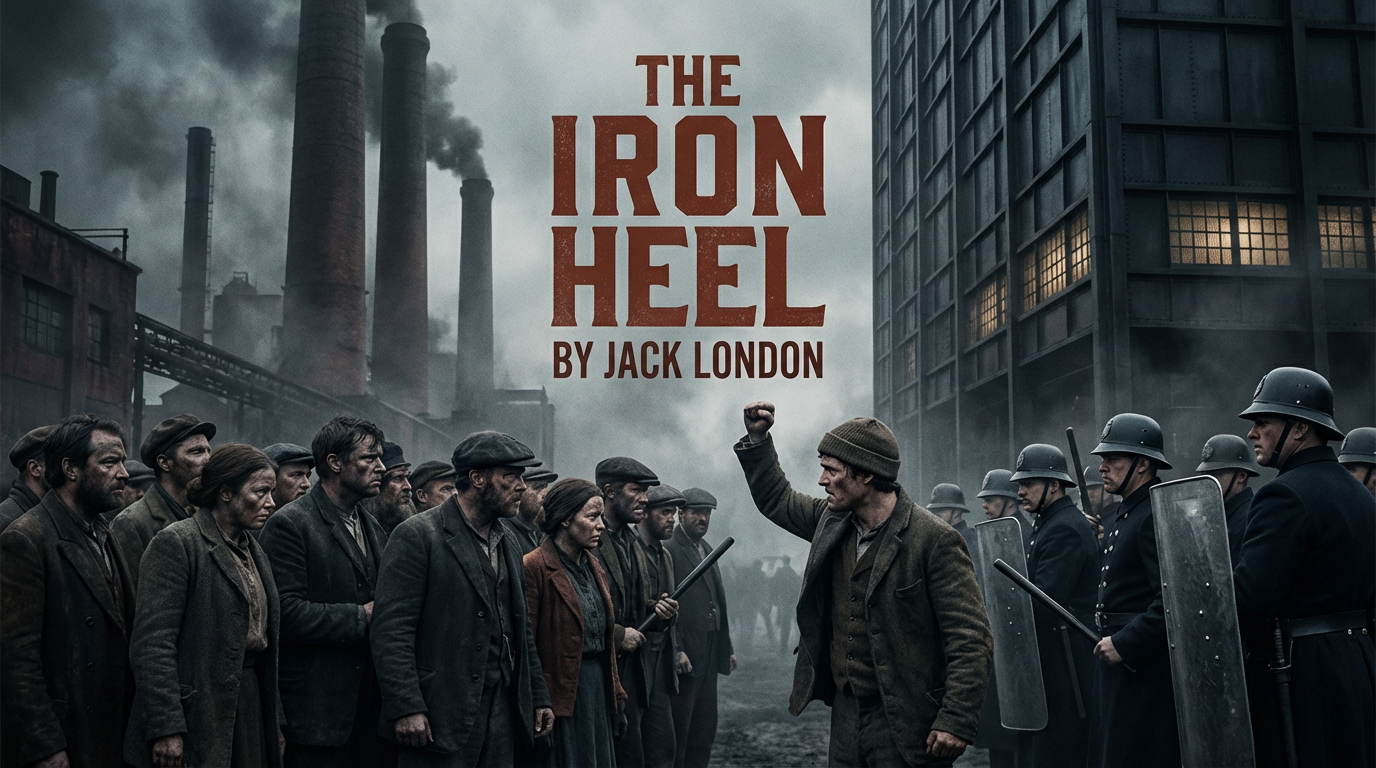
An excerpt from the original text.(complete · 1899 words)
LAST DAYS
It was near the end of January, 1913, that the changed attitude of the
Oligarchy toward the favored unions was made public. The newspapers
published information of an unprecedented rise in wages and shortening
of hours for the railroad employees, the iron and steel workers, and
the engineers and machinists. But the whole truth was not told. The
oligarchs did not dare permit the telling of the whole truth. In
reality, the wages had been raised much higher, and the privileges were
correspondingly greater. All this was secret, but secrets will out.
Members of the favored unions told their wives, and the wives gossiped,
and soon all the labor world knew what had happened.
It was merely the logical development of what in the nineteenth century
had been known as grab-sharing. In the industrial warfare of that time,
profit-sharing had been tried. That is, the capitalists had striven to
placate the workers by interesting them financially in their work. But
profit-sharing, as a system, was ridiculous and impossible.
Profit-sharing could be successful only in isolated cases in the midst
of a system of industrial strife; for if all labor and all capital
shared profits, the same conditions would obtain as did obtain when
there was no profit-sharing.
So, out of the unpractical idea of profit-sharing, arose the practical
idea of grab-sharing. “Give us more pay and charge it to the public,”
was the slogan of the strong unions.[1] And here and there this selfish
policy worked successfully. In charging it to the public, it was
charged to the great mass of unorganized labor and of weakly organized
labor. These workers actually paid the increased wages of their
stronger brothers who were members of unions that were labor
monopolies. This idea, as I say, was merely carried to its logical
conclusion, on a large scale, by the combination of the oligarchs and
the favored unions.
[1] All the railroad unions entered into this combination with the
oligarchs, and it is of interest to note that the first definite
application of the policy of profit-grabbing was made by a railroad
union in the nineteenth century A.D., namely, the Brotherhood of
Locomotive Engineers. P. M. Arthur was for twenty years Grand Chief of
the Brotherhood. After the strike on the Pennsylvania Railroad in
1877, he broached a scheme to have the Locomotive Engineers make terms
with the railroads and to “go it alone” so far as the rest of the
labor unions were concerned. This scheme was eminently successful. It
was as successful as it was selfish, and out of it was coined the word
“arthurization,” to denote grab-sharing on the part of labor unions.
This word “arthurization” has long puzzled the etymologists, but its
derivation, I hope, is now made clear.
As soon as the secret of the defection of the favored unions leaked
out, there were rumblings and mutterings in the labor world. Next, the
favored unions withdrew from the international organizations and broke
off all affiliations. Then came trouble and violence. The members of
the favored unions were branded as traitors, and in saloons and
brothels, on the streets and at work, and, in fact, everywhere, they
were assaulted by the comrades they had so treacherously deserted.
Countless heads were broken, and there were many killed. No member of
the favored unions was safe. They gathered together in bands in order
to go to work or to return from work. They walked always in the middle
of the street. On the sidewalk they were liable to have their skulls
crushed by bricks and cobblestones thrown from windows and house-tops.
They were permitted to carry weapons, and the authorities aided them in
every way. Their persecutors were sentenced to long terms in prison,
where they were harshly treated; while no man, not a member of the
favored unions, was permitted to carry weapons. Violation of this law
was made a high misdemeanor and punished accordingly.
Outraged labor continued to wreak vengeance on the traitors. Caste
lines formed automatically. The children of the traitors were
persecuted by the children of the workers who had been betrayed, until
it was impossible for the former to play on the streets or to attend
the public schools. Also, the wives and families of the traitors were
ostracized, while the corner groceryman who sold provisions to them was
boycotted.
As a result, driven back upon themselves from every side, the traitors
and their families became clannish. Finding it impossible to dwell in
safety in the midst of the betrayed proletariat, they moved into new
localities inhabited by themselves alone. In this they were favored by
the oligarchs. Good dwellings, modern and sanitary, were built for
them, surrounded by spacious yards, and separated here and there by
parks and playgrounds. Their children attended schools especially built
for them, and in these schools manual training and applied science were
specialized upon. Thus, and unavoidably, at the very beginning, out of
this segregation arose caste. The members of the favored unions became
the aristocracy of labor. They were set apart from the rest of labor.
They were better housed, better clothed, better fed, better treated.
They were grab-sharing with a vengeance.
In the meantime, the rest of the working class was more harshly
treated. Many little privileges were taken away from it, while its
wages and its standard of living steadily sank down. Incidentally, its
public schools deteriorated, and education slowly ceased to be
compulsory. The increase in the younger generation of children who
could not read nor write was perilous.
The capture of the world-market by the United States had disrupted the
rest of the world. Institutions and governments were everywhere
crashing or transforming. Germany, Italy, France, Australia, and New
Zealand were busy forming cooperative commonwealths. The British Empire
was falling apart. England’s hands were full. In India revolt was in
full swing. The cry in all Asia was, “Asia for the Asiatics!” And
behind this cry was Japan, ever urging and aiding the yellow and brown
races against the white. And while Japan dreamed of continental empire
and strove to realize the dream, she suppressed her own proletarian
revolution. It was a simple war of the castes, Coolie versus Samurai,
and the coolie socialists were executed by tens of thousands. Forty
thousand were killed in the street-fighting of Tokio and in the futile
assault on the Mikado’s palace. Kobe was a shambles; the slaughter of
the cotton operatives by machine-guns became classic as the most
terrific execution ever achieved by modern war machines. Most savage of
all was the Japanese Oligarchy that arose. Japan dominated the East,
and took to herself the whole Asiatic portion of the world-market, with
the exception of India.
England managed to crush her own proletarian revolution and to hold on
to India, though she was brought to the verge of exhaustion. Also, she
was compelled to let her great colonies slip away from her. So it was
that the socialists succeeded in making Australia and New Zealand into
cooperative commonwealths. And it was for the same reason that Canada
was lost to the mother country. But Canada crushed her own socialist
revolution, being aided in this by the Iron Heel. At the same time, the
Iron Heel helped Mexico and Cuba to put down revolt. The result was
that the Iron Heel was firmly established in the New World. It had
welded into one compact political mass the whole of North America from
the Panama Canal to the Arctic Ocean.
And England, at the sacrifice of her great colonies, had succeeded only
in retaining India. But this was no more than temporary. The struggle
with Japan and the rest of Asia for India was merely delayed. England
was destined shortly to lose India, while behind that event loomed the
struggle between a united Asia and the world.
And while all the world was torn with conflict, we of the United States
were not placid and peaceful. The defection of the great unions had
prevented our proletarian revolt, but violence was everywhere. In
addition to the labor troubles, and the discontent of the farmers and
of the remnant of the middle class, a religious revival had blazed up.
An offshoot of the Seventh Day Adventists sprang into sudden
prominence, proclaiming the end of the world.
“Confusion thrice confounded!” Ernest cried. “How can we hope for
solidarity with all these cross purposes and conflicts?”
And truly the religious revival assumed formidable proportions. The
people, what of their wretchedness, and of their disappointment in all
things earthly, were ripe and eager for a heaven where industrial
tyrants entered no more than camels passed through needle-eyes.
Wild-eyed itinerant preachers swarmed over the land; and despite the
prohibition of the civil authorities, and the persecution for
disobedience, the flames of religious frenzy were fanned by countless
camp-meetings.
It was the last days, they claimed, the beginning of the end of the
world. The four winds had been loosed. God had stirred the nations to
strife. It was a time of visions and miracles, while seers and
prophetesses were legion. The people ceased work by hundreds of
thousands and fled to the mountains, there to await the imminent coming
of God and the rising of the hundred and forty and four thousand to
heaven. But in the meantime God did not come, and they starved to death
in great numbers. In their desperation they ravaged the farms for food,
and the consequent tumult and anarchy in the country districts but
increased the woes of the poor expropriated farmers.
Also, the farms and warehouses were the property of the Iron Heel.
Armies of troops were put into the field, and the fanatics were herded
back at the bayonet point to their tasks in the cities. There they
broke out in ever recurring mobs and riots. Their leaders were executed
for sedition or confined in madhouses. Those who were executed went to
their deaths with all the gladness of martyrs. It was a time of
madness. The unrest spread. In the swamps and deserts and waste places,
from Florida to Alaska, the small groups of Indians that survived were
dancing ghost dances and waiting the coming of a Messiah of their own.
And through it all, with a serenity and certitude that was terrifying,
continued to rise the form of that monster of the ages, the Oligarchy.
With iron hand and iron heel it mastered the surging millions, out of
confusion brought order, out of the very chaos wrought its own
foundation and structure.
“Just wait till we get in,” the Grangers said—Calvin said it to us in
our Pell Street quarters. “Look at the states we’ve captured. With you
socialists to back us, we’ll make them sing another song when we take
office.”
“The millions of the discontented and the impoverished are ours,” the
socialists said. “The Grangers have come over to us, the farmers, the
middle class, and the laborers. The capitalist system will fall to
pieces. In another month we send fifty men to Congress. Two years hence
every office will be ours, from the President down to the local
dog-catcher.”
To all of which Ernest would shake his head and say:
“How many rifles have you got? Do you know where you can get plenty of
lead? When it comes to powder, chemical mixtures are better than
mechanical mixtures, you take my word.”
Master this chapter. Complete your experience
Purchase the complete book to access all chapters and support classic literature
As an Amazon Associate, we earn a small commission from qualifying purchases at no additional cost to you.
Available in paperback, hardcover, and e-book formats
Let's Analyse the Pattern
Power maintains control by strategically elevating some potential opponents while crushing others, creating artificial divisions and bought loyalty.
Why This Matters
Connect literature to life
This chapter teaches how to identify when authority figures create artificial divisions to prevent unified resistance.
Practice This Today
This week, notice when management offers benefits to some workers but not others, and ask yourself: who benefits from this division?
Now let's explore the literary elements.
Key Quotes & Analysis
"Give us more pay and charge it to the public"
Context: Describing the slogan of the strong unions under the grab-sharing system
This quote reveals how the Oligarchy corrupts labor solidarity by letting some workers benefit at others' expense. It shows how divide-and-conquer works by making privileged workers complicit in exploitation.
In Today's Words:
We want our raise, and we don't care if everyone else pays for it through higher prices
"How many rifles have you got?"
Context: Asked when others boast about their growing political support and electoral victories
Ernest cuts through political illusions to the hard reality of power. He understands that when push comes to shove, the ruling class will use violence to maintain control, making political victories meaningless without force to back them up.
In Today's Words:
All your votes and protests won't matter when they decide to crack down - what's your real power?
"Secrets will out"
Context: Explaining how news of the favored unions' privileges spread despite attempts at secrecy
This shows how the Oligarchy's strategy depends on information control, but human nature makes perfect secrecy impossible. The revelation of unfair privileges destroys working-class unity.
In Today's Words:
You can't keep that kind of favoritism quiet - word always gets out
Thematic Threads
Class Division
In This Chapter
The Iron Heel creates a labor aristocracy with privileges that separate them from other workers, forcing them into different neighborhoods and lifestyles
Development
Evolved from earlier economic oppression into active social engineering and caste creation
In Your Life:
You might see this when management promotes certain workers to create distance from their former peers and prevent organizing
Betrayal
In This Chapter
Favored union workers are seen as traitors by other workers, leading to violence and assassination attempts between former allies
Development
Introduced here as the logical outcome of the Oligarchy's divide-and-conquer strategy
In Your Life:
You might experience this when accepting a promotion or benefit that requires you to enforce policies against former colleagues
False Hope
In This Chapter
Religious mania sweeps America as desperate people turn to apocalyptic beliefs when earthly solutions seem impossible
Development
New manifestation of how people seek escape when political and economic systems fail them completely
In Your Life:
You might see this in yourself or others when turning to extreme ideologies or magical thinking during overwhelming stress
Power Illusion
In This Chapter
Socialists celebrate electoral victories while Ernest asks the crucial question: 'How many rifles have you got?'
Development
Builds on earlier themes about the difference between apparent political power and real control
In Your Life:
You might experience this when confusing formal authority or titles with actual ability to create change
Strategic Violence
In This Chapter
The Iron Heel uses military force to control religious fanatics while allowing worker-on-worker violence to continue
Development
Shows how the Oligarchy applies violence selectively to maintain control while appearing to restore order
In Your Life:
You might see this in workplaces where certain conflicts are quickly shut down while others are allowed to fester
You now have the context. Time to form your own thoughts.
Discussion Questions
- 1
How does the Iron Heel prevent revolution by treating different groups of workers differently?
analysis • surface - 2
Why do the favored union workers end up fighting against other workers instead of joining them against the Oligarchy?
analysis • medium - 3
Where do you see this 'divide and purchase' strategy in workplaces, schools, or communities today?
application • medium - 4
If you were offered privileges that separated you from people facing similar struggles, how would you decide whether to accept?
application • deep - 5
What does this chapter reveal about how people choose between individual advancement and group solidarity?
reflection • deep
Critical Thinking Exercise
Map the Divide Strategy
Think of a situation where you've seen people who should be allies end up fighting each other instead of addressing the real source of their problems. Draw a simple diagram showing who has the real power, who gets bought off with privileges, and who gets left behind. Then identify what each group is really fighting about versus what they think they're fighting about.
Consider:
- •Look for who benefits most when natural allies turn against each other
- •Notice how privileges often come with conditions that prevent solidarity
- •Consider whether the conflict distracts from addressing the root cause
Journaling Prompt
Write about a time when you had to choose between accepting an advantage that separated you from others or standing with people in a similar situation. What influenced your decision, and how do you feel about it now?
Coming Up Next...
Chapter 16: The End of Open Warfare
As all the pieces fall into place and the final confrontation approaches, the true test of the revolution begins. Will Ernest's warnings about the need for armed resistance prove prophetic, or can the combined political movements find another way to challenge the Iron Heel's grip on power?



