
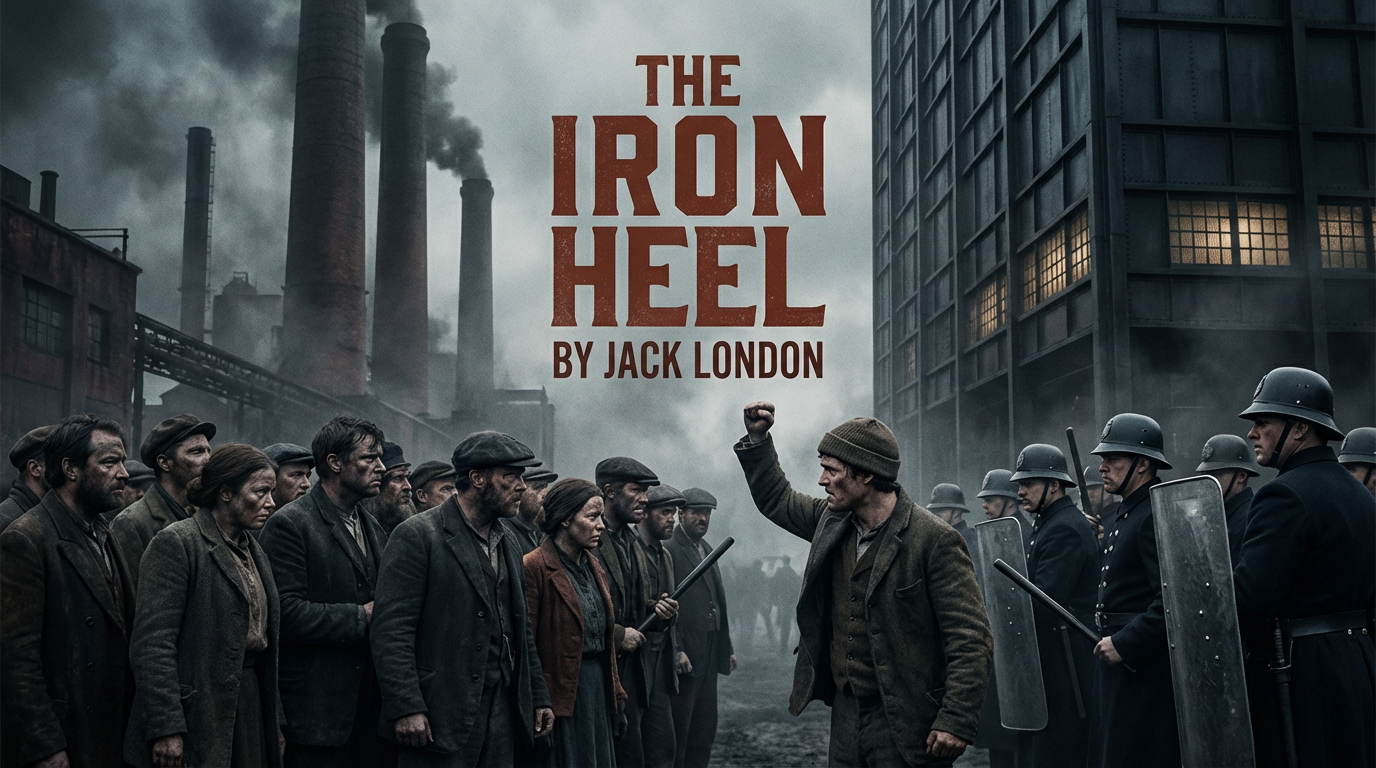
An excerpt from the original text.(complete · 3487 words)
THE END
When it came time for Ernest and me to go to Washington, father did not
accompany us. He had become enamoured of proletarian life. He looked
upon our slum neighborhood as a great sociological laboratory, and he
had embarked upon an apparently endless orgy of investigation. He
chummed with the laborers, and was an intimate in scores of homes.
Also, he worked at odd jobs, and the work was play as well as learned
investigation, for he delighted in it and was always returning home
with copious notes and bubbling over with new adventures. He was the
perfect scientist.
There was no need for his working at all, because Ernest managed to
earn enough from his translating to take care of the three of us. But
father insisted on pursuing his favorite phantom, and a protean phantom
it was, judging from the jobs he worked at. I shall never forget the
evening he brought home his street pedler’s outfit of shoe-laces and
suspenders, nor the time I went into the little corner grocery to make
some purchase and had him wait on me. After that I was not surprised
when he tended bar for a week in the saloon across the street. He
worked as a night watchman, hawked potatoes on the street, pasted
labels in a cannery warehouse, was utility man in a paper-box factory,
and water-carrier for a street railway construction gang, and even
joined the Dishwashers’ Union just before it fell to pieces.
I think the Bishop’s example, so far as wearing apparel was concerned,
must have fascinated father, for he wore the cheap cotton shirt of the
laborer and the overalls with the narrow strap about the hips. Yet one
habit remained to him from the old life; he always dressed for dinner,
or supper, rather.
I could be happy anywhere with Ernest; and father’s happiness in our
changed circumstances rounded out my own happiness.
“When I was a boy,” father said, “I was very curious. I wanted to know
why things were and how they came to pass. That was why I became a
physicist. The life in me to-day is just as curious as it was in my
boyhood, and it’s the being curious that makes life worth living.”
Sometimes he ventured north of Market Street into the shopping and
theatre district, where he sold papers, ran errands, and opened cabs.
There, one day, closing a cab, he encountered Mr. Wickson. In high glee
father described the incident to us that evening.
“Wickson looked at me sharply when I closed the door on him, and
muttered, ‘Well, I’ll be damned.’ Just like that he said it, ‘Well,
I’ll be damned.’ His face turned red and he was so confused that he
forgot to tip me. But he must have recovered himself quickly, for the
cab hadn’t gone fifty feet before it turned around and came back. He
leaned out of the door.
“‘Look here, Professor,’ he said, ‘this is too much. What can I do for
you?’
“‘I closed the cab door for you,’ I answered. ‘According to common
custom you might give me a dime.’
“‘Bother that!’ he snorted. ‘I mean something substantial.’
“He was certainly serious—a twinge of ossified conscience or something;
and so I considered with grave deliberation for a moment.
“His face was quite expectant when I began my answer, but you should
have seen it when I finished.
“‘You might give me back my home,’ I said, ‘and my stock in the Sierra
Mills.’”
Father paused.
“What did he say?” I questioned eagerly.
“What could he say? He said nothing. But I said, ‘I hope you are
happy.’ He looked at me curiously. ‘Tell me, are you happy?’” I asked.
“He ordered the cabman to drive on, and went away swearing horribly.
And he didn’t give me the dime, much less the home and stock; so you
see, my dear, your father’s street-arab career is beset with
disappointments.”
And so it was that father kept on at our Pell Street quarters, while
Ernest and I went to Washington. Except for the final consummation, the
old order had passed away, and the final consummation was nearer than I
dreamed. Contrary to our expectation, no obstacles were raised to
prevent the socialist Congressmen from taking their seats. Everything
went smoothly, and I laughed at Ernest when he looked upon the very
smoothness as something ominous.
We found our socialist comrades confident, optimistic of their strength
and of the things they would accomplish. A few Grangers who had been
elected to Congress increased our strength, and an elaborate programme
of what was to be done was prepared by the united forces. In all of
which Ernest joined loyally and energetically, though he could not
forbear, now and again, from saying, apropos of nothing in particular,
“When it comes to powder, chemical mixtures are better than mechanical
mixtures, you take my word.”
The trouble arose first with the Grangers in the various states they
had captured at the last election. There were a dozen of these states,
but the Grangers who had been elected were not permitted to take
office. The incumbents refused to get out. It was very simple. They
merely charged illegality in the elections and wrapped up the whole
situation in the interminable red tape of the law. The Grangers were
powerless. The courts were in the hands of their enemies.
This was the moment of danger. If the cheated Grangers became violent,
all was lost. How we socialists worked to hold them back! There were
days and nights when Ernest never closed his eyes in sleep. The big
leaders of the Grangers saw the peril and were with us to a man. But it
was all of no avail. The Oligarchy wanted violence, and it set its
agents-provocateurs to work. Without discussion, it was the
agents-provocateurs who caused the Peasant Revolt.
In a dozen states the revolt flared up. The expropriated farmers took
forcible possession of the state governments. Of course this was
unconstitutional, and of course the United States put its soldiers into
the field. Everywhere the agents-provocateurs urged the people on.
These emissaries of the Iron Heel disguised themselves as artisans,
farmers, and farm laborers. In Sacramento, the capital of California,
the Grangers had succeeded in maintaining order. Thousands of secret
agents were rushed to the devoted city. In mobs composed wholly of
themselves, they fired and looted buildings and factories. They worked
the people up until they joined them in the pillage. Liquor in large
quantities was distributed among the slum classes further to inflame
their minds. And then, when all was ready, appeared upon the scene the
soldiers of the United States, who were, in reality, the soldiers of
the Iron Heel. Eleven thousand men, women, and children were shot down
on the streets of Sacramento or murdered in their houses. The national
government took possession of the state government, and all was over
for California.
And as with California, so elsewhere. Every Granger state was ravaged
with violence and washed in blood. First, disorder was precipitated by
the secret agents and the Black Hundreds, then the troops were called
out. Rioting and mob-rule reigned throughout the rural districts. Day
and night the smoke of burning farms, warehouses, villages, and cities
filled the sky. Dynamite appeared. Railroad bridges and tunnels were
blown up and trains were wrecked. The poor farmers were shot and hanged
in great numbers. Reprisals were bitter, and many plutocrats and army
officers were murdered. Blood and vengeance were in men’s hearts. The
regular troops fought the farmers as savagely as had they been Indians.
And the regular troops had cause. Twenty-eight hundred of them had been
annihilated in a tremendous series of dynamite explosions in Oregon,
and in a similar manner, a number of train loads, at different times
and places, had been destroyed. So it was that the regular troops
fought for their lives as well as did the farmers.
As for the militia, the militia law of 1903 was put into effect, and
the workers of one state were compelled, under pain of death, to shoot
down their comrade-workers in other states. Of course, the militia law
did not work smoothly at first. Many militia officers were murdered,
and many militiamen were executed by drumhead court martial. Ernest’s
prophecy was strikingly fulfilled in the cases of Mr. Kowalt and Mr.
Asmunsen. Both were eligible for the militia, and both were drafted to
serve in the punitive expedition that was despatched from California
against the farmers of Missouri. Mr. Kowalt and Mr. Asmunsen refused to
serve. They were given short shrift. Drumhead court martial was their
portion, and military execution their end. They were shot with their
backs to the firing squad.
Many young men fled into the mountains to escape serving in the
militia. There they became outlaws, and it was not until more peaceful
times that they received their punishment. It was drastic. The
government issued a proclamation for all law-abiding citizens to come
in from the mountains for a period of three months. When the proclaimed
date arrived, half a million soldiers were sent into the mountainous
districts everywhere. There was no investigation, no trial. Wherever a
man was encountered, he was shot down on the spot. The troops operated
on the basis that no man not an outlaw remained in the mountains. Some
bands, in strong positions, fought gallantly, but in the end every
deserter from the militia met death.
A more immediate lesson, however, was impressed on the minds of the
people by the punishment meted out to the Kansas militia. The great
Kansas Mutiny occurred at the very beginning of military operations
against the Grangers. Six thousand of the militia mutinied. They had
been for several weeks very turbulent and sullen, and for that reason
had been kept in camp. Their open mutiny, however, was without doubt
precipitated by the agents-provocateurs.
On the night of the 22d of April they arose and murdered their
officers, only a small remnant of the latter escaping. This was beyond
the scheme of the Iron Heel, for the agents-provocateurs had done their
work too well. But everything was grist to the Iron Heel. It had
prepared for the outbreak, and the killing of so many officers gave it
justification for what followed. As by magic, forty thousand soldiers
of the regular army surrounded the malcontents. It was a trap. The
wretched militiamen found that their machine-guns had been tampered
with, and that the cartridges from the captured magazines did not fit
their rifles. They hoisted the white flag of surrender, but it was
ignored. There were no survivors. The entire six thousand were
annihilated. Common shell and shrapnel were thrown in upon them from a
distance, and, when, in their desperation, they charged the encircling
lines, they were mowed down by the machine-guns. I talked with an
eye-witness, and he said that the nearest any militiaman approached the
machine-guns was a hundred and fifty yards. The earth was carpeted with
the slain, and a final charge of cavalry, with trampling of horses’
hoofs, revolvers, and sabres, crushed the wounded into the ground.
Simultaneously with the destruction of the Grangers came the revolt of
the coal miners. It was the expiring effort of organized labor.
Three-quarters of a million of miners went out on strike. But they were
too widely scattered over the country to advantage from their own
strength. They were segregated in their own districts and beaten into
submission. This was the first great slave-drive. Pocock[1] won his
spurs as a slave-driver and earned the undying hatred of the
proletariat. Countless attempts were made upon his life, but he seemed
to bear a charmed existence. It was he who was responsible for the
introduction of the Russian passport system among the miners, and the
denial of their right of removal from one part of the country to
another.
[1] Albert Pocock, another of the notorious strike-breakers of earlier
years, who, to the day of his death, successfully held all the
coal-miners of the country to their task. He was succeeded by his son,
Lewis Pocock, and for five generations this remarkable line of
slave-drivers handled the coal mines. The elder Pocock, known as
Pocock I., has been described as follows: “A long, lean head,
semicircled by a fringe of brown and gray hair, with big cheek-bones
and a heavy chin, . . . a pale face, lustreless gray eyes, a metallic
voice, and a languid manner.” He was born of humble parents, and began
his career as a bartender. He next became a private detective for a
street railway corporation, and by successive steps developed into a
professional strikebreaker. Pocock V., the last of the line, was blown
up in a pump-house by a bomb during a petty revolt of the miners in
the Indian Territory. This occurred in 2073 A.D.
In the meantime, the socialists held firm. While the Grangers expired
in flame and blood, and organized labor was disrupted, the socialists
held their peace and perfected their secret organization. In vain the
Grangers pleaded with us. We rightly contended that any revolt on our
part was virtually suicide for the whole Revolution. The Iron Heel, at
first dubious about dealing with the entire proletariat at one time,
had found the work easier than it had expected, and would have asked
nothing better than an uprising on our part. But we avoided the issue,
in spite of the fact that agents-provocateurs swarmed in our midst. In
those early days, the agents of the Iron Heel were clumsy in their
methods. They had much to learn and in the meantime our Fighting Groups
weeded them out. It was bitter, bloody work, but we were fighting for
life and for the Revolution, and we had to fight the enemy with its own
weapons. Yet we were fair. No agent of the Iron Heel was executed
without a trial. We may have made mistakes, but if so, very rarely. The
bravest, and the most combative and self-sacrificing of our comrades
went into the Fighting Groups. Once, after ten years had passed, Ernest
made a calculation from figures furnished by the chiefs of the Fighting
Groups, and his conclusion was that the average life of a man or woman
after becoming a member was five years. The comrades of the Fighting
Groups were heroes all, and the peculiar thing about it was that they
were opposed to the taking of life. They violated their own natures,
yet they loved liberty and knew of no sacrifice too great to make for
the Cause.[2]
[2] These Fighting groups were modelled somewhat after the Fighting
Organization of the Russian Revolution, and, despite the unceasing
efforts of the Iron Heel, these groups persisted throughout the three
centuries of its existence. Composed of men and women actuated by
lofty purpose and unafraid to die, the Fighting Groups exercised
tremendous influence and tempered the savage brutality of the rulers.
Not alone was their work confined to unseen warfare with the secret
agents of the Oligarchy. The oligarchs themselves were compelled to
listen to the decrees of the Groups, and often, when they disobeyed,
were punished by death—and likewise with the subordinates of the
oligarchs, with the officers of the army and the leaders of the labor
castes.
Stern justice was meted out by these organized avengers, but most
remarkable was their passionless and judicial procedure. There were
no snap judgments. When a man was captured he was given fair trial
and opportunity for defence. Of necessity, many men were tried and
condemned by proxy, as in the case of General Lampton. This
occurred in 2138 A.D. Possibly the most bloodthirsty and malignant
of all the mercenaries that ever served the Iron Heel, he was
informed by the Fighting Groups that they had tried him, found him
guilty, and condemned him to death—and this, after three warnings
for him to cease from his ferocious treatment of the proletariat.
After his condemnation he surrounded himself with a myriad
protective devices. Years passed, and in vain the Fighting Groups
strove to execute their decree. Comrade after comrade, men and
women, failed in their attempts, and were cruelly executed by the
Oligarchy. It was the case of General Lampton that revived
crucifixion as a legal method of execution. But in the end the
condemned man found his executioner in the form of a slender girl
of seventeen, Madeline Provence, who, to accomplish her purpose,
served two years in his palace as a seamstress to the household.
She died in solitary confinement after horrible and prolonged
torture; but to-day she stands in imperishable bronze in the
Pantheon of Brotherhood in the wonder city of Serles.
We, who by personal experience know nothing of bloodshed, must not
judge harshly the heroes of the Fighting Groups. They gave up their
lives for humanity, no sacrifice was too great for them to
accomplish, while inexorable necessity compelled them to bloody
expression in an age of blood. The Fighting Groups constituted the
one thorn in the side of the Iron Heel that the Iron Heel could
never remove. Everhard was the father of this curious army, and its
accomplishments and successful persistence for three hundred years
bear witness to the wisdom with which he organized and the solid
foundation he laid for the succeeding generations to build upon. In
some respects, despite his great economic and sociological
contributions, and his work as a general leader in the Revolution,
his organization of the Fighting Groups must be regarded as his
greatest achievement.
The task we set ourselves was threefold. First, the weeding out from
our circles of the secret agents of the Oligarchy. Second, the
organizing of the Fighting Groups, and outside of them, of the general
secret organization of the Revolution. And third, the introduction of
our own secret agents into every branch of the Oligarchy—into the labor
castes and especially among the telegraphers and secretaries and
clerks, into the army, the agents-provocateurs, and the slave-drivers.
It was slow work, and perilous, and often were our efforts rewarded
with costly failures.
The Iron Heel had triumphed in open warfare, but we held our own in the
new warfare, strange and awful and subterranean, that we instituted.
All was unseen, much was unguessed; the blind fought the blind; and yet
through it all was order, purpose, control. We permeated the entire
organization of the Iron Heel with our agents, while our own
organization was permeated with the agents of the Iron Heel. It was
warfare dark and devious, replete with intrigue and conspiracy, plot
and counterplot. And behind all, ever menacing, was death, violent and
terrible. Men and women disappeared, our nearest and dearest comrades.
We saw them to-day. To-morrow they were gone; we never saw them again,
and we knew that they had died.
There was no trust, no confidence anywhere. The man who plotted beside
us, for all we knew, might be an agent of the Iron Heel. We mined the
organization of the Iron Heel with our secret agents, and the Iron Heel
countermined with its secret agents inside its own organization. And it
was the same with our organization. And despite the absence of
confidence and trust we were compelled to base our every effort on
confidence and trust. Often were we betrayed. Men were weak. The Iron
Heel could offer money, leisure, the joys and pleasures that waited in
the repose of the wonder cities. We could offer nothing but the
satisfaction of being faithful to a noble ideal. As for the rest, the
wages of those who were loyal were unceasing peril, torture, and death.
Men were weak, I say, and because of their weakness we were compelled
to make the only other reward that was within our power. It was the
reward of death. Out of necessity we had to punish our traitors. For
every man who betrayed us, from one to a dozen faithful avengers were
loosed upon his heels. We might fail to carry out our decrees against
our enemies, such as the Pococks, for instance; but the one thing we
could not afford to fail in was the punishment of our own traitors.
Comrades turned traitor by permission, in order to win to the wonder
cities and there execute our sentences on the real traitors. In fact,
so terrible did we make ourselves, that it became a greater peril to
betray us than to remain loyal to us.
The Revolution took on largely the character of religion. We worshipped
at the shrine of the Revolution, which was the shrine of liberty. It
was the divine flashing through us. Men and women devoted their lives
to the Cause, and new-born babes were sealed to it as of old they had
been sealed to the service of God. We were lovers of Humanity.
Master this chapter. Complete your experience
Purchase the complete book to access all chapters and support classic literature
As an Amazon Associate, we earn a small commission from qualifying purchases at no additional cost to you.
Available in paperback, hardcover, and e-book formats
Let's Analyse the Pattern
Those in power create problems they can then solve to justify expanding their control.
Why This Matters
Connect literature to life
This chapter teaches how to recognize when crises are artificially created to justify predetermined actions that benefit those in power.
Practice This Today
This week, notice when someone creates a deadline or emergency that conveniently requires you to accept something you normally wouldn't—then ask who benefits from the urgency.
Now let's explore the literary elements.
Key Quotes & Analysis
"He looked upon our slum neighborhood as a great sociological laboratory, and he had embarked upon an apparently endless orgy of investigation."
Context: Avis describes her father's fascination with studying working-class life firsthand
This reveals both the father's genuine intellectual curiosity and the privilege that allows him to treat poverty as an interesting experiment. The word 'orgy' suggests excessive indulgence in something that for others is simply survival.
In Today's Words:
He treated our poor neighborhood like his personal research project and couldn't get enough of studying how the other half lives.
"The Iron Heel had prepared for the Peasant Revolt, had prepared for it so well that it was a trap."
Context: Explaining how the ruling class orchestrated the very uprising they claimed to be fighting
This shows the sophisticated manipulation tactics of those in power - they don't just react to threats, they create them to justify their responses. It reveals how 'law and order' can be weaponized against legitimate grievances.
In Today's Words:
The people in charge didn't just expect the uprising - they set it up so they'd have an excuse to crack down hard.
"The Revolution took on largely the character of religion. We worshipped at the shrine of the Revolution, which was the shrine of liberty."
Context: Describing how the underground movement became a sacred cause for its members
This shows how political movements can become deeply spiritual experiences when people are fighting for their basic humanity. The religious language suggests total commitment and willingness to sacrifice everything for the cause.
In Today's Words:
Fighting for freedom became like a religion to us - we were willing to die for it because it was bigger than our individual lives.
Thematic Threads
Manufactured Consent
In This Chapter
The Iron Heel uses agent-provocateurs to create violence they can then crush, manufacturing public support for their brutal methods
Development
Builds on earlier themes of deception, showing how manipulation operates at the systemic level
In Your Life:
You might see this when your workplace creates artificial crises to justify unpopular changes.
Strategic Patience
In This Chapter
The socialists resist the temptation to strike prematurely, instead building underground networks and avoiding traps
Development
Contrasts with earlier impulsive actions, showing the evolution toward disciplined resistance
In Your Life:
You might need this when facing workplace bullying—sometimes the winning move is not to react immediately.
Trust Networks
In This Chapter
Survival depends on building reliable networks while weeding out infiltrators and agents
Development
Deepens the relationship theme by showing how trust becomes literally life-or-death
In Your Life:
You might recognize this in building your support system—knowing who you can really count on matters.
Moral Transformation
In This Chapter
The Revolution becomes like a religion, demanding absolute devotion to the cause of human liberty
Development
Shows how extreme circumstances can transform ordinary people into something approaching fanatics
In Your Life:
You might see this in how crisis situations reveal what you're truly willing to sacrifice for.
Systemic Violence
In This Chapter
The Iron Heel forces workers to kill other workers through the militia system, turning the oppressed against each other
Development
Escalates from earlier individual violence to show how systems can corrupt even decent people
In Your Life:
You might recognize this when you're pressured to compete against coworkers instead of addressing management problems.
You now have the context. Time to form your own thoughts.
Discussion Questions
- 1
How did the Iron Heel use the Peasant Revolt to their advantage, even though they didn't start it naturally?
analysis • surface - 2
Why did the socialists refuse to join the uprising when their allies were being massacred?
analysis • medium - 3
Where have you seen someone create a problem just so they could offer to fix it?
application • medium - 4
When facing manufactured urgency in your own life, what questions should you ask before reacting?
application • deep - 5
What does this chapter reveal about the difference between being right and being effective?
reflection • deep
Critical Thinking Exercise
Spot the Setup
Think of a recent situation where you felt pressured to make a quick decision or take immediate action. Write down what happened, who was pushing for urgency, and what they stood to gain from your quick response. Then rewrite the scenario as if you had taken time to think it through first.
Consider:
- •Who benefits most from you acting quickly without thinking?
- •What would happen if you waited 24 hours before responding?
- •Are there patterns you can identify in how this person or organization creates urgency?
Journaling Prompt
Write about a time when you refused to be rushed into a decision. What did you learn about yourself and the situation by taking time to think?
Coming Up Next...
Chapter 17: The Scarlet Livery
The Iron Heel's victory in open warfare forces the revolutionaries deeper underground, where new forms of resistance and survival will emerge. Avis will witness how the oligarchy's control reshapes society itself.



