
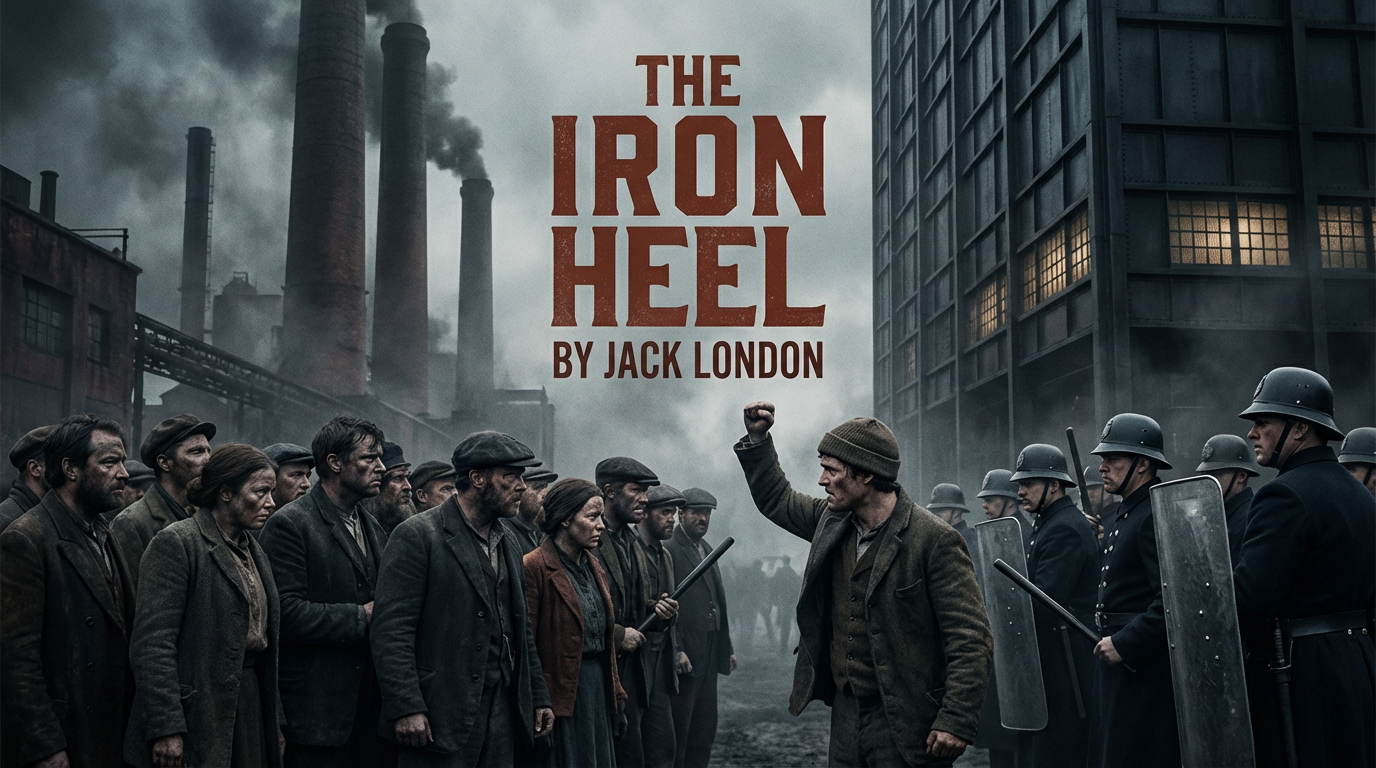
An excerpt from the original text.(complete · 3214 words)
THE SCARLET LIVERY
With the destruction of the Granger states, the Grangers in Congress
disappeared. They were being tried for high treason, and their places
were taken by the creatures of the Iron Heel. The socialists were in a
pitiful minority, and they knew that their end was near. Congress and
the Senate were empty pretences, farces. Public questions were gravely
debated and passed upon according to the old forms, while in reality
all that was done was to give the stamp of constitutional procedure to
the mandates of the Oligarchy.
Ernest was in the thick of the fight when the end came. It was in the
debate on the bill to assist the unemployed. The hard times of the
preceding year had thrust great masses of the proletariat beneath the
starvation line, and the continued and wide-reaching disorder had but
sunk them deeper. Millions of people were starving, while the oligarchs
and their supporters were surfeiting on the surplus.[1] We called these
wretched people the people of the abyss,[2] and it was to alleviate
their awful suffering that the socialists had introduced the unemployed
bill. But this was not to the fancy of the Iron Heel. In its own way it
was preparing to set these millions to work, but the way was not our
way, wherefore it had issued its orders that our bill should be voted
down. Ernest and his fellows knew that their effort was futile, but
they were tired of the suspense. They wanted something to happen. They
were accomplishing nothing, and the best they hoped for was the putting
of an end to the legislative farce in which they were unwilling
players. They knew not what end would come, but they never anticipated
a more disastrous end than the one that did come.
[1] The same conditions obtained in the nineteenth century A.D. under
British rule in India. The natives died of starvation by the million,
while their rulers robbed them of the fruits of their toil and
expended it on magnificent pageants and mumbo-jumbo fooleries.
Perforce, in this enlightened age, we have much to blush for in the
acts of our ancestors. Our only consolation is philosophic. We must
accept the capitalistic stage in social evolution as about on a par
with the earlier monkey stage. The human had to pass through those
stages in its rise from the mire and slime of low organic life. It was
inevitable that much of the mire and slime should cling and be not
easily shaken off.
[2] The people of the abyss—this phrase was struck out by the genius
of H. G. Wells in the late nineteenth century A.D. Wells was a
sociological seer, sane and normal as well as warm human. Many
fragments of his work have come down to us, while two of his greatest
achievements, “Anticipations” and “Mankind in the Making,” have come
down intact. Before the oligarchs, and before Everhard, Wells
speculated upon the building of the wonder cities, though in his
writings they are referred to as “pleasure cities.”
I sat in the gallery that day. We all knew that something terrible was
imminent. It was in the air, and its presence was made visible by the
armed soldiers drawn up in lines in the corridors, and by the officers
grouped in the entrances to the House itself. The Oligarchy was about
to strike. Ernest was speaking. He was describing the sufferings of the
unemployed, as if with the wild idea of in some way touching their
hearts and consciences; but the Republican and Democratic members
sneered and jeered at him, and there was uproar and confusion. Ernest
abruptly changed front.
“I know nothing that I may say can influence you,” he said. “You have
no souls to be influenced. You are spineless, flaccid things. You
pompously call yourselves Republicans and Democrats. There is no
Republican Party. There is no Democratic Party. There are no
Republicans nor Democrats in this House. You are lick-spittlers and
panderers, the creatures of the Plutocracy. You talk verbosely in
antiquated terminology of your love of liberty, and all the while you
wear the scarlet livery of the Iron Heel.”
Here the shouting and the cries of “Order! order!” drowned his voice,
and he stood disdainfully till the din had somewhat subsided. He waved
his hand to include all of them, turned to his own comrades, and said:
“Listen to the bellowing of the well-fed beasts.”
Pandemonium broke out again. The Speaker rapped for order and glanced
expectantly at the officers in the doorways. There were cries of
“Sedition!” and a great, rotund New York member began shouting
“Anarchist!” at Ernest. And Ernest was not pleasant to look at. Every
fighting fibre of him was quivering, and his face was the face of a
fighting animal, withal he was cool and collected.
“Remember,” he said, in a voice that made itself heard above the din,
“that as you show mercy now to the proletariat, some day will that same
proletariat show mercy to you.”
The cries of “Sedition!” and “Anarchist!” redoubled.
“I know that you will not vote for this bill,” Ernest went on. “You
have received the command from your masters to vote against it. And yet
you call me anarchist. You, who have destroyed the government of the
people, and who shamelessly flaunt your scarlet shame in public places,
call me anarchist. I do not believe in hell-fire and brimstone; but in
moments like this I regret my unbelief. Nay, in moments like this I
almost do believe. Surely there must be a hell, for in no less place
could it be possible for you to receive punishment adequate to your
crimes. So long as you exist, there is a vital need for hell-fire in
the Cosmos.”
There was movement in the doorways. Ernest, the Speaker, all the
members turned to see.
“Why do you not call your soldiers in, Mr. Speaker, and bid them do
their work?” Ernest demanded. “They should carry out your plan with
expedition.”
“There are other plans afoot,” was the retort. “That is why the
soldiers are present.”
“Our plans, I suppose,” Ernest sneered. “Assassination or something
kindred.”
But at the word “assassination” the uproar broke out again. Ernest
could not make himself heard, but he remained on his feet waiting for a
lull. And then it happened. From my place in the gallery I saw nothing
except the flash of the explosion. The roar of it filled my ears and I
saw Ernest reeling and falling in a swirl of smoke, and the soldiers
rushing up all the aisles. His comrades were on their feet, wild with
anger, capable of any violence. But Ernest steadied himself for a
moment, and waved his arms for silence.
“It is a plot!” his voice rang out in warning to his comrades. “Do
nothing, or you will be destroyed.”
Then he slowly sank down, and the soldiers reached him. The next moment
soldiers were clearing the galleries and I saw no more.
Though he was my husband, I was not permitted to get to him. When I
announced who I was, I was promptly placed under arrest. And at the
same time were arrested all socialist Congressmen in Washington,
including the unfortunate Simpson, who lay ill with typhoid fever in
his hotel.
The trial was prompt and brief. The men were foredoomed. The wonder was
that Ernest was not executed. This was a blunder on the part of the
Oligarchy, and a costly one. But the Oligarchy was too confident in
those days. It was drunk with success, and little did it dream that
that small handful of heroes had within them the power to rock it to
its foundations. To-morrow, when the Great Revolt breaks out and all
the world resounds with the tramp, tramp of the millions, the Oligarchy
will realize, and too late, how mightily that band of heroes has
grown.[3]
[3] Avis Everhard took for granted that her narrative would be read in
her own day, and so omits to mention the outcome of the trial for high
treason. Many other similar disconcerting omissions will be noticed in
the Manuscript. Fifty-two socialist Congressmen were tried, and all
were found guilty. Strange to relate, not one received the death
sentence. Everhard and eleven others, among whom were Theodore
Donnelson and Matthew Kent, received life imprisonment. The remaining
forty received sentences varying from thirty to forty-five years;
while Arthur Simpson, referred to in the Manuscript as being ill of
typhoid fever at the time of the explosion, received only fifteen
years. It is the tradition that he died of starvation in solitary
confinement, and this harsh treatment is explained as having been
caused by his uncompromising stubbornness and his fiery and tactless
hatred for all men that served the despotism. He died in Cabañas in
Cuba, where three of his comrades were also confined. The fifty- two
socialist Congressmen were confined in military fortresses scattered
all over the United States. Thus, Du Bois and Woods were held in Porto
Rico, while Everhard and Merryweather were placed in Alcatraz, an
island in San Francisco Bay that had already seen long service as a
military prison.
As a revolutionist myself, as one on the inside who knew the hopes and
fears and secret plans of the revolutionists, I am fitted to answer, as
very few are, the charge that they were guilty of exploding the bomb in
Congress. And I can say flatly, without qualification or doubt of any
sort, that the socialists, in Congress and out, had no hand in the
affair. Who threw the bomb we do not know, but the one thing we are
absolutely sure of is that we did not throw it.
On the other hand, there is evidence to show that the Iron Heel was
responsible for the act. Of course, we cannot prove this. Our
conclusion is merely presumptive. But here are such facts as we do
know. It had been reported to the Speaker of the House, by
secret-service agents of the government, that the Socialist Congressmen
were about to resort to terroristic tactics, and that they had decided
upon the day when their tactics would go into effect. This day was the
very day of the explosion. Wherefore the Capitol had been packed with
troops in anticipation. Since we knew nothing about the bomb, and since
a bomb actually was exploded, and since the authorities had prepared in
advance for the explosion, it is only fair to conclude that the Iron
Heel did know. Furthermore, we charge that the Iron Heel was guilty of
the outrage, and that the Iron Heel planned and perpetrated the outrage
for the purpose of foisting the guilt on our shoulders and so bringing
about our destruction.
From the Speaker the warning leaked out to all the creatures in the
House that wore the scarlet livery. They knew, while Ernest was
speaking, that some violent act was to be committed. And to do them
justice, they honestly believed that the act was to be committed by the
socialists. At the trial, and still with honest belief, several
testified to having seen Ernest prepare to throw the bomb, and that it
exploded prematurely. Of course they saw nothing of the sort. In the
fevered imagination of fear they thought they saw, that was all.
As Ernest said at the trial: “Does it stand to reason, if I were going
to throw a bomb, that I should elect to throw a feeble little squib
like the one that was thrown? There wasn’t enough powder in it. It made
a lot of smoke, but hurt no one except me. It exploded right at my
feet, and yet it did not kill me. Believe me, when I get to throwing
bombs, I’ll do damage. There’ll be more than smoke in my petards.”
In return it was argued by the prosecution that the weakness of the
bomb was a blunder on the part of the socialists, just as its premature
explosion, caused by Ernest’s losing his nerve and dropping it, was a
blunder. And to clinch the argument, there were the several Congressmen
who testified to having seen Ernest fumble and drop the bomb.
As for ourselves, not one of us knew how the bomb was thrown. Ernest
told me that the fraction of an instant before it exploded he both
heard and saw it strike at his feet. He testified to this at the trial,
but no one believed him. Besides, the whole thing, in popular slang,
was “cooked up.” The Iron Heel had made up its mind to destroy us, and
there was no withstanding it.
There is a saying that truth will out. I have come to doubt that
saying. Nineteen years have elapsed, and despite our untiring efforts,
we have failed to find the man who really did throw the bomb.
Undoubtedly he was some emissary of the Iron Heel, but he has escaped
detection. We have never got the slightest clew to his identity. And
now, at this late date, nothing remains but for the affair to take its
place among the mysteries of history.[4]
[4] Avis Everhard would have had to live for many generations ere she
could have seen the clearing up of this particular mystery. A little
less than a hundred years ago, and a little more than six hundred
years after her death, the confession of Pervaise was discovered in
the secret archives of the Vatican. It is perhaps well to tell a
little something about this obscure document, which, in the main, is
of interest to the historian only.
Pervaise was an American, of French descent, who in 1913 A.D., was
lying in the Tombs Prison, New York City, awaiting trial for
murder. From his confession we learn that he was not a criminal. He
was warm-blooded, passionate, emotional. In an insane fit of
jealousy he killed his wife—a very common act in those times.
Pervaise was mastered by the fear of death, all of which is
recounted at length in his confession. To escape death he would
have done anything, and the police agents prepared him by assuring
him that he could not possibly escape conviction of murder in the
first degree when his trial came off. In those days, murder in the
first degree was a capital offense. The guilty man or woman was
placed in a specially constructed death-chair, and, under the
supervision of competent physicians, was destroyed by a current of
electricity. This was called electrocution, and it was very popular
during that period. Anaesthesia, as a mode of compulsory death, was
not introduced until later.
This man, good at heart but with a ferocious animalism close at the
surface of his being, lying in jail and expectant of nothing less
than death, was prevailed upon by the agents of the Iron Heel to
throw the bomb in the House of Representatives. In his confession
he states explicitly that he was informed that the bomb was to be a
feeble thing and that no lives would be lost. This is directly in
line with the fact that the bomb was lightly charged, and that its
explosion at Everhard’s feet was not deadly.
Pervaise was smuggled into one of the galleries ostensibly closed
for repairs. He was to select the moment for the throwing of the
bomb, and he naively confesses that in his interest in Everhard’s
tirade and the general commotion raised thereby, he nearly forgot
his mission.
Not only was he released from prison in reward for his deed, but he
was granted an income for life. This he did not long enjoy. In 1914
A.D., in September, he was stricken with rheumatism of the heart
and lived for three days. It was then that he sent for the Catholic
priest, Father Peter Durban, and to him made confession. So
important did it seem to the priest, that he had the confession
taken down in writing and sworn to. What happened after this we can
only surmise. The document was certainly important enough to find
its way to Rome. Powerful influences must have been brought to
bear, hence its suppression. For centuries no hint of its existence
reached the world. It was not until in the last century that
Lorbia, the brilliant Italian scholar, stumbled upon it quite by
chance during his researches in the Vatican.
There is to-day no doubt whatever that the Iron Heel was
responsible for the bomb that exploded in the House of
Representatives in 1913 A.D. Even though the Pervaise confession
had never come to light, no reasonable doubt could obtain; for the
act in question, that sent fifty-two Congressmen to prison, was on
a par with countless other acts committed by the oligarchs, and,
before them, by the capitalists.
There is the classic instance of the ferocious and wanton judicial
murder of the innocent and so-called Haymarket Anarchists in
Chicago in the penultimate decade of the nineteenth century A.D. In
a category by itself is the deliberate burning and destruction of
capitalist property by the capitalists themselves. For such
destruction of property innocent men were frequently
punished—“railroaded” in the parlance of the times.
In the labor troubles of the first decade of the twentieth century
A.D., between the capitalists and the Western Federation of Miners,
similar but more bloody tactics were employed. The railroad station
at Independence was blown up by the agents of the capitalists.
Thirteen men were killed, and many more were wounded. And then the
capitalists, controlling the legislative and judicial machinery of
the state of Colorado, charged the miners with the crime and came
very near to convicting them. Romaines, one of the tools in this
affair, like Pervaise, was lying in jail in another state, Kansas,
awaiting trial, when he was approached by the agents of the
capitalists. But, unlike Pervaise, the confession of Romaines was
made public in his own time.
Then, during this same period, there was the case of Moyer and
Haywood, two strong, fearless leaders of labor. One was president
and the other was secretary of the Western Federation of Miners.
The ex-governor of Idaho had been mysteriously murdered. The crime,
at the time, was openly charged to the mine owners by the
socialists and miners. Nevertheless, in violation of the national
and state constitutions, and by means of conspiracy on the parts of
the governors of Idaho and Colorado, Moyer and Haywood were
kidnapped, thrown into jail, and charged with the murder. It was
this instance that provoked from Eugene V. Debs, national leader of
the American socialists at the time, the following words: “The
labor leaders that cannot be bribed nor bullied, must be ambushed
and murdered. The only crime of Moyer and Haywood is that they have
been unswervingly true to the working class. The capitalists have
stolen our country, debauched our politics, defiled our judiciary,
and ridden over us rough-shod, and now they propose to murder those
who will not abjectly surrender to their brutal dominion. The
governors of Colorado and Idaho are but executing the mandates of
their masters, the Plutocracy. The issue is the Workers versus the
Plutocracy. If they strike the first violent blow, we will strike
the last.”
Master this chapter. Complete your experience
Purchase the complete book to access all chapters and support classic literature
As an Amazon Associate, we earn a small commission from qualifying purchases at no additional cost to you.
Available in paperback, hardcover, and e-book formats
Let's Analyse the Pattern
Those in power create fake emergencies to justify actions they wanted to take anyway, using fear to eliminate opposition and expand control.
Why This Matters
Connect literature to life
This chapter teaches how to recognize when emergencies are created specifically to justify actions those in power wanted to take anyway.
Practice This Today
This week, notice when workplace 'emergencies' coincidentally solve management problems - budget crises before raises, safety concerns that only affect organizers, or urgent policy changes that benefit supervisors.
Now let's explore the literary elements.
Key Quotes & Analysis
"You are not legislators, you are the creatures of the Plutocracy; you wear the scarlet livery of the Iron Heel."
Context: Ernest's final defiant speech to Congress before the bombing
This quote captures the central theme of how democracy dies - not through violent overthrow, but through corruption that turns representatives into servants of wealth. Ernest strips away all pretense and calls out the reality everyone knows but won't acknowledge.
In Today's Words:
You're not working for the people - you're just employees of the rich, and everyone can see whose payroll you're on.
"Millions of people were starving, while the oligarchs and their supporters were surfeiting on the surplus."
Context: Describing the economic conditions that prompted the unemployment bill
This stark contrast reveals the deliberate nature of inequality under oligarchy. It's not scarcity causing suffering - it's the hoarding of abundance by the few while the many go without.
In Today's Words:
There's plenty to go around, but the wealthy are hoarding everything while regular people can't even get basic needs met.
"They wanted something definite to happen, and they were prepared to go down to defeat valiantly."
Context: Explaining why the socialists pushed forward despite knowing they would lose
This shows the psychological toll of fighting a rigged system. Sometimes people choose noble defeat over endless, demoralizing compromise. It's about maintaining dignity and principles even in hopeless circumstances.
In Today's Words:
They were tired of the BS and ready to go down swinging, even if they knew they'd lose.
Thematic Threads
False Flag Operations
In This Chapter
The Iron Heel plants a bomb at Ernest's feet, then immediately arrests all socialist congressmen for the terrorism they themselves committed
Development
Escalation from earlier surveillance and intimidation to active frame-ups and false evidence
In Your Life:
You might see this when management creates a workplace 'incident' to justify firing union organizers or activists
Predetermined Justice
In This Chapter
Ernest's trial is swift and the verdict predetermined - the legal system becomes theater to legitimize the Iron Heel's actions
Development
Continuation of corrupted institutions theme, now showing courts as completely captured
In Your Life:
You experience this in workplace 'investigations' where HR has already decided the outcome before hearing evidence
Historical Manipulation
In This Chapter
The narrator reveals the truth was buried in Vatican archives for centuries while lies became accepted history
Development
New theme showing how power controls not just present events but historical memory
In Your Life:
You see this when companies rewrite safety incidents or when your family rewrites painful history to protect certain members
Desperate Pawns
In This Chapter
Pervaise, a desperate prisoner, is used as the Iron Heel's bomb-planting agent, exploiting his vulnerability
Development
Continuation of how power exploits the desperate, now showing them as unwitting tools in larger schemes
In Your Life:
You might recognize this when stressed coworkers are manipulated into reporting on union activities or when financial desperation makes you consider questionable offers
Defiant Last Stands
In This Chapter
Ernest's final speech calling out his fellow congressmen as 'creatures of the Plutocracy' represents the last gasp of legitimate opposition
Development
Evolution from earlier defiance to final, desperate truth-telling before total suppression
In Your Life:
You face this moment when speaking up at work or in family situations where you know there will be consequences but staying silent feels like betraying yourself
You now have the context. Time to form your own thoughts.
Discussion Questions
- 1
How does the Iron Heel use the bomb explosion to eliminate their opposition, even though they planted it themselves?
analysis • surface - 2
Why is it so effective that the Iron Heel frames Ernest and the socialists for terrorism right after Ernest's speech calling them out?
analysis • medium - 3
Where have you seen someone create a crisis to justify actions they wanted to take anyway - at work, in politics, or in personal relationships?
application • medium - 4
When facing a sudden 'emergency' that demands immediate action, what questions would you ask to determine if the crisis is real or manufactured?
application • deep - 5
What does this chapter reveal about how power protects itself when threatened by legitimate opposition?
reflection • deep
Critical Thinking Exercise
Spot the Manufactured Crisis
Think of a recent situation where someone claimed there was an urgent crisis requiring immediate action - at your workplace, in the news, or in your personal life. Write down what the crisis was, who declared it urgent, what solution they demanded, and who benefited from that solution. Then ask: What would have happened if people had taken time to investigate instead of acting immediately?
Consider:
- •Real emergencies usually have verifiable facts and transparent solutions
- •Manufactured crises often demand you stop asking questions and act immediately
- •Look at who benefits most from the proposed 'emergency' solution
Journaling Prompt
Write about a time when you felt pressured to make a quick decision because of an 'emergency.' What would you do differently now if you recognized it might have been manufactured pressure?
Coming Up Next...
Chapter 18: Building Networks in Enemy Territory
With Ernest imprisoned and the socialist movement crushed, the Iron Heel's grip tightens across America. But in the shadows of Sonoma County, new forms of resistance begin to take shape as the remaining revolutionaries adapt to their underground reality.



