
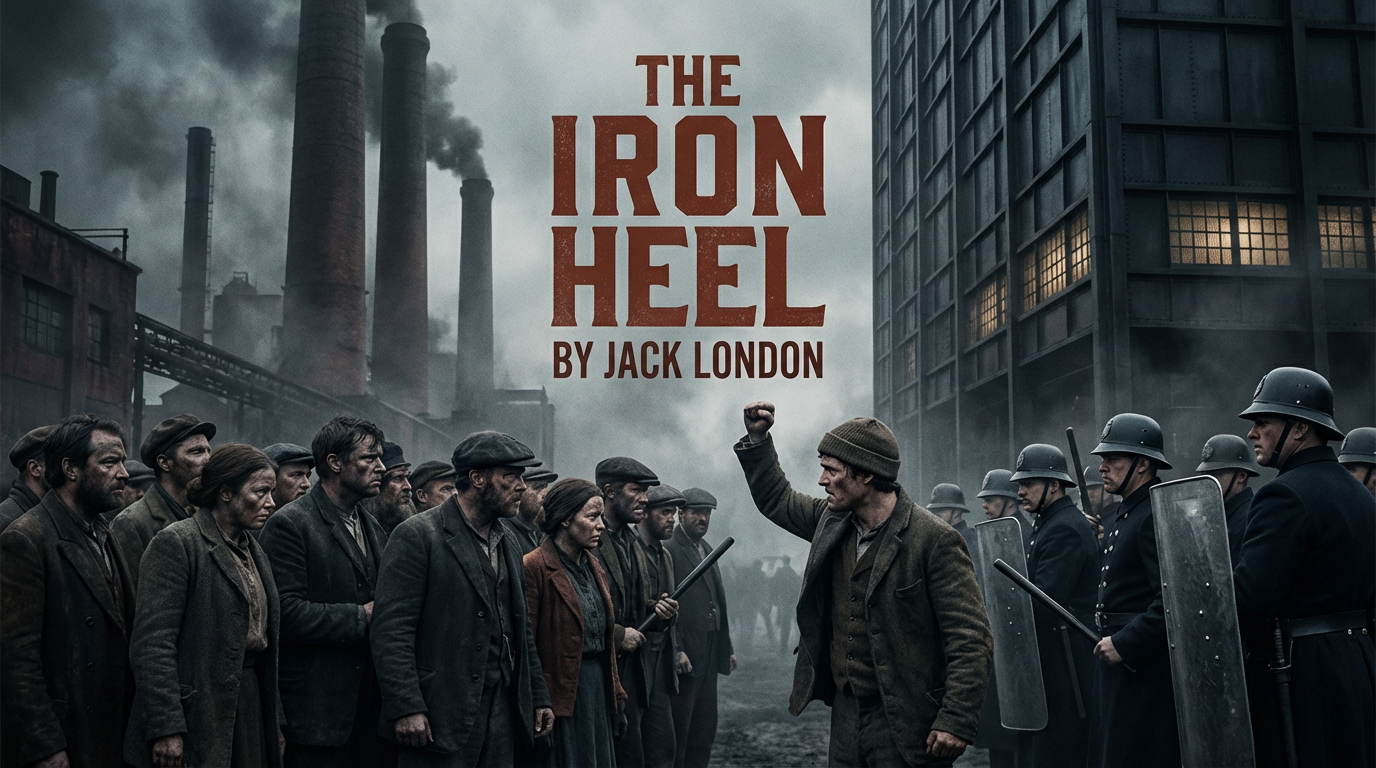
An excerpt from the original text.(complete · 7096 words)
THE PHILOMATHS
Ernest was often at the house. Nor was it my father, merely, nor the
controversial dinners, that drew him there. Even at that time I
flattered myself that I played some part in causing his visits, and it
was not long before I learned the correctness of my surmise. For never
was there such a lover as Ernest Everhard. His gaze and his hand-clasp
grew firmer and steadier, if that were possible; and the question that
had grown from the first in his eyes, grew only the more imperative.
My impression of him, the first time I saw him, had been unfavorable.
Then I had found myself attracted toward him. Next came my repulsion,
when he so savagely attacked my class and me. After that, as I saw that
he had not maligned my class, and that the harsh and bitter things he
said about it were justified, I had drawn closer to him again. He
became my oracle. For me he tore the sham from the face of society and
gave me glimpses of reality that were as unpleasant as they were
undeniably true.
As I have said, there was never such a lover as he. No girl could live
in a university town till she was twenty-four and not have love
experiences. I had been made love to by beardless sophomores and gray
professors, and by the athletes and the football giants. But not one of
them made love to me as Ernest did. His arms were around me before I
knew. His lips were on mine before I could protest or resist. Before
his earnestness conventional maiden dignity was ridiculous. He swept me
off my feet by the splendid invincible rush of him. He did not propose.
He put his arms around me and kissed me and took it for granted that we
should be married. There was no discussion about it. The only
discussion—and that arose afterward—was when we should be married.
It was unprecedented. It was unreal. Yet, in accordance with Ernest’s
test of truth, it worked. I trusted my life to it. And fortunate was
the trust. Yet during those first days of our love, fear of the future
came often to me when I thought of the violence and impetuosity of his
love-making. Yet such fears were groundless. No woman was ever blessed
with a gentler, tenderer husband. This gentleness and violence on his
part was a curious blend similar to the one in his carriage of
awkwardness and ease. That slight awkwardness! He never got over it,
and it was delicious. His behavior in our drawing-room reminded me of a
careful bull in a china shop.[1]
[1] In those days it was still the custom to fill the living rooms
with bric-a-brac. They had not discovered simplicity of living. Such
rooms were museums, entailing endless labor to keep clean. The
dust-demon was the lord of the household. There were a myriad devices
for catching dust, and only a few devices for getting rid of it.
It was at this time that vanished my last doubt of the completeness of
my love for him (a subconscious doubt, at most). It was at the
Philomath Club—a wonderful night of battle, wherein Ernest bearded the
masters in their lair. Now the Philomath Club was the most select on
the Pacific Coast. It was the creation of Miss Brentwood, an enormously
wealthy old maid; and it was her husband, and family, and toy. Its
members were the wealthiest in the community, and the strongest-minded
of the wealthy, with, of course, a sprinkling of scholars to give it
intellectual tone.
The Philomath had no club house. It was not that kind of a club. Once a
month its members gathered at some one of their private houses to
listen to a lecture. The lecturers were usually, though not always,
hired. If a chemist in New York made a new discovery in say radium, all
his expenses across the continent were paid, and as well he received a
princely fee for his time. The same with a returning explorer from the
polar regions, or the latest literary or artistic success. No visitors
were allowed, while it was the Philomath’s policy to permit none of its
discussions to get into the papers. Thus great statesmen—and there had
been such occasions—were able fully to speak their minds.
I spread before me a wrinkled letter, written to me by Ernest twenty
years ago, and from it I copy the following:
“Your father is a member of the Philomath, so you are able to come.
Therefore come next Tuesday night. I promise you that you will have the
time of your life. In your recent encounters, you failed to shake the
masters. If you come, I’ll shake them for you. I’ll make them snarl
like wolves. You merely questioned their morality. When their morality
is questioned, they grow only the more complacent and superior. But I
shall menace their money-bags. That will shake them to the roots of
their primitive natures. If you can come, you will see the cave-man, in
evening dress, snarling and snapping over a bone. I promise you a great
caterwauling and an illuminating insight into the nature of the beast.
“They’ve invited me in order to tear me to pieces. This is the idea of
Miss Brentwood. She clumsily hinted as much when she invited me. She’s
given them that kind of fun before. They delight in getting
trustful-souled gentle reformers before them. Miss Brentwood thinks I
am as mild as a kitten and as good-natured and stolid as the family
cow. I’ll not deny that I helped to give her that impression. She was
very tentative at first, until she divined my harmlessness. I am to
receive a handsome fee—two hundred and fifty dollars—as befits the man
who, though a radical, once ran for governor. Also, I am to wear
evening dress. This is compulsory. I never was so apparelled in my
life. I suppose I’ll have to hire one somewhere. But I’d do more than
that to get a chance at the Philomaths.”
Of all places, the Club gathered that night at the Pertonwaithe house.
Extra chairs had been brought into the great drawing-room, and in all
there must have been two hundred Philomaths that sat down to hear
Ernest. They were truly lords of society. I amused myself with running
over in my mind the sum of the fortunes represented, and it ran well
into the hundreds of millions. And the possessors were not of the idle
rich. They were men of affairs who took most active parts in industrial
and political life.
We were all seated when Miss Brentwood brought Ernest in. They moved at
once to the head of the room, from where he was to speak. He was in
evening dress, and, what of his broad shoulders and kingly head, he
looked magnificent. And then there was that faint and unmistakable
touch of awkwardness in his movements. I almost think I could have
loved him for that alone. And as I looked at him I was aware of a great
joy. I felt again the pulse of his palm on mine, the touch of his lips;
and such pride was mine that I felt I must rise up and cry out to the
assembled company: “He is mine! He has held me in his arms, and I, mere
I, have filled that mind of his to the exclusion of all his
multitudinous and kingly thoughts!”
At the head of the room, Miss Brentwood introduced him to Colonel Van
Gilbert, and I knew that the latter was to preside. Colonel Van Gilbert
was a great corporation lawyer. In addition, he was immensely wealthy.
The smallest fee he would deign to notice was a hundred thousand
dollars. He was a master of law. The law was a puppet with which he
played. He moulded it like clay, twisted and distorted it like a
Chinese puzzle into any design he chose. In appearance and rhetoric he
was old-fashioned, but in imagination and knowledge and resource he was
as young as the latest statute. His first prominence had come when he
broke the Shardwell will.[2] His fee for this one act was five hundred
thousand dollars. From then on he had risen like a rocket. He was often
called the greatest lawyer in the country—corporation lawyer, of
course; and no classification of the three greatest lawyers in the
United States could have excluded him.
[2] This breaking of wills was a peculiar feature of the period. With
the accumulation of vast fortunes, the problem of disposing of these
fortunes after death was a vexing one to the accumulators. Will-making
and will-breaking became complementary trades, like armor-making and
gun-making. The shrewdest will-making lawyers were called in to make
wills that could not be broken. But these wills were always broken,
and very often by the very lawyers that had drawn them up.
Nevertheless the delusion persisted in the wealthy class that an
absolutely unbreakable will could be cast; and so, through the
generations, clients and lawyers pursued the illusion. It was a
pursuit like unto that of the Universal Solvent of the mediæval
alchemists.
He arose and began, in a few well-chosen phrases that carried an
undertone of faint irony, to introduce Ernest. Colonel Van Gilbert was
subtly facetious in his introduction of the social reformer and member
of the working class, and the audience smiled. It made me angry, and I
glanced at Ernest. The sight of him made me doubly angry. He did not
seem to resent the delicate slurs. Worse than that, he did not seem to
be aware of them. There he sat, gentle, and stolid, and somnolent. He
really looked stupid. And for a moment the thought rose in my mind,
What if he were overawed by this imposing array of power and brains?
Then I smiled. He couldn’t fool me. But he fooled the others, just as
he had fooled Miss Brentwood. She occupied a chair right up to the
front, and several times she turned her head toward one or another of
her confrères and smiled her appreciation of the remarks.
Colonel Van Gilbert done, Ernest arose and began to speak. He began in
a low voice, haltingly and modestly, and with an air of evident
embarrassment. He spoke of his birth in the working class, and of the
sordidness and wretchedness of his environment, where flesh and spirit
were alike starved and tormented. He described his ambitions and
ideals, and his conception of the paradise wherein lived the people of
the upper classes. As he said:
“Up above me, I knew, were unselfishnesses of the spirit, clean and
noble thinking, keen intellectual living. I knew all this because I
read ‘Seaside Library’[3] novels, in which, with the exception of the
villains and adventuresses, all men and women thought beautiful
thoughts, spoke a beautiful tongue, and performed glorious deeds. In
short, as I accepted the rising of the sun, I accepted that up above me
was all that was fine and noble and gracious, all that gave decency and
dignity to life, all that made life worth living and that remunerated
one for his travail and misery.”
[3] A curious and amazing literature that served to make the working
class utterly misapprehend the nature of the leisure class.
He went on and traced his life in the mills, the learning of the
horseshoeing trade, and his meeting with the socialists. Among them, he
said, he had found keen intellects and brilliant wits, ministers of the
Gospel who had been broken because their Christianity was too wide for
any congregation of mammon-worshippers, and professors who had been
broken on the wheel of university subservience to the ruling class. The
socialists were revolutionists, he said, struggling to overthrow the
irrational society of the present and out of the material to build the
rational society of the future. Much more he said that would take too
long to write, but I shall never forget how he described the life among
the revolutionists. All halting utterance vanished. His voice grew
strong and confident, and it glowed as he glowed, and as the thoughts
glowed that poured out from him. He said:
“Amongst the revolutionists I found, also, warm faith in the human,
ardent idealism, sweetnesses of unselfishness, renunciation, and
martyrdom—all the splendid, stinging things of the spirit. Here life
was clean, noble, and alive. I was in touch with great souls who
exalted flesh and spirit over dollars and cents, and to whom the thin
wail of the starved slum child meant more than all the pomp and
circumstance of commercial expansion and world empire. All about me
were nobleness of purpose and heroism of effort, and my days and nights
were sunshine and starshine, all fire and dew, with before my eyes,
ever burning and blazing, the Holy Grail, Christ’s own Grail, the warm
human, long-suffering and maltreated but to be rescued and saved at the
last.”
As before I had seen him transfigured, so now he stood transfigured
before me. His brows were bright with the divine that was in him, and
brighter yet shone his eyes from the midst of the radiance that seemed
to envelop him as a mantle. But the others did not see this radiance,
and I assumed that it was due to the tears of joy and love that dimmed
my vision. At any rate, Mr. Wickson, who sat behind me, was unaffected,
for I heard him sneer aloud, “Utopian.”[4]
[4] The people of that age were phrase slaves. The abjectness of their
servitude is incomprehensible to us. There was a magic in words
greater than the conjurer’s art. So befuddled and chaotic were their
minds that the utterance of a single word could negative the
generalizations of a lifetime of serious research and thought. Such a
word was the adjective Utopian. The mere utterance of it could damn
any scheme, no matter how sanely conceived, of economic amelioration
or regeneration. Vast populations grew frenzied over such phrases as
“an honest dollar” and “a full dinner pail.” The coinage of such
phrases was considered strokes of genius.
Ernest went on to his rise in society, till at last he came in touch
with members of the upper classes, and rubbed shoulders with the men
who sat in the high places. Then came his disillusionment, and this
disillusionment he described in terms that did not flatter his
audience. He was surprised at the commonness of the clay. Life proved
not to be fine and gracious. He was appalled by the selfishness he
encountered, and what had surprised him even more than that was the
absence of intellectual life. Fresh from his revolutionists, he was
shocked by the intellectual stupidity of the master class. And then, in
spite of their magnificent churches and well-paid preachers, he had
found the masters, men and women, grossly material. It was true that
they prattled sweet little ideals and dear little moralities, but in
spite of their prattle the dominant key of the life they lived was
materialistic. And they were without real morality—for instance, that
which Christ had preached but which was no longer preached.
“I met men,” he said, “who invoked the name of the Prince of Peace in
their diatribes against war, and who put rifles in the hands of
Pinkertons[5] with which to shoot down strikers in their own factories.
I met men incoherent with indignation at the brutality of
prize-fighting, and who, at the same time, were parties to the
adulteration of food that killed each year more babes than even
red-handed Herod had killed.
[5] Originally, they were private detectives; but they quickly became
hired fighting men of the capitalists, and ultimately developed into
the Mercenaries of the Oligarchy.
“This delicate, aristocratic-featured gentleman was a dummy director
and a tool of corporations that secretly robbed widows and orphans.
This gentleman, who collected fine editions and was a patron of
literature, paid blackmail to a heavy-jowled, black-browed boss of a
municipal machine. This editor, who published patent medicine
advertisements, called me a scoundrelly demagogue because I dared him
to print in his paper the truth about patent medicines.[6] This man,
talking soberly and earnestly about the beauties of idealism and the
goodness of God, had just betrayed his comrades in a business deal.
This man, a pillar of the church and heavy contributor to foreign
missions, worked his shop girls ten hours a day on a starvation wage
and thereby directly encouraged prostitution. This man, who endowed
chairs in universities and erected magnificent chapels, perjured
himself in courts of law over dollars and cents. This railroad magnate
broke his word as a citizen, as a gentleman, and as a Christian, when
he granted a secret rebate, and he granted many secret rebates. This
senator was the tool and the slave, the little puppet, of a brutal
uneducated machine boss;[7] so was this governor and this supreme court
judge; and all three rode on railroad passes; and, also, this sleek
capitalist owned the machine, the machine boss, and the railroads that
issued the passes.
[6] Patent medicines were patent lies, but, like the charms and
indulgences of the Middle Ages, they deceived the people. The only
difference lay in that the patent medicines were more harmful and more
costly.
[7] Even as late as 1912, A.D., the great mass of the people still
persisted in the belief that they ruled the country by virtue of their
ballots. In reality, the country was ruled by what were called
political machines. At first the machine bosses charged the master
capitalists extortionate tolls for legislation; but in a short time
the master capitalists found it cheaper to own the political machines
themselves and to hire the machine bosses.
“And so it was, instead of in paradise, that I found myself in the arid
desert of commercialism. I found nothing but stupidity, except for
business. I found none clean, noble, and alive, though I found many who
were alive—with rottenness. What I did find was monstrous selfishness
and heartlessness, and a gross, gluttonous, practised, and practical
materialism.”
Much more Ernest told them of themselves and of his disillusionment.
Intellectually they had bored him; morally and spiritually they had
sickened him; so that he was glad to go back to his revolutionists, who
were clean, noble, and alive, and all that the capitalists were not.
“And now,” he said, “let me tell you about that revolution.”
But first I must say that his terrible diatribe had not touched them. I
looked about me at their faces and saw that they remained complacently
superior to what he had charged. And I remembered what he had told me:
that no indictment of their morality could shake them. However, I could
see that the boldness of his language had affected Miss Brentwood. She
was looking worried and apprehensive.
Ernest began by describing the army of revolution, and as he gave the
figures of its strength (the votes cast in the various countries), the
assemblage began to grow restless. Concern showed in their faces, and I
noticed a tightening of lips. At last the gage of battle had been
thrown down. He described the international organization of the
socialists that united the million and a half in the United States with
the twenty-three millions and a half in the rest of the world.
“Such an army of revolution,” he said, “twenty-five millions strong, is
a thing to make rulers and ruling classes pause and consider. The cry
of this army is: ‘No quarter! We want all that you possess. We will be
content with nothing less than all that you possess. We want in our
hands the reins of power and the destiny of mankind. Here are our
hands. They are strong hands. We are going to take your governments,
your palaces, and all your purpled ease away from you, and in that day
you shall work for your bread even as the peasant in the field or the
starved and runty clerk in your metropolises. Here are our hands. They
are strong hands!’”
And as he spoke he extended from his splendid shoulders his two great
arms, and the horseshoer’s hands were clutching the air like eagle’s
talons. He was the spirit of regnant labor as he stood there, his hands
outreaching to rend and crush his audience. I was aware of a faintly
perceptible shrinking on the part of the listeners before this figure
of revolution, concrete, potential, and menacing. That is, the women
shrank, and fear was in their faces. Not so with the men. They were of
the active rich, and not the idle, and they were fighters. A low,
throaty rumble arose, lingered on the air a moment, and ceased. It was
the forerunner of the snarl, and I was to hear it many times that
night—the token of the brute in man, the earnest of his primitive
passions. And they were unconscious that they had made this sound. It
was the growl of the pack, mouthed by the pack, and mouthed in all
unconsciousness. And in that moment, as I saw the harshness form in
their faces and saw the fight-light flashing in their eyes, I realized
that not easily would they let their lordship of the world be wrested
from them.
Ernest proceeded with his attack. He accounted for the existence of the
million and a half of revolutionists in the United States by charging
the capitalist class with having mismanaged society. He sketched the
economic condition of the cave-man and of the savage peoples of to-day,
pointing out that they possessed neither tools nor machines, and
possessed only a natural efficiency of one in producing power. Then he
traced the development of machinery and social organization so that
to-day the producing power of civilized man was a thousand times
greater than that of the savage.
“Five men,” he said, “can produce bread for a thousand. One man can
produce cotton cloth for two hundred and fifty people, woollens for
three hundred, and boots and shoes for a thousand. One would conclude
from this that under a capable management of society modern civilized
man would be a great deal better off than the cave-man. But is he? Let
us see. In the United States to-day there are fifteen million[8] people
living in poverty; and by poverty is meant that condition in life in
which, through lack of food and adequate shelter, the mere standard of
working efficiency cannot be maintained. In the United States to-day,
in spite of all your so-called labor legislation, there are three
millions of child laborers.[9] In twelve years their numbers have been
doubled. And in passing I will ask you managers of society why you did
not make public the census figures of 1910? And I will answer for you,
that you were afraid. The figures of misery would have precipitated the
revolution that even now is gathering.
[8] Robert Hunter, in 1906, in a book entitled “Poverty,” pointed out
that at that time there were ten millions in the United States living
in poverty.
[9] In the United States Census of 1900 (the last census the figures
of which were made public), the number of child laborers was placed at
1,752,187.
“But to return to my indictment. If modern man’s producing power is a
thousand times greater than that of the cave-man, why then, in the
United States to-day, are there fifteen million people who are not
properly sheltered and properly fed? Why then, in the United States
to-day, are there three million child laborers? It is a true
indictment. The capitalist class has mismanaged. In face of the facts
that modern man lives more wretchedly than the cave-man, and that his
producing power is a thousand times greater than that of the cave-man,
no other conclusion is possible than that the capitalist class has
mismanaged, that you have mismanaged, my masters, that you have
criminally and selfishly mismanaged. And on this count you cannot
answer me here to-night, face to face, any more than can your whole
class answer the million and a half of revolutionists in the United
States. You cannot answer. I challenge you to answer. And furthermore,
I dare to say to you now that when I have finished you will not answer.
On that point you will be tongue-tied, though you will talk wordily
enough about other things.
“You have failed in your management. You have made a shambles of
civilization. You have been blind and greedy. You have risen up (as you
to-day rise up), shamelessly, in our legislative halls, and declared
that profits were impossible without the toil of children and babes.
Don’t take my word for it. It is all in the records against you. You
have lulled your conscience to sleep with prattle of sweet ideals and
dear moralities. You are fat with power and possession, drunken with
success; and you have no more hope against us than have the drones,
clustered about the honey-vats, when the worker-bees spring upon them
to end their rotund existence. You have failed in your management of
society, and your management is to be taken away from you. A million
and a half of the men of the working class say that they are going to
get the rest of the working class to join with them and take the
management away from you. This is the revolution, my masters. Stop it
if you can.”
For an appreciable lapse of time Ernest’s voice continued to ring
through the great room. Then arose the throaty rumble I had heard
before, and a dozen men were on their feet clamoring for recognition
from Colonel Van Gilbert. I noticed Miss Brentwood’s shoulders moving
convulsively, and for the moment I was angry, for I thought that she
was laughing at Ernest. And then I discovered that it was not laughter,
but hysteria. She was appalled by what she had done in bringing this
firebrand before her blessed Philomath Club.
Colonel Van Gilbert did not notice the dozen men, with passion-wrought
faces, who strove to get permission from him to speak. His own face was
passion-wrought. He sprang to his feet, waving his arms, and for a
moment could utter only incoherent sounds. Then speech poured from him.
But it was not the speech of a one-hundred-thousand-dollar lawyer, nor
was the rhetoric old-fashioned.
“Fallacy upon fallacy!” he cried. “Never in all my life have I heard so
many fallacies uttered in one short hour. And besides, young man, I
must tell you that you have said nothing new. I learned all that at
college before you were born. Jean Jacques Rousseau enunciated your
socialistic theory nearly two centuries ago. A return to the soil,
forsooth! Reversion! Our biology teaches the absurdity of it. It has
been truly said that a little learning is a dangerous thing, and you
have exemplified it to-night with your madcap theories. Fallacy upon
fallacy! I was never so nauseated in my life with overplus of fallacy.
That for your immature generalizations and childish reasonings!”
He snapped his fingers contemptuously and proceeded to sit down. There
were lip-exclamations of approval on the part of the women, and hoarser
notes of confirmation came from the men. As for the dozen men who were
clamoring for the floor, half of them began speaking at once. The
confusion and babel was indescribable. Never had Mrs. Pertonwaithe’s
spacious walls beheld such a spectacle. These, then, were the cool
captains of industry and lords of society, these snarling, growling
savages in evening clothes. Truly Ernest had shaken them when he
stretched out his hands for their moneybags, his hands that had
appeared in their eyes as the hands of the fifteen hundred thousand
revolutionists.
But Ernest never lost his head in a situation. Before Colonel Van
Gilbert had succeeded in sitting down, Ernest was on his feet and had
sprung forward.
“One at a time!” he roared at them.
The sound arose from his great lungs and dominated the human tempest.
By sheer compulsion of personality he commanded silence.
“One at a time,” he repeated softly. “Let me answer Colonel Van
Gilbert. After that the rest of you can come at me—but one at a time,
remember. No mass-plays here. This is not a football field.
“As for you,” he went on, turning toward Colonel Van Gilbert, “you have
replied to nothing I have said. You have merely made a few excited and
dogmatic assertions about my mental caliber. That may serve you in your
business, but you can’t talk to me like that. I am not a workingman,
cap in hand, asking you to increase my wages or to protect me from the
machine at which I work. You cannot be dogmatic with truth when you
deal with me. Save that for dealing with your wage-slaves. They will
not dare reply to you because you hold their bread and butter, their
lives, in your hands.
“As for this return to nature that you say you learned at college
before I was born, permit me to point out that on the face of it you
cannot have learned anything since. Socialism has no more to do with
the state of nature than has differential calculus with a Bible class.
I have called your class stupid when outside the realm of business.
You, sir, have brilliantly exemplified my statement.”
This terrible castigation of her hundred-thousand-dollar lawyer was too
much for Miss Brentwood’s nerves. Her hysteria became violent, and she
was helped, weeping and laughing, out of the room. It was just as well,
for there was worse to follow.
“Don’t take my word for it,” Ernest continued, when the interruption
had been led away. “Your own authorities with one unanimous voice will
prove you stupid. Your own hired purveyors of knowledge will tell you
that you are wrong. Go to your meekest little assistant instructor of
sociology and ask him what is the difference between Rousseau’s theory
of the return to nature and the theory of socialism; ask your greatest
orthodox bourgeois political economists and sociologists; question
through the pages of every text-book written on the subject and stored
on the shelves of your subsidized libraries; and from one and all the
answer will be that there is nothing congruous between the return to
nature and socialism. On the other hand, the unanimous affirmative
answer will be that the return to nature and socialism are
diametrically opposed to each other. As I say, don’t take my word for
it. The record of your stupidity is there in the books, your own books
that you never read. And so far as your stupidity is concerned, you are
but the exemplar of your class.
“You know law and business, Colonel Van Gilbert. You know how to serve
corporations and increase dividends by twisting the law. Very good.
Stick to it. You are quite a figure. You are a very good lawyer, but
you are a poor historian, you know nothing of sociology, and your
biology is contemporaneous with Pliny.”
Here Colonel Van Gilbert writhed in his chair. There was perfect quiet
in the room. Everybody sat fascinated—paralyzed, I may say. Such
fearful treatment of the great Colonel Van Gilbert was unheard of,
undreamed of, impossible to believe—the great Colonel Van Gilbert
before whom judges trembled when he arose in court. But Ernest never
gave quarter to an enemy.
“This is, of course, no reflection on you,” Ernest said. “Every man to
his trade. Only you stick to your trade, and I’ll stick to mine. You
have specialized. When it comes to a knowledge of the law, of how best
to evade the law or make new law for the benefit of thieving
corporations, I am down in the dirt at your feet. But when it comes to
sociology—my trade—you are down in the dirt at my feet. Remember that.
Remember, also, that your law is the stuff of a day, and that you are
not versatile in the stuff of more than a day. Therefore your dogmatic
assertions and rash generalizations on things historical and
sociological are not worth the breath you waste on them.”
Ernest paused for a moment and regarded him thoughtfully, noting his
face dark and twisted with anger, his panting chest, his writhing body,
and his slim white hands nervously clenching and unclenching.
“But it seems you have breath to use, and I’ll give you a chance to use
it. I indicted your class. Show me that my indictment is wrong. I
pointed out to you the wretchedness of modern man—three million child
slaves in the United States, without whose labor profits would not be
possible, and fifteen million under-fed, ill-clothed, and worse-housed
people. I pointed out that modern man’s producing power through social
organization and the use of machinery was a thousand times greater than
that of the cave-man. And I stated that from these two facts no other
conclusion was possible than that the capitalist class had mismanaged.
This was my indictment, and I specifically and at length challenged you
to answer it. Nay, I did more. I prophesied that you would not answer.
It remains for your breath to smash my prophecy. You called my speech
fallacy. Show the fallacy, Colonel Van Gilbert. Answer the indictment
that I and my fifteen hundred thousand comrades have brought against
your class and you.”
Colonel Van Gilbert quite forgot that he was presiding, and that in
courtesy he should permit the other clamorers to speak. He was on his
feet, flinging his arms, his rhetoric, and his control to the winds,
alternately abusing Ernest for his youth and demagoguery, and savagely
attacking the working class, elaborating its inefficiency and
worthlessness.
“For a lawyer, you are the hardest man to keep to a point I ever saw,”
Ernest began his answer to the tirade. “My youth has nothing to do with
what I have enunciated. Nor has the worthlessness of the working class.
I charged the capitalist class with having mismanaged society. You have
not answered. You have made no attempt to answer. Why? Is it because
you have no answer? You are the champion of this whole audience. Every
one here, except me, is hanging on your lips for that answer. They are
hanging on your lips for that answer because they have no answer
themselves. As for me, as I said before, I know that you not only
cannot answer, but that you will not attempt an answer.”
“This is intolerable!” Colonel Van Gilbert cried out. “This is insult!”
“That you should not answer is intolerable,” Ernest replied gravely.
“No man can be intellectually insulted. Insult, in its very nature, is
emotional. Recover yourself. Give me an intellectual answer to my
intellectual charge that the capitalist class has mismanaged society.”
Colonel Van Gilbert remained silent, a sullen, superior expression on
his face, such as will appear on the face of a man who will not bandy
words with a ruffian.
“Do not be downcast,” Ernest said. “Take consolation in the fact that
no member of your class has ever yet answered that charge.” He turned
to the other men who were anxious to speak. “And now it’s your chance.
Fire away, and do not forget that I here challenge you to give the
answer that Colonel Van Gilbert has failed to give.”
It would be impossible for me to write all that was said in the
discussion. I never realized before how many words could be spoken in
three short hours. At any rate, it was glorious. The more his opponents
grew excited, the more Ernest deliberately excited them. He had an
encyclopaedic command of the field of knowledge, and by a word or a
phrase, by delicate rapier thrusts, he punctured them. He named the
points of their illogic. This was a false syllogism, that conclusion
had no connection with the premise, while that next premise was an
impostor because it had cunningly hidden in it the conclusion that was
being attempted to be proved. This was an error, that was an
assumption, and the next was an assertion contrary to ascertained truth
as printed in all the text-books.
And so it went. Sometimes he exchanged the rapier for the club and went
smashing amongst their thoughts right and left. And always he demanded
facts and refused to discuss theories. And his facts made for them a
Waterloo. When they attacked the working class, he always retorted,
“The pot calling the kettle black; that is no answer to the charge that
your own face is dirty.” And to one and all he said: “Why have you not
answered the charge that your class has mismanaged? You have talked
about other things and things concerning other things, but you have not
answered. Is it because you have no answer?”
It was at the end of the discussion that Mr. Wickson spoke. He was the
only one that was cool, and Ernest treated him with a respect he had
not accorded the others.
“No answer is necessary,” Mr. Wickson said with slow deliberation. “I
have followed the whole discussion with amazement and disgust. I am
disgusted with you gentlemen, members of my class. You have behaved
like foolish little schoolboys, what with intruding ethics and the
thunder of the common politician into such a discussion. You have been
outgeneralled and outclassed. You have been very wordy, and all you
have done is buzz. You have buzzed like gnats about a bear. Gentlemen,
there stands the bear” (he pointed at Ernest), “and your buzzing has
only tickled his ears.
“Believe me, the situation is serious. That bear reached out his paws
tonight to crush us. He has said there are a million and a half of
revolutionists in the United States. That is a fact. He has said that
it is their intention to take away from us our governments, our
palaces, and all our purpled ease. That, also, is a fact. A change, a
great change, is coming in society; but, haply, it may not be the
change the bear anticipates. The bear has said that he will crush us.
What if we crush the bear?”
The throat-rumble arose in the great room, and man nodded to man with
indorsement and certitude. Their faces were set hard. They were
fighters, that was certain.
“But not by buzzing will we crush the bear,” Mr. Wickson went on coldly
and dispassionately. “We will hunt the bear. We will not reply to the
bear in words. Our reply shall be couched in terms of lead. We are in
power. Nobody will deny it. By virtue of that power we shall remain in
power.”
He turned suddenly upon Ernest. The moment was dramatic.
“This, then, is our answer. We have no words to waste on you. When you
reach out your vaunted strong hands for our palaces and purpled ease,
we will show you what strength is. In roar of shell and shrapnel and in
whine of machine-guns will our answer be couched.[10] We will grind you
revolutionists down under our heel, and we shall walk upon your faces.
The world is ours, we are its lords, and ours it shall remain. As for
the host of labor, it has been in the dirt since history began, and I
read history aright. And in the dirt it shall remain so long as I and
mine and those that come after us have the power. There is the word. It
is the king of words—Power. Not God, not Mammon, but Power. Pour it
over your tongue till it tingles with it. Power.”
[10] To show the tenor of thought, the following definition is quoted
from “The Cynic’s Word Book” (1906 A.D.), written by one Ambrose
Bierce, an avowed and confirmed misanthrope of the period: “Grapeshot,
n. An argument which the future is preparing in answer to the demands
of American Socialism.”
“I am answered,” Ernest said quietly. “It is the only answer that could
be given. Power. It is what we of the working class preach. We know,
and well we know by bitter experience, that no appeal for the right,
for justice, for humanity, can ever touch you. Your hearts are hard as
your heels with which you tread upon the faces of the poor. So we have
preached power. By the power of our ballots on election day will we
take your government away from you—”
“What if you do get a majority, a sweeping majority, on election day?”
Mr. Wickson broke in to demand. “Suppose we refuse to turn the
government over to you after you have captured it at the ballot-box?”
“That, also, have we considered,” Ernest replied. “And we shall give
you an answer in terms of lead. Power you have proclaimed the king of
words. Very good. Power it shall be. And in the day that we sweep to
victory at the ballot-box, and you refuse to turn over to us the
government we have constitutionally and peacefully captured, and you
demand what we are going to do about it—in that day, I say, we shall
answer you; and in roar of shell and shrapnel and in whine of
machine-guns shall our answer be couched.
“You cannot escape us. It is true that you have read history aright. It
is true that labor has from the beginning of history been in the dirt.
And it is equally true that so long as you and yours and those that
come after you have power, that labor shall remain in the dirt. I agree
with you. I agree with all that you have said. Power will be the
arbiter, as it always has been the arbiter. It is a struggle of
classes. Just as your class dragged down the old feudal nobility, so
shall it be dragged down by my class, the working class. If you will
read your biology and your sociology as clearly as you do your history,
you will see that this end I have described is inevitable. It does not
matter whether it is in one year, ten, or a thousand—your class shall
be dragged down. And it shall be done by power. We of the labor hosts
have conned that word over till our minds are all a-tingle with it.
Power. It is a kingly word.”
And so ended the night with the Philomaths.
Master this chapter. Complete your experience
Purchase the complete book to access all chapters and support classic literature
As an Amazon Associate, we earn a small commission from qualifying purchases at no additional cost to you.
Available in paperback, hardcover, and e-book formats
Let's Analyse the Pattern
When confronted with uncomfortable truths, those benefiting from broken systems retreat through predictable stages of denial, dismissal, and force rather than face necessary change.
Why This Matters
Connect literature to life
This chapter teaches how to recognize when authority figures shift from addressing your concerns to attacking your credibility.
Practice This Today
Next time someone in authority dismisses your legitimate concern by questioning your qualifications rather than addressing the issue, notice the deflection and document what you actually observed.
Now let's explore the literary elements.
Key Quotes & Analysis
"I have found you wanting in power of intellect, wanting in courage, wanting in everything that goes to make up the noble human being."
Context: Ernest directly confronts the wealthy elite about their moral and intellectual failures
This quote strips away all pretense and forces the elite to confront their own inadequacy. Ernest isn't just criticizing their politics - he's attacking their fundamental character and competence.
In Today's Words:
You people aren't as smart or brave as you think you are, and you're definitely not the good guys
"We will grind you revolutionists down under our heel, and we shall walk upon your faces."
Context: Wickson drops all pretense and openly threatens violence against those who challenge their power
This reveals the true foundation of elite power - not intelligence or moral authority, but the willingness to use violence. It's a moment of brutal honesty that exposes how the system really works.
In Today's Words:
We don't care about your arguments - we'll crush anyone who threatens our position
"You have failed in your management. You have made a shambles of civilization."
Context: Ernest holds the ruling class accountable for society's problems despite their claims of competence
This cuts to the heart of legitimacy - if the wealthy claim to deserve power because they're competent managers, then widespread poverty and suffering proves they've failed at their job.
In Today's Words:
You said you knew how to run things, but look at this mess - you're terrible at your job
Thematic Threads
Class
In This Chapter
Ernest exposes the moral bankruptcy of the wealthy elite who justify their privilege through religious rhetoric while perpetuating poverty
Development
Deepens from earlier personal encounters to public confrontation of the entire power structure
In Your Life:
You might see this when management talks about "family values" while cutting healthcare benefits
Power
In This Chapter
Wickson's honest admission that they'll use force rather than moral arguments to maintain control reveals power's true nature
Development
Escalates from individual power plays to open acknowledgment of systemic violence
In Your Life:
You might encounter this when challenging unfair policies and facing threats to your job security
Truth
In This Chapter
Ernest's devastating factual presentation strips away comfortable lies about capitalism's success and moral superiority
Development
Evolves from personal truth-telling to public revelation of systemic deception
In Your Life:
You might face this when pointing out obvious problems that everyone pretends don't exist
Identity
In This Chapter
The elite's self-image as noble, intelligent leaders crumbles when confronted with evidence of their actual impact
Development
Develops from individual identity conflicts to collective identity crisis of the ruling class
In Your Life:
You might experience this when your professional identity conflicts with what you actually see happening
Conflict
In This Chapter
Both sides acknowledge that democratic debate has failed and physical force will determine the outcome
Development
Escalates from ideological disagreement to open acknowledgment of inevitable violent confrontation
In Your Life:
You might recognize this when workplace tensions move beyond discussion to threats and retaliation
You now have the context. Time to form your own thoughts.
Discussion Questions
- 1
What specific tactics did the wealthy audience use to avoid addressing Ernest's accusations about poverty and child labor?
analysis • surface - 2
Why did Colonel Van Gilbert's legal expertise fail him when debating broader social issues, and what does this reveal about specialized knowledge?
analysis • medium - 3
Where have you seen people in comfortable positions use similar deflection tactics when confronted with uncomfortable truths about their impact on others?
application • medium - 4
When someone responds to your legitimate concerns with condescension or threats, how do you maintain your position without escalating the conflict?
application • deep - 5
What does Mr. Wickson's final honest admission about using force reveal about how power really works when moral arguments fail?
reflection • deep
Critical Thinking Exercise
Map the Deflection Pattern
Think of a recent situation where you raised a legitimate concern and someone in authority dismissed you. Write down their exact responses and identify which stage of deflection they used: denial of the problem, personal attacks on your credibility, or appeals to their superior position. Then rewrite how you might approach the same situation knowing this pattern.
Consider:
- •Notice whether they addressed your actual concern or changed the subject
- •Identify if they attacked your qualifications rather than your argument
- •Observe whether they eventually fell back on 'because I said so' authority
Journaling Prompt
Write about a time when you caught yourself using these same deflection tactics to avoid facing an uncomfortable truth about your own behavior. What was really at stake for you?
Coming Up Next...
Chapter 6: Warning Signs and Power Plays
After this explosive confrontation, the ruling class begins to show their true nature more openly. Ernest and Avis will discover just how far the oligarchy is willing to go to maintain control, and the shadows of the coming Iron Heel start to take shape.



