
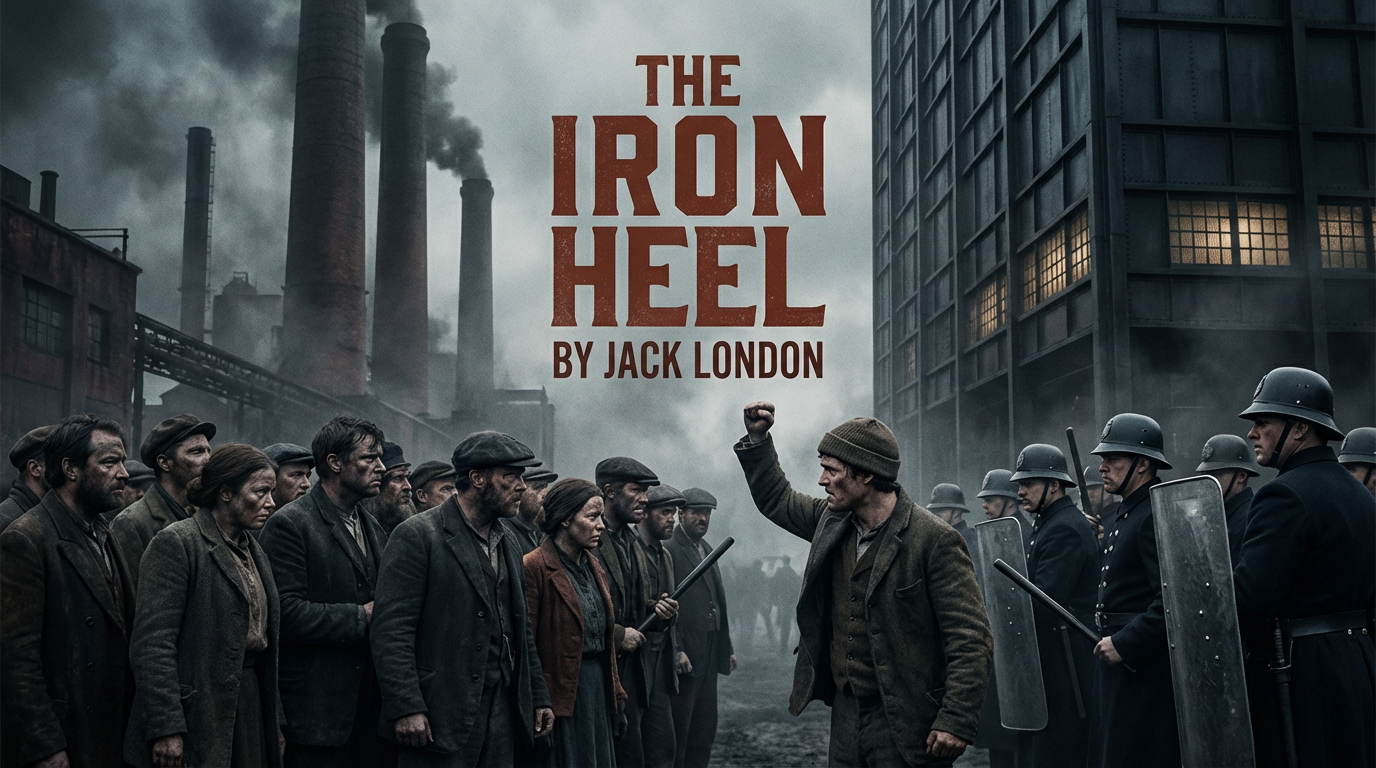
An excerpt from the original text.(complete · 3046 words)
TRANSFORMATION
“You must make yourself over again,” Ernest wrote to me. “You must
cease to be. You must become another woman—and not merely in the
clothes you wear, but inside your skin under the clothes. You must make
yourself over again so that even I would not know you—your voice, your
gestures, your mannerisms, your carriage, your walk, everything.”
This command I obeyed. Every day I practised for hours in burying
forever the old Avis Everhard beneath the skin of another woman whom I
may call my other self. It was only by long practice that such results
could be obtained. In the mere detail of voice intonation I practised
almost perpetually till the voice of my new self became fixed,
automatic. It was this automatic assumption of a rôle that was
considered imperative. One must become so adept as to deceive oneself.
It was like learning a new language, say the French. At first speech in
French is self-conscious, a matter of the will. The student thinks in
English and then transmutes into French, or reads in French but
transmutes into English before he can understand. Then later, becoming
firmly grounded, automatic, the student reads, writes, and thinks in
French, without any recourse to English at all.
And so with our disguises. It was necessary for us to practise until
our assumed roles became real; until to be our original selves would
require a watchful and strong exercise of will. Of course, at first,
much was mere blundering experiment. We were creating a new art, and we
had much to discover. But the work was going on everywhere; masters in
the art were developing, and a fund of tricks and expedients was being
accumulated. This fund became a sort of text-book that was passed on, a
part of the curriculum, as it were, of the school of Revolution.[1]
[1] Disguise did become a veritable art during that period. The
revolutionists maintained schools of acting in all their refuges. They
scorned accessories, such as wigs and beards, false eyebrows, and such
aids of the theatrical actors. The game of revolution was a game of
life and death, and mere accessories were traps. Disguise had to be
fundamental, intrinsic, part and parcel of one’s being, second nature.
The Red Virgin is reported to have been one of the most adept in the
art, to which must be ascribed her long and successful career.
It was at this time that my father disappeared. His letters, which had
come to me regularly, ceased. He no longer appeared at our Pell Street
quarters. Our comrades sought him everywhere. Through our secret
service we ransacked every prison in the land. But he was lost as
completely as if the earth had swallowed him up, and to this day no
clew to his end has been discovered.[2]
[2] Disappearance was one of the horrors of the time. As a motif, in
song and story, it constantly crops up. It was an inevitable
concomitant of the subterranean warfare that raged through those three
centuries. This phenomenon was almost as common in the oligarch class
and the labor castes, as it was in the ranks of the revolutionists.
Without warning, without trace, men and women, and even children,
disappeared and were seen no more, their end shrouded in mystery.
Six lonely months I spent in the refuge, but they were not idle months.
Our organization went on apace, and there were mountains of work always
waiting to be done. Ernest and his fellow-leaders, from their prisons,
decided what should be done; and it remained for us on the outside to
do it. There was the organization of the mouth-to-mouth propaganda; the
organization, with all its ramifications, of our spy system; the
establishment of our secret printing-presses; and the establishment of
our underground railways, which meant the knitting together of all our
myriads of places of refuge, and the formation of new refuges where
links were missing in the chains we ran over all the land.
So I say, the work was never done. At the end of six months my
loneliness was broken by the arrival of two comrades. They were young
girls, brave souls and passionate lovers of liberty: Lora Peterson, who
disappeared in 1922, and Kate Bierce, who later married Du Bois,[3] and
who is still with us with eyes lifted to to-morrow’s sun, that heralds
in the new age.
[3] Du Bois, the present librarian of Ardis, is a lineal descendant of
this revolutionary pair.
The two girls arrived in a flurry of excitement, danger, and sudden
death. In the crew of the fishing boat that conveyed them across San
Pablo Bay was a spy. A creature of the Iron Heel, he had successfully
masqueraded as a revolutionist and penetrated deep into the secrets of
our organization. Without doubt he was on my trail, for we had long
since learned that my disappearance had been cause of deep concern to
the secret service of the Oligarchy. Luckily, as the outcome proved, he
had not divulged his discoveries to any one. He had evidently delayed
reporting, preferring to wait until he had brought things to a
successful conclusion by discovering my hiding-place and capturing me.
His information died with him. Under some pretext, after the girls had
landed at Petaluma Creek and taken to the horses, he managed to get
away from the boat.
Part way up Sonoma Mountain, John Carlson let the girls go on, leading
his horse, while he went back on foot. His suspicions had been aroused.
He captured the spy, and as to what then happened, Carlson gave us a
fair idea.
“I fixed him,” was Carlson’s unimaginative way of describing the
affair. “I fixed him,” he repeated, while a sombre light burnt in his
eyes, and his huge, toil-distorted hands opened and closed eloquently.
“He made no noise. I hid him, and tonight I will go back and bury him
deep.”
During that period I used to marvel at my own metamorphosis. At times
it seemed impossible, either that I had ever lived a placid, peaceful
life in a college town, or else that I had become a revolutionist
inured to scenes of violence and death. One or the other could not be.
One was real, the other was a dream, but which was which? Was this
present life of a revolutionist, hiding in a hole, a nightmare? or was
I a revolutionist who had somewhere, somehow, dreamed that in some
former existence I have lived in Berkeley and never known of life more
violent than teas and dances, debating societies, and lecture rooms?
But then I suppose this was a common experience of all of us who had
rallied under the red banner of the brotherhood of man.
I often remembered figures from that other life, and, curiously enough,
they appeared and disappeared, now and again, in my new life. There was
Bishop Morehouse. In vain we searched for him after our organization
had developed. He had been transferred from asylum to asylum. We traced
him from the state hospital for the insane at Napa to the one in
Stockton, and from there to the one in the Santa Clara Valley called
Agnews, and there the trail ceased. There was no record of his death.
In some way he must have escaped. Little did I dream of the awful
manner in which I was to see him once again—the fleeting glimpse of him
in the whirlwind carnage of the Chicago Commune.
Jackson, who had lost his arm in the Sierra Mills and who had been the
cause of my own conversion into a revolutionist, I never saw again; but
we all knew what he did before he died. He never joined the
revolutionists. Embittered by his fate, brooding over his wrongs, he
became an anarchist—not a philosophic anarchist, but a mere animal, mad
with hate and lust for revenge. And well he revenged himself. Evading
the guards, in the nighttime while all were asleep, he blew the
Pertonwaithe palace into atoms. Not a soul escaped, not even the
guards. And in prison, while awaiting trial, he suffocated himself
under his blankets.
Dr. Hammerfield and Dr. Ballingford achieved quite different fates from
that of Jackson. They have been faithful to their salt, and they have
been correspondingly rewarded with ecclesiastical palaces wherein they
dwell at peace with the world. Both are apologists for the Oligarchy.
Both have grown very fat. “Dr. Hammerfield,” as Ernest once said, “has
succeeded in modifying his metaphysics so as to give God’s sanction to
the Iron Heel, and also to include much worship of beauty and to reduce
to an invisible wraith the gaseous vertebrate described by Haeckel—the
difference between Dr. Hammerfield and Dr. Ballingford being that the
latter has made the God of the oligarchs a little more gaseous and a
little less vertebrate.”
Peter Donnelly, the scab foreman at the Sierra Mills whom I encountered
while investigating the case of Jackson, was a surprise to all of us.
In 1918 I was present at a meeting of the ’Frisco Reds. Of all our
Fighting Groups this one was the most formidable, ferocious, and
merciless. It was really not a part of our organization. Its members
were fanatics, madmen. We dared not encourage such a spirit. On the
other hand, though they did not belong to us, we remained on friendly
terms with them. It was a matter of vital importance that brought me
there that night. I, alone in the midst of a score of men, was the only
person unmasked. After the business that brought me there was
transacted, I was led away by one of them. In a dark passage this guide
struck a match, and, holding it close to his face, slipped back his
mask. For a moment I gazed upon the passion-wrought features of Peter
Donnelly. Then the match went out.
“I just wanted you to know it was me,” he said in the darkness. “D’you
remember Dallas, the superintendent?”
I nodded at recollection of the vulpine-faced superintendent of the
Sierra Mills.
“Well, I got him first,” Donnelly said with pride. “’Twas after that I
joined the Reds.”
“But how comes it that you are here?” I queried. “Your wife and
children?”
“Dead,” he answered. “That’s why. No,” he went on hastily, “’tis not
revenge for them. They died easily in their beds—sickness, you see, one
time and another. They tied my arms while they lived. And now that
they’re gone, ’tis revenge for my blasted manhood I’m after. I was once
Peter Donnelly, the scab foreman. But to-night I’m Number 27 of the
’Frisco Reds. Come on now, and I’ll get you out of this.”
More I heard of him afterward. In his own way he had told the truth
when he said all were dead. But one lived, Timothy, and him his father
considered dead because he had taken service with the Iron Heel in the
Mercenaries.[4] A member of the ’Frisco Reds pledged himself to twelve
annual executions. The penalty for failure was death. A member who
failed to complete his number committed suicide. These executions were
not haphazard. This group of madmen met frequently and passed wholesale
judgments upon offending members and servitors of the Oligarchy. The
executions were afterward apportioned by lot.
[4] In addition to the labor castes, there arose another caste, the
military. A standing army of professional soldiers was created,
officered by members of the Oligarchy and known as the Mercenaries.
This institution took the place of the militia, which had proved
impracticable under the new regime. Outside the regular secret service
of the Iron Heel, there was further established a secret service of
the Mercenaries, this latter forming a connecting link between the
police and the military.
In fact, the business that brought me there the night of my visit was
such a trial. One of our own comrades, who for years had successfully
maintained himself in a clerical position in the local bureau of the
secret service of the Iron Heel, had fallen under the ban of the
’Frisco Reds and was being tried. Of course he was not present, and of
course his judges did not know that he was one of our men. My mission
had been to testify to his identity and loyalty. It may be wondered how
we came to know of the affair at all. The explanation is simple. One of
our secret agents was a member of the ’Frisco Reds. It was necessary
for us to keep an eye on friend as well as foe, and this group of
madmen was not too unimportant to escape our surveillance.
But to return to Peter Donnelly and his son. All went well with
Donnelly until, in the following year, he found among the sheaf of
executions that fell to him the name of Timothy Donnelly. Then it was
that that clannishness, which was his to so extraordinary a degree,
asserted itself. To save his son, he betrayed his comrades. In this he
was partially blocked, but a dozen of the ’Frisco Reds were executed,
and the group was well-nigh destroyed. In retaliation, the survivors
meted out to Donnelly the death he had earned by his treason.
Nor did Timothy Donnelly long survive. The ’Frisco Reds pledged
themselves to his execution. Every effort was made by the Oligarchy to
save him. He was transferred from one part of the country to another.
Three of the Reds lost their lives in vain efforts to get him. The
Group was composed only of men. In the end they fell back on a woman,
one of our comrades, and none other than Anna Roylston. Our Inner
Circle forbade her, but she had ever a will of her own and disdained
discipline. Furthermore, she was a genius and lovable, and we could
never discipline her anyway. She is in a class by herself and not
amenable to the ordinary standards of the revolutionists.
Despite our refusal to grant permission to do the deed, she went on
with it. Now Anna Roylston was a fascinating woman. All she had to do
was to beckon a man to her. She broke the hearts of scores of our young
comrades, and scores of others she captured, and by their heart-strings
led into our organization. Yet she steadfastly refused to marry. She
dearly loved children, but she held that a child of her own would claim
her from the Cause, and that it was the Cause to which her life was
devoted.
It was an easy task for Anna Roylston to win Timothy Donnelly. Her
conscience did not trouble her, for at that very time occurred the
Nashville Massacre, when the Mercenaries, Donnelly in command,
literally murdered eight hundred weavers of that city. But she did not
kill Donnelly. She turned him over, a prisoner, to the ’Frisco Reds.
This happened only last year, and now she had been renamed. The
revolutionists everywhere are calling her the “Red Virgin.”[5]
[5] It was not until the Second Revolt was crushed, that the ’Frisco
Reds flourished again. And for two generations the Group flourished.
Then an agent of the Iron Heel managed to become a member, penetrated
all its secrets, and brought about its total annihilation. This
occurred in 2002 A.D. The members were executed one at a time, at
intervals of three weeks, and their bodies exposed in the labor-ghetto
of San Francisco.
Colonel Ingram and Colonel Van Gilbert are two more familiar figures
that I was later to encounter. Colonel Ingram rose high in the
Oligarchy and became Minister to Germany. He was cordially detested by
the proletariat of both countries. It was in Berlin that I met him,
where, as an accredited international spy of the Iron Heel, I was
received by him and afforded much assistance. Incidentally, I may state
that in my dual rôle I managed a few important things for the
Revolution.
Colonel Van Gilbert became known as “Snarling” Van Gilbert. His
important part was played in drafting the new code after the Chicago
Commune. But before that, as trial judge, he had earned sentence of
death by his fiendish malignancy. I was one of those that tried him and
passed sentence upon him. Anna Roylston carried out the execution.
Still another figure arises out of the old life—Jackson’s lawyer. Least
of all would I have expected again to meet this man, Joseph Hurd. It
was a strange meeting. Late at night, two years after the Chicago
Commune, Ernest and I arrived together at the Benton Harbor refuge.
This was in Michigan, across the lake from Chicago. We arrived just at
the conclusion of the trial of a spy. Sentence of death had been
passed, and he was being led away. Such was the scene as we came upon
it. The next moment the wretched man had wrenched free from his captors
and flung himself at my feet, his arms clutching me about the knees in
a vicelike grip as he prayed in a frenzy for mercy. As he turned his
agonized face up to me, I recognized him as Joseph Hurd. Of all the
terrible things I have witnessed, never have I been so unnerved as by
this frantic creature’s pleading for life. He was mad for life. It was
pitiable. He refused to let go of me, despite the hands of a dozen
comrades. And when at last he was dragged shrieking away, I sank down
fainting upon the floor. It is far easier to see brave men die than to
hear a coward beg for life.[6]
[6] The Benton Harbor refuge was a catacomb, the entrance of which was
cunningly contrived by way of a well. It has been maintained in a fair
state of preservation, and the curious visitor may to-day tread its
labyrinths to the assembly hall, where, without doubt, occurred the
scene described by Avis Everhard. Farther on are the cells where the
prisoners were confined, and the death chamber where the executions
took place. Beyond is the cemetery—long, winding galleries hewn out of
the solid rock, with recesses on either hand, wherein, tier above
tier, lie the revolutionists just as they were laid away by their
comrades long years agone.
Master this chapter. Complete your experience
Purchase the complete book to access all chapters and support classic literature
As an Amazon Associate, we earn a small commission from qualifying purchases at no additional cost to you.
Available in paperback, hardcover, and e-book formats
Let's Analyse the Pattern
When circumstances demand it, humans can completely rewire their identity, making their former self feel foreign and their new self automatic.
Why This Matters
Connect literature to life
This chapter teaches how to identify when someone (including yourself) is undergoing complete psychological transformation rather than surface-level change.
Practice This Today
This week, notice when someone's automatic responses have changed—not just their opinions, but their reflexes, their voice patterns, their way of moving through space.
Now let's explore the literary elements.
Key Quotes & Analysis
"You must make yourself over again. You must cease to be. You must become another woman—and not merely in the clothes you wear, but inside your skin under the clothes."
Context: Ernest instructs Avis on how to create a deep cover identity for underground work.
This quote reveals the psychological cost of revolutionary work—complete loss of original identity. It shows how survival under authoritarian rule requires fundamental self-transformation, not just surface changes.
In Today's Words:
You need to completely reinvent yourself from the inside out, not just change how you look.
"It was necessary for us to practise until our assumed roles became real; until to be our original selves would require a watchful and strong exercise of will."
Context: Avis describes the thorough nature of identity transformation required for revolutionary work.
This shows how complete psychological reconstruction works—the fake identity becomes more natural than the real one. It highlights the profound personal cost of resistance work.
In Today's Words:
We had to practice being fake until fake felt more natural than being ourselves.
"Which was real—the beautiful world of my girlhood or this harsh and terrible world of revolution?"
Context: Avis reflects on her transformation and questions which version of her life is authentic.
This captures the disorienting effect of radical life change and how extreme circumstances can make your past feel like someone else's life. It shows the psychological fragmentation that comes with survival.
In Today's Words:
I couldn't tell anymore which version of my life was the real one—the peaceful past or this violent present.
Thematic Threads
Identity
In This Chapter
Avis transforms so completely that her old self requires conscious effort to access
Development
Evolved from earlier class awakening to total psychological reconstruction
In Your Life:
You might experience this during major life transitions like divorce, career change, or trauma recovery
Loyalty
In This Chapter
Peter Donnelly chooses his son over his revolutionary comrades, leading to both their deaths
Development
Builds on earlier themes of conflicted allegiances between class and family
In Your Life:
You face this when workplace demands conflict with family needs or when friend groups have opposing values
Extremism
In This Chapter
The 'Frisco Reds commit to annual executions, turning revolution into ritualized violence
Development
Shows how earlier revolutionary idealism hardens into systematic brutality
In Your Life:
You might see this in how workplace grievances escalate into permanent hostility or how political beliefs become all-consuming
Disappearance
In This Chapter
Avis's father vanishes without trace, joining countless others who simply cease to exist
Development
Represents the ultimate consequence of the surveillance state introduced earlier
In Your Life:
You experience this when people suddenly cut contact or when institutions make individuals 'invisible'
Reality
In This Chapter
Avis questions which life is real—her peaceful past or violent present
Development
Culminates earlier questioning of social roles and authentic self
In Your Life:
You might feel this when comparing your pre-crisis self to who you've become through hardship
You now have the context. Time to form your own thoughts.
Discussion Questions
- 1
How does Avis's transformation go beyond just changing her appearance or name?
analysis • surface - 2
Why does Peter Donnelly's choice between his revolutionary ideals and saving his son lead to both their deaths?
analysis • medium - 3
Where do you see people today undergoing complete identity transformations when circumstances demand it?
application • medium - 4
If you had to completely reinvent yourself for survival, what parts of your identity would be hardest to let go of?
reflection • deep - 5
What does this chapter reveal about which loyalties people prioritize when forced to choose between family, ideology, and survival?
analysis • deep
Critical Thinking Exercise
Map Your Identity Layers
Create a simple diagram with three circles: your surface identity (job, appearance, daily habits), your social identity (relationships, community roles), and your core identity (deepest values, instincts). Mark which elements you could change if survival demanded it, which would be difficult to change, and which feel absolutely unchangeable. Consider how someone like Avis managed to transform even her automatic responses.
Consider:
- •Some identity changes happen gradually through life circumstances, not just crisis
- •What feels 'unchangeable' about yourself might be more flexible than you think
- •Complete transformation requires letting go of who you used to be, not just adding new traits
Journaling Prompt
Write about a time when you had to become a different version of yourself - maybe starting a new job, moving somewhere new, or facing a major life change. What surprised you about what you could adapt and what felt impossible to change?
Coming Up Next...
Chapter 20: Converting an Enemy
The next chapter promises to reveal the fate of a lost oligarch, suggesting Avis will encounter someone from the ruling class who has fallen from grace or gone missing, potentially offering insights into the cracks appearing within the Iron Heel's power structure.



