
What to expect ahead
What follows is a compact summary of each chapter in the book, designed to help you quickly grasp the core ideas while inviting you to continue into the full original text. Even when chapter text is presented here, these summaries are meant as a gateway to understanding, so your eventual reading of the complete book feels richer, deeper, and more fully appreciated.
Divine Comedy
A Brief Description
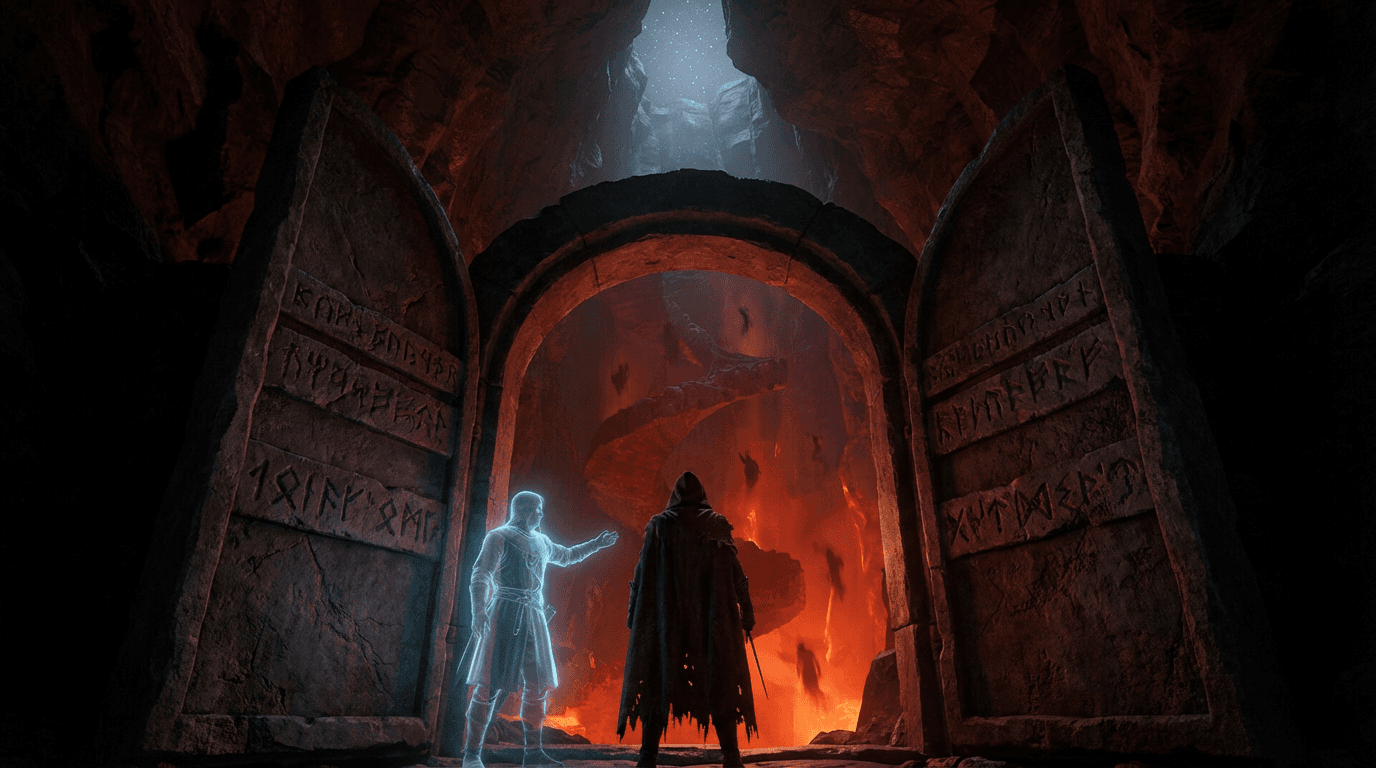
The Divine Comedy is the greatest literary journey ever written—a 14th-century Italian epic in which the poet Dante Alighieri descends into Hell, climbs the mountain of Purgatory, and ascends through the spheres of Heaven, guided first by the Roman poet Virgil and then by his idealized love, Beatrice.
It begins in crisis. At age thirty-five—the midpoint of a human life—Dante finds himself lost in a dark forest, having strayed from the right path. What follows is no ordinary adventure. Over three canticles—Inferno, Purgatorio, and Paradiso—Dante witnesses the full moral architecture of existence: every sin and its consequence, every virtue and its reward, every soul placed with terrible precision into its eternal home.
In Hell, he meets the greedy, the violent, the fraudulent, and the treacherous—each torment a perfect mirror of the sin itself. In Purgatory, souls climb toward redemption, shedding pride, envy, and sloth one terrace at a time. In Paradise, Dante encounters philosophers, emperors, saints, and mystics, ascending toward a vision of God so brilliant it transcends language.
But the poem is not merely theological. It is ferociously personal and political. Dante places his enemies in Hell and his heroes in Heaven with the confidence of a man who believes moral truth is absolute. It is an act of artistic audacity that has never been surpassed.
What makes The Divine Comedy endure is its central question—one every reader recognizes: how do you find your way back when you've lost yourself? Dante's answer is precise: you need a guide, you need to face what you've done, and you need something worth moving toward. Seven hundred years later, that answer still holds.
Essential Life Skills Deep Dive
Explore chapter-by-chapter breakdowns of the essential life skills taught in this classic novel.
Recognizing When You Are Lost
8 chapters on the experience of disorientation — how to name it honestly, accept help, face what caused it, and find your way back from the dark wood.
Where Your Vices Actually Lead
8 chapters from the Inferno tracing specific patterns — self-deception, money obsession, sown division — to their logical, irreversible endpoints in Hell.
The Structure of Transformation
8 chapters from Purgatorio on how deep change actually works — the stages, the weight you carry, the threshold that always appears at the end, and what completion feels like.
Receiving Guidance and Honoring Teachers
8 chapters tracing how Dante navigates Virgil, Beatrice, Brunetto, and Cacciaguida — and what it means to be genuinely guided and to honor those who made your journey possible.
You Become What You Do
8 chapters on the contrapasso principle — how punishments in Hell mirror sins precisely, and what that logic reveals about how repeated choices build (or destroy) your identity.
Finding Purpose When the World Rejects You
8 chapters tracing Dante's own exile — how the loss of everything he worked for became the condition that made the Commedia, and one of the greatest works in history, possible.
Essential Skills
Life skills and patterns this book helps you develop—drawn from its themes and characters.
Critical Thinking Through Literature
Develop analytical skills by examining the complex themes and character motivations in Divine Comedy, learning to question assumptions and see multiple perspectives.
Historical Context Understanding
Learn to place events and ideas within their historical context, understanding how Divine Comedy reflects and responds to the issues of its time.
Empathy and Perspective-Taking
Build empathy by experiencing life through the eyes of characters from different times, backgrounds, and circumstances in Divine Comedy.
Recognizing Timeless Human Nature
Understand that human nature remains constant across centuries, as Divine Comedy reveals patterns of behavior and motivation that persist today.
Articulating Complex Ideas
Improve your ability to express nuanced thoughts and feelings by engaging with the sophisticated language and themes in Divine Comedy.
Moral Reasoning and Ethics
Develop your ethical reasoning by grappling with the moral dilemmas and philosophical questions raised throughout Divine Comedy.
Table of Contents
Lost in the Dark Wood
Dante's Crisis of Confidence
The Gate of Hell
Descent into Limbo
The Judge and the Lovers
The Gluttons in Eternal Rain
The Greedy and the Wasteful Clash
The Ferryman's Rage and City Gates
The Heavenly Messenger Opens the Gate
Conversations with the Dead
The Architecture of Evil
The River of Blood
The Forest of Self-Destruction
The Rain of Fire
Meeting an Old Teacher in Hell
About Dante Alighieri
Published 1320
Dante Alighieri (1265-1321) was an Italian poet, philosopher, and political figure. Exiled from his beloved Florence, he wrote The Divine Comedy during his years of wandering. The work is considered the greatest literary achievement in Italian and one of the supreme works of world literature, establishing Tuscan as the literary language of Italy.
Why This Author Matters Today
Dante Alighieri's insights into human nature, social constraints, and the search for authenticity remain powerfully relevant. Their work helps us understand the timeless tensions between individual desire and social expectation, making them an essential guide for navigating modern life's complexities.
Amplified Classics is different.
not a sparknotes, nor a cliffnotes
This is a retelling. The story is still told—completely. You walk with the characters, feel what they feel, discover what they discover. The meaning arrives because you experienced it, not because someone explained a summary.
Read this, then read the original. The prose will illuminate—you'll notice what makes the author that author, because you're no longer fighting to follow the story.
Read the original first, then read this. Something will click. You'll want to go back.
Either way, the door opens inward.
Get the Full Book
Purchase the complete book to access all chapters and support classic literature
As an Amazon Associate, we earn a small commission from qualifying purchases at no additional cost to you.
Available in paperback, hardcover, and e-book formats
You Might Also Like




Free to read • No account required