An excerpt from the original text.(complete · 1083 words)
Soon as the charity of native land
Wrought in my bosom, I the scatter’d leaves
Collected, and to him restor’d, who now
Was hoarse with utt’rance. To the limit thence
We came, which from the third the second round
Divides, and where of justice is display’d
Contrivance horrible. Things then first seen
Clearlier to manifest, I tell how next
A plain we reach’d, that from its sterile bed
Each plant repell’d. The mournful wood waves round
Its garland on all sides, as round the wood
Spreads the sad foss. There, on the very edge,
Our steps we stay’d. It was an area wide
Of arid sand and thick, resembling most
The soil that erst by Cato’s foot was trod.

Vengeance of Heav’n! Oh ! how shouldst thou be fear’d
By all, who read what here my eyes beheld!

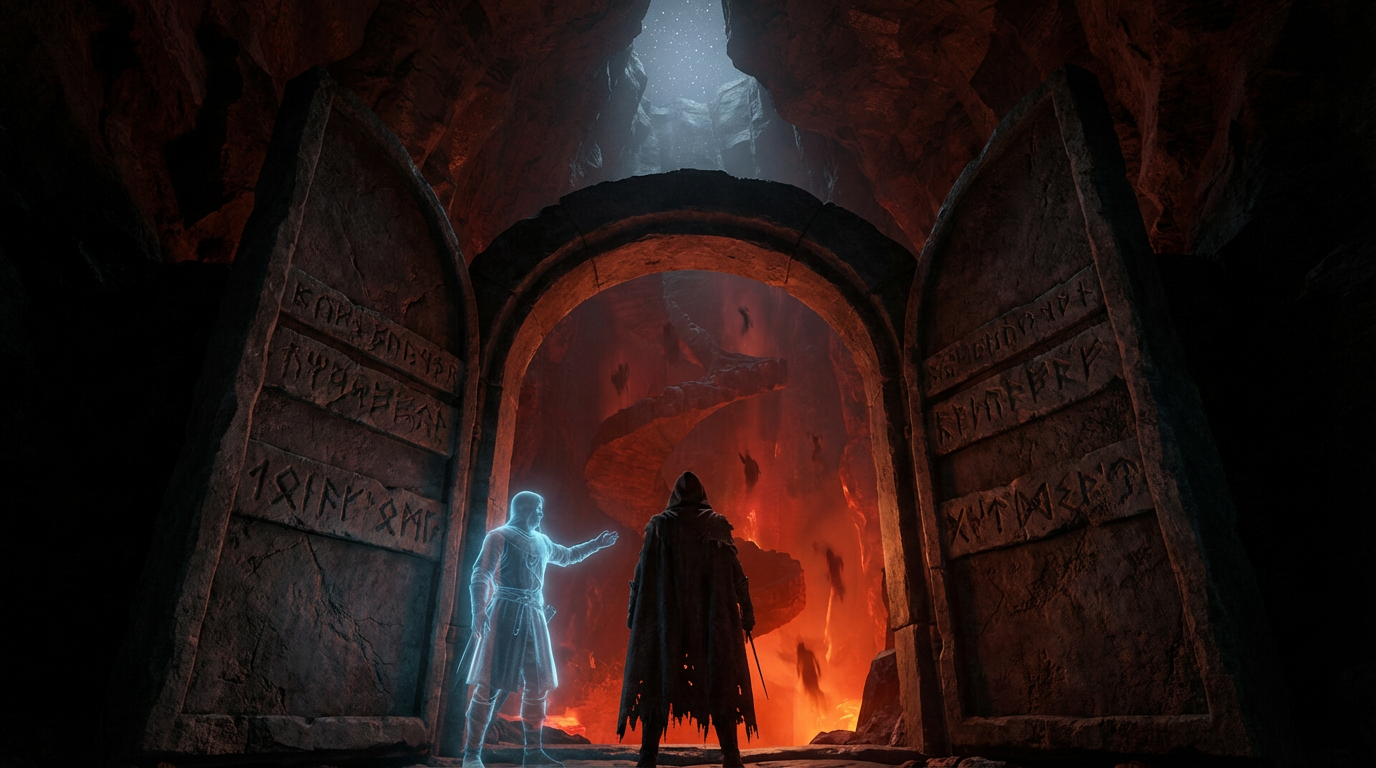
Of naked spirits many a flock I saw,
All weeping piteously, to different laws
Subjected: for on the’ earth some lay supine,
Some crouching close were seated, others pac’d
Incessantly around; the latter tribe,
More numerous, those fewer who beneath
The torment lay, but louder in their grief.

O’er all the sand fell slowly wafting down
Dilated flakes of fire, as flakes of snow
On Alpine summit, when the wind is hush’d.
As in the torrid Indian clime, the son
Of Ammon saw upon his warrior band
Descending, solid flames, that to the ground
Came down: whence he bethought him with his troop
To trample on the soil; for easier thus
The vapour was extinguish’d, while alone;
So fell the eternal fiery flood, wherewith
The marble glow’d underneath, as under stove
The viands, doubly to augment the pain.
Unceasing was the play of wretched hands,
Now this, now that way glancing, to shake off
The heat, still falling fresh. I thus began:
“Instructor! thou who all things overcom’st,
Except the hardy demons, that rush’d forth
To stop our entrance at the gate, say who
Is yon huge spirit, that, as seems, heeds not
The burning, but lies writhen in proud scorn,
As by the sultry tempest immatur’d?”

Straight he himself, who was aware I ask’d
My guide of him, exclaim’d: “Such as I was
When living, dead such now I am. If Jove
Weary his workman out, from whom in ire
He snatch’d the lightnings, that at my last day
Transfix’d me, if the rest be weary out
At their black smithy labouring by turns
In Mongibello, while he cries aloud;
“Help, help, good Mulciber!” as erst he cried
In the Phlegraean warfare, and the bolts
Launch he full aim’d at me with all his might,
He never should enjoy a sweet revenge.”

Then thus my guide, in accent higher rais’d
Than I before had heard him: “Capaneus!
Thou art more punish’d, in that this thy pride
Lives yet unquench’d: no torrent, save thy rage,
Were to thy fury pain proportion’d full.”

Next turning round to me with milder lip
He spake: “This of the seven kings was one,
Who girt the Theban walls with siege, and held,
As still he seems to hold, God in disdain,
And sets his high omnipotence at nought.
But, as I told him, his despiteful mood
Is ornament well suits the breast that wears it.
Follow me now; and look thou set not yet
Thy foot in the hot sand, but to the wood
Keep ever close.” Silently on we pass’d
To where there gushes from the forest’s bound
A little brook, whose crimson’d wave yet lifts
My hair with horror. As the rill, that runs
From Bulicame, to be portion’d out
Among the sinful women; so ran this
Down through the sand, its bottom and each bank
Stone-built, and either margin at its side,
Whereon I straight perceiv’d our passage lay.

“Of all that I have shown thee, since that gate
We enter’d first, whose threshold is to none
Denied, nought else so worthy of regard,
As is this river, has thine eye discern’d,
O’er which the flaming volley all is quench’d.”

So spake my guide; and I him thence besought,
That having giv’n me appetite to know,
The food he too would give, that hunger crav’d.

“In midst of ocean,” forthwith he began,
“A desolate country lies, which Crete is nam’d,
Under whose monarch in old times the world
Liv’d pure and chaste. A mountain rises there,
Call’d Ida, joyous once with leaves and streams,
Deserted now like a forbidden thing.
It was the spot which Rhea, Saturn’s spouse,
Chose for the secret cradle of her son;
And better to conceal him, drown’d in shouts
His infant cries. Within the mount, upright
An ancient form there stands and huge, that turns
His shoulders towards Damiata, and at Rome
As in his mirror looks. Of finest gold
His head is shap’d, pure silver are the breast
And arms; thence to the middle is of brass.
And downward all beneath well-temper’d steel,
Save the right foot of potter’s clay, on which
Than on the other more erect he stands,
Each part except the gold, is rent throughout;
And from the fissure tears distil, which join’d
Penetrate to that cave. They in their course
Thus far precipitated down the rock
Form Acheron, and Styx, and Phlegethon;
Then by this straiten’d channel passing hence
Beneath, e’en to the lowest depth of all,
Form there Cocytus, of whose lake (thyself
Shall see it) I here give thee no account.”

Then I to him: “If from our world this sluice
Be thus deriv’d; wherefore to us but now
Appears it at this edge?” He straight replied:
“The place, thou know’st, is round; and though great part
Thou have already pass’d, still to the left
Descending to the nethermost, not yet
Hast thou the circuit made of the whole orb.
Wherefore if aught of new to us appear,
It needs not bring up wonder in thy looks.”

Then I again inquir’d: “Where flow the streams
Of Phlegethon and Lethe? for of one
Thou tell’st not, and the other of that shower,
Thou say’st, is form’d.” He answer thus return’d:
“Doubtless thy questions all well pleas’d I hear.
Yet the red seething wave might have resolv’d
One thou proposest. Lethe thou shalt see,
But not within this hollow, in the place,
Whither to lave themselves the spirits go,
Whose blame hath been by penitence remov’d.”
He added: “Time is now we quit the wood.
Look thou my steps pursue: the margins give
Safe passage, unimpeded by the flames;
For over them all vapour is extinct.”
Master this chapter. Complete your experience
Purchase the complete book to access all chapters and support classic literature
As an Amazon Associate, we earn a small commission from qualifying purchases at no additional cost to you.
Available in paperback, hardcover, and e-book formats
Let's Analyse the Pattern
When protecting our ego becomes more important than solving our problems, we trap ourselves in cycles of escalating suffering.
Why This Matters
Connect literature to life
This chapter teaches how to recognize when pride shifts from healthy self-respect to self-destructive stubbornness.
Practice This Today
This week, notice when you feel resistance to feedback or help—that's your pride alarm going off, signaling time to pause and choose growth over image.
Now let's explore the literary elements.
Key Quotes & Analysis
"O vengeance of God, how much you should be feared by everyone who reads what was revealed before my eyes!"
Context: When he first sees the burning desert and the tortured souls
This shows Dante's growing understanding that divine justice is real and terrifying. He's moved from just feeling sorry for sinners to recognizing that consequences for our actions are inevitable and severe.
In Today's Words:
Holy crap, everyone needs to see this - actions really do have consequences and they're worse than you think.
"In life I was what I am now in death. Though Jove wear out his smith from whom he took the sharp thunderbolt that pierced me through on my last day, he cannot have revenge."
Context: When Dante and Virgil encounter him burning on the sand
Capaneus shows how pride can make suffering worse. Even in Hell, he refuses to humble himself or admit defeat. His defiance is actually what keeps him trapped in torment.
In Today's Words:
I was stubborn when I was alive and I'm still stubborn now. God can punish me all he wants but I'll never give him the satisfaction of breaking me.
"His very rage is the fitting punishment for him; no torments other than his own fury could give his pride pain that would truly bite."
Context: Explaining why Capaneus's punishment is so perfect
This reveals the deeper truth about how our worst traits become our own punishment. Capaneus's pride and rage hurt him more than any external torture could. It's a perfect example of how we often create our own hell.
In Today's Words:
His own anger is what's really destroying him - nothing else could hurt someone that proud as much as his own fury does.
Thematic Threads
Pride
In This Chapter
Capaneus refuses to acknowledge divine authority even while burning, making his punishment worse through defiance
Development
Evolved from earlier encounters with prideful souls, now showing how pride can become self-perpetuating torture
In Your Life:
You might see this when you refuse to ask for help at work, letting problems compound rather than admitting you don't know something
Class
In This Chapter
The different positions of punishment reflect social hierarchies—some lie flat like servants, others pace like nobility
Development
Continues the pattern of Hell reflecting earthly social structures, but now showing how all classes suffer equally under pride
In Your Life:
You might notice how people from different backgrounds express pride differently, but everyone gets trapped by it
Social Expectations
In This Chapter
Capaneus maintains his warrior identity even in Hell, performing defiance because that's what heroes are supposed to do
Development
Building on earlier themes of people trapped by their social roles, now showing the ultimate cost
In Your Life:
You might feel pressure to maintain a tough exterior at work even when you're struggling and need support
Personal Growth
In This Chapter
The statue allegory shows human civilization declining from gold to clay, suggesting growth requires acknowledging deterioration
Development
Introduced here as a new way to think about human development and the necessity of recognizing our flaws
In Your Life:
You might realize that admitting your current struggles is the first step toward building something better
Human Relationships
In This Chapter
Virgil patiently explains the deeper meaning to Dante, showing how wisdom is shared through relationship rather than demanded
Development
Continues the mentor-student dynamic, contrasting with Capaneus's isolation through pride
In Your Life:
You might see how your relationships improve when you're willing to learn from others rather than always needing to be right
You now have the context. Time to form your own thoughts.
Discussion Questions
- 1
Why does Capaneus continue to rage against the gods even while burning in eternal fire?
analysis • surface - 2
How does Capaneus's pride actually make his punishment worse than it has to be?
analysis • medium - 3
Think of someone you know who would rather suffer than admit they need help. What drives that choice?
application • medium - 4
When have you chosen to 'burn' rather than humble yourself? What would have happened if you'd asked for help instead?
reflection • deep - 5
The statue's tears become Hell's rivers - what does this suggest about how our collective pain shapes the world we navigate?
analysis • deep
Critical Thinking Exercise
Map Your Pride Triggers
Create a simple map of situations where your pride kicks in strongest. Draw three columns: 'Trigger Situation', 'What Pride Tells Me', and 'What Actually Happens'. Fill in at least three examples from your own life - times when you resisted help, feedback, or admitting mistakes.
Consider:
- •Notice if your pride triggers cluster around specific areas like work, relationships, or skills
- •Pay attention to the gap between what pride promises and what actually results
- •Look for patterns in the cost - what do you lose when pride takes over?
Journaling Prompt
Write about a current situation where your pride might be keeping you stuck. What would change if you chose growth over being right?
Coming Up Next...
Chapter 15: Meeting an Old Teacher in Hell
Following a mysterious red stream that cuts through the burning desert, Dante and Virgil find their path forward. The boiling river offers protection from the falling fire, but what lies ahead as they walk along its supernatural banks?