
You Become What You Do
8 chapters on the contrapasso principle — how the punishments in Hell mirror the sins precisely, and what that logic reveals about how repeated choices shape who you are.
The Pattern: Contrapasso — the Punishment Mirrors the Crime
The word contrapassoappears only once in the Commedia — Bertran de Born uses it to explain his own punishment. But the principle operates everywhere in Hell: the punishment is not arbitrary retribution; it is the logical extension of the sin. Fortune tellers walk backward. The hypocrites wear gilded lead. The frozen lake is generated by Satan's wings. The mechanism is always the same: what you do, you become; what you become, you inhabit forever.
The Sin and Its Mirror
Every punishment in Hell is a precise reflection of the sin — not a random penalty but the sin's own nature made permanent.
The Depth Reveals the Choice
Hell's structure goes from passion (highest) to fraud to treachery (lowest). Deliberate betrayal is worse than losing control.
Justice as Logic
Dante's Hell is not cruel — it is logical. The punishment is inherent in the act. This is the point: justice is not imposed from outside. It emerges from the inside.
Chapter by Chapter
The Inscription at the Gate of Hell
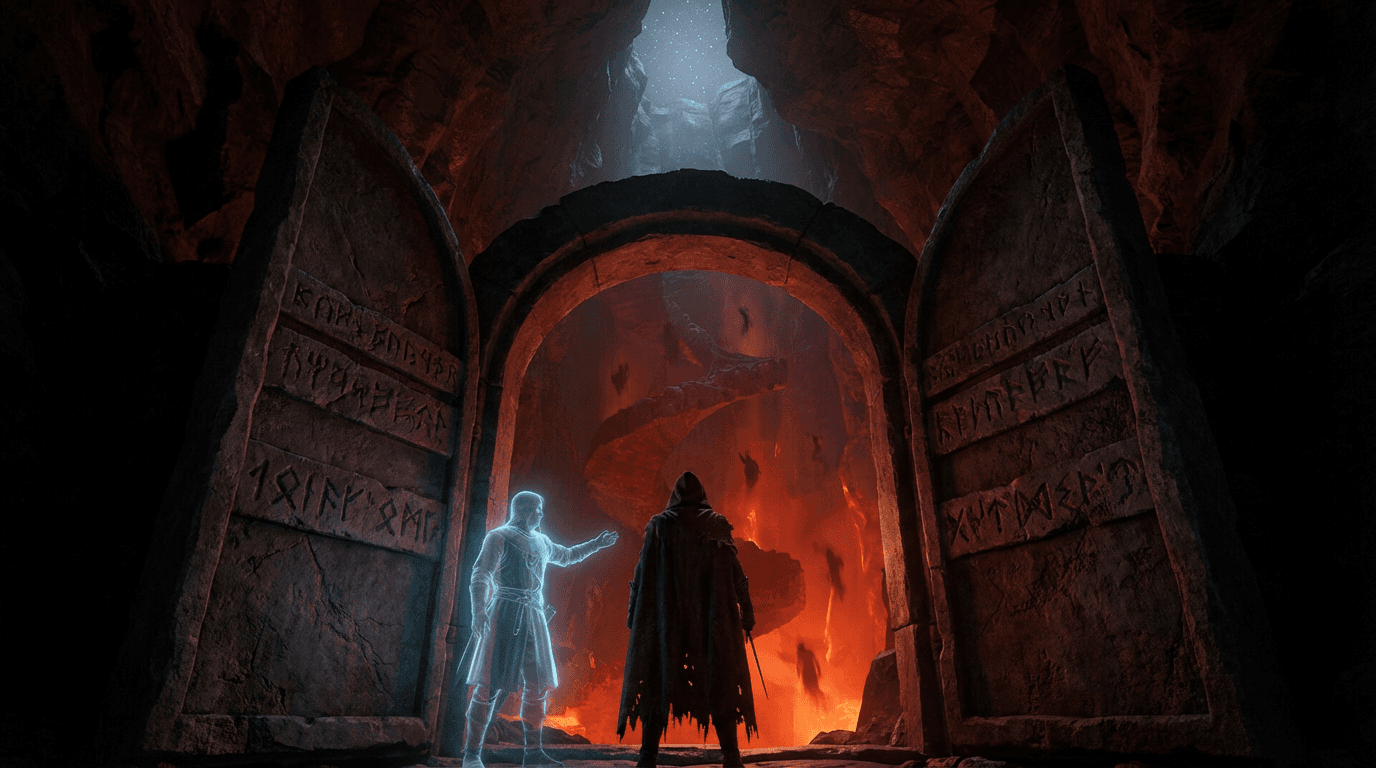
Dante and Virgil approach Hell's gate and read the famous inscription ending with 'Abandon all hope, ye who enter here.' Inside, Dante immediately encounters those who lived without choosing — the uncommitted, who ran a banner and were chased by wasps and flies forever. They were neither good nor evil. Hell does not want them; Heaven rejected them. They are nowhere.
The Inscription at the Gate of Hell
Divine Comedy — Chapter 3
“Abandon all hope, ye who enter here.”
Key Insight
Hell's first lesson is not about dramatic sin but about chronic avoidance. The uncommitted never made a decisive choice for anything. They ran in every direction and ended up nowhere. The contrapasso of pointless running forever mirrors a life of pointless running. The logic of justice here is simply: what you do becomes what you are, and what you are becomes your eternity.
The Gluttons Under Perpetual Filth
The gluttons lie in the third circle under an endless, freezing, stinking rain of hail, black snow, and putrid sleet, guarded by Cerberus, the three-headed dog. They lived to consume — to take in without thought or limit. Now they lie in filth, consuming it. The rain that was the pleasure — the falling, overflowing, excessive receiving — now comes as disgust.
The Gluttons Under Perpetual Filth
Divine Comedy — Chapter 6
Key Insight
Gluttony in Dante's taxonomy is not just about food — it is about the excessive, thoughtless consumption of anything. What you consume without restraint eventually consumes you. The contrapasso is exact: the pleasure was in the taking-in; now the taking-in is perpetual and revolting. The habit of overconsumption, extended to its logical end, produces a self that cannot stop receiving filth.
The Architecture of Evil: Why Hell Is Organized
Standing at the edge of lower Hell, Dante and Virgil pause behind a tomb while Virgil explains the structure of Hell. It is not arbitrary — it is a moral taxonomy. The deeper you go, the more the sins involve deliberate harm to others: violence, then fraud, then treachery. Sins of the intellect are worse than sins of passion, because they require more of the self.
The Architecture of Evil: Why Hell Is Organized
Divine Comedy — Chapter 11
Key Insight
Hell's organization reveals a crucial distinction: sins that involve betraying reason and deliberate choice are worse than sins driven by appetite. This is not about severity of consequences to others — it is about what you had to become to commit the act. The deeper sins require more of yourself to perform. You had to work harder to become capable of them.
Geryon: The Beautiful Face of Fraud
Geryon, the monster who carries Dante and Virgil into lower Hell, is one of the Inferno's most striking creations: a human face, beautiful and benign; a serpent's body; a scorpion's stinger tail. He is the embodiment of fraud — what it looks like from the outside, and what it is on the inside. Dante studies him carefully before they climb aboard.
Geryon: The Beautiful Face of Fraud
Divine Comedy — Chapter 17
Key Insight
Fraud requires a beautiful face precisely because it must deceive. The people most capable of sustained fraud have had to develop the capacity to present a face that is entirely disconnected from their interior. This split — maintaining a presentation that is the opposite of what you are — is itself a form of becoming. The face and the serpent eventually cannot be separated.
The Fortune Tellers Walk Backward Forever
In the fourth ditch of Malebolge, Dante encounters the diviners and fortune tellers — those who tried to see into the future. Their punishment: their heads are twisted completely backward. They can only see what is behind them; they walk backward, unable to see where they are going. Dante weeps at the sight, and Virgil rebukes him for this sympathy.
The Fortune Tellers Walk Backward Forever
Divine Comedy — Chapter 20
Key Insight
Those who tried to see forward face backward. The contrapasso is a precise inversion. But there is a deeper level: the act of claiming to see what only God can see — of usurping the future — produces a permanent inability to see what is actually in front of you. The pursuit of certainty about what you cannot know deprives you of clarity about what you can.
The Hypocrites Wear Lead Cloaks of Gold
In the sixth ditch, the hypocrites walk in gilded lead cloaks — beautiful on the outside, unbearably heavy on the inside. They spend eternity moving slowly under the weight of their performance. Dante even finds the Pharisees here, crucified to the floor, their bodies serving as the pavement for everyone else to walk on.
The Hypocrites Wear Lead Cloaks of Gold
Divine Comedy — Chapter 23
Key Insight
Hypocrisy requires the constant maintenance of a performance. The gilded lead is perfect: the appearance is of gold, the reality is crushing weight. What you perform, rather than inhabit, will eventually weigh more than you can bear. The life lived as performance — as what you appear to be rather than what you are — does not become lighter with practice. It becomes heavier.
The Thieves Transform Into What They Steal
In the circle of thieves, Dante witnesses one of the most bizarre punishments in Hell: thieves are repeatedly fused with and separated from serpents. A man and a serpent merge into a new form; then they separate, each becoming the other. They steal each other's form, endlessly. One soul who was a human becomes a serpent; the serpent that bit him becomes human in his place.
The Thieves Transform Into What They Steal
Divine Comedy — Chapter 25
Key Insight
Those who took what was not theirs have their very identity become something that can be taken. The transformation scenes in the circle of thieves are Dante's most unsettling because they show identity itself as fungible — when you spend a life taking what belongs to others, you gradually lose the fixedness of your own self. You become fluid, interchangeable, not quite yourself.
The Frozen Lake: What Betrayal Makes of You
Dante and Virgil reach Cocytus, the frozen lake at the bottom of Hell where traitors are encased in ice. The first zone holds those who betrayed family; the second, those who betrayed political allies; the third and fourth, those who betrayed guests and lords. Satan himself is at the center. The lake is frozen by the beating of Satan's wings — his very effort to escape generates the cold that holds him.
The Frozen Lake: What Betrayal Makes of You
Divine Comedy — Chapter 32
Key Insight
Betrayal — the breaking of the fundamental bonds of trust — freezes everything around it. The lake of ice is produced by the activity of the one who betrayed everything; his perpetual motion perpetually freezes the place. The logic is exact: the effort to escape what you made, through the same energy that made it, makes it more permanent. What you do to trust eventually turns you into the thing that destroys it.
Modern Application
Contemporary neuroscience has a version of contrapasso: every time you perform a behavior, the neural pathway for it strengthens. Every time you choose a certain response to a situation, you make that response more likely next time. You literally become what you repeatedly do. The Inferno knew this seven hundred years ago — it just rendered it in images rather than fMRI scans.
The practical implication is both sobering and useful. Sobering because there is no such thing as a consequence-free act. Everything you do is building something. Useful because the same logic applies in reverse: every act of generosity, attention, honesty, or courage is also building something.
The uncommitted — those who lived without choosing anything — are in Hell's entrance, not its depths. But they are still in Hell. The contrapasso is: the life without decision becomes, as its permanent form, a life of pointless, exhausting running. Choose. It matters what you choose. But the act of choosing itself is what builds a self.
The Central Lesson
Justice is not imposed from outside — it emerges from within the act. What you do, you become. The punishment and the sin are the same thing, seen from different angles. This is not a warning about Hell. It is a description of how identity is built.
Related Themes in This Book
Where Your Vices Actually Lead
Specific patterns traced to their endpoints in the Inferno.
Recognizing When You Are Lost
The counterpoint: awareness before patterns solidify.
The Structure of Transformation
If you can become what you do, you can also undo it.
Finding Purpose When the World Rejects You
Building identity through the right actions.