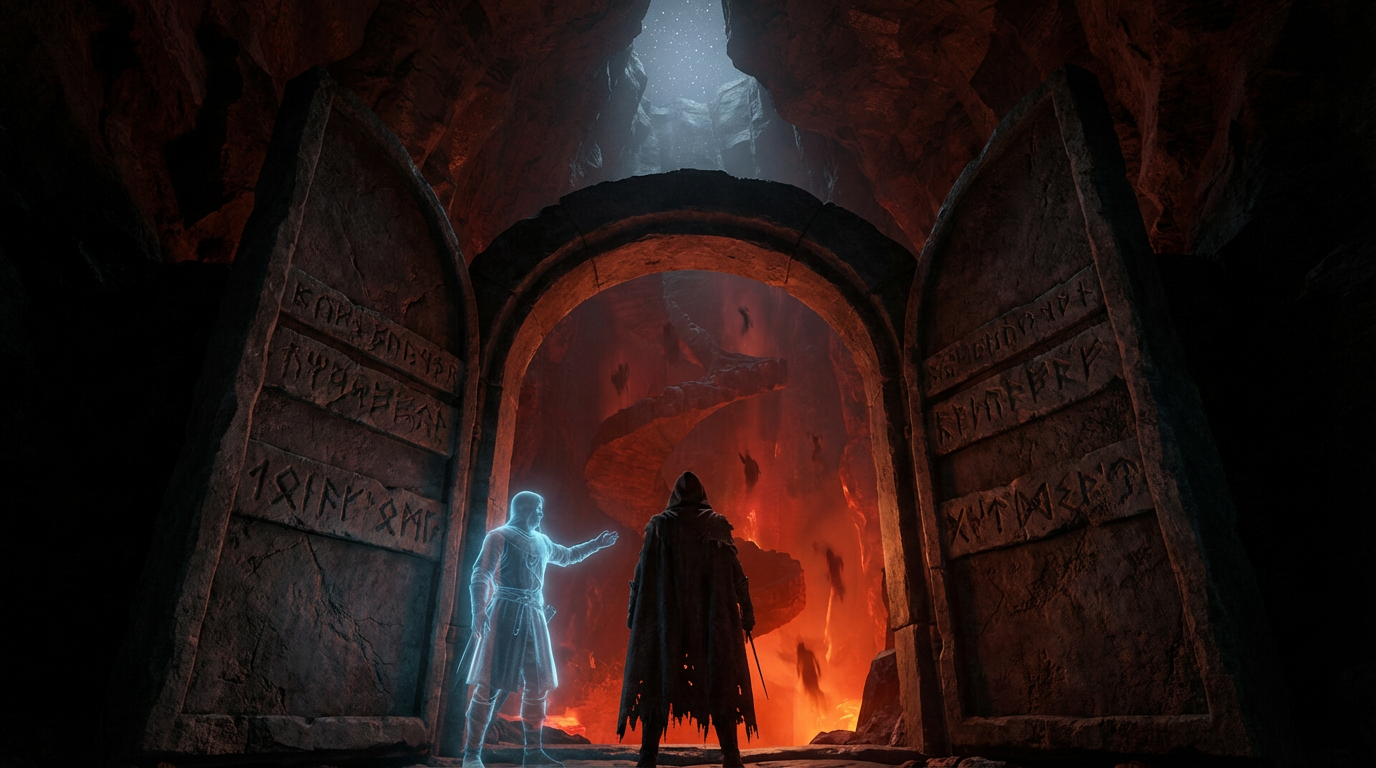
An excerpt from the original text.(complete · 1093 words)
When he had spoke, the sinner rais’d his hands
Pointed in mockery, and cried: “Take them, God!
I level them at thee!” From that day forth
The serpents were my friends; for round his neck
One of then rolling twisted, as it said,
“Be silent, tongue!” Another to his arms
Upgliding, tied them, riveting itself
So close, it took from them the power to move.

Pistoia! Ah Pistoia! why dost doubt
To turn thee into ashes, cumb’ring earth
No longer, since in evil act so far
Thou hast outdone thy seed? I did not mark,
Through all the gloomy circles of the’ abyss,
Spirit, that swell’d so proudly ’gainst his God,
Not him, who headlong fell from Thebes. He fled,
Nor utter’d more; and after him there came
A centaur full of fury, shouting, “Where
Where is the caitiff?” On Maremma’s marsh
Swarm not the serpent tribe, as on his haunch
They swarm’d, to where the human face begins.
Behind his head upon the shoulders lay,
With open wings, a dragon breathing fire
On whomsoe’er he met. To me my guide:
“Cacus is this, who underneath the rock
Of Aventine spread oft a lake of blood.
He, from his brethren parted, here must tread
A different journey, for his fraudful theft
Of the great herd, that near him stall’d; whence found
His felon deeds their end, beneath the mace
Of stout Alcides, that perchance laid on
A hundred blows, and not the tenth was felt.”

While yet he spake, the centaur sped away:
And under us three spirits came, of whom
Nor I nor he was ware, till they exclaim’d;
“Say who are ye?” We then brake off discourse,
Intent on these alone. I knew them not;
But, as it chanceth oft, befell, that one
Had need to name another. “Where,” said he,
“Doth Cianfa lurk?” I, for a sign my guide
Should stand attentive, plac’d against my lips
The finger lifted. If, O reader! now
Thou be not apt to credit what I tell,
No marvel; for myself do scarce allow
The witness of mine eyes. But as I looked
Toward them, lo! a serpent with six feet
Springs forth on one, and fastens full upon him:
His midmost grasp’d the belly, a forefoot
Seiz’d on each arm (while deep in either cheek
He flesh’d his fangs); the hinder on the thighs
Were spread, ’twixt which the tail inserted curl’d
Upon the reins behind. Ivy ne’er clasp’d
A dodder’d oak, as round the other’s limbs
The hideous monster intertwin’d his own.
Then, as they both had been of burning wax,
Each melted into other, mingling hues,
That which was either now was seen no more.
Thus up the shrinking paper, ere it burns,
A brown tint glides, not turning yet to black,
And the clean white expires. The other two
Look’d on exclaiming: “Ah, how dost thou change,
Agnello! See! Thou art nor double now,
Nor only one.” The two heads now became
One, and two figures blended in one form
Appear’d, where both were lost. Of the four lengths
Two arms were made: the belly and the chest
The thighs and legs into such members chang’d,
As never eye hath seen. Of former shape
All trace was vanish’d. Two yet neither seem’d
That image miscreate, and so pass’d on
With tardy steps. As underneath the scourge
Of the fierce dog-star, that lays bare the fields,
Shifting from brake to brake, the lizard seems
A flash of lightning, if he thwart the road,
So toward th’ entrails of the other two
Approaching seem’d, an adder all on fire,
As the dark pepper-grain, livid and swart.
In that part, whence our life is nourish’d first,
One he transpierc’d; then down before him fell
Stretch’d out. The pierced spirit look’d on him
But spake not; yea stood motionless and yawn’d,
As if by sleep or fev’rous fit assail’d.
He ey’d the serpent, and the serpent him.
One from the wound, the other from the mouth
Breath’d a thick smoke, whose vap’ry columns join’d.

Lucan in mute attention now may hear,
Nor thy disastrous fate, Sabellus! tell,
Nor shine, Nasidius! Ovid now be mute.
What if in warbling fiction he record
Cadmus and Arethusa, to a snake
Him chang’d, and her into a fountain clear,
I envy not; for never face to face
Two natures thus transmuted did he sing,
Wherein both shapes were ready to assume
The other’s substance. They in mutual guise
So answer’d, that the serpent split his train
Divided to a fork, and the pierc’d spirit
Drew close his steps together, legs and thighs
Compacted, that no sign of juncture soon
Was visible: the tail disparted took
The figure which the spirit lost, its skin
Soft’ning, his indurated to a rind.
The shoulders next I mark’d, that ent’ring join’d
The monster’s arm-pits, whose two shorter feet
So lengthen’d, as the other’s dwindling shrunk.
The feet behind then twisting up became
That part that man conceals, which in the wretch
Was cleft in twain. While both the shadowy smoke
With a new colour veils, and generates
Th’ excrescent pile on one, peeling it off
From th’ other body, lo! upon his feet
One upright rose, and prone the other fell.
Not yet their glaring and malignant lamps
Were shifted, though each feature chang’d beneath.
Of him who stood erect, the mounting face
Retreated towards the temples, and what there
Superfluous matter came, shot out in ears
From the smooth cheeks, the rest, not backward dragg’d,
Of its excess did shape the nose; and swell’d
Into due size protuberant the lips.
He, on the earth who lay, meanwhile extends
His sharpen’d visage, and draws down the ears
Into the head, as doth the slug his horns.
His tongue continuous before and apt
For utt’rance, severs; and the other’s fork
Closing unites. That done the smoke was laid.
The soul, transform’d into the brute, glides off,
Hissing along the vale, and after him
The other talking sputters; but soon turn’d
His new-grown shoulders on him, and in few
Thus to another spake: “Along this path
Crawling, as I have done, speed Buoso now!”

So saw I fluctuate in successive change
Th’ unsteady ballast of the seventh hold:
And here if aught my tongue have swerv’d, events
So strange may be its warrant. O’er mine eyes
Confusion hung, and on my thoughts amaze.

Yet ’scap’d they not so covertly, but well
I mark’d Sciancato: he alone it was
Of the three first that came, who chang’d not: thou,
The other’s fate, Gaville, still dost rue.
Master this chapter. Complete your experience
Purchase the complete book to access all chapters and support classic literature
As an Amazon Associate, we earn a small commission from qualifying purchases at no additional cost to you.
Available in paperback, hardcover, and e-book formats
Let's Analyse the Pattern
When we consistently take what isn't ours, we gradually lose our authentic identity and become unrecognizable even to ourselves.
Why This Matters
Connect literature to life
This chapter teaches how to spot the gradual loss of authentic self that comes from repeated dishonest actions.
Practice This Today
This week, notice when you justify taking something that isn't yours - time, credit, supplies, or trust - and ask yourself what story you're telling to make it okay.
Now let's explore the literary elements.
Key Quotes & Analysis
"Take them, God! I level them at thee!"
Context: The thief makes obscene gestures toward heaven in defiance
This shows ultimate rebellion - even in Hell, facing eternal punishment, some people still refuse to accept responsibility. It demonstrates how pride and anger can persist even when they're clearly self-destructive.
In Today's Words:
Screw you, God! Here's what I think of you!
"Pistoia! Ah Pistoia! why dost doubt to turn thee into ashes?"
Context: Dante condemns his contemporary city for being worse than Hell itself
Dante uses his journey through Hell to criticize real-world corruption. He's saying some places on Earth are so morally bankrupt they're worse than the underworld itself.
In Today's Words:
That city is so corrupt it should just burn itself down and start over!
"The serpents were my friends; for round his neck one of them rolling twisted"
Context: Describing how serpents punish the blasphemous thief
The irony is bitter - the very creatures that represent evil become agents of divine justice. The punishment is immediate and fitting, silencing the voice that spoke against God.
In Today's Words:
The snakes became his worst nightmare, wrapping around his throat to shut him up
"I did not mark, through all the gloomy circles of the abyss, spirit that swelled so proudly against his God"
Context: Dante reflects on how defiant this particular sinner is
Even among all the sinners Dante has seen, this one stands out for his arrogance. It shows how some people's pride is so extreme it becomes their defining characteristic, even in damnation.
In Today's Words:
In all the terrible people I've seen down here, nobody was this arrogant toward God
Thematic Threads
Identity
In This Chapter
Thieves literally lose their physical forms and become unrecognizable through constant transformation
Development
Evolved from earlier circles where sinners maintained recognizable forms but suffered specific punishments
In Your Life:
You might notice this when you realize you don't recognize the person you've become after years of small compromises
Class
In This Chapter
Theft represents the ultimate violation of social order and property boundaries that maintain class structure
Development
Builds on earlier themes of social disruption, now showing complete breakdown of social identity
In Your Life:
You see this when people from any background lose their social standing through dishonest behavior
Personal Growth
In This Chapter
The impossibility of growth when one's identity is constantly shifting and unstable
Development
Contrasts sharply with earlier circles where sinners could at least maintain consistent identity
In Your Life:
You experience this when dishonesty makes it impossible to build genuine skills or relationships
Human Relationships
In This Chapter
Relationships become impossible when people are literally unrecognizable and constantly changing
Development
Shows the ultimate breakdown of the social bonds that have been deteriorating throughout Hell
In Your Life:
You might see this when deception makes your relationships feel unstable and untrustworthy
You now have the context. Time to form your own thoughts.
Discussion Questions
- 1
What happens to the thieves in this circle of Hell, and why can't they maintain a stable form?
analysis • surface - 2
Why is constant transformation the perfect punishment for thieves - what's the connection between stealing and losing your identity?
analysis • medium - 3
Where do you see this pattern today - people who take what isn't theirs gradually becoming unrecognizable to themselves or others?
application • medium - 4
If you noticed yourself starting to lose your authentic identity through small compromises, what specific steps would you take to rebuild it?
application • deep - 5
What does this chapter suggest about the relationship between our actions and our sense of self - can we really separate who we are from what we do?
reflection • deep
Critical Thinking Exercise
Identity Erosion Tracker
Think of someone you know who gradually became unrecognizable - not physically, but in their character or behavior. Map out the small compromises or 'takings' that led to their transformation. Then honestly examine your own life: identify one area where you might be taking something that isn't yours (credit, time, emotional energy, etc.) and trace how it's affecting your sense of authentic self.
Consider:
- •Small compromises compound over time - look for patterns, not just single events
- •Consider emotional and social 'theft' as seriously as material theft
- •Notice how justifications and rationalizations change your internal narrative
Journaling Prompt
Write about a time when you caught yourself becoming someone you didn't recognize. What were you taking that wasn't yours, and how did you find your way back to your authentic self?
Coming Up Next...
Chapter 26: Ulysses Speaks: The Fatal Quest for Knowledge
Dante turns his attention to Florence, his beloved but corrupt hometown, and delivers a scathing critique of the city's moral decay. He's about to encounter more Florentine citizens suffering in Hell, forcing him to confront how his own city has contributed to the spiritual crisis he's witnessing.