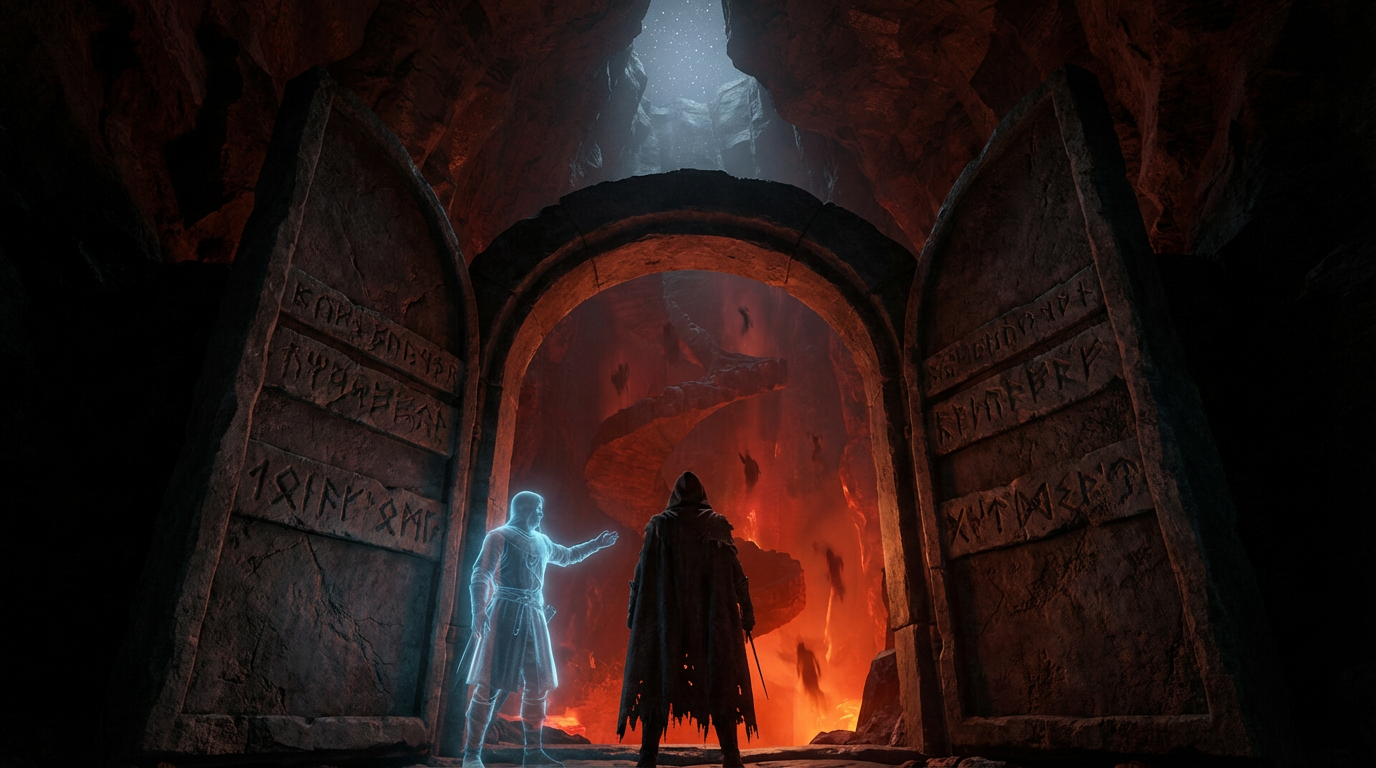
An excerpt from the original text.(complete · 1167 words)
n the year’s early nonage, when the sun
Tempers his tresses in Aquarius’ urn,
And now towards equal day the nights recede,
When as the rime upon the earth puts on
Her dazzling sister’s image, but not long
Her milder sway endures, then riseth up
The village hind, whom fails his wintry store,
And looking out beholds the plain around
All whiten’d, whence impatiently he smites
His thighs, and to his hut returning in,
There paces to and fro, wailing his lot,
As a discomfited and helpless man;
Then comes he forth again, and feels new hope
Spring in his bosom, finding e’en thus soon
The world hath chang’d its count’nance, grasps his crook,
And forth to pasture drives his little flock:
So me my guide dishearten’d when I saw
His troubled forehead, and so speedily
That ill was cur’d; for at the fallen bridge
Arriving, towards me with a look as sweet,
He turn’d him back, as that I first beheld
At the steep mountain’s foot. Regarding well
The ruin, and some counsel first maintain’d
With his own thought, he open’d wide his arm
And took me up. As one, who, while he works,
Computes his labour’s issue, that he seems
Still to foresee the’ effect, so lifting me
Up to the summit of one peak, he fix’d
His eye upon another. “Grapple that,”
Said he, “but first make proof, if it be such
As will sustain thee.” For one capp’d with lead
This were no journey. Scarcely he, though light,
And I, though onward push’d from crag to crag,
Could mount. And if the precinct of this coast
Were not less ample than the last, for him
I know not, but my strength had surely fail’d.
But Malebolge all toward the mouth
Inclining of the nethermost abyss,
The site of every valley hence requires,
That one side upward slope, the other fall.

At length the point of our descent we reach’d
From the last flag: soon as to that arriv’d,
So was the breath exhausted from my lungs,
I could no further, but did seat me there.

“Now needs thy best of man;” so spake my guide:
“For not on downy plumes, nor under shade
Of canopy reposing, fame is won,
Without which whosoe’er consumes his days
Leaveth such vestige of himself on earth,
As smoke in air or foam upon the wave.
Thou therefore rise: vanish thy weariness
By the mind’s effort, in each struggle form’d
To vanquish, if she suffer not the weight
Of her corporeal frame to crush her down.
A longer ladder yet remains to scale.
From these to have escap’d sufficeth not.
If well thou note me, profit by my words.”

I straightway rose, and show’d myself less spent
Than I in truth did feel me. “On,” I cried,
“For I am stout and fearless.” Up the rock
Our way we held, more rugged than before,
Narrower and steeper far to climb. From talk
I ceas’d not, as we journey’d, so to seem
Least faint; whereat a voice from the other foss
Did issue forth, for utt’rance suited ill.
Though on the arch that crosses there I stood,
What were the words I knew not, but who spake
Seem’d mov’d in anger. Down I stoop’d to look,
But my quick eye might reach not to the depth
For shrouding darkness; wherefore thus I spake:
“To the next circle, Teacher, bend thy steps,
And from the wall dismount we; for as hence
I hear and understand not, so I see
Beneath, and naught discern.”—“I answer not,”
Said he, “but by the deed. To fair request
Silent performance maketh best return.”

We from the bridge’s head descended, where
To the eighth mound it joins, and then the chasm
Opening to view, I saw a crowd within
Of serpents terrible, so strange of shape
And hideous, that remembrance in my veins
Yet shrinks the vital current. Of her sands
Let Lybia vaunt no more: if Jaculus,
Pareas and Chelyder be her brood,
Cenchris and Amphisboena, plagues so dire
Or in such numbers swarming ne’er she shew’d,
Not with all Ethiopia, and whate’er
Above the Erythraean sea is spawn’d.

Amid this dread exuberance of woe
Ran naked spirits wing’d with horrid fear,
Nor hope had they of crevice where to hide,
Or heliotrope to charm them out of view.
With serpents were their hands behind them bound,
Which through their reins infix’d the tail and head
Twisted in folds before. And lo! on one
Near to our side, darted an adder up,
And, where the neck is on the shoulders tied,
Transpierc’d him. Far more quickly than e’er pen
Wrote O or I, he kindled, burn’d, and chang’d
To ashes, all pour’d out upon the earth.
When there dissolv’d he lay, the dust again
Uproll’d spontaneous, and the self-same form
Instant resumed. So mighty sages tell,
The’ Arabian Phoenix, when five hundred years
Have well nigh circled, dies, and springs forthwith
Renascent. Blade nor herb throughout his life
He tastes, but tears of frankincense alone
And odorous amomum: swaths of nard
And myrrh his funeral shroud. As one that falls,
He knows not how, by force demoniac dragg’d
To earth, or through obstruction fettering up
In chains invisible the powers of man,
Who, risen from his trance, gazeth around,
Bewilder’d with the monstrous agony
He hath endur’d, and wildly staring sighs;
So stood aghast the sinner when he rose.

Oh! how severe God’s judgment, that deals out
Such blows in stormy vengeance! Who he was
My teacher next inquir’d, and thus in few
He answer’d: “Vanni Fucci am I call’d,
Not long since rained down from Tuscany
To this dire gullet. Me the beastial life
And not the human pleas’d, mule that I was,
Who in Pistoia found my worthy den.”

I then to Virgil: “Bid him stir not hence,
And ask what crime did thrust him hither: once
A man I knew him choleric and bloody.”

The sinner heard and feign’d not, but towards me
His mind directing and his face, wherein
Was dismal shame depictur’d, thus he spake:
“It grieves me more to have been caught by thee
In this sad plight, which thou beholdest, than
When I was taken from the other life.
I have no power permitted to deny
What thou inquirest.” I am doom’d thus low
To dwell, for that the sacristy by me
Was rifled of its goodly ornaments,
And with the guilt another falsely charged.
But that thou mayst not joy to see me thus,
So as thou e’er shalt ’scape this darksome realm
Open thine ears and hear what I forebode.
Reft of the Neri first Pistoia pines,
Then Florence changeth citizens and laws.
From Valdimagra, drawn by wrathful Mars,
A vapour rises, wrapt in turbid mists,
And sharp and eager driveth on the storm
With arrowy hurtling o’er Piceno’s field,
Whence suddenly the cloud shall burst, and strike
Each helpless Bianco prostrate to the ground.
This have I told, that grief may rend thy heart.”
Master this chapter. Complete your experience
Purchase the complete book to access all chapters and support classic literature
As an Amazon Associate, we earn a small commission from qualifying purchases at no additional cost to you.
Available in paperback, hardcover, and e-book formats
Let's Analyse the Pattern
When protecting your reputation becomes more important than addressing the underlying problem, leading to destructive retaliation against witnesses.
Why This Matters
Connect literature to life
This chapter teaches how to distinguish between legitimate grievances and lashing out driven by wounded pride.
Practice This Today
This week, notice when someone's anger seems disproportionate to the actual issue - they might be fighting shame, not you.
Now let's explore the literary elements.
Key Quotes & Analysis
"You cannot achieve fame sitting on cushions or lying under blankets"
Context: Virgil motivates Dante to keep pushing forward through Hell's difficult terrain
This reveals that greatness requires sustained effort and discomfort. Virgil is teaching Dante that meaningful achievement comes from persevering through challenges, not from seeking comfort.
In Today's Words:
You can't succeed by taking the easy way out or avoiding hard work
"It grieves me more that you have found me here than the day death took me from life"
Context: Fucci explains why seeing Dante witness his punishment is worse than the punishment itself
This shows how shame and reputation can hurt more than physical consequences. Being seen at our lowest by someone who knew us before can feel like the ultimate humiliation.
In Today's Words:
I'm more embarrassed that you caught me like this than I am about actually being here
"I was a beast, not a man"
Context: Fucci describes his violent nature in life before revealing his crimes
This admission reveals how some people acknowledge their destructive nature but don't necessarily feel remorse. It's a recognition of behavior without true repentance.
In Today's Words:
I was an animal, not a human being
Thematic Threads
Identity
In This Chapter
Fucci's entire sense of self crumbles when seen in his powerless state by someone from his past life
Development
Deepening from earlier explorations of how we construct ourselves versus who we really are
In Your Life:
You might recognize this when you feel more upset about who saw your mistake than about the mistake itself
Class
In This Chapter
The distinction between sacred and profane crime—Fucci stole from a church, violating both legal and spiritual boundaries
Development
Continuing the theme of how different types of transgression carry different social weight
In Your Life:
You see this when certain mistakes or failures feel more shameful based on your community's values
Social Expectations
In This Chapter
Fucci's rage stems from being caught violating the image he cultivated as untouchable and clever
Development
Building on how characters struggle with the gap between public persona and private reality
In Your Life:
You might feel this when your professional competence is questioned in front of people you want to impress
Personal Growth
In This Chapter
Virgil teaches Dante that reputation requires sustained effort—you can't achieve greatness from comfort
Development
Reinforcing earlier lessons about the necessity of struggle for development
In Your Life:
You experience this when you realize that maintaining respect requires consistent work, not just past achievements
Human Relationships
In This Chapter
Fucci uses prophecy as a weapon, inflicting emotional pain on Dante through knowledge of future political disasters
Development
Exploring how relationships can become battlegrounds when shame and power dynamics collide
In Your Life:
You might see this when someone uses inside knowledge about your fears or vulnerabilities to hurt you during conflict
You now have the context. Time to form your own thoughts.
Discussion Questions
- 1
What hurts Vanni Fucci more - his physical punishment or being seen by Dante? What does this tell us about shame versus pain?
analysis • surface - 2
Why does Fucci choose to hurt Dante with prophecy instead of just accepting his situation? What psychological need is he serving?
analysis • medium - 3
Think about someone who lashed out when their reputation was damaged. How did their reaction compare to Fucci's response to being exposed?
application • medium - 4
If you witnessed someone at their lowest moment, how would you handle it to minimize their shame while protecting yourself from potential retaliation?
application • deep - 5
What does Fucci's story reveal about building identity on reputation versus building it on things you can control?
reflection • deep
Critical Thinking Exercise
Map Your Reputation Vulnerabilities
List three aspects of your reputation that matter most to you. For each one, imagine it being exposed or challenged in front of someone whose opinion you value. Write down your likely emotional reaction and what you might be tempted to do. Then identify one thing you could do instead that would preserve your integrity.
Consider:
- •Notice which vulnerabilities trigger the strongest emotional reactions
- •Consider whether your reputation is built on things you can control
- •Think about people who've maintained dignity during public setbacks
Journaling Prompt
Write about a time when your reputation was threatened. How did you handle it? What would you do differently now, knowing about the Recognition Trap?
Coming Up Next...
Chapter 25: The Thieves Transform
Fucci's defiant gesture toward God triggers an immediate response from the serpents, who become his tormentors and silencers. The punishment escalates as the thieves face even more grotesque transformations that blur the line between human and beast.