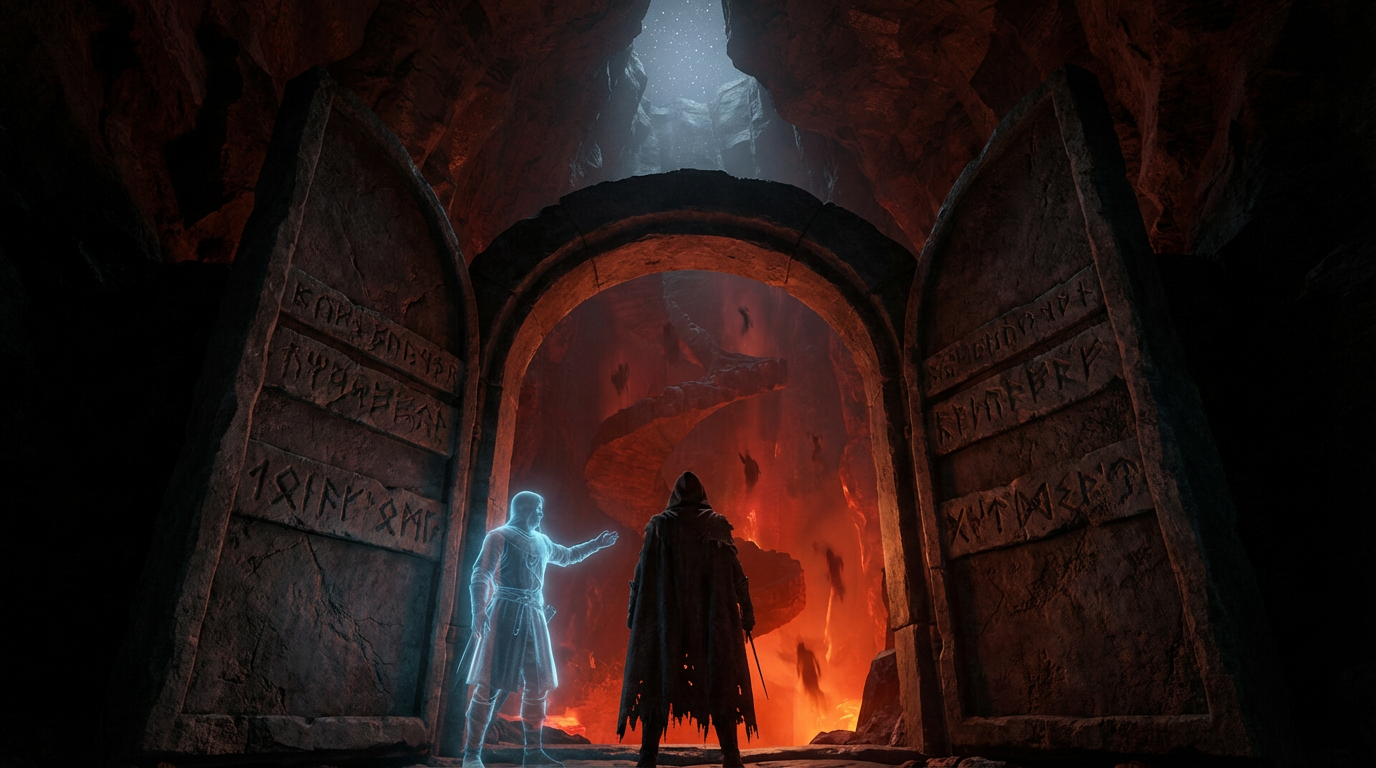
An excerpt from the original text.(complete · 1070 words)
Florence exult! for thou so mightily
Hast thriven, that o’er land and sea thy wings
Thou beatest, and thy name spreads over hell!
Among the plund’rers such the three I found
Thy citizens, whence shame to me thy son,
And no proud honour to thyself redounds.

But if our minds, when dreaming near the dawn,
Are of the truth presageful, thou ere long
Shalt feel what Prato, (not to say the rest)
Would fain might come upon thee; and that chance
Were in good time, if it befell thee now.
Would so it were, since it must needs befall!
For as time wears me, I shall grieve the more.

We from the depth departed; and my guide
Remounting scal’d the flinty steps, which late
We downward trac’d, and drew me up the steep.
Pursuing thus our solitary way
Among the crags and splinters of the rock,
Sped not our feet without the help of hands.

Then sorrow seiz’d me, which e’en now revives,
As my thought turns again to what I saw,
And, more than I am wont, I rein and curb
The powers of nature in me, lest they run
Where Virtue guides not; that if aught of good
My gentle star, or something better gave me,
I envy not myself the precious boon.

As in that season, when the sun least veils
His face that lightens all, what time the fly
Gives way to the shrill gnat, the peasant then
Upon some cliff reclin’d, beneath him sees
Fire-flies innumerous spangling o’er the vale,
Vineyard or tilth, where his day-labour lies:
With flames so numberless throughout its space
Shone the eighth chasm, apparent, when the depth
Was to my view expos’d. As he, whose wrongs
The bears aveng’d, at its departure saw
Elijah’s chariot, when the steeds erect
Rais’d their steep flight for heav’n; his eyes meanwhile,
Straining pursu’d them, till the flame alone
Upsoaring like a misty speck he kenn’d;
E’en thus along the gulf moves every flame,
A sinner so enfolded close in each,
That none exhibits token of the theft.

Upon the bridge I forward bent to look,
And grasp’d a flinty mass, or else had fall’n,
Though push’d not from the height. The guide, who mark d
How I did gaze attentive, thus began:
“Within these ardours are the spirits, each
Swath’d in confining fire.”—“Master, thy word,”
I answer’d, “hath assur’d me; yet I deem’d
Already of the truth, already wish’d
To ask thee, who is in yon fire, that comes
So parted at the summit, as it seem’d
Ascending from that funeral pile, where lay
The Theban brothers?” He replied: “Within
Ulysses there and Diomede endure
Their penal tortures, thus to vengeance now
Together hasting, as erewhile to wrath.
These in the flame with ceaseless groans deplore
The ambush of the horse, that open’d wide
A portal for that goodly seed to pass,
Which sow’d imperial Rome; nor less the guile
Lament they, whence of her Achilles ’reft
Deidamia yet in death complains.
And there is rued the stratagem, that Troy
Of her Palladium spoil’d.”—“If they have power
Of utt’rance from within these sparks,” said I,
“O master! think my prayer a thousand fold
In repetition urg’d, that thou vouchsafe
To pause, till here the horned flame arrive.
See, how toward it with desire I bend.”

He thus: “Thy prayer is worthy of much praise,
And I accept it therefore: but do thou
Thy tongue refrain: to question them be mine,
For I divine thy wish: and they perchance,
For they were Greeks, might shun discourse with thee.”

When there the flame had come, where time and place
Seem’d fitting to my guide, he thus began:
“O ye, who dwell two spirits in one fire!
If living I of you did merit aught,
Whate’er the measure were of that desert,
When in the world my lofty strain I pour’d,
Move ye not on, till one of you unfold
In what clime death o’ertook him self-destroy’d.”

Of the old flame forthwith the greater horn
Began to roll, murmuring, as a fire
That labours with the wind, then to and fro
Wagging the top, as a tongue uttering sounds,
Threw out its voice, and spake: “When I escap’d
From Circe, who beyond a circling year
Had held me near Caieta, by her charms,
Ere thus Aeneas yet had nam’d the shore,
Nor fondness for my son, nor reverence
Of my old father, nor return of love,
That should have crown’d Penelope with joy,
Could overcome in me the zeal I had
T’ explore the world, and search the ways of life,
Man’s evil and his virtue. Forth I sail’d
Into the deep illimitable main,
With but one bark, and the small faithful band
That yet cleav’d to me. As Iberia far,
Far as Morocco either shore I saw,
And the Sardinian and each isle beside
Which round that ocean bathes. Tardy with age
Were I and my companions, when we came
To the strait pass, where Hercules ordain’d
The bound’ries not to be o’erstepp’d by man.
The walls of Seville to my right I left,
On the’ other hand already Ceuta past.
“O brothers!” I began, “who to the west
Through perils without number now have reach’d,
To this the short remaining watch, that yet
Our senses have to wake, refuse not proof
Of the unpeopled world, following the track
Of Phoebus. Call to mind from whence we sprang:
Ye were not form’d to live the life of brutes
But virtue to pursue and knowledge high.
With these few words I sharpen’d for the voyage
The mind of my associates, that I then
Could scarcely have withheld them. To the dawn
Our poop we turn’d, and for the witless flight
Made our oars wings, still gaining on the left.
Each star of the’ other pole night now beheld,
And ours so low, that from the ocean-floor
It rose not. Five times re-illum’d, as oft
Vanish’d the light from underneath the moon
Since the deep way we enter’d, when from far
Appear’d a mountain dim, loftiest methought
Of all I e’er beheld. Joy seiz’d us straight,
But soon to mourning changed. From the new land
A whirlwind sprung, and at her foremost side
Did strike the vessel. Thrice it whirl’d her round
With all the waves, the fourth time lifted up
The poop, and sank the prow: so fate decreed:
And over us the booming billow clos’d.”
Master this chapter. Complete your experience
Purchase the complete book to access all chapters and support classic literature
As an Amazon Associate, we earn a small commission from qualifying purchases at no additional cost to you.
Available in paperback, hardcover, and e-book formats
Let's Analyse the Pattern
Using elevated ideals and beautiful language to justify selfish or reckless choices while avoiding honest examination of true motivations and consequences.
Why This Matters
Connect literature to life
This chapter teaches how to recognize when beautiful language masks selfish or destructive impulses.
Practice This Today
This week, notice when you or others use elevated language to justify questionable choices—pause and ask what the real motivation is and who bears the risk.
Now let's explore the literary elements.
Key Quotes & Analysis
"Ye were not formed to live the life of brutes, but virtue to pursue and knowledge high."
Context: Ulysses recounts the speech he gave to convince his aging crew to sail beyond the known world.
This sounds noble and inspiring, but it's actually manipulation. Ulysses uses lofty language about human dignity to convince tired old men to risk their lives for his personal ambition. The tragedy is that the sentiment itself is beautiful - humans should pursue knowledge and virtue - but he's using it to justify something reckless.
In Today's Words:
You're better than this ordinary life - we're meant for something greater.
"Neither fondness for my son, nor reverence for my aged father, nor the due love that should have cheered Penelope, could overcome within me the ardor that I had to gain experience of the world."
Context: Ulysses explains why he left home again instead of settling down with his family.
This reveals the core of Ulysses' character - he's honest about choosing his own desires over his responsibilities to others. He doesn't pretend his family didn't matter; he admits he chose his ambition over their needs. It's both admirable in its honesty and tragic in its selfishness.
In Today's Words:
I loved my family, but I loved the thrill of new experiences more.
"As pleased the Other, the sea closed over us."
Context: The final line of Ulysses' story, describing how God destroyed their ship just as they glimpsed the forbidden mountain.
The simple, understated ending contrasts with all of Ulysses' grand rhetoric. After all his noble speeches about pursuing knowledge, he's reduced to admitting that a higher power decided their fate. It suggests that some boundaries exist for good reasons, and crossing them has consequences beyond our control.
In Today's Words:
God had other plans, and that was the end of us.
Thematic Threads
Pride
In This Chapter
Ulysses cannot accept ordinary domestic life after being a legendary hero, driving him to seek glory beyond human limits
Development
Builds on earlier pride themes but shows how pride disguises itself as virtue
In Your Life:
You might recognize this when you can't settle for 'good enough' because it doesn't match your self-image.
Leadership
In This Chapter
Ulysses uses his charisma and eloquence to convince his crew to follow him into deadly danger
Development
Introduced here as corrupted leadership that serves the leader's needs over followers' wellbeing
In Your Life:
You see this when someone uses their influence to get others to take risks they wouldn't take themselves.
Boundaries
In This Chapter
The Pillars of Hercules represent limits humans shouldn't cross, which Ulysses deliberately violates
Development
Introduced here as the dangerous consequences of refusing to accept natural limitations
In Your Life:
You encounter this when you're tempted to push past clear warnings or established limits.
Deception
In This Chapter
Ulysses deceives himself and others by framing reckless adventure as noble pursuit of knowledge
Development
Evolves from earlier fraud themes to show self-deception as the most dangerous form
In Your Life:
You might catch yourself doing this when you use high-minded reasons to justify questionable decisions.
Consequences
In This Chapter
Ulysses' crew drowns because they trusted his beautiful words over practical wisdom
Development
Reinforces that others always pay the price for our fraudulent counsel
In Your Life:
You see this when someone else's poor judgment affects your life or livelihood.
You now have the context. Time to form your own thoughts.
Discussion Questions
- 1
What excuse does Ulysses give his crew for sailing beyond the known world, and what do you think his real motivation was?
analysis • surface - 2
Why is Ulysses' speech to his crew so persuasive, even though it leads them to their deaths?
analysis • medium - 3
When have you heard someone use noble-sounding language to justify questionable decisions? What were they really after?
application • medium - 4
How can you tell the difference between genuine idealism and someone using beautiful words to avoid responsibility?
application • deep - 5
What does Ulysses' story reveal about the danger of leaders who believe their own inspiring rhetoric?
reflection • deep
Critical Thinking Exercise
Translate the Noble Language
Think of a recent situation where someone used elevated, inspiring language to justify a decision that seemed questionable. Write down their exact words or the gist of what they said. Then translate it into plain, honest language - what were they really asking for and why?
Consider:
- •Look for phrases like 'for the greater good', 'pursuing excellence', 'being authentic', or 'growth opportunity'
- •Ask yourself: who benefits from this decision and who pays the cost?
- •Notice if the person can explain their reasoning without the fancy language
Journaling Prompt
Write about a time when you used noble-sounding reasons to justify something you wanted to do anyway. What were you really after, and how might you have been more honest about it?
Coming Up Next...
Chapter 27: The Pope's Corrupt Bargain
As Ulysses' flame departs, another burning soul approaches with urgent, confused sounds. This new spirit carries a different kind of anguish - not the regret of a hero's failed quest, but the desperate confusion of someone still trapped in earthly concerns and political schemes.