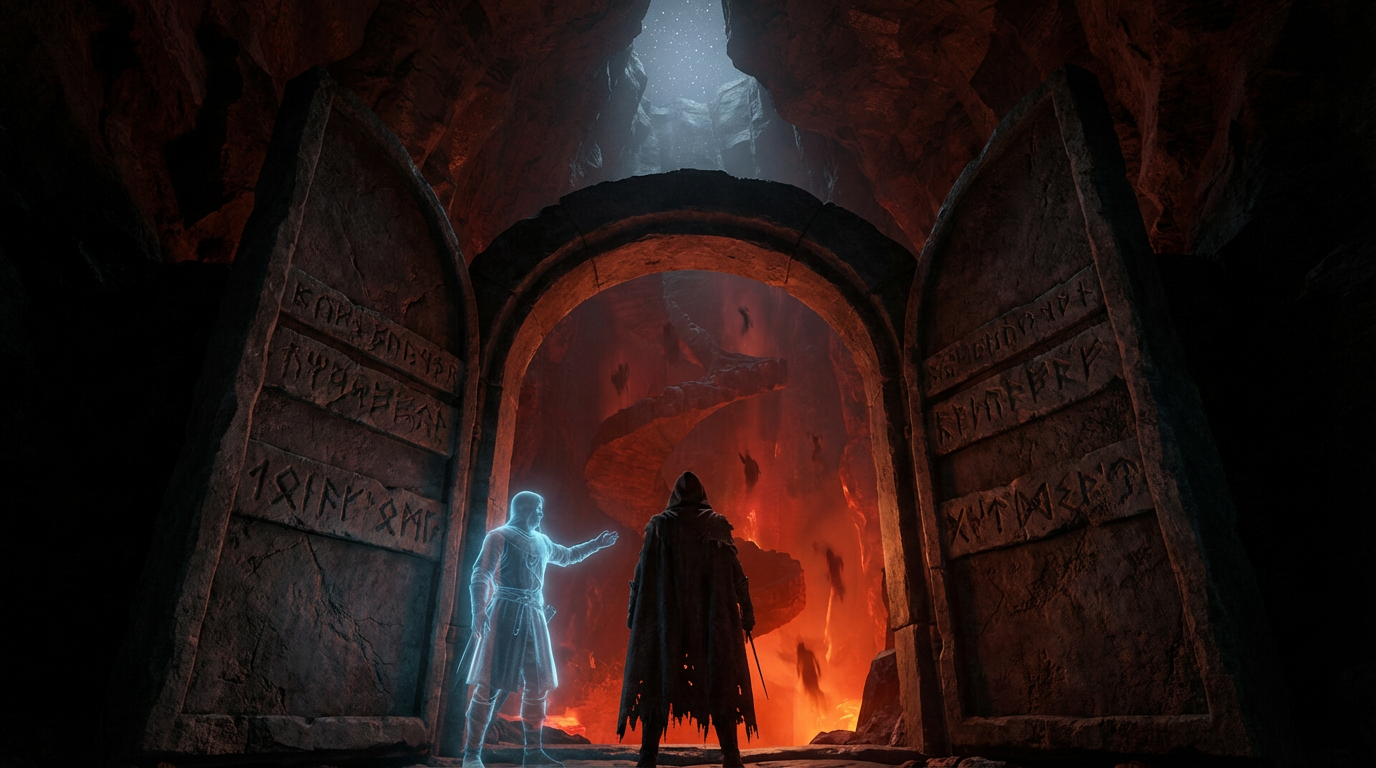
An excerpt from the original text.(complete · 1030 words)
Now upward rose the flame, and still’d its light
To speak no more, and now pass’d on with leave
From the mild poet gain’d, when following came
Another, from whose top a sound confus’d,
Forth issuing, drew our eyes that way to look.

As the Sicilian bull, that rightfully
His cries first echoed, who had shap’d its mould,
Did so rebellow, with the voice of him
Tormented, that the brazen monster seem’d
Pierc’d through with pain; thus while no way they found
Nor avenue immediate through the flame,
Into its language turn’d the dismal words:
But soon as they had won their passage forth,
Up from the point, which vibrating obey’d
Their motion at the tongue, these sounds we heard:
“O thou! to whom I now direct my voice!
That lately didst exclaim in Lombard phrase,

Depart thou, I solicit thee no more,’
Though somewhat tardy I perchance arrive
Let it not irk thee here to pause awhile,
And with me parley: lo! it irks not me
And yet I burn. If but e’en now thou fall
into this blind world, from that pleasant land
Of Latium, whence I draw my sum of guilt,
Tell me if those, who in Romagna dwell,
Have peace or war. For of the mountains there
Was I, betwixt Urbino and the height,
Whence Tyber first unlocks his mighty flood.”

Leaning I listen’d yet with heedful ear,
When, as he touch’d my side, the leader thus:
“Speak thou: he is a Latian.” My reply
Was ready, and I spake without delay:

“O spirit! who art hidden here below!
Never was thy Romagna without war
In her proud tyrants’ bosoms, nor is now:
But open war there left I none. The state,
Ravenna hath maintain’d this many a year,
Is steadfast. There Polenta’s eagle broods,
And in his broad circumference of plume
O’ershadows Cervia. The green talons grasp
The land, that stood erewhile the proof so long,
And pil’d in bloody heap the host of France.

“The’ old mastiff of Verruchio and the young,
That tore Montagna in their wrath, still make,
Where they are wont, an augre of their fangs.

“Lamone’s city and Santerno’s range
Under the lion of the snowy lair.
Inconstant partisan! that changeth sides,
Or ever summer yields to winter’s frost.
And she, whose flank is wash’d of Savio’s wave,
As ’twixt the level and the steep she lies,
Lives so ’twixt tyrant power and liberty.

“Now tell us, I entreat thee, who art thou?
Be not more hard than others. In the world,
So may thy name still rear its forehead high.”

Then roar’d awhile the fire, its sharpen’d point
On either side wav’d, and thus breath’d at last:
“If I did think, my answer were to one,
Who ever could return unto the world,
This flame should rest unshaken. But since ne’er,
If true be told me, any from this depth
Has found his upward way, I answer thee,
Nor fear lest infamy record the words.

“A man of arms at first, I cloth’d me then
In good Saint Francis’ girdle, hoping so
T’ have made amends. And certainly my hope
Had fail’d not, but that he, whom curses light on,
The’ high priest again seduc’d me into sin.
And how and wherefore listen while I tell.
Long as this spirit mov’d the bones and pulp
My mother gave me, less my deeds bespake
The nature of the lion than the fox.
All ways of winding subtlety I knew,
And with such art conducted, that the sound
Reach’d the world’s limit. Soon as to that part
Of life I found me come, when each behoves
To lower sails and gather in the lines;
That which before had pleased me then I rued,
And to repentance and confession turn’d;
Wretch that I was! and well it had bested me!
The chief of the new Pharisees meantime,
Waging his warfare near the Lateran,
Not with the Saracens or Jews (his foes
All Christians were, nor against Acre one
Had fought, nor traffic’d in the Soldan’s land),
He his great charge nor sacred ministry
In himself, rev’renc’d, nor in me that cord,
Which us’d to mark with leanness whom it girded.
As in Socrate, Constantine besought
To cure his leprosy Sylvester’s aid,
So me to cure the fever of his pride
This man besought: my counsel to that end
He ask’d: and I was silent: for his words
Seem’d drunken: but forthwith he thus resum’d:
“From thy heart banish fear: of all offence
I hitherto absolve thee. In return,
Teach me my purpose so to execute,
That Penestrino cumber earth no more.
Heav’n, as thou knowest, I have power to shut
And open: and the keys are therefore twain,
The which my predecessor meanly priz’d.”

Then, yielding to the forceful arguments,
Of silence as more perilous I deem’d,
And answer’d: “Father! since thou washest me
Clear of that guilt wherein I now must fall,
Large promise with performance scant, be sure,
Shall make thee triumph in thy lofty seat.”

“When I was number’d with the dead, then came
Saint Francis for me; but a cherub dark
He met, who cried: “‘Wrong me not; he is mine,
And must below to join the wretched crew,
For the deceitful counsel which he gave.
E’er since I watch’d him, hov’ring at his hair,
No power can the impenitent absolve;
Nor to repent and will at once consist,
By contradiction absolute forbid.”
Oh mis’ry! how I shook myself, when he
Seiz’d me, and cried, “Thou haply thought’st me not
A disputant in logic so exact.”
To Minos down he bore me, and the judge
Twin’d eight times round his callous back the tail,
Which biting with excess of rage, he spake:
“This is a guilty soul, that in the fire
Must vanish.’ Hence perdition-doom’d I rove
A prey to rankling sorrow in this garb.”

When he had thus fulfill’d his words, the flame
In dolour parted, beating to and fro,
And writhing its sharp horn. We onward went,
I and my leader, up along the rock,
Far as another arch, that overhangs
The foss, wherein the penalty is paid
Of those, who load them with committed sin.
Master this chapter. Complete your experience
Purchase the complete book to access all chapters and support classic literature
As an Amazon Associate, we earn a small commission from qualifying purchases at no additional cost to you.
Available in paperback, hardcover, and e-book formats
Let's Analyse the Pattern
Using institutional authority to justify actions that violate your personal moral code.
Why This Matters
Connect literature to life
This chapter teaches how to recognize when people in power use their position to make you complicit in wrongdoing.
Practice This Today
Next time someone in authority asks you to do something that feels wrong, pause and ask yourself: 'If this were entirely my decision, would I do it?'
Now let's explore the literary elements.
Key Quotes & Analysis
"You cannot be absolved unless you first repent, nor can you repent and will a thing at once, for the contradiction does not permit it"
Context: The demon explains to Saint Francis why Guido's soul belongs in hell despite papal absolution
This reveals the central moral truth: you cannot genuinely seek forgiveness while planning to commit the sin. It exposes how Guido tried to game the system and why it backfired.
In Today's Words:
You can't be sorry for something while you're still planning to do it - that's not how apologies work.
"Promise largely, but observe little"
Context: The corrupt advice Guido gave Pope Boniface VIII on how to destroy Palestrina through deception
This cynical counsel represents the moment Guido chose manipulation over integrity. It shows how corruption spreads when good people compromise their values for authority figures.
In Today's Words:
Make big promises you have no intention of keeping.
"Francis came afterward for me, but one of the black cherubim said to him: 'Do not take him; do not wrong me'"
Context: Describing the battle for his soul at the moment of death
This dramatic scene shows that spiritual redemption cannot be faked or manipulated. Despite his monastic vows, Guido's final corrupt act sealed his fate.
In Today's Words:
The good part of me tried to win, but my bad choices caught up with me.
Thematic Threads
Authority
In This Chapter
Pope Boniface weaponizes religious authority to manipulate Guido into giving corrupt counsel
Development
Building on earlier themes of corrupted leadership and institutional failure
In Your Life:
You might face pressure from supervisors, administrators, or other authority figures to compromise your values
Moral Responsibility
In This Chapter
Guido learns that moral responsibility cannot be transferred to others, even papal authority
Development
Deepens the theme of personal accountability introduced in earlier circles
In Your Life:
You remain morally responsible for your actions regardless of who ordered them
Deception
In This Chapter
Guido advises the Pope to make promises he has no intention of keeping
Development
Continues the pattern of fraud and deception punished throughout Hell
In Your Life:
You might be pressured to make commitments or promises you know you cannot or will not keep
Corruption
In This Chapter
A Pope corrupts a reformed monk by offering false spiritual protection for political crimes
Development
Escalates the theme of institutional corruption seen throughout the journey
In Your Life:
You might encounter situations where institutional systems enable or encourage unethical behavior
Self-Deception
In This Chapter
Guido convinces himself he can game the spiritual system and avoid consequences
Development
Reflects the ongoing theme of characters who refuse to accept reality
In Your Life:
You might rationalize questionable actions by telling yourself the rules don't apply to your situation
You now have the context. Time to form your own thoughts.
Discussion Questions
- 1
Why did Guido da Montefeltro think he could give corrupt advice to the Pope and still avoid spiritual consequences?
analysis • surface - 2
What made the Pope's request so morally dangerous, and why couldn't Guido simply refuse?
analysis • medium - 3
Where do you see people today using 'I was just following orders' to justify questionable actions?
application • medium - 4
How would you respond if someone in authority asked you to do something that violated your values?
application • deep - 5
What does Guido's story reveal about the relationship between power, responsibility, and moral compromise?
reflection • deep
Critical Thinking Exercise
Map Your Authority Pressure Points
Think about the different authority figures in your life - bosses, family members, institutions, or social groups. List three situations where someone in authority might pressure you to act against your values. For each situation, write down what you would say or do to maintain your integrity while navigating the power dynamic.
Consider:
- •Consider both direct orders and subtle pressure to conform
- •Think about the difference between legitimate authority and authority being misused
- •Remember that saying no to authority often requires strategic thinking, not just courage
Journaling Prompt
Write about a time when you felt pressured to compromise your values because someone in authority told you to. How did you handle it, and what would you do differently now?
Coming Up Next...
Chapter 28: The Price of Division
Dante and Virgil move deeper into Hell's landscape, where they will witness scenes of violence so extreme that no earthly comparison could capture their horror. The next circle promises revelations about the ultimate consequences of those who chose force over reason.